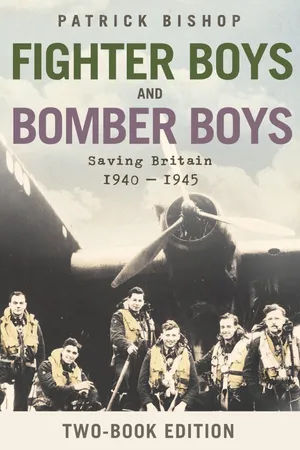
- English
- ePUB (mobile friendly)
- Available on iOS & Android
eBook - ePub
Trusted by 375,005 students
Access to over 1.5 million titles for a fair monthly price.
Study more efficiently using our study tools.
Information
BOMBER BOYS
FIGHTING BACK
1940–1945
1940–1945
PATRICK BISHOP

Dedication
To Peter, Margaret, Amelia
and Daniel
and Daniel
Contents
Title Page
Dedication
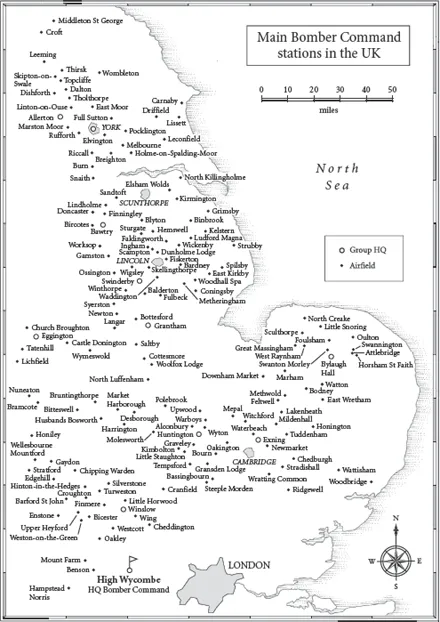
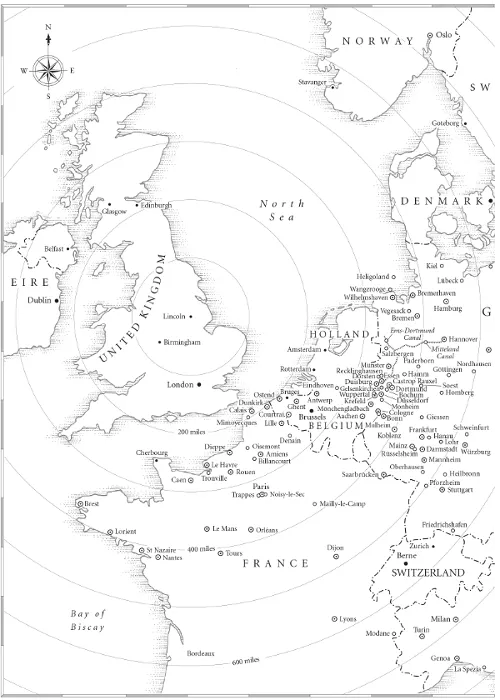
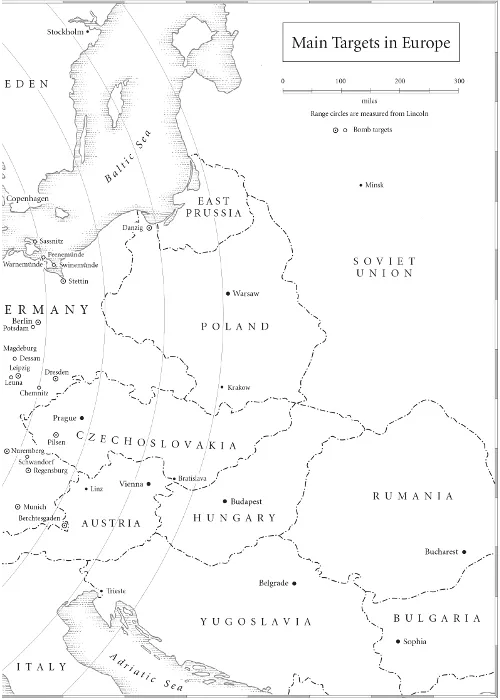
Maps
Prologue: Perkins
Introduction
1 Learning the Hard Way
2 Coventrated
3 ‘To Fly and Fight’
4 Crewing Up
5 Dying in the Dark
6 Enter ‘Butch’
7 The Feast of St Peter and St Paul
8 The Reasons Why
9 The Battle
10 ‘A Select Gang of Blokes’
11 The Big City
12 The Chop
13 Crack Up
14 Home Front
15 Love in Uniform
16 D-Day Diversion
17 Tallboys and Tirpitz
18 Götterdämmerung
19 Forgetting
Epilogue: Went the day well?
Notes
Bombers
Index
Acknowledgements
P.S. Ideas, Interviews & Features…
About the Author
Q and A: Louise Tucker talks to Patrick Bishop
Life at a Glance
Top Ten Favourite Reads
Read On
Have You Read?
If You Loved This, You Might Like…
Find Out More
Read the first chapter of Patrick Bishop’s new book 3 Para
Maps
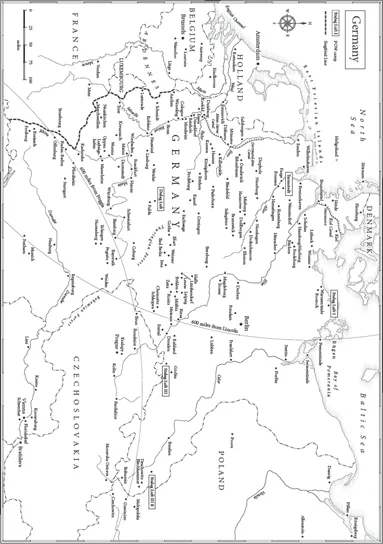
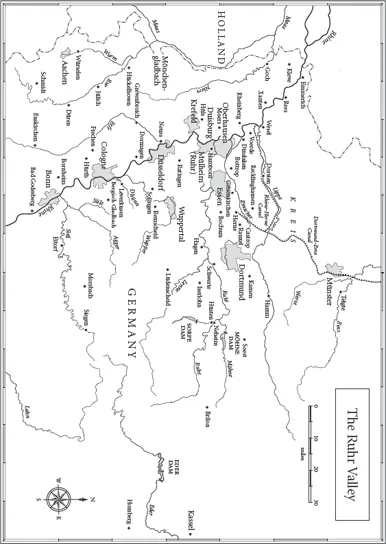
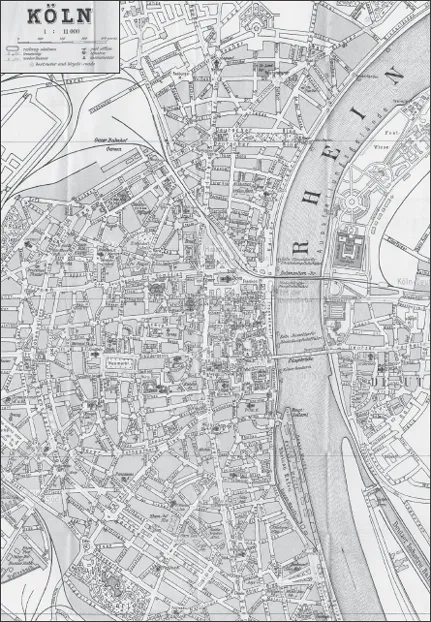
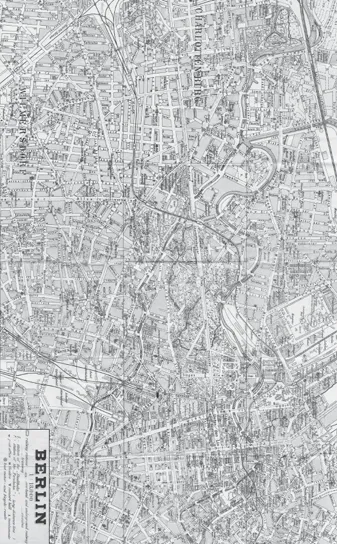
Prologue:
PERKINS
In the early summer of 1961, sophisticated Londoners were laughing at an entertainment brought to them by four young Oxbridge graduates. Beyond the Fringe had been a great hit at the Edinburgh Festival the previous year. Now, night after night, smiling audiences in the capital left the Fortune Theatre feeling they had witnessed something fresh, audacious and above all very funny. The excitement that comes with the anticipation of sudden and unpredictable change was in the May air. The old, hierarchical Britain personified by the prime minister, Harold Macmillan, appeared to be tottering to an end. The shape of the future was hard to make out but it surely belonged to the young, the daring and the irreverent. Alan Bennett, Peter Cook, Jonathan Miller and Dudley Moore were the incarnation of all that.
One of the sketches was called ‘Aftermyth of War’. It made fun of legends created during wartime and already planted deep in Britain’s consciousness. There was quite a list. It mocked Neville Chamberlain and his ‘piece of paper’, stoical working-class Londoners and the Blitz spirit and even the Battle of Britain. Then it was the turn of the men who flew in the aeroplanes that bombed Germany.
The sequence opens with Peter Cook, in the uniform of a senior RAF officer, entering to the sound of airmen singing heartily around a piano.
COOK: Perkins! (Jonathan Miller breaks away from the singing.) Sorry to drag you away from the fun, old boy. War’s not going very well, you know.
MILLER: Oh my God!
COOK: … war is a psychological thing, Perkins, rather like a game of football. You know how in a game of football ten men often play better than eleven?
MILLER: Yes, sir.
COOK: Perkins, we are asking you to be that one man. I want you to lay down your life, Perkins. We need a futile gesture at this stage. It will raise the whole tone of the war. Get up in a crate, Perkins, pop over to Bremen, take a shufti, don’t come back. Goodbye, Perkins. God, I wish I was going too.
MILLER: Goodbye, sir – or is it – au revoir?
COOK: No, Perkins.
The last lines got one of the biggest laughs of the night. In the stalls, sitting with his wife Margery Baker, Tony Iveson tried to laugh along with the rest. They both worked in the new world of television and were part of the emerging Britain. But not very long before he had been Squadron Leader Tony Iveson DFC of 617 Squadron, and at the front of the bombing war. ‘I didn’t like it,’ he said forty-four years later. ‘I remember being upset. I probably wouldn’t be now but at the time it seemed unnecessary, in view of how many we lost.’1
Of the 125,000 airmen who passed through Bomber Command during the war, about 55,000 were killed. Twenty-one of them were called Perkins. The first to die was Flying Officer Reginald Perkins of 54 Squadron who was killed on the night of 14/15 November 1940. He was the pilot of a Hampden which took off from Waddington in Lincolnshire to bomb Berlin. Little is known about his death or those of his three crew mates. Their aircraft is ‘believed to have exploded in the air and crashed on the outskirts of Berlin’.2 The last to die was Flying Officer Robert Perkins of 49 Squadron, the pilot of a Lancaster who was killed with the rest of his crew while bombing the Lutzkendorf oil refinery on the night of 8/9 April 1945, a month before the end of the war in Europe.3 Nothing at all is known about how they were lost.
As far as I am aware, no Perkins died bombing Bremen, but one might well have done. From 18 May 1940 until the end of the Second World War it was attacked some seventy times. As a result, about 575 aircrew were killed. So too were 3,562 residents.4 It is this aspect of Bomber Command’s war, the death of German civilians, that has preoccupied historians in the years since the Beyond the Fringe sketch. All the myths that were the butt of its jokes have since been re-examined and turned out to be remarkably resilient. It is Bomber Command’s reputation that has suffered the most. Re-evaluations have found the crews’ efforts to be at best misdirected and at worst little better than war crimes.
This last accusation is false and insults truth and justice. Bomber Command, as I have said, attacked Bremen frequently. The first bombs killed thirteen people. They also burned down two warehouses full of furniture confiscated from Jews who had understood what fate awaited them in Germany and fled. Bombers were busy over the city on the night of 17/18 January 1942. Only eight of the eighty-three aircraft dispatched found the target and little damage appears to have been done. The Nazi newspapers in the days following denounced the raiders as ‘terror fliers’. As they did so, sixteen Nazi bureaucrats met on 20 January in a villa at Wannsee outside Berlin to co-ordinate the extermination of the entire Jewish population of Europe.
The Nazis were to good as a black hole is to light. The effects of British and American bombing on Germany and the lands the Germans conquered were dreadful and it is right that they should be recorded and remembered. But the Allies’ real crime would have been to hold back from using any of the means at their disposal to destroy Hitler and those who sustained his war.
The argument over exactly what Bomber Command achieved will never be settled. One undeniable success, an awkward one to acknowledge nowadays, is that it altered Germany’s personality. Saturation bombing may not, as intended, have broken the Germans’ spirit. But it helped powerfully to bring about their post-war conversion to peaceful democracy.
History in its current mood has paid limited attention to the ethos and character of the men who fought this most extraordinary war. This book sets out to correct that imbalance. It is for, and about, Perkins. In the process I want also to redress a wrong. There is no national memorial to the men of Bomber Command, no one place where their sacrifice and contribution to victory are properly and thankfully commemorated. I hope that Bomber Boys will mark a first step in changing that.
Introduction
After the Whirlwind
No one who saw what Allied bombing did to Germany forgot it. A traveller in an official delegation passing through Berlin two months after the German surrender noted in his diary: ‘Berlin … is ghastly. I could never have believed how complete the destruction is. We covered [about five miles] and saw less than a dozen undamaged houses and not one in ten was anything more than a burned-out shell.’
Soon afterwards he visited Potsdam, less than twenty miles to the west. ‘Bert Harris removed the town of Potsdam in half an hour one night in April,’ he wrote. ‘I have never seen anything so complete … the usual procession of handcarts, prams etc. and the same slab-faced people as in Berlin.’
The sight, he felt, was the finest possible lesson to the Germans of the folly of initiating wars. Yet he ‘came away feeling very sorry for these people and when I eventually said so I found all the others felt just the same.’1
The man who wrote these words had played a central part in creating the scenes he witnessed. He was Marshal of the Royal Air Force Sir Charles Portal, who as Chief of the Air Staff had overseen the bombing campaign. ‘Bert Harris’ was his subordinate, Air Marshal Sir Arthur Harris, the head of Bomber Command who had put Allied strategic theories into devastating practice.
A little afterwards, a veteran pilot who had taken part in many of the raids flew over some of the areas he had bombed. ‘It was a fine clear day and we flew at 4,000 feet,’ wrote Peter Johnson, ‘a good height for an overall view and we saw as we passed something of what had happened to, amongst others, Hamburg, Lübeck, Hanover, the Ruhr towns, Cologne, Aachen and Düsseldorf and so south to Stuttgart, Nuremberg and Munich … the general devastation was almost unbelievable. In town after town hardly a building seemed to be intact, hardly a house seemed to be habitable. All that showed from the air were rows and rows of empty boxes, walls enclosing nothing … the whole area was, for the time being at least, dead, dead, dead.’
Johnson could not help wondering ‘whether this truly dreadful sight represented a degree of overkill, whether such destruction had really been necessary to stop the production of arms for the Nazis in the greatest industrial complex in Europe.’ He reassured himself with the thought that even when the Ruhr was encircled by Allied forces the German people ‘were still obeying Hitler’s frenzied calls for resistance to the last man.’2
The debris was to hang around accusingly for years. In March 1949 the American diplomat George Kennan returned to Hamburg where he had served in pre-war days. He visited the large residential districts east of the Alster. ‘Here was sweeping devastation, down to the ground, mile after mile,’ he wrote. ‘It had all been done in three days and nights in 1943, my host told me. Seventy-five thousand persons had perished in the process. Even now, after the lapse of six years, over three thousand bodies were estimated to be buried there in the rubble.’ [The actual number of victims of the raids carried out on Hamburg between 27-30 July 1943 was closer to 40,000 dead.]
These sights demanded reflection, and justification or judgement. The natural response of most of those who planned or carried out the attacks was the same as Portal’s. The Germans, unquestionably, had started it. They had, as Harris predicted in a much-repeated proverb, sown the wind and reaped the whirlwind. Kennan, however, felt differently. For the first time since the war ended, he wrote, ‘I felt an unshakeable conviction that no momentary military advantage – even if such could be calculated to exist – could have justified this stupendous, careless destruction of civilian life and of material values, built up laboriously by human hands over the course of centuries for purposes having nothing to do with this war. Least of all could it be justified by the screaming non-sequitur, “They did it to us.”’3
The debate over the morality of all-out aerial bombardment had been under way long before the strategic air campaign began and would rumble through the post-war years to the present day. But the first reaction of those who gazed across the haunted mounds of rubble that were all that remained of scores of German city centres was simple awe at the destruction that had been wrought. The onlookers thought they knew what a blitzed town looked like. The results of what bombs did were on display in many of Britain’s major cities. But none of them looked like this.
During the war Bomber Command had been a priceless asset to government propaganda, as a symbol of Britain’s resolve and its willingness and ability to take the war to the enemy. Its actions were thoroughly publicized and its pilots and crewmen ranked as heroes. It fought a continuous campaign from the first day of the war to the last, interrupted only by the weather. The enormous effort and the great sacrifice of life this entailed were honoured and the destruction done to the enemy was presented as a vital element in the victory. In peacetime, the wrecked towns and the grave pits filled with the bones of civilians became an embarrassment and the Bomber Boys faded from the official legend. On the afternoon of 13 May 1945 Churchill broadcast his Victory in Europe speech. There was praise for everyone who had contributed to the war effort. But apart from an allusion to the damage done to Berlin, the main activities of the bomber crews were barely mentioned. There were campaign medals for those who had fought in Asia, the Middle East and Europe. There was to be no specific award for the men who had set about dismantling Hitler’s empire from the air.
The public memory of the air war was selective. People seemed inclined to consign the bombing campaign and those who had fought it to the past. The pilots of Fighter Command, however, had a special place in the post-war consciousness. Scores of books were written by them and about them. Men like Douglas Bader, Bob Stanford Tuck and ‘Sailor’ Malan were celebrities. They were The Few and the battle that they fought was relatively short, roughly four months from the beginning of July to the end of October 1940. The men who crewed the bombers were The Many and their struggle went on and on. Of the 125,000 who passed through the fire, only Guy Gibson and Leonard Cheshire won any lasting fame. Gibso...
Table of contents
- Title Page
- Copyright
- Contents
- Fighter Boys: Saving Britain 1940
- Bomber Boys: Fighting Back 1940-1945
- About the Author
- Also by Patrick Bishop
- About the Publisher
Frequently asked questions
Yes, you can cancel anytime from the Subscription tab in your account settings on the Perlego website. Your subscription will stay active until the end of your current billing period. Learn how to cancel your subscription
No, books cannot be downloaded as external files, such as PDFs, for use outside of Perlego. However, you can download books within the Perlego app for offline reading on mobile or tablet. Learn how to download books offline
Perlego offers two plans: Essential and Complete
- Essential is ideal for learners and professionals who enjoy exploring a wide range of subjects. Access the Essential Library with 800,000+ trusted titles and best-sellers across business, personal growth, and the humanities. Includes unlimited reading time and Standard Read Aloud voice.
- Complete: Perfect for advanced learners and researchers needing full, unrestricted access. Unlock 1.5M+ books across hundreds of subjects, including academic and specialized titles. The Complete Plan also includes advanced features like Premium Read Aloud and Research Assistant.
We are an online textbook subscription service, where you can get access to an entire online library for less than the price of a single book per month. With over 1.5 million books across 990+ topics, we’ve got you covered! Learn about our mission
Look out for the read-aloud symbol on your next book to see if you can listen to it. The read-aloud tool reads text aloud for you, highlighting the text as it is being read. You can pause it, speed it up and slow it down. Learn more about Read Aloud
Yes! You can use the Perlego app on both iOS and Android devices to read anytime, anywhere — even offline. Perfect for commutes or when you’re on the go.
Please note we cannot support devices running on iOS 13 and Android 7 or earlier. Learn more about using the app
Please note we cannot support devices running on iOS 13 and Android 7 or earlier. Learn more about using the app
Yes, you can access Fighter Boys and Bomber Boys by Patrick Bishop in PDF and/or ePUB format, as well as other popular books in History & World War II. We have over 1.5 million books available in our catalogue for you to explore.