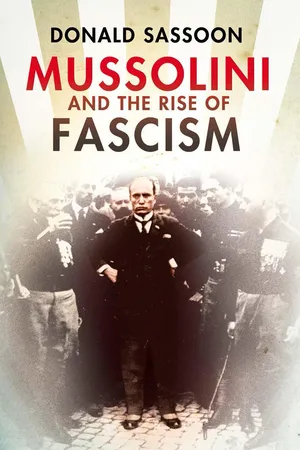
Mussolini and the Rise of Fascism (Text Only Edition)
eBook - ePub

Mussolini and the Rise of Fascism (Text Only Edition)

  1. English
  2. ePUB (mobile friendly)
  3. Available on iOS & Android
eBook - ePub

Mussolini and the Rise of Fascism (Text Only Edition)

About this book

In this fascinating look at the unique conjuncture of factors surrounding Il Duce's seizure of power, eminent historian Donald Sassoon traces the political circumstances that sent Italy on a collision course with the most destructive war of the century.

On the morning of 30 October 1922, Mussolini arrived in Rome to accept the premiership of a constitutional, conservative government. Within five years, however, his regime would morph into a dictatorship that neither his fascist supporters nor the conservative old order could have predicted, and Mussolini himself would be transformed from figurehead to despot.

A multiplicity of personalities and wider impersonal forces, including the social upheaval caused by the previous world war, combined to make possible the crisis of 1922 and the Fascist 'March on Rome'. But in fact, Donald Sassoon argues, things could have gone very differently and the core focus of this illuminating study is not so much what happened, but how. How did Mussolini seize power so effectively that he maintained it for the next twenty years, until he dragged his country, disastrously, into World War II? Social fragmentation, unionization, inflation and nationalism all played a part in weakening the old political system, while Mussolini seemed to provide answers in a troubling new era. In the event, Il Duce's ruthless political ambition and cruel authoritarianism would surprise his supporters and opponents alike.

Note that it has not been possible to include the same picture content that appeared in the original print version.

Trusted by 375,005 students

Access to over 1.5 million titles for a fair monthly price.

Study more efficiently using our study tools.

Information

Publisher
HarperPress
Year
2012
Print ISBN
9780007192434
eBook ISBN
9780007404216

Notes

Chapter 1: The Conjuncture

1 Italo Balbo, Diario 1922, Mondadori, Milan 1932, p.4
2 Giovanni Giolitti, Discorsi extraparlamentari, Einaudi, Turin 1952, p.345
3 Benito Mussolini, Opera Omnia, edited by Edoardo and Duilio Susmel, La Fenice, Florence 1951–1963, Vol. 18, p.464
4 Corriere della sera, 31 October 1922
5 Giovanni Gentile, Che cosa Ăš il fascismo. Discorsi e polemiche, Vallecchi, Florence 1924, p. 123
6 Augusto Turati, Preface to Partito nazionale fascista. Le origini e lo sviluppo delfascismo attraverso gli scritti e la parola del Duce e le deliberazioni del P.N.F., dall’intervento alla marcia su Roma, Libreria del littorio, Roma 1928, p.xv, henceforth Partito nazionale fascista
7 Cited in Antonino Répaci, La marcia su Roma, Rizzoli, Milan 1972, p.18
8 Mussolini, Storia di un anno, 1944, cited in RĂ©paci, La marcia su Roma, cit, p. 17 and also in Renzo De Felice, Mussolini il fascista. La conquista del potere 1921–1925, Einaudi, Turin 1966, p.307n
9 Corriere della sera, 31 October 1922
10 Vinicio Araldi, Camicie nere a Montecitorio: storia parlamentare dell’awento del fascismo, Mursia, Milano 1974, pp. 162–3
11 Emanuele Pugliese, Io difendo l’esercito, Rispoli, Naples 1946, p.30
12 Denis Mack Smith, Italy and its Monarchy, Yale University Press, New Haven and London 1989, p.250
13 ‘L’esercito nei giorni della “Marcia su Roma”: dalle memorie storiche della 16a Divisione di Fanteria di stanza a Roma nel 1922’ in Storia Contemporanea, Vol. 15, No. 6, December 1984, p.1209
14 De Felice, Mussolini il fascista, cit., pp.324–5
15 ‘L’esercito nei giorni della “Marcia su Roma” 
’, p.1208
16 Mario Piazzesi, Diario di uno squadrista toscano 1919–1922, Bonacci editore, Rome 1980, pp.245, 51
17 Cited in Répaci, La marcia su Roma, cit., p.455
18 Ibid., p.414
19 Giulia Albanese, ‘Dire violenza, fare violenza. Espressione, minaccia, occultamento e pratica della violenza durante la Marcia su Roma’ in Memoria e Ricerca, No. 13, May–August 2003, p. 59
20 Balbo, Diario 1922, cit., p.185
21 Corriere della sera, 31 October 1922
22 Ibid.
23 Partito nazionale fascista, cit., p. 140
24 In ‘Lettere aperte a Mussolini’ published in Il Popolo d’Italia (1920–21) collected in Gioacchino Volpe, Guerra Dopoguerra Fascismo, La Nuova Italia, Venice 1928, pp.261–6. Volpe joined the fascists in 1921
25 Benedetto Croce, Nuovepagine sparse, Vol. 1, Riccardo Ricciardi editore, Naples 1949 pp.62–3
26 Pierre Milza, Mussolini, Fayard, Paris 1999, p.9; Richard J.B. Bosworth, Mussolini, Arnold, London 2002, p.46
27 Martin Clark, Mussolini, Pearson Longman, Harlow 2005, p.9
28 Benito Mussolini, Il mio diario di Guerra (1915–1917), Imperia, Milano 1923, p.80
29 De Felice, Mussolini il fascista, cit., pp. 10–11
30 Marco Palla, ‘La presenza del fascismo. Geografia e storia quantitativa’ in Italia Contemporanea, No. 184, September 1991, p.400
31 Palmiro Togliatti, Lectures on Fascism, Lawrence and Wishart, London 1976, pp.15, 24–5
32 Corriere della sera, 1 November 1922; Gianpasquale Santomassimo, La Marcia su Roma, Giunti, Florence 2000, p.74
33 Reported by Massimo Rocca, once an anarchist then one of Mussolini’s early supporters, expelled from the party in May 1924 in his Come il fascismo divenne una dittatura. Storia interna del fascismo dal 1914 al 1925, ELI, Milan 1952, pp.117, 122
34 Lenin, Left–Wing Communism: an Infantile Disorder, in Collected Works, Vol. 31, Progress Publishers, Moscow 1966, p.85. Emphasis in the original
35 Terry Pinkard, Hegel. A Biography, CUP 2000, p.228
36 See articles in L’Ordine nuovo, 19 August and 23 August and 1921, in Antonio Gramsci, Selections from the Political Writings 1921–1926, Lawrence and Wishart, London 1968, pp.61–5
37 Antonio Gramsci, leader in L’Ordine nuovo, March 1924 (unsigned) in Gramsci, Selections from the Political Writings 1921–1926, cit., p.212
38 Max Weber, Economy and Society. An outline of interpretative sociology, Vol. 1, University of California Press 1978, p.241
39 Paul Preston, Franco. A Biography, HarperCollins...

Table of contents

  1. Cover
  2. Title Page
  3. Contents
  4. ONE The Conjuncture
  5. TWO A Divisive War – a Lost Victory
  6. THREE The Parliamentary Crisis
  7. FOUR The Advance of Fascism
  8. FIVE ‘We Need a Strong Government’
  9. Notes
  10. Bibliography Of Works Cited
  11. Index
  12. About the Author
  13. By The Same Author
  14. Copyright
  15. About the Publisher

Frequently asked questions

Yes, you can cancel anytime from the Subscription tab in your account settings on the Perlego website. Your subscription will stay active until the end of your current billing period. Learn how to cancel your subscription
No, books cannot be downloaded as external files, such as PDFs, for use outside of Perlego. However, you can download books within the Perlego app for offline reading on mobile or tablet. Learn how to download books offline
Perlego offers two plans: Essential and Complete
  • Essential is ideal for learners and professionals who enjoy exploring a wide range of subjects. Access the Essential Library with 800,000+ trusted titles and best-sellers across business, personal growth, and the humanities. Includes unlimited reading time and Standard Read Aloud voice.
  • Complete: Perfect for advanced learners and researchers needing full, unrestricted access. Unlock 1.5M+ books across hundreds of subjects, including academic and specialized titles. The Complete Plan also includes advanced features like Premium Read Aloud and Research Assistant.
Both plans are available with monthly, semester, or annual billing cycles.
We are an online textbook subscription service, where you can get access to an entire online library for less than the price of a single book per month. With over 1.5 million books across 990+ topics, we’ve got you covered! Learn about our mission
Look out for the read-aloud symbol on your next book to see if you can listen to it. The read-aloud tool reads text aloud for you, highlighting the text as it is being read. You can pause it, speed it up and slow it down. Learn more about Read Aloud
Yes! You can use the Perlego app on both iOS and Android devices to read anytime, anywhere — even offline. Perfect for commutes or when you’re on the go.
Please note we cannot support devices running on iOS 13 and Android 7 or earlier. Learn more about using the app
Yes, you can access Mussolini and the Rise of Fascism (Text Only Edition) by Donald Sassoon in PDF and/or ePUB format, as well as other popular books in History & 20th Century History. We have over 1.5 million books available in our catalogue for you to explore.