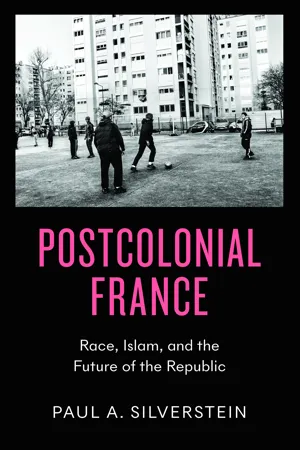
France is a bellwether for the postcolonial anxieties and populist politics emerging across the world today. This book explores the dynamics and dilemmas of the present moment of crisis and hope in France, through an exploration of recent moral panics. Taking stock of the tensions as they have emerged over the last quarter of a century, Paul Silverstein looks at urban racial violence, female Islamic dress and male public prayer, anti-system gangster rap, and sporting performances in and around which debates over France's multicultural future have arisen. It traces these conflicts to the unresolved tensions of an imperial project, the present-day effects of which are still felt by many. Despite the barriers, which include neo-nationalist racism and Islamophobia, French citizens of various backgrounds have found ways to build flourishing lives. Silverstein shows how they have responded to urban marginalisation, police violence and institutional discrimination in remarkably creative ways.
- 240 pages
- English
- ePUB (mobile friendly)
- Available on iOS & Android
eBook - ePub
About this book
Trusted by 375,005 students
Access to over 1.5 million titles for a fair monthly price.
Study more efficiently using our study tools.
Information
1
Mobile Subjects
In the 2006 film, Africa paradis, the Béninois director Sylvestre Amoussou imagines a Europe of 2033, where economic recession and urban overcrowding have reached a point where Europeans are willing to risk their lives to cross the Mediterranean in search of a better life in a relatively prosperous and politically amalgamated “United States of Africa.” There they face widespread racism and xenophobia, are relegated to menial jobs and underserviced urban peripheries and, as undocumented laborers, are under constant threat of deportation. Well-meaning politicians advocating multicultural policies of tolerance find themselves blocked by right-wing nationalist movements wielding a powerful populist rhetoric of “Africa for Africans.” Antiracist protests are repressed by heavy-handed police, and a cycle of violence risks exploding. As undocumented immigrants from France, Pauline and Olivier are caught in the midst and are forced to make difficult choices and risk sacrificing their family’s unity for long-term economic survival.
The film is a brilliant satire that works precisely because of how close it hits its mark, how recognizable the scenes are to the everyday lives of many in postcolonial France, albeit with the racial cast reversed. It reminds us of the arbitrariness of what we take for granted and denaturalizes the presumed inherent link between European culture and material wealth. Were it not for centuries of imperialist resource extraction and labor exploitation of the Global South, the film implies, our economic world order might look very different indeed. And, if theorists of disaster capitalism (see Davis 2006) prove to be correct, it might still look quite different in the not so distant future. Africa may be all of our future, and perhaps, as Jean and John Comaroff (2011), among others, have suggested, we might look to it for our theoretical models of sociopolitical life (see also De Boeck and Baloji 2016; Simone 2004).
I begin with this inversion fantasy in order to highlight contemporary political and economic anxieties over France’s place in the postcolonial world, anxieties which broadly recapitulate past fin-de-siècle plaints about the decline of the West (see Spengler 1926). Such concerns undergird current alarmist depictions of the permeability of France’s borders to migrants and refugees arriving from across the Mediterranean, and the negative effects such newcomers are feared to have on national unity and prosperity. As elsewhere across Europe, North America, Australia, and South Africa, these fears have strongly racialist and nationalist undertones, even in countries with official multicultural national policies or, in the case of France, putatively color-blind models of rights and access.
Of course, there is nothing inherently new about moral panics about the “flood” or “invasion” of needy newcomers carrying with them cultural-religious values or political ideologies seemingly at odds with national norms. Such panics seem to come to a head during moments of economic uncertainty, most notably in France during the 1930s and 1970s, moments marked by the concomitant rise of rightist nationalist movements. In the 1930s, French nationalist groups like Charles Maurras’s Action Française transformed into fascist movements built around violent anti-Semitism. Even rival centrist and leftist parties feared that immigrants from southern, central, and eastern Europe would import foreign revolutionary (fascist, anarchist, or communist) ideologies and dilute or sully the national (biological or moral) character. Well before the German occupation, politically active foreigners were arrested, interned, and their associations banned. Meanwhile, the economic downturn of the early 1970s witnessed the foundation of Jean-Marie Le Pen’s anti-immigrant National Front, as well as the publication of Jean Raspail’s novel Le camp des saints (1973), a bestselling, apocalyptic nightmare of South Asian economic refugees invading Europe and setting off a global race war.1 Nativist policies in both periods enjoined periodic attacks on (North) African immigrants by gangs generally composed of working-class white Europeans, themselves often of relatively recent immigrant ancestry and structurally vulnerable to economic downturns (see MacMaster 1997; Sternhell 1983; Taguieff 1991). The immigrant parents and grandparents of many of today’s Muslim-French citizens survived such earlier scares, and the first wave of Muslim-French political activism in the late 1970s and early 1980s was a direct response to the violence and deportations that their parents and elder siblings faced (Aissaoui 2009; Derderian 2004). The 1983 March for Equality and Against Racism, colloquially known as the Marche des Beurs,2 continues to be upheld by activists of color like the Party of the Indigènes of the Republic (PIR) today as the first political action of young French men and women from postcolonial immigrant backgrounds, as the preliminary step in the long, ongoing fight for civil rights (Hajjat 2013).
Contemporary concerns over “uncontrolled” immigration and asylum in France build on this older supremacist history, but in a context of an expanding wealth gap between an entrenched white bourgeoisie and a growing multiracial, postindustrial precariat pushed to the urban peripheries, in which the defense of privilege gets cast as a security issue and tied to a broader “global war on terror.”3 Indeed, the immigrant scapegoat for present fears of economic-cum-national decline has shifted from the European revolutionary to the Third World destitute to the Islamic jihadist, the abject figure par excellence of French secular republicanism. These Muslim men and women come from families who hail from across the Muslim-majority world (especially from North Africa, sub-Saharan Africa, Turkey, and South Asia), but—more frightening to some observers—many are also recent converts (or reverts) to Islam.4 According to certain right-wing pundits, French born-and-raised Muslims are a fifth column of an Islamist reverse-imperialism that is in the process of transforming Europe into Eurabia and threatens to reduce non-Muslim populations to a marginal status of dhimmitude—akin to the ghettoized lives of Jewish and Christian minorities in the Ottoman Empire (see Ye’or 2005). In later chapters I will discuss the effects of this Islamophobia on the cultural and religious lives of Muslim-French citizens and denizens; in this chapter I will focus on their abjection as outsiders in relation to the French national project on the basis of their history of familial mobility and their ongoing transnational orientation toward and participation in trans-Mediterranean worlds—as well as their efforts to build robust communities in the face of such rejection.
In contemporary assessments of Europe’s political economic crisis, Muslim immigrants and asylum seekers are triply to blame. First, media pundits and conservative politicians portray them as over-procreating, welfare-dependent abusers of increasingly limited public funds who naturally call forth native aversion. Since the 1970s, politicians and pundits have, drawing on 1920s Chicago School sociology, postulated a demographic “tipping point” (seuil de tolérance) of “outsiders” (étrangers) beyond which local communities will feel threatened and respond violently (MacMaster 1991). From this perspective, immigrants and their children are not only “matter out of place,” to use the language of Mary Douglas’s structuralist analysis of pollution (Douglas 1966: 36), but they are also what one might call “matter out of time.” They are polluting insofar as their presence in postindustrial France is deemed no longer necessary; while Muslim immigrants may have played a key role in the wartime effort or the postwar reconstruction, for which France as a “host” nation should be grateful and respectful, they now only constitute surplus population, a problem to be managed, and a drain on state resources. They are guests who have overstayed their welcome, who should have left a long time ago, whose continued presence is a challenge to national decorum. As Abdelmalek Sayad (2004: 162–215) asked: What becomes of a migrant laborer who can no longer labor? And to the extent that French-born Muslims are still considered “second” or “third” generation immigrants, they have remained forever tied to that laboring past and still carry their parents’ “original sin” of foreignness. Insofar as French women and men of color today demand equal rights and recognition as French citizens, they have violated both their parents’ original explicit contract of paid mobility and their implicit agreement to quiescence and politesse. They not only stand out as reminders of France’s past industrial glory, but also of the incapacity of the present state to live up to its social compact, which promised the opportunity for flourishing lives to all. From the perspective of the once providential Catholic-secular state, today’s Muslim French—and those from postcolonial immigrant backgrounds more broadly—are a social embarrassment and an ethical challenge.
Secondly, their history of family mobility continues to haunt their performance of belonging within France, making them suspected of having never mentally or materially invested in what for many is their country of birth. Popular portrayals of Muslim and black French lives emphasize their alienation, their lack of homeliness, their failure to incorporate themselves into the French body politic. Their Africanness or Arabness tends to be treated not as a hyphenated modifier of their Frenchness, but an index of alternate patriotic ties, whether or not they hold dual citizenship elsewhere; it signals their theoretical or threatened deportability (see De Genova 2001). Indeed, French law allows for the revocation (déchéance) of French nationality for naturalized citizens in cases of terrorism or other crimes that “jeopardize (porte atteinte) the fundamental interests of the Nation,”5 and French officials have considered extending such provisions to include polygamy and to apply to French-born dual nationals as well. Even for the latter, their consumption of non-French media, regular visits to family abroad, religious or cultural travel, and sending of remittances, making donations, or investing financially elsewhere mark them as only partially committed to French life.
Moreover, as with the equally marginalized Roma, the areas of residence associated with Muslim immigrants and asylum seekers come off as dilapidated, ramshackle, and unsettled, as lacking in community care and attention. State failures to provide and maintain adequate infrastructure not only discourage identification with French national geography but serve as stigmatizing signs of otherness for those without better residential options. This is true not only for temporary refugee camps like the now defunct “Jungle” outside of Calais, where undocumented migrants stuck en route to Britain have consistently defied French police efforts to disperse and deport them, but also for the long-term suburban housing projects (les cités or quartiers populaires) established in the 1950s and 1960s precisely to settle Algerian migrants and their families previously housed in worker hostels, “transit camps” (camps de transit), or shantytowns (bidonvilles). As has been well-documented, suburban housing-project residents often suffer from “postal code racism”—a mode of discrimination that supplements racial profiling based on perceived origin, physiognomy, or class status—when they apply for employment or merely traverse urban centers (Jobard & Lévy 2009; Silverstein 2008b). Their precarious living conditions—much like the economic poverty and reported criminality that characterize the cités—come to be taken as yet another defining characteristic of Muslim-French subjectivity: impoverished, criminal, and unstable.
Third, Muslim and black immigrants, asylum seekers, and their children are seen as not just mobile subjects but mobilizers of cultural and religious values fundamentally deemed incompatible with French secular, liberal norms. Islamophobic accounts warn over the expansion of enclaves of cultural difference within France, “lost territories of the Republic” (Brenner 2002) where otherness is deemed reproduced through Muslim-French endogamous marriage practices and the seeming refusal to secularize their religious practices. Recent international right-wing media reports about the existence of “no-go areas” in the banlieues run by criminal gangs and Islamist preachers, where police supposedly refuse to step foot, merely echo long-standing domestic fears of sectarianism (communautarisme) and the development of American-style ethno-racial “ghettos” as “areas outside the law” (zones de non-droit).6 Of course, from the perspective of racialized residents of urban peripheries, the law is overly enforced and their lives overly policed, with various forms of everyday leisure (including merely hanging out in groups near building entrances) criminalized by the Anti-Criminal Brigade (BAC) in the name of a low-intensity war on drugs and delinquency (Fassin 2013; Mohammed & Mucchielli 2006).
As I will detail in later chapters, such enclaves are further characterized as particularly “Islamic suburbs” (see Kepel 1987), governed by rigid religious interpretations and norms that even former 1968 radicals and militant feminists fear will turn back the clock on postwar gains in gender equality, sexual freedom, and social justice more generally. The hyper-visible agent of this Islamization is, as Nacira Guénif-Souilamas has critically analyzed, the “Arab boy” (le garçon arabe), portrayed as a veritable Trojan horse of extremism, violence, and misogyny, and accused of forcing women to either submit to Islamic codes of modesty or be treated as sexually available “whores” (Guénif-Souilamas 2006; Guénif-Souilamas & Macé 2004). Revelations about les tournantes (gang rapes) of teenage girls by groups of mostly Muslim men in the early 2000s—as well as the tragic death of 17-year-old Sohane Benziane, burned alive by her boyfriend in Vitry-sur-Seine—ignited public furor and gave birth to the movement of Muslim-French women known as Ni Putes Ni Soumises (NPNS, Neither Whores nor Doormats), co-founded by Muslim-French feminist activists Fadela Amara and Samira Bellil (see F. Amara 2006; Bellil 2002).7 Insofar as young immigrant women have long been constituted as a hope for the assimilative powers of the French secular Republic, the French state embraced NPNS, boosted Amara’s political career, and championed NPNS’s characterization of banlieue women living in terror in order to legitimate its subsequent bans on public veiling.
More recent public outcries over a perceived increase in public sexual harassment—as well as media coverage of sexual misconduct allegations against Swiss academic Tariq Ramadan whose long-standing critique of Islamophobia has made him popular among many young Muslim-French youth—have similarly pointed the finger at supposedly violent, sexually predatory, hyper-masculine men trafficking in foreign North African gender norms. In this analysis, misogyny is either an unreflexive cultural enactment or a product of the social dysfunction of postcolonial men frustrated in their own social and professional mobility, and in their failure to achieve full masculine autonomy through marriage and the establishment of their own households. Even those African and Middle Eastern male asylum seekers who have risked their lives in perilous trips across the Mediterranean come to stand in as expressions of pernicious patriarchy, their solo migration negatively interpreted as a selfish act at the expense of their female or child kinfolk left behind in lands ravaged by war or environmental degradation.
In many ways, then, the Muslim male, as a perpetual migrant, has come to encapsulate the threats and promises, the anxieties and hopes of postcolonial France. Once upheld as a laboring, fertile body promising social and economic renewal for a stagnant postwar France, he now emerges as a threatening vector of social disintegration and civilizational conflict. The past, present, and future mobility of Muslim-French residents—and those tracing their heritage across the Mediterranean more broadly—constitutes a racialized stigma, a sign of social alienation, and an alibi for proposed populist policies of “national preference” in state education and the civil service. As such, racialized immigrants and their children come to carry the burden and the blame for broader structural shifts, for the failure of the French welfare state to adjust to the postindustrial economic landscape and guarantee the same social mobility available to past generations or the same homely comfort to the white privileged few increasingly confronted with those disabled by global political and economic violence. Even supposedly balanced accounts, such as that of the American journalist Christopher Caldwell (2009), join in the blame-the-victim rhetoric, rehashing older Islamophobic and anti-immigrant scapegoating.8 As Sayad has brilliantly put it:
The immigrant is the perfect embodiment of otherness: he always belongs to a different “ethnic group” and a different “culture” (in the broadest, vaguest and ethnocentric sense of both words). He is also someone of poor social and economic condition, essentially because he originates from a country that is socially and economically poor. He is part of a different history, and the mode of his absorption into this society has nothing to do with its history. He belongs to or originates from a country, a nation, a continent that occupies a dominated position on the international chessboard, especially when compared with countries of immigration, and which is dominated in every respect. (Sayad 2004: 168)
As I argued in the Introduction, current anxieties around France’s de facto multiracial trajectory reflect unresolved tensions within colonial racialized violence and the blowback of decolonization—all of which were predicated on mobility. The export of excess, undesirable, or criminal French and southern European populations to settle conquered lands was balanced by the import of colonized laborers to man the industrial, mining, and military machines during and after the world wars (Liauzu 1996; Noiriel 1988). The postwar reconstruction of France largely occurred through the backbreaking efforts of recruited immigrant workers, generally men with limited life choices after the agricultural infrastructure of their homelands had been destroyed by colonial land confiscations (Talha 1989).9 These immigrant populations were joined by an educated colonized elite pursuing their advanced studie...
Table of contents
- Cover
- Title
- Copyright
- Contents
- Acknowledgments
- List of Abbreviations
- Glossary
- Introduction: Whither Postcolonial France?
- 1 Mobile Subjects
- 2 How Does It Feel to Be the Crisis?
- 3 The Muslim and the Jew
- 4 Dangerous Signs: Charlie Hebdo and Dieudonné
- 5 Anxious Football
- 6 Tracing Places: Parkour and Urban Space
- 7 Hip-Hop Nations
- Conclusion: Postcolonial Love
- Notes
- References
- Index
Frequently asked questions
Yes, you can cancel anytime from the Subscription tab in your account settings on the Perlego website. Your subscription will stay active until the end of your current billing period. Learn how to cancel your subscription
No, books cannot be downloaded as external files, such as PDFs, for use outside of Perlego. However, you can download books within the Perlego app for offline reading on mobile or tablet. Learn how to download books offline
Perlego offers two plans: Essential and Complete
- Essential is ideal for learners and professionals who enjoy exploring a wide range of subjects. Access the Essential Library with 800,000+ trusted titles and best-sellers across business, personal growth, and the humanities. Includes unlimited reading time and Standard Read Aloud voice.
- Complete: Perfect for advanced learners and researchers needing full, unrestricted access. Unlock 1.5M+ books across hundreds of subjects, including academic and specialized titles. The Complete Plan also includes advanced features like Premium Read Aloud and Research Assistant.
We are an online textbook subscription service, where you can get access to an entire online library for less than the price of a single book per month. With over 1.5 million books across 990+ topics, we’ve got you covered! Learn about our mission
Look out for the read-aloud symbol on your next book to see if you can listen to it. The read-aloud tool reads text aloud for you, highlighting the text as it is being read. You can pause it, speed it up and slow it down. Learn more about Read Aloud
Yes! You can use the Perlego app on both iOS and Android devices to read anytime, anywhere — even offline. Perfect for commutes or when you’re on the go.
Please note we cannot support devices running on iOS 13 and Android 7 or earlier. Learn more about using the app
Please note we cannot support devices running on iOS 13 and Android 7 or earlier. Learn more about using the app
Yes, you can access Postcolonial France by Paul Silverstein in PDF and/or ePUB format, as well as other popular books in Social Sciences & Ethnic Studies. We have over 1.5 million books available in our catalogue for you to explore.