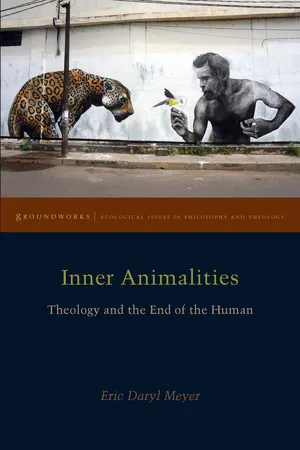
Most theology proceeds under the assumption that divine grace works on human beings at the points of our supposed uniqueness among earth's creatures—our freedom, our self-awareness, our language, or our rationality. Inner Animalities turns this assumption on its head. Arguing that much theological anthropology contains a deeply anti-ecological impulse, the book draws creatively on historical and scriptural texts to imagine an account of human life centered in our creaturely commonality.
The tendency to deny our own human animality leaves our self-understanding riven with contradictions, disavowals, and repressions. How are human relationships transformed when God draws us into communion through our instincts, our desires, and our bodily needs? Meyer argues that humanity's exceptional status is not the result of divine endorsement, but a delusion of human sin. Where the work of God knits human beings back into creaturely connections, ecological degradation is no longer just a matter of bodily life and death, but a matter of ultimate significance.
Bringing a theological perspective to the growing field of Critical Animal Studies, Inner Animalities puts Gregory of Nyssa and Karl Rahner in conversation with Jacques Derrida, Giorgio Agamben, Kelly Oliver, and Cary Wolfe. What results is not only a counterintuitive account of human life in relation with nonhuman neighbors, but also a new angle into ecological theology.
- 224 pages
- English
- ePUB (mobile friendly)
- Available on iOS & Android
eBook - ePub
About this book
Trusted by 375,005 students
Access to over 1.5 million titles for a fair monthly price.
Study more efficiently using our study tools.
Information
Publisher
Fordham University PressYear
2018Print ISBN
9780823280155
9780823280148
eBook ISBN
9780823280162
PART I
Critical and Historical Animalities
1
Gregory of Nazianzus: Animality and Ascent
The Moon gives the beasts fearless speech [parrhesia]; the Sun rouses the human for work.
—Gregory of Nazianzus1
A bishop in late antiquity could be measured by the fulfillment of two prominent vocational criteria: first, the practice of mystagogy, leading Christians in spiritual ascent by means of ritual, instruction, and personal example; second, the practice of parrhesía, bold and fearless speech that stands up to powerful forces on behalf of the poor and the vulnerable.2 Bishops such as Ambrose of Milan, Basil of Caesarea, and Gregory of Nazianzus practiced parrhesia by confronting emperors and governors on behalf of their flocks.
By daylight, both mystagogy and parrhesia are paradigmatically human activities for Gregory of Nazianzus, marks of the categorical difference between human beings and nonhuman animals. Humanity is almost angelic in proximity to God; animals are earthbound, filthy, passion ridden, and associated with idolatry. Under the gentler light of the moon however, wild animals emerge from between the lines of the text practicing a parhessia and a mystagogy of their own. And although Gregory will not grant episcopal authority to the lunar endeavors of the beasts, this chapter demonstrates that the daylight of Gregory’s texts presses on toward an evening, opening onto the light of the moon and the boldness of animals in speech and mysticism of their own. In Gregory’s theological anthropology, human animality fares much the same. With his pen, Gregory violently excludes animals and animality from theological knowledge and spiritual practice, and yet human animality remains essential—even if unacknowledged—for the transformation of the redeemed.
The problem of human animality produces fault lines in Gregory’s theology. Gregory’s theological anthropology stands conflicted on its own terms. Human animality is radically and violently disavowed, yet simultaneously plays an indispensable role in human salvation. The movements of human transformation in Gregory’s theological anthropology rely on fundamentally conflicted depictions of nonhuman animals and animality to generate movement from dissolute fallenness toward a renewed and elevated human nature. Gregory’s text transgresses the terms of his own categorical cut between humanity and animality in order to describe God’s redemption of the whole human being. On the one hand, Gregory’s spirituality of purification (kátharsis) operates with a logic of sacrifice. Gregory’s discourse violently subordinates nonhuman animals to make the point that human animality must be either silenced or slaughtered for the sake of spiritual union with God. On the other hand, however, Gregory’s explicit disavowal of animality falters where animals also provide images of a redeemed and perfected humanity living out an elevated instinctual bond to God. Humanity’s genuine repentance, vocation to worship, and perfected subjectivity all absolutely depend on qualities that Gregory associates with animality, but by the time he discusses these points, animality has been forcefully removed from the frame of reference.
This chapter begins by mapping the major elements of Gregory’s theological anthropology—mind, flesh, logos—onto the division between humanity and animality. The bulk of the chapter is then devoted to analysis of two of Gregory’s homilies—Oration 39 and Oration 28. Although these orations respectively address the mystery of baptism and the knowledge of God, taken together they present a complete anthropological narrative, from primordial origins to eschatological transformation, taking stock of the pitiable state of humanity between. These two texts offer an excellent synopsis of Gregory’s theological anthropology,3 but they are also two texts in which animals appear quite frequently at the margins, inhabiting the edges of Gregory’s theological anthropology. Nonhuman faces appear momentarily in imagery and exhortation, but rarely linger long since these texts are overwhelmingly concerned to carve out space for an authentic and proper humanity. I will follow these animal apparitions closely to trace out the complex relation between humanity and animality in Gregory’s texts.
Gregory’s Paradoxical Anthropology: Mind, Flesh, and Logos
Like most ancient thinkers, Gregory divides the human being into conceptual parts, allocating and measuring the humanity and animality of each. While Gregory follows Origen in conceiving of a human being as the tripartite composition of flesh, soul, and mind (sárx, psyché, and noūs),4 he much more frequently presents the human being as a paradoxical dipolarity between mind and flesh (noūs and sárx).5 Gregory obviously and persistently devalues flesh: “Flesh is shoddy in comparison with soul, as everyone with a good understanding should agree.”6 Flesh is material, corruptible, mortal, dense, obstructive, unspiritual, distracting, and riddled with pain and passion (páthos)—qualities associated with animality. Mind (noūs) is immaterial, immortal, light (both luminous and ethereal), spiritual, and active—qualities associated with angels and proper, normative humanity. The division between mind and flesh aligns precisely with an intrahuman division between proper humanity and human animality.7
Within the interior geography of the human, the seeing and speaking subject resides in the mind—the proper site of freedom, subjectivity, and knowledge.8 Gregory’s “I” or “We” speaks from the position of the mind while the flesh is an intimate alterity, an object or obstacle to be managed and overcome: “This bodily ‘murkiness’ stands between us and God just like that ancient cloud stood between the Egyptians and the Hebrews, and again like that ‘darkness [God] set as his covering,’ namely our density, through which only a few spy ever so briefly.”9 When Gregory urges members of his congregation to confess, pray, contemplate, or reform their lives, he addresses their minds and counsels them to go to work upon their flesh. The mind faces the challenge of the flesh’s passion and takes responsibility for the flesh’s purification.
Gregory persistently worries over the animality of human flesh: The animality of the flesh must be tamed and put to good use or it will surely run wild and overcome the human mind. The passions (which reside particularly in the flesh), “wickedly feed upon and consume the inner human being.”10 The inner work of the mind consists of “driving out,” keeping tight reins upon, but not “violently strangling” the life of the flesh.11 A steady reliance on metaphors of domestication and capture bind animality and flesh together in Gregory’s anthropology.
In addition to harboring untamed animality, Gregory also complains that the flesh has a deadening effect on the operation of the mind. Norris notes, “As Gregory sees it, full knowledge of God’s nature is impossible for humans since their view is obstructed by their fleshly condition. The problem is not one of language or attitude, but one of mental power, for such knowledge is beyond even those prepared by contemplation.”12 The flesh is a thick curtain or a lead blanket which impedes contemplation in two ways. It obscures the ability of the contemplative mind to see the divine light but also impedes transformation toward a more ethereal mode of life.13 The mind naturally strains to see great distances and rises in affinity with the divine and angelic natures, but flesh blocks its vision and drags it downward: “By fear they are rectified, purified, and (so to speak) rarified in order to rise up to the heights. For where fear is, there is heeding of commands. Where heeding of commands is, there is purification of flesh—that cloud eclipsing the soul, not allowing it to see the beam of divine light in purity. But where purification is, there is illumination.”14 God’s incomprehensibility is only partly a function of divine transcendence and mystery. It is also the density of the flesh that prevents a more adequate knowledge of God by impeding the mind’s efforts to rise to God’s unsearchable heights: “There is no way for those in the body to become fully present with intellectual things apart from corporeal things. For something of our embodiedness always intrudes if the mind strives to attend to connatural and invisible matters—even though the mind completely divorces itself from visible things and more fully realizes its nature.”15 For Gregory, flesh marks off distance and difference from God. It is the thick veil through which the human mind labors to peer and the dissolute animality that drags the mind away from spiritual concentration.
While the flesh marks off human distance from God, the mind is the site of a deep affinity between discursive creatures (the logikōn—angels and human beings) and the divine Logos. Discursive beings would have a profound and transformative knowledge of God were it not for the density and impurity of the flesh. Logos is the substance or content upon which a mind operates and the bond of perception and expression between one mind and the next.16 Through creation, incarnation, and redemption, the divine Logos anchors an intellectual fellowship; a relation of special continuity between God, humanity, and angels that Gregory frequently describes with metaphors of light and illumination:17
[Angelic nature] is nearly incorporeal; at any rate, it is exceedingly close. You see how our heads spin around this discourse (perì tòn lógon)! We do not have a way forward, some means great enough to know angels and archangels, thrones, dominions, magistracies, authorities, brilliant lights, ascents, mindful powers or minds, pure and authentic natures—all immovable (or very difficult to move) toward inferiority, always dancing around the First Cause. Illumined as they are by the purest of light from that origin—or else each [illumined] with the light fitting for its nature and position—how should someone hymn them!? They are so thoroughly formed and molded in beauty that even as they become lights, they are able also to illumine others by their own influx and communication of the first light.18
Reading such passages, one scholar goes so far as to claim that, for Gregory, God is a “great Mind.”19 In the same way that flesh links humanity to animals/animality, the mind links humanity to God and the angels.20
Despite proposing an equally hierarchical anthropology, Gregory does not follow Origen in linking the human fall into sin with the union of human mind and flesh. It is not human flesh that is responsible for the fall, but the immaturity of newly created minds. Using a medical term, Gregory describes the immaturity of the human mind as a protopath—a leading indicator or symptom of a disease that will get much worse.21 An immature mind is not a problem in and of itself, but through its confusion the entire human may be led astray. The mind is the linchpin, in other words, to spiritual health, and once it has been struck blind (as the devil well knows) a human being may be led into every form of vice to which the animal flesh was already prone.22 The fleshy corporeality of human life is not the origin of the predicament of sin, but once an undisciplined mind allows the flesh room to go astray, the flesh becomes the site of all manner of wickedness.23 Overcoming the sinful condition of humanity, then, requires a two-fold strategy of purification and illumination. Stripping away the burdensome distractions of the flesh through a rigorous program of cathartic purification opens the way for the reunification of the human mind with God and the angels, a destiny toward which luminous human minds naturally yearn.
The purification of the flesh is a precondition for the union of the mind with God. For that reason, Gregory’s twofold strategy for overcoming sin also describes a trajectory of development that moves from animal entanglement toward a rarified proper humanity centered in the intellect. Even though purification is an operation that takes place within a human being—an action of the mind upon the flesh—it is simultaneously a task that divides humanity from animality, inscribing this familiar boundary within the interior geography of the human for the sake of self-reflective discipline. Insofar as the flesh obscures the mind’s spiritual vision and encumbers its spiritual progress, Gregory describes the spirituality of purification as a sacrifice—not of the flesh itself, but of the animality of the flesh—carried out by the mind as it strives toward God. In what follows, I offer a reading of Oration 39 that traces out the contours of Gregory’s spirituality of purification followed by a reading of Oration 28 that tracks the ascent of the mind toward union with God. In both cases, Gregory’s theology cannot finally afford the success of its own sacrificial strategy because fleshly animality remains silently indispensable to the logic of Gregory’s account of human salvation.
What Kind of Animal Is a Purified Human?
Gregory delivered Oration 39, traditionally entitled “On the Holy Lights,”24 shortly after Emperor Theodosius legitimized Gregory’s claim to be the Bishop of Constantinople by exiling Demophilus, his anti-Nicene rival.25 It is a baptismal homily given at Epiphany, and Gregory preaches to a group of catechumens whom he has not catechized, but whom, nevertheless, are to be baptized the following day. In fact, they have been catechized by his opponent and predecessor, Demophilus.26 To put it mildly, Gregory is not terrifically confident of the theological rectitude of those he will shortly initiate into full participation in the church. Undertones of trinitarian politics resound through the themes o...
Table of contents
- Cover
- Series Page
- Title Page
- Copyright
- Dedication
- Contents
- Introduction
- Part I: Critical and Historical Animalities
- Part II: Constructive Animalities
- Conclusion
- Acknowledgments
- Notes
- Bibliography
- Index
- Series List
Frequently asked questions
Yes, you can cancel anytime from the Subscription tab in your account settings on the Perlego website. Your subscription will stay active until the end of your current billing period. Learn how to cancel your subscription
No, books cannot be downloaded as external files, such as PDFs, for use outside of Perlego. However, you can download books within the Perlego app for offline reading on mobile or tablet. Learn how to download books offline
Perlego offers two plans: Essential and Complete
- Essential is ideal for learners and professionals who enjoy exploring a wide range of subjects. Access the Essential Library with 800,000+ trusted titles and best-sellers across business, personal growth, and the humanities. Includes unlimited reading time and Standard Read Aloud voice.
- Complete: Perfect for advanced learners and researchers needing full, unrestricted access. Unlock 1.5M+ books across hundreds of subjects, including academic and specialized titles. The Complete Plan also includes advanced features like Premium Read Aloud and Research Assistant.
We are an online textbook subscription service, where you can get access to an entire online library for less than the price of a single book per month. With over 1.5 million books across 990+ topics, we’ve got you covered! Learn about our mission
Look out for the read-aloud symbol on your next book to see if you can listen to it. The read-aloud tool reads text aloud for you, highlighting the text as it is being read. You can pause it, speed it up and slow it down. Learn more about Read Aloud
Yes! You can use the Perlego app on both iOS and Android devices to read anytime, anywhere — even offline. Perfect for commutes or when you’re on the go.
Please note we cannot support devices running on iOS 13 and Android 7 or earlier. Learn more about using the app
Please note we cannot support devices running on iOS 13 and Android 7 or earlier. Learn more about using the app
Yes, you can access Inner Animalities by Eric Daryl Meyer in PDF and/or ePUB format, as well as other popular books in Theology & Religion & Mind & Body in Philosophy. We have over 1.5 million books available in our catalogue for you to explore.