Owen W. Gilman Jr. stresses the US experience of war in the twenty-first century and argues that wherever and whenever there is war, there will be imaginative responses to it, especially the recent wars in Afghanistan and Iraq. Since the trauma of September 11, the experience of Americans at war has been rendered honestly and fully in a wide range of texts--creative nonfiction and journalism, film, poetry, and fiction. These responses, Gilman contends, have packed a lot of power and measure up even to World War II's literature and film.Like few other books, Gilman's volume studies these new texts-- among them Kevin Powers's debut novel The Yellow Birds and Phil Klay's short stories Redeployment, along with the films The Hurt Locker, American Sniper, and Billy Lynn's Long Halftime Walk. For perspective, Gilman also looks at some touchstones from the Vietnam War. Compared to a few of the big Vietnam books and films, this new material has mostly been read and watched by small audiences and generated less discussion.Gilman exposes the circumstances in American culture currently preventing literature and film of our recent wars from making a significant impact. He contends that Americans' inclination to demand distraction limits learning from these compelling responses to war in the past decade. According to Gilman, where there should be clarity and depth of knowledge, we instead face misunderstanding and the anguish endured by veterans betrayed by war and our lack of understanding.
eBook - ePub
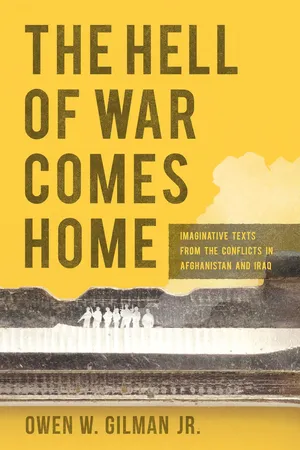
The Hell of War Comes Home
Imaginative Texts from the Conflicts in Afghanistan and Iraq
- 264 pages
- English
- ePUB (mobile friendly)
- Available on iOS & Android
eBook - ePub
The Hell of War Comes Home
Imaginative Texts from the Conflicts in Afghanistan and Iraq
About this book
Trusted by 375,005 students
Access to over 1.5 million titles for a fair monthly price.
Study more efficiently using our study tools.
Information
PART I
THE LONG ARC OF WAR
EXPERIENCE FOR AMERICANS
EXPERIENCE FOR AMERICANS
A Brief Introduction
Veterans Face the Challenge of American Fantasyland at War
America is a nation born of war. From the beginning centuries ago, it was with us—war against indigenous tribes, against rival colonial empires, and finally in North America, the great war of Independence, with British rule replaced by self-governance. Only by war could this have happened, and as a consequence, the stamp of war is indelible upon America. The loudest and most boisterous secular holiday in America is the Fourth of July; every year on that date Americans are called to remember how they came to be independent, in charge of their destiny—entirely because a group of very brave and determined men put their lives on the line, acquiescing in the necessity of war, to secure liberty and justice for themselves and for posterity. War was with Americans in the beginning.
War remains with Americans. In 2012, during the initial stage of this study, the war in Iraq seemed to have reached a clear endpoint with the withdrawal of American combat forces, an action dictated by the Status of Forces Agreement signed by President George W. Bush on 14 Dec. 2008; at the same time, the war in Afghanistan had a projected timetable for American withdrawal. Thus, there would be a return to peace, to a time without war. However, as years moved along, the Afghanistan conclusion date kept getting pushed further into the future—eventually to enter into a thoroughly indefinite time frame.1
While the war situation in Afghanistan persisted, the forces of ISIS (Islamic State of Iraq and Syria—a movement that President Obama typically called ISIL, Islamic State of Iraq and the Levant, thereby denoting a significantly broader region of concern) took over much of northern and western Iraq (Fallujah fell early in 2014, with Mosul being captured in June of 2014), all of which constituted a devastating development for American veterans who had suffered so much in fierce battles in those areas in the first decade of the century. This setback for Iraq necessitated introduction of American military support with both air power and on-the-ground advisors.2 The fight to regain control of Mosul, Iraq’s second-largest city, took place in the summer/fall of 2016 and winter of 2017, thirteen years after the American-led invasion to topple Saddam Hussein, and in the aftermath of fighting, deep concerns persist as to the ability of the Iraqi government to provide safety for the residents of Mosul, as well as other areas of the country.
Furthermore, elite American special forces wound up being committed to areas in Syria to bolster the fight against ISIS/ISIL. The president, as commander-in-chief, holds clear responsibility for all of the combat action and initiatives that have been deemed necessary because Americans want to be safe at home. As the second decade of the twenty-first century moved along, the standard operating procedure called for enemy forces to be engaged and defeated wherever they might be operating—Iraq, Afghanistan, Pakistan, Syria—in order to protect American domestic security. Thus, the war on terror—a worldwide phenomenon—staggers on, year by year, with no end in sight all around the planet. There are a great many locations where suicide desperados can be trained, and it is impossible to scare down people who are willing to strap explosives on their bodies and blow themselves up in attacks against innocent souls who just happen to be in the wrong place at the wrong time.
Every incident of domestic terrorism linked to ISIS/ISIL spikes anxiety. The West Coast was shocked by the November 2015 shooting in San Bernardino, and then the East Coast received a similar jolt in the Orlando nightclub attack in June 2016. When the horror of war comes home in such staggering events, around-the-clock media attention is inevitable—for a short while at least. However, when regarding war action at a distance, with combat engagements in far-off locations, Americans are generally inattentive to what their military forces are doing. There are just too many distractions. In The Shallows: What the Internet Is Doing to Our Brains (2010), Nicholas Carr has argued that the compulsive way we use the Internet today, repeated quick dashes to it for the need of a moment (addictive behavior that now begins in infancy and in short order will follow us to the end of our days), is making it steadily more difficult to concentrate our attention on matters that are presented to us in complex forms—the stuff of book-length narratives or even tautly inscribed and challenging poems. In the years following publication of Carr’s anxious analysis of American culture, more and more of national decision making is relegated to less and less in terms of sustained attention.
Our age, early in the twenty-first century, is increasingly defined by Twitter—a form that requires just a split second of brain processing, and then we crave another hit of this digitized drug. Bouncing along, tweet to tweet, we have a pronounced tendency to shun anything that takes longer to process. The experience of war is colossal; it is profound. Veterans acquire massive memory moments that become indelible. The stories and other imaginative reflections of daunting experiences of war take great effort and persistence to engage in the degree that is warranted; consequently, these traumatic experiences and the imaginative responses to them should merit long and determined attention from those left behind on the home front. Yet instead of providing attention that would lead to depth of learning and understanding, citizens at home offer the most superficial of responses—a great vat of know-nothingness—and then turn quickly to something distracting, some facet of fantasyland, virtually anything that provides entertainment, distracts attention from reality, and demands no effort. The ultimate manifestation of this pattern is represented in the huge appeal of the actual Fantasyland at Disney theme parks, a phenomenon scrutinized in chapter 6.
Whenever possible, Americans are happy to venture off to fantasyland, through whatever means it may be realized, and this tendency has presented daunting challenges for veterans, a matter of concern that is often reflected in the imaginative texts from the conflicts in Afghanistan and Iraq. The examination of war texts here finds a serious fault line in American culture, something that is highlighted often in the memoirs, novels, poems, and films that have taken up America’s most recent war experience: veterans are shown to be frequently upset in witnessing the inattentiveness of their fellow citizens with regard to these recent wars and their consequences. As Sebastian Junger has powerfully illuminated in his latest book, Tribe: On Homecoming and Belonging (2016), the problem for contemporary veterans transcends the effects of post-traumatic stress disorder (PTSD). The solace needed for healing is regrettably not provided by American culture in the twenty-first century.
This situation stands in stark relief to one of the first gestures toward establishing the highest bar of possible achievement for Americans, long before the development of an independent American nation. In 1630 John Winthrop delivered his “Modell of Christian Charity” sermon aboard the Arabella, shortly before his group of Puritans reached shore to found the Massachusetts Bay Colony. We regularly are reminded of his words by politicians striving to claim a high place for America in the world. Toward the end of his sermon, Winthrop uttered the now-famous “Citty vpon a Hill” (32) description for the greatness that might come to distinguish this new enterprise. However, Winthrop’s carefully stipulated background for these words is invariably lost in modern references; Winthrop had built his sermon on a biblical grounding that called for all members of the group, even though they represented considerable diversity, to be closely knit with the others, none to be excluded, a snug community of intensely interdependent souls. Only in the steadiness of this bound-together community could there be hope for God’s approval. Should things fall apart, and the community splinter, there would be hell to pay, a stern point driven home vigorously in Winthrop’s conclusion. If Winthrop could catch a glimpse of twenty-first-century America, a nation broken open, shattered, bitterly divided, spiraling downward in libertarian self-centeredness, it is certain there could be no “Citty vpon a Hill” commendation or accolade to follow.
Diverse signs in our time have appeared to suggest Americans manifest considerable animosity toward one another; a nation of virulent individuals packed with divisive impulses and equipped with technology that allows instant expression of frustration and fury produces a toxic mix of distress that is barely held together—except by war as a unifying force, us against them. However, now the unrelenting wars have produced another schism, with the war vet (a small group) set off against the non-vet (a large group); the current-day veteran is not judged negatively as soldiers returning from Vietnam often were but, rather, suffers by being lost in the deep tide of distractions so present in the activities of contemporary American culture. Without a strong tribal feeling to hold everything together, a solution longed for by Sebastian Junger as he reflects on contemporary America (and demanded ages ago by John Winthrop for the community of his day), the veteran faces a staggering sense of separateness.
Again and again, in one way or another, the imaginative texts explored in this study converge in representing feelings of anger, abandonment, and alienation by veterans as they face figurative burial beneath all the mindless distractions operating in American culture. Horrific pain that made ironic sense in the tumult of combat becomes utterly devoid of meaning against the backdrop of the superficial interests that dominate the American scene.
This study is centered on the experience of war for Americans in the twenty-first century as revealed through a wide range of imaginative texts that work hard to bring the wars in Iraq and Afghanistan home so that all can intimately know and truly comprehend the hellish nature of war in any time, including ours. The most startling revelation from these most recent American experiences with war as represented in diverse imaginative texts involves the way the hell of war becomes the hell of home: this conclusion could not have been possible without all the evidence gathered from a wide range of imaginative responses to recent war experience, stretching across all the genres. Not every text explored here arrives at this key point, but a great many bring it to the surface for concern.
This striking new development is best understood against a brief history of war as Americans have known it, albeit with much inherited from earlier cultures, even as far back as Homer’s time. Wars are downright difficult to avoid, especially for nation-states that seek to influence large areas of the world. All of the efforts at civilization in the vicinity of the Mediterranean Sea—the Egyptians, the Mesopotamians, the Greeks, the Romans—involved confronting the war challenge often. Asian civilizations regularly struggled with war as well. With the rise of modern Europe and the age of colonial expansion, war was everywhere, a pattern running through Napoleon and on to culmination in two World Wars and a long cold war. War experience from the historical record is pointedly acknowledged at the outset of this study, for the past bears significantly on war as it has been known and represented by Americans.
The first chapter serves two purposes: 1) to account quickly for key patterns that have shadowed war over the centuries, including those conflicts joined by Americans since the Revolutionary War, and 2) to delineate historical, psychological, and political forces that combine to make it easier than ever before for Americans to be sent into combat somewhere. American readiness for war in the twenty-first century has much to do with the wars of our past. Going into war is increasingly easy for America; getting out of war is increasingly problematical.
Wherever and whenever there is war, there will be imaginative responses to it, and such has been the case with the wars in Afghanistan and Iraq. American soldiers were dispatched to these foreign places; they engaged enemies both expected and unexpected; and they experienced the full range of possible outcomes—from survival to death. The experience of Americans at war in our time has been rendered honestly and fully in a wide range of texts—creative nonfiction and journalism, memoir, film, poetry, and fiction. These responses, individually and in the aggregate, have packed a lot of power, fully measuring up to great war literature and film from the past. The middle portion of this study works to closely analyze salient features of the imaginative representations of war that have emerged since the trauma of 9/11, a day as loaded with infamy for Americans as December 7, 1941.
But going to war and then representing the experience of war constitute only two elements of a three-part sequence. The final consideration explores the way circumstances in American culture currently bedevil veterans, making their home a kind of hell. As long as average Americans are preoccupied with superficial nonsense, veterans will feel marginalized to the point of nonexistence (the current suicide rate for veterans—to be addressed in detail later—is provocative evidence of this problem), and this whole pattern serves at the same time to prevent literature and film of war from having deep or significant impact. In the final part of the study, a summary case is made to show that the inclinations of Americans to distract themselves in one form or another with fantasyland products and experiences significantly limit learning or growth from the stringent responses to war that have been proffered to reading and viewing audiences in the past decade. It should be noted, however, that even though book and film reviewers—potent cultural gatekeepers—have devoted appropriate attention to these imaginative responses to war, such acknowledgement by reviewers stands in stark contrast to the limits of general American public awareness about war texts of the twenty-first century, as well as about war more broadly.
Returning veterans of war often are deeply burdened as they face reentry into their cultures of origin. Haunting memories pursue them. The soldier-to-soldier bonds that supported them in war are dissolved. Their experience isolates them, setting them apart. Meanwhile, their stay-at-home compatriots make shallow gestures of appreciation: the “Support the Troops” bumper stickers, the invitations for veterans to stand for a moment of thankful applause at political rallies, the murmurings of “Thanks for your defense of our Freedom” offered to veterans at happenstance encounters. These forms of gratitude are not inherently wrong, but as balm goes, they barely touch the surface, while the hurt lies deep inside. Meanwhile, American culture hurtles along riding waves of consumption, frantically calling all to pursue their happiness as stipulated in the Declaration of Independence. In full hustle mode, hell-bent for whatever scrap of happiness can be grasped, people have almost no time to feel the pain of war.
Most Americans these days are caught up in the fight to not fall behind. This challenge is daunting, and relief is sought in distractions that serve to dull anxiety. Given that imaginative responses to the conflicts in Iraq and Afghanistan are packed with genuinely rough stuff, it is not surprising that many might opt instead for mindless distractions. Even veterans can get caught up in this escapist impulse, sometimes ironically bingeing on war video games, but for them, the respite is never long. Their pain persists; war releases its hold with agonizing slowness. In a powerful and deeply moving article early in 2017, “The Fighter,” C. J. Chivers details the experience of Sam Siatta in going to fight in Afghanistan and then being beset by disabling demons throughout a long and torturous effort to return to normalcy back at home. The title subhead captures the brutal irony involved, a point to be highlighted in various ways throughout this study: “The Marine Corps Taught Sam Siatta How to Shoot. The War in Afghanistan Taught Him How to Kill. Nobody Taught Him How to Come Home.” Despite some exceptions, Americans with no war experience are typically inattentive, loath to venture deep in understanding the real consequences of war as borne out in the lives of veterans and as reflected in the broad array of creative renderings of war experience. The old axiom “Ignorance is bliss” holds true on the home front, and it can be hell for veterans to face.
This inattentiveness has two equally unfortunate consequences: 1) it contributes to the alienation of veterans, and 2) it increases the likelihood that America will soon again venture into war, thus repeating the whole pattern. By the end of the study, it will be evident that our approach to war is front-loaded with fantasy, and when a war draws to a close, our approach is back-loaded with fantasy; in the middle, where there should be some clarity and depth of knowledge drawn from imaginative treatments of war experience, all we have is a muddle of long-lasting misunderstanding and anguish to be endured by veterans who ventured to war fueled by fantasy and returned betrayed by the implications of fantasy as played out in American culture at large.
The film adaptation of Ben Fountain’s novel Billy Lynn’s Long Halftime Walk, which reached just two theaters on Veterans Day in November of 2016 (and then went into nationwide release a week later), can serve handily to illustrate the essential problem that recent war literature highlights. With astute direction from Ang Lee, the film does an excellent job of showing the hellish experience of war veterans—eight surviving members of Bravo squad—as they encounter diverse home-bound fellow Americans. Following the novel quite closely, the film tracks the effort to elevate these soldiers to hero status by featuring them and their war experience as part of the halftime show at an NFL game in Texas. Against the backdrop of the usual pyrotechnic extravaganza features of halftime performances, including booty-shaking stars of the America music industry, there is hyperventilated talk of a movie deal. It’s all a twenty-first-century variation on the adulation heaped on Audie Murphy (who is explicitly mentioned by the rahrah owner of the football stadium, Norm Oglesby, played by Steve Martin) when Murphy came back from World War II with a chest full of medals and Hollywood eager to capitalize on his war exploits.
When Murphy wrote his memoir, To Hell and Back (1949), and then starred in the movie version a few years later, it seemed to all that the hell part was just the war. However, by the 1960s, Murphy was suffering from PTSD, clear evidence that he had brought hell back home with him. He suffered alone, however, for in the eyes of the public, there was no allowance for the hard reality of his actual experience; the American public was blissfully unaware of this development in his life.
For the soldiers brought home from Iraq in Billy Lynn’s Long Halftime Walk, they too had experienced a version of hell in the horrific fight that attracted so much attention to them, and then they are snatched up briefly to become central figures in a public relations “Victory Tour” spectacle, before being returned to Iraq to continue their tour of duty. As it turns out, none of the survivors is a poster-boy hero type; they all have dark clouds in their life stories, most recently involving the shared loss of Sergeant Breem (nicknamed “Shroom”), a deeply liked leader who was killed in the devastating battle for which they are being celebrated. The sharp juxtaposition between the actual reality of their gruesome experiences and the pure fantasy of this victory tour—in search of a movie by way of a halftime show for a professional football game in Dallas, Texas, on Thanksgiving—constitutes another form of hell.
Reality and truth are shunted aside in favor of glitz and absurd hyperbole. To make the right impact during the halftime show, Billy’s squad members have to change from the Class A Greens they wore to the stadium into their camouflag...
Table of contents
- Cover
- Title Page
- Copyright
- Dedication
- Contents
- Acknowledgments
- Part I: The Long Arc of War Experience for Americans
- Part II: America’S Recent War Experience Comes Home in Imaginative Texts
- Part III: Veterans Lost as Distractions Rule in Fantasyland America
- Notes
- Bibliography
- Index
Frequently asked questions
Yes, you can cancel anytime from the Subscription tab in your account settings on the Perlego website. Your subscription will stay active until the end of your current billing period. Learn how to cancel your subscription
No, books cannot be downloaded as external files, such as PDFs, for use outside of Perlego. However, you can download books within the Perlego app for offline reading on mobile or tablet. Learn how to download books offline
Perlego offers two plans: Essential and Complete
- Essential is ideal for learners and professionals who enjoy exploring a wide range of subjects. Access the Essential Library with 800,000+ trusted titles and best-sellers across business, personal growth, and the humanities. Includes unlimited reading time and Standard Read Aloud voice.
- Complete: Perfect for advanced learners and researchers needing full, unrestricted access. Unlock 1.5M+ books across hundreds of subjects, including academic and specialized titles. The Complete Plan also includes advanced features like Premium Read Aloud and Research Assistant.
We are an online textbook subscription service, where you can get access to an entire online library for less than the price of a single book per month. With over 1.5 million books across 990+ topics, we’ve got you covered! Learn about our mission
Look out for the read-aloud symbol on your next book to see if you can listen to it. The read-aloud tool reads text aloud for you, highlighting the text as it is being read. You can pause it, speed it up and slow it down. Learn more about Read Aloud
Yes! You can use the Perlego app on both iOS and Android devices to read anytime, anywhere — even offline. Perfect for commutes or when you’re on the go.
Please note we cannot support devices running on iOS 13 and Android 7 or earlier. Learn more about using the app
Please note we cannot support devices running on iOS 13 and Android 7 or earlier. Learn more about using the app
Yes, you can access The Hell of War Comes Home by Owen W. Gilman Jr. in PDF and/or ePUB format, as well as other popular books in Social Sciences & Popular Culture. We have over 1.5 million books available in our catalogue for you to explore.