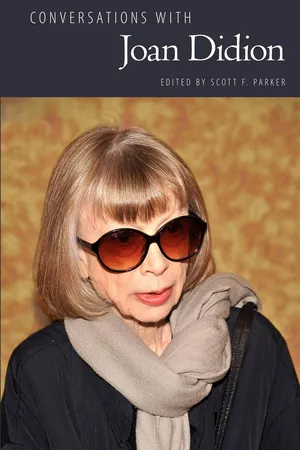
Joan Didion (b. 1934) is an American icon. Her essays, particularly those in Slouching Towards Bethlehem and The White Album, have resonated in American culture to a degree unmatched over the past half century. Two generations of writers have taken her as the measure of what it means to write personal essays. No one writes about California, the sixties, media narratives, cultural mythology, or migraines without taking Didion into account. She has also written five novels; several screenplays with her husband, John Gregory Dunne; and three late-in-life memoirs, including The Year of Magical Thinking and Blue Nights, which have brought her a new wave of renown. Conversations with Joan Didion features seventeen interviews with the author, spanning decades, continents, and genres. Didion reflects on her childhood in Sacramento; her time at Berkeley (both as a student and later as a visiting professor), in New York, and in Hollywood; her marriage to Dunne; and of course her writing. Didion describes her methods of writing, the ways in which the various genres she has worked in inform one another, and the concerns that have motivated her to write.
- 186 pages
- English
- ePUB (mobile friendly)
- Available on iOS & Android
eBook - ePub
Conversations with Joan Didion
About this book
Trusted by 375,005 students
Access to over 1.5 million titles for a fair monthly price.
Study more efficiently using our study tools.
Information
Joan Didion: The Art of Nonfiction No 1.
From The Paris Review, Issue 176, Spring 2006. Copyright © 2006 by The Paris Review. Reprinted by permission of the Wylie Agency LLC.
The last time this magazine spoke with Joan Didion, in August of 1977, she was living in California and had just published her third novel, A Book of Common Prayer. Didion was forty-two years old and well-known not only for her fiction but also for her work in magazines—reviews, reportage, and essays—some of which had been collected in Slouching Towards Bethlehem (1968). In addition, Didion and her husband, John Gregory Dunne (who was himself the subject of a Paris Review interview in 1996), had written a number of screenplays together, including The Panic in Needle Park (1971); an adaptation of her second novel, Play It As It Lays (1972); and A Star Is Born (1976). When Didion’s first interview appeared in these pages in 1978, she was intent on exploring her gift for fiction and nonfiction. Since then, her breadth and craft as a writer have only grown deeper with each project.
Joan Didion was born in Sacramento, and both her parents, too, were native Californians. She studied English at Berkeley, and in 1956, after graduating, she won an essay contest sponsored by Vogue and moved to New York City to join the magazine’s editorial staff. While at Vogue, she wrote fashion copy, as well as book and movie reviews. She also became a frequent contributor to The National Review, among other publications. In 1963, Didion published her first novel, Run River. The next year she married Dunne, and soon afterwards, they moved to Los Angeles. There, in 196[6], they adopted their only child, Quintana Roo.
In 1973, Didion began writing for The New York Review of Books, where she has remained a regular contributor. While she has continued to write novels in recent decades—Democracy (1984) and The Last Thing He Wanted (1996)—she has increasingly explored different forms of nonfiction: critical essay, political reportage, memoir. In 1979, she published a second collection of her magazine work, The White Album, which was followed by Salvador (1983), Miami (1987), After Henry (1992), Political Fictions (2001), and Where I Was From (2003). In the spring of 2005, Didion was awarded a Gold Medal from the American Academy of Arts and Letters.
In December of 2003, shortly before their fortieth anniversary, Didion’s husband died. Last fall, she published The Year of Magical Thinking, a book-length meditation on grief and memory. It became a best-seller, and won the National Book Award for nonfiction; Didion is now adapting the book for the stage as a monologue. Two months before the book’s publication, Didion’s thirty-nine-year-old daughter died after a long illness.
Our conversation took place over the course of two afternoons in the Manhattan apartment Didion shared with her husband. On the walls of the spacious flat, one could see many photographs of Didion, Dunne, and their daughter. Daylight flooded the book-filled parlor. “When we got the place, we assumed the sun went all through the apartment. It doesn’t,” Didion said, laughing. Her laughter was the additional punctuation to her precise speech.
INTERVIEWER: By now you’ve written at least as much nonfiction as you have fiction. How would you describe the difference between writing the one or the other?
JOAN DIDION: Writing fiction is for me a fraught business, an occasion of daily dread for at least the first half of the novel, and sometimes all the way through. The work process is totally different from writing nonfiction. You have to sit down every day and make it up. You have no notes—or sometimes you do, I made extensive notes for A Book of Common Prayer—but the notes give you only the background, not the novel itself. In nonfiction, the notes give you the piece. Writing nonfiction is more like sculpture, a matter of shaping the research into the finished thing. Novels are like paintings, specifically watercolors. Every stroke you put down you have to go with. Of course you can rewrite, but the original strokes are still there in the texture of the thing.
INTERVIEWER: Do you do a lot of rewriting?
DIDION: When I’m working on a book, I constantly retype my own sentences. Every day I go back to page one and just retype what I have. It gets me into a rhythm. Once I get over maybe a hundred pages, I won’t go back to page one, but I might go back to page fifty-five, or twenty, even. But then every once in a while I feel the need to go to page one again and start rewriting. At the end of the day, I mark up the pages I’ve done—pages or page—all the way back to page one. I mark them up so that I can retype them in the morning. It gets me past that blank terror.
INTERVIEWER: Did you do that sort of retyping for The Year of Magical Thinking?
DIDION: I did. It was especially important with this book because so much of it depended on echo. I wrote it in three months, but I marked it up every night.
INTERVIEWER: The book moves quickly. Did you think about how your readers would read it?
DIDION: Of course, you always think about how it will be read. I always aim for a reading in one sitting.
INTERVIEWER: At what point did you know that the notes you were writing in response to John’s death would be a book for publication?
DIDION: John died December 30, 2003. Except for a few lines written a day or so after he died, I didn’t begin making the notes that became the book until the following October. After a few days of making notes, I realized that I was thinking about how to structure a book, which was the point at which I realized that I was writing one. This realization in no way changed what I was writing.
INTERVIEWER: Was it difficult to finish the book? Or were you happy to have your life back—to live with a lower level of self-scrutiny?
DIDION: Yes. It was difficult to finish the book. I didn’t want to let John go. I don’t really have my life back yet, since Quintana died only on August 26.
INTERVIEWER: Since you write about yourself, interviewers tend to ask about your personal life; I want to ask you about writing and books. In the past you’ve written pieces on V. S. Naipaul, Graham Greene, Norman Mailer, and Ernest Hemingway—titanic, controversial iconoclasts whom you tend to defend. Were these the writers you grew up with and wanted to emulate?
DIDION: Hemingway was really early. I probably started reading him when I was just eleven or twelve. There was just something magnetic to me in the arrangement of those sentences. Because they were so simple—or rather they appeared to be so simple, but they weren’t.
Something I was looking up the other day, that’s been in the back of my mind, is a study done several years ago about young women’s writing skills and the incidence of Alzheimer’s. As it happens, the subjects were all nuns, because all of these women had been trained in a certain convent. They found that those who wrote simple sentences as young women later had a higher incidence of Alzheimer’s, while those who wrote complicated sentences with several clauses had a lower incidence of Alzheimer’s. The assumption—which I thought was probably erroneous—was that those who tended to write simple sentences as young women did not have strong memory skills.
INTERVIEWER: Though you wouldn’t classify Hemingway’s sentences as simple.
DIDION: No, they’re deceptively simple because he always brings a change in.
INTERVIEWER: Did you think you could write that kind of sentence? Did you want to try?
DIDION: I didn’t think that I could do them, but I thought that I could learn—because they felt so natural. I could see how they worked once I started typing them out. That was when I was about fifteen. I would just type those stories. It’s a great way to get rhythms into your head.
INTERVIEWER: Did you read anyone else before Hemingway?
DIDION: No one who attracted me in that way. I had been reading a lot of plays. I had a misguided idea that I wanted to act. The form this took was not acting, however, but reading plays. Sacramento was not a place where you saw a lot of plays. I think the first play I ever saw was the Lunts in the touring company of O Mistress Mine. I don’t think that that’s what inspired me. The Theater Guild used to do plays on the radio, and I remember being very excited about listening to them. I remember memorizing speeches from Death of a Salesman and Member of the Wedding in the period right after the war.
INTERVIEWER: Which playwrights did you read?
DIDION: I remember at one point going through everything of Eugene O’Neill’s. I was struck by the sheer theatricality of his plays. You could see how they worked. I read them all one summer. I had nosebleeds, and for some reason it took all summer to get the appointment to get my nose cauterized. So I just lay still on the porch all day and read Eugene O’Neill. That was all I did. And dab at my face with an ice cube.
INTERVIEWER: What you really seem to have responded to in these early influences was style—voice and form.
DIDION: Yes, but another writer I read in high school who just knocked me out was Theodore Dreiser. I read An American Tragedy all in one weekend and couldn’t put it down—I locked myself in my room. Now that was antithetical to every other book I was reading at the time, because Dreiser really had no style, but it was powerful.
And one book I totally missed when I first read it was Moby-Dick. I reread it when Quintana was assigned it in high school. It was clear that she wasn’t going to get through it unless we did little talks about it at dinner. I had not gotten it at all when I read it at her age. I had missed that wild control of language. What I had thought discursive were really these great leaps. The book had just seemed a jumble; I didn’t get the control in it.
INTERVIEWER: After high school you wanted to go to Stanford. Why?
DIDION: It’s pretty straightforward—all my friends were going to Stanford.
INTERVIEWER: But you went to Berkeley and majored in literature. What were you reading there?
DIDION: The people I did the most work on were Henry James and D. H. Lawrence, who I was not high on. He irritated me on almost every level.
INTERVIEWER: He didn’t know anything about women at all.
DIDION: No, nothing. And the writing was so clotted and sentimental. It didn’t work for me on any level.
INTERVIEWER: Was he writing too quickly, do you think?
DIDION: I don’t know, I think he just had a clotted and sentimental mind.
INTERVIEWER: You mentioned reading Moby-Dick. Do you do much rereading?
DIDION: I often reread Victory, which is maybe my favorite book in the world.
INTERVIEWER: Conrad? Really? Why?
DIDION: The story is told thirdhand. It’s not a story the narrator even heard from someone who experienced it. The narrator seems to have heard it from people he runs into around the Malacca Strait. So there’s this fantastic distancing of the narrative, except that when you’re in the middle of it, it remains very immediate. It’s incredibly skillful. I have never started a novel—I mean except the first, when I was starting a novel just to start a novel—I’ve never written one without rereading Victory. It opens up the possibilities of a novel. It makes it seem worth doing. In the same way, John and I always prepared for writing a movie by watching The Third Man. It’s perfectly told.
INTERVIEWER: Conrad was also a huge inspiration for Naipaul, whose work you admire. What drew you to Naipaul?
DIDION: I read the nonfiction first. But the novel that really attracted me—and I still read the beginning of it now and then—is Guerillas. It has that bauxite factory in the opening pages, which just gives you the whole feel of that part of the world. That was a thrilling book to me. The nonfiction had the same effect on me as reading Elizabeth Hardwick—you get the sense that it’s possible simply to go through life noticing things and writing them down and that this is OK, it’s worth doing. That the seemingly insignificant things that most of us spend our days noticing are really significant, have meaning, and tell us something. Naipaul is a great person to read before you have to do a piece. And Edmund Wilson, his essays for The American Earthquake. They have that everyday-traveler-in-the-world aspect, which is the opposite of an authoritative tone.
INTERVIEWER: Was it as a student at Berkeley that you began to feel that you were a writer?
DIDION: No, it began to feel almost impossible at Berkeley because we were constantly being impressed with the fact that everybody else had done it already and better. It was very daunting to me. I didn’t think I could write. It took me a couple of years after I got out of Berkeley before I dared to start writing. That academic mind-set—which was kind of shallow in my case anyway...
Table of contents
- Cover
- Title Page
- Copyright
- Contents
- Introduction
- Chronology
- The Female Angst
- A Day in the Life of Joan Didion
- A Visit with Joan Didion
- Book of Common Prayer
- Joan Didion: The Art of Fiction No. 71
- Wired for Books
- The Salon Interview: Joan Didion
- Joan Didion, One Week after 9/11
- Berkeley Alumna Discusses Politics after Fictions
- Revelle Forum at the Neurosciences Institute: Joan Didion
- Dave Eggers Talks with Joan Didion
- Joan Didion: The Art of Nonfiction No. 1
- Seeing Things Straight
- Joan Didion Remembers The Panic in Needle Park
- Joan Didion: Crafting an Elegy for Her Daughter
- An Evening with Joan Didion
- Joan Didion
- Index
Frequently asked questions
Yes, you can cancel anytime from the Subscription tab in your account settings on the Perlego website. Your subscription will stay active until the end of your current billing period. Learn how to cancel your subscription
No, books cannot be downloaded as external files, such as PDFs, for use outside of Perlego. However, you can download books within the Perlego app for offline reading on mobile or tablet. Learn how to download books offline
Perlego offers two plans: Essential and Complete
- Essential is ideal for learners and professionals who enjoy exploring a wide range of subjects. Access the Essential Library with 800,000+ trusted titles and best-sellers across business, personal growth, and the humanities. Includes unlimited reading time and Standard Read Aloud voice.
- Complete: Perfect for advanced learners and researchers needing full, unrestricted access. Unlock 1.5M+ books across hundreds of subjects, including academic and specialized titles. The Complete Plan also includes advanced features like Premium Read Aloud and Research Assistant.
We are an online textbook subscription service, where you can get access to an entire online library for less than the price of a single book per month. With over 1.5 million books across 990+ topics, we’ve got you covered! Learn about our mission
Look out for the read-aloud symbol on your next book to see if you can listen to it. The read-aloud tool reads text aloud for you, highlighting the text as it is being read. You can pause it, speed it up and slow it down. Learn more about Read Aloud
Yes! You can use the Perlego app on both iOS and Android devices to read anytime, anywhere — even offline. Perfect for commutes or when you’re on the go.
Please note we cannot support devices running on iOS 13 and Android 7 or earlier. Learn more about using the app
Please note we cannot support devices running on iOS 13 and Android 7 or earlier. Learn more about using the app
Yes, you can access Conversations with Joan Didion by Scott F. Parker in PDF and/or ePUB format, as well as other popular books in Literature & Literary Biographies. We have over 1.5 million books available in our catalogue for you to explore.