eBook - ePub
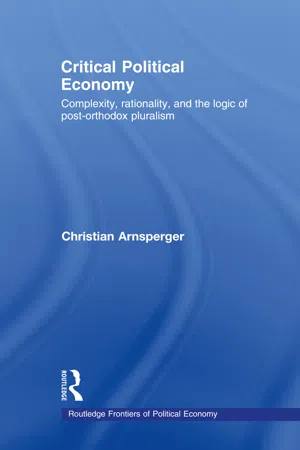
Critical Political Economy
Complexity, Rationality, and the Logic of Post-Orthodox Pluralism
- 352 pages
- English
- ePUB (mobile friendly)
- Available on iOS & Android
eBook - ePub
Critical Political Economy
Complexity, Rationality, and the Logic of Post-Orthodox Pluralism
About this book
This book asks how a more liberating economics could be constructed and taught. It suggests that if economists today are serious about emancipation and empowerment, they will have to radically change their conception about what it means for a citizen to act rationally in a complex society.Arnsperger emphasises that current economics neglects an imp
Trusted by 375,005 students
Access to over 1.5 million titles for a fair monthly price.
Study more efficiently using our study tools.
Information
Topic
Negocios y empresaSubtopic
Negocios en generalPart I
Uncritical complexity
2
Uncritical atoms
The limits of standard economics
This chapter lays the groundwork for the analysis. In a sense, the arguments developed here are pretty self-evident. They are simply meant to convey the basic idea underlying the whole of Part I: mainstream economics has not, up to today, been constructed in such a way as to be able to portray the economy as a self-criticizing system. This chapter engages standard neoclassical economics—or “Economics 101”—and its more rudimentary portrayal of rationality and interactions. As Chapters 3 and 4 will subsequently show, the basic idea applies also to cutting-edge “complexity economics” and to its main philosophical proponent, Hayek.
Some might argue that spending one’s time discussing the all too obvious limitations of standard, pre-complexity economics amounts to denigrating a straw man. After all, what can you expect in terms of critical force from an approach such as neoclassical economics, which is no longer even part of the frontier of the discipline? We will see, however, that standard theory’s neoclassical heritage is rooted in an atomistic framework that actually did have critical force two-and-a-half centuries ago, but has nowadays become outdated. So, although this chapter should surprise no one in highlighting the intrinsic inability of basic neoclassical economics to be of any real help as a contemporary tool for social criticism, analyzing that inability nevertheless is important. Indeed, although the inability is surely to be expected, it is the reasons for the inability that interest me here.
Moreover, there is always a substantial lag between front-line research and ground-level teaching, as well as everyday political debates. Therefore, “Economics 101” reasoning is still widely used both by scholars and by educated citizens (including philosophers) when they want to speak out on normative social issues such as, for instance, the optimality of taxation or the link between markets and freedoms. Although conceptually outdated on various counts, standard neoclassical economics is still heuristically influential. It is therefore important to suggest that it has today become an intellectual obstacle to further social emancipation.
Thus, the rationale for this first chapter is twofold. First, it will allow us to sweep the floor clean of very basic misunderstandings about economics and emancipation. Such misunderstandings can be addressed already within the simple analytical framework of the pre-complexity mainstream. Second, it will allow us to introduce some of the arguments to be further developed later on, and to bring in some of the basic concepts that will gradually help us to ground Critical Political Economy. The reader should therefore not infer from the content of this first chapter that I believe mainstream economics has remained merely neoclassical. We will be moving on from here!
Two basic questions
A stormy context
There is currently a resurgence of discussions on social criticism and on the possible return of the critical intellectual (see, among many others, the impressive systematization effort by Boltanski and Chiapello 1999, as well as recent collective volumes such as Jallon and Mathieu 2002, Lojkine 2002, or Renault and Sintomer 2003). However, this movement does not seem to have reached the bulk of economics departments. Some of us might lament this situation. Should we not see it as yet another sign of the “conservatism” allegedly pervading a substantial portion of mainstream economics profession, making it one of the strongholds of “anti-politics” about which so much has been written in recent years (see, for example, Bourdieu 1998, 2000a; Sapir 2002; or Dezalay and Garth 2002)? I don’t think this is the correct view of things. I want to suggest something different. Mainstream economists are, often unwittingly, using theoretical concepts and tools that make it impossible for them to speak coherently about the emancipation of sections of the population that are dissatisfied with the existing economy.
The reason for this impossibility is not that these theorists are all more or less implicitly “right-wing.” That is certainly not the case. Rather, it is the theoretical tools they routinely use that render problematic, or even unintelligible, certain categories which used to be the pride of critical social science (see, for example, Giddens 1971; Fay 1975). I am thinking of categories such as “social change,” but also “revolution” and even “social emancipation” as such, as well as the concept of “oppression,” which used to guide the progressive citizen’s consciousness and activism. I want to surmise that the tools of standard economics do not make room for economic agents’ aspirations to a better economy and to better ways of being human.
May 2000 saw the publication, in the Parisian daily Le Monde, of the “open letters” of the French economics students (see Fullbrook 2003). In almost immediate response, and on request of the Education minister, Jean-Paul Fitoussi drafted a report concerning the teaching of economics at French universities (Fitoussi 2001). Two camps debated passionately. On the one hand, there were those who had long been, and were still, accusing the mathematical social sciences of condoning the prevailing state of social relations. Standard mathematical economics and especially general equilibrium theory, it was claimed, is an objective ally of the economically dominant social classes. On the other hand, there were those who had always viewed mathematics as a mere language with no connection to any philosophical, political, or ideological options. Now, sure enough, mathematics is an important factor in the debate. But the question of the mathematization of economics may in fact have distracted the debaters from a deeper conceptual and structural issue. Given its very structure, and quite independently of the intentions of this or that particular theorist, is today’s standard economics a non-critical, or even an anti-critical, discipline?
I am using the word “today” because, as we will see, I believe a sensible answer to this question can be offered only if we become more sensitive to the historicity of theory. That is, the standard paradigm of economics is specific to a time and space; it is historically located in a very strong sense. As Bourdieu (2001) has argued, natural science may be able to account in a historically located way for scientific laws and patterns which in themselves have little or no historical character. But in social science, this split is more problematic. Even if you are careful not to lapse into a sort of “mystical” functionalism, it is difficult to deny that the theories of the social world—i.e., the representations of society held by people in a given time and place—are closely linked to the sociopolitical issues of that time and place. Of course, this does not mean that theoretical representations just change mechanically or automatically along with the changes in social or economic conditions. But there are indeed, at any given moment, tensions working for or against certain theoretical representations of society.
The reason for this is not hard to find. In social science a theory, or even a “piece” of theory, always offers grounds for saying how things should be (even if you have only been describing the way they currently are), and for making judgments that will affect certain groups and/or persons given the “place” they occupy in the representation of society to which the key speakers and key decision-makers subscribe. (For various discussions of this aspect of social science and especially economics see, for example, Cordonnier 2000; Lebaron 2000; Bernstein 2001; Nelson 2001; Hoover 2003.) In the terminology used later on in this book, social theories are always (be it only implicitly) critical descriptions of the social world. What preoccupies me in this book is whether given the tools and concepts it uses economics is offering a sensible framework in which to reflect on what it means to live and act in a liberating economy.
The time therefore seems ripe to ask what critical and emancipatory potential, if any, today’s standard economics possesses. Given the pretty generalized dissatisfaction voiced outside the economics profession but also, in part, inside it, the question is indeed crucial. Only if we make progress toward a more explicitly critically oriented economics can we hope to keep up the ideal that has always pervaded progressive social science: not only to give a “positive” descriptive sketch of whatever social arrangements currently exist, not only to offer a technically sophisticated blueprint for a non-existing, imaginary system, but to provide tools for a reflexive endeavor toward a better society, starting from society as it is.
Two questions: methodological, sociological
Our aim throughout this book will be to scrutinize the basic structure of contemporary mainstream economics in order to see if it can support a possible critical posture. In this regard, I think we are currently facing two separate questions:
(a) A theoretical and methodological question: Does standard economics contain a potential for social criticism? If it does, of what sort is that potential, and can it be oriented toward social emancipation? As we will see, today’s body of standard economics is the belated residue of a now antiquated “bourgeois critique” of pre-bourgeois modes of economic organization. How could this body be reformed (if that is at all possible) so that it might become a tool for the kind of social criticism so eagerly awaited by an increasing number of observers, both within and outside the discipline?
(b) A sociological and political question: Do the economists who inhabit today’s economics departments carry in them a potential for social criticism? Even if they knew the critical-emancipatory potential of the theories they teach, and if they were aware of the changes needed to make that potential effective [see question (a)], would there be political room today for economics departments with a “high critical content”? This question is about the political embeddedness of research and teaching in economics.
In Parts I and II, I will be concerned mainly with question (a). Question (b) will become increasingly central as we approach and enter Parts III and IV. Together, these two basic questions make up the foundation of a critical methodology in economics. By that, I mean a methodology allowing for the possibility that the currently dominant body of economic theory is part of an ancient project of social emancipation that has by now become pretty outdated, and that might actually have become a non-emancipatory, or even an anti-emancipatory, body of thought.
A tradition of social criticism
The meaning of criticism
What do I mean by “critical” and “criticism”? For the more philosophically minded, let me point out that I do not mainly have in mind the idealist criticism which was brought to full fruition by Kant and then by Hegel. These thinkers constructed an elaborate “critique” of the faculties of the human understanding—a critique that consciousness is able to perform on itself. This implied the self-criticism of a reflexive, and therefore ultimately self-regarding consciousness.
So criticism is closely linked to reflection. But “to reflect” does not mean only consciousness looking at itself. It also means to stand at a critical distance in order to assess the material conditions of existence that emerge in the world outside of consciousness. These material conditions depend on the differentiated and varied ways in which agents interact in society in general, and in the economy in particular. This other meaning of “criticism” leads the critical agent to reflect on social and economic interactions. This implies that the agent performs a threefold judgment:
1 First, he exercises his normative judgment in order to figure out what kind of socioeconomic organization is required for the economy to be a “rational” one (which includes a rational way of structuring interactions and a rational way of being a human agent).
2 Second, he exercises his theoretical judgment in order to understand which factors explain the distance between current (“real”) socioeconomic organization and desired one. This is an explanation of why 1 is, for the moment, merely an abstract exercise.
3 Finally, he uses his practical judgment in order to assess the concrete possibilities available in the current society for realizing the desired social organization, i.e., for collapsing the current distance in 2 by moving out of abstraction and realizing 1.
So the word “criticism” does not designate a reactive expression of discontent, as when a teenager criticizes his parents. It means that the individual spells out to himself the reasons he has to oppose the current economic organization and the current social relations, and to act rationally on those reasons. Clearly, this practical goal nee...
Table of contents
- Routledge Frontiers of Political Economy
- Contents
- Acknowledgements
- Foreword
- Part I Uncritical complexity
- Part II Bottom-up Critical Theory
- Part III Toward a critical mainstream?
- Part IV Critical Political Economy
- Notes
- Bibliography
- Index
Frequently asked questions
Yes, you can cancel anytime from the Subscription tab in your account settings on the Perlego website. Your subscription will stay active until the end of your current billing period. Learn how to cancel your subscription
No, books cannot be downloaded as external files, such as PDFs, for use outside of Perlego. However, you can download books within the Perlego app for offline reading on mobile or tablet. Learn how to download books offline
Perlego offers two plans: Essential and Complete
- Essential is ideal for learners and professionals who enjoy exploring a wide range of subjects. Access the Essential Library with 800,000+ trusted titles and best-sellers across business, personal growth, and the humanities. Includes unlimited reading time and Standard Read Aloud voice.
- Complete: Perfect for advanced learners and researchers needing full, unrestricted access. Unlock 1.5M+ books across hundreds of subjects, including academic and specialized titles. The Complete Plan also includes advanced features like Premium Read Aloud and Research Assistant.
We are an online textbook subscription service, where you can get access to an entire online library for less than the price of a single book per month. With over 1.5 million books across 990+ topics, we’ve got you covered! Learn about our mission
Look out for the read-aloud symbol on your next book to see if you can listen to it. The read-aloud tool reads text aloud for you, highlighting the text as it is being read. You can pause it, speed it up and slow it down. Learn more about Read Aloud
Yes! You can use the Perlego app on both iOS and Android devices to read anytime, anywhere — even offline. Perfect for commutes or when you’re on the go.
Please note we cannot support devices running on iOS 13 and Android 7 or earlier. Learn more about using the app
Please note we cannot support devices running on iOS 13 and Android 7 or earlier. Learn more about using the app
Yes, you can access Critical Political Economy by Christian Arnsperger in PDF and/or ePUB format, as well as other popular books in Negocios y empresa & Negocios en general. We have over 1.5 million books available in our catalogue for you to explore.