eBook - ePub
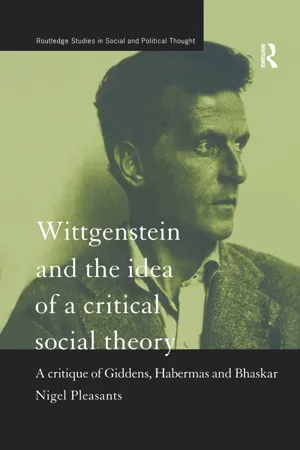
Wittgenstein and the Idea of a Critical Social Theory
A Critique of Giddens, Habermas and Bhaskar
- 211 pages
- English
- ePUB (mobile friendly)
- Available on iOS & Android
eBook - ePub
Wittgenstein and the Idea of a Critical Social Theory
A Critique of Giddens, Habermas and Bhaskar
About this book
This book uses the philosophy of Wittgenstein as a perspective from which to challenge the very idea of critical social theory, represented preeminently by Giddens, Habermas and Bhaskar. Renouncing the quest for an alternative Wittgensteinian theory of social and political life, the author shows that Wittgenstein nevertheless has considerable significance for critical thought and practice.
Information
Topic
Ciencias socialesSubtopic
Sociología1
WITTGENSTEIN AND CRITICAL SOCIAL THEORY
I Introduction
Ludwig Wittgenstein did not, in his main philosophical works, write about moral, political or cultural issues. However, his more ‘personal’ writings, post-humously collected in Culture and Value, show that he was in fact profoundly concerned with just these issues. It is entirely in keeping with his philosophy that such matters should not be addressed philosophically – which is not to say that he did not think that deliberation on them could not be improved by overcoming certain deeply entrenched confusions on what philosophy is and what it can be expected to do.
Wittgenstein’s philosophy, then, does not have any particular connection with social and political issues. Nevertheless, a number of social and political theorists have claimed to perceive, or sought to establish, a Wittgensteinian social/political theory (for example Winch [1958] 1990; Danford 1978; Rubinstein 1981; Bloor 1983; Easton 1983; Schatzki 1996). However, I have no wish to construct a new ‘Wittgensteinian critical social theory’. On the contrary, I regard the idea of a Wittgensteinian theory (of anything) as irreparably oxymoronic. But I am, like Wittgenstein, very much interested in social, political and cultural issues.
This book is written from the perspective of having attempted to learn from Wittgenstein’s critique of philosophy and, in the light of that critique, examining how contemporary ‘post-positivist/empiricist’ theorists set about constructing a critical theory of modern social and political life. I focus upon ‘critical social theory’, which amounts, if not to a new paradigm, to a substantial ‘new consensus’ at least, in social, political and sociological theory. Critical social theory, as I characterise it, is represented pre-eminently by Anthony Giddens, Jürgen Habermas and Roy Bhaskar – each one of whom has attempted to assimilate to their own theoretical perspective what they take to be Wittgenstein’s most important philosophical insights. Although there are of course considerable differences between each of these theorists, they manifest significant similarities and a common purpose. Part of my aim will be to identify and exhibit this common ground.
I find that critical social theory embodies very similar confusions to those that Wittgenstein identified in professional philosophical practice. I will endeavour to show how Wittgenstein’s critique of philosophy can be a valuable resource for revealing the incoherence and impotence of contemporary critical social theory. And I will argue that the central ‘Idea’ of critical social theory – that social and political criticism requires a foundational theory of individual and social ‘ontology’ – is a pseudo-scientific myth which they have erected upon the ruins of the old, now discredited, positivist conception of social science. Whilst my critique is directed at ‘critical social theory’ as a ‘new consensus’ in social and political theory, it will be prosecuted largely through detailed analyses and ‘deconstructions’1 of the central theoretical propositions of each of the aforementioned theorists.
In the remainder of this chapter I will outline my basic approach and attitude towards Wittgenstein’s philosophy and adumbrate the main features of critical social theory, as I understand it.
II Wittgenstein: against theory
It is not my intention to provide a wholly ‘new’ reading or interpretation of Wittgenstein; indeed, for reasons which Wittgenstein himself espoused, I believe that there can be no such thing as ‘a correct interpretation’ which somehow captures what Wittgenstein really meant.2 Rather, I want to propose that there are, broadly, two contrasting attitudes which can be assumed towards Wittgenstein’s later philosophy, especially that of the Philosophical Investigations. The two attitudes involve either: (a) treating Wittgenstein’s philosophy as a radically new method for providing a more accurate picture of certain phenomena (for example the nature of meaning, mental states, rule-following action, etc.) than traditional philosophical perspectives; or (b) accepting Wittgenstein’s (1968: §109) statement that ‘we may not advance any kind of theory.3 There must not be anything hypothetical in our considerations. We must do away with all explanation.’ In my view, these two attitudes are mutually exclusive – one cannot assert both that one should refrain from postulating explanatory theories and claim to be able to provide a more accurate picture of some phenomenon of interest.
Because of this conflict many theorists have chosen to ignore, or to deemphasise, Wittgenstein’s anti-theoretical stance. It is just this option that critical social theorists have taken – they have attempted to extract philosophical theses and ‘ontological’ insight from Wittgenstein’s philosophy whilst rejecting his anti-theoretical stance as a disposable anti-scientific prejudice. Nor is it only social theorists who adopt this attitude towards Wittgenstein’s philosophy; many, perhaps most, Wittgensteinian philosophers do so also, to varying degrees, though they rarely announce that this is what they are doing, and often seem to be unaware that they are doing it. My own approach to Wittgenstein’s philosophy, by contrast, is to take his anti-theoretical injunctions seriously. In consequence of this, my critique of critical social theory will not be based upon any allegedly superior ‘Wittgensteinian social theory’. I shall follow Wittgenstein in not claiming to be in possession of any special insight into (social and political) reality.
I referred above to two ‘attitudes’ towards Wittgenstein’s philosophy because I do not want to claim that either is an ‘interpretation’ as such. Rather, the attitudes are better characterised as dispositional or presuppositional orientations that constitute a framework within which interpretation takes place. Moreover, I do not think that Wittgenstein’s anti-theoretical recommendations can be justified argumentatively – at least not by conventionally accepted standards of philosophical argumentation. Any attempt to do so seems doomed to founder on self-referential paradox. Wittgenstein himself, anyway, did not attempt to argue for, or justify, his stance – as can be seen from the above quotation. His mode of expression utilises sweeping rhetorical flourishes; he once said (Wittgenstein 1970: 28), quite openly, that he was ‘making propaganda for one style of thinking as opposed to another’.
How could one set about proving that there cannot be a successful, informative or authentic philosophical theory? For a start, wouldn’t one have to specify precisely what one means by ‘theory’ – which activities do, and which do not, count as instances of ‘theory’? In other words one would need a theory of ‘theory’ – which would, of course, be self-defeating. Perhaps more to the point, one would have to claim to have a more accurate insight into the true nature of a phenomenon in order to be able to say why that phenomenon cannot be understood theoretically. In which case, one would be claiming to see, or know, more than any theory of that phenomenon could provide. But then wouldn’t that ‘seeing’ or ‘knowing’ just be a better kind of theory than that which one rejects? These problems will be explored more fully in the next chapter.
In spite of myself, I have already been speaking too generally. Although Wittgenstein summarily renounces ‘any kind of theory’, and advocates doing ‘away with all explanation’ (my emphases), he is, I contend, primarily concerned with a particular kind of theoretical explanation. In Philosophical Investigations he is preoccupied with what he calls ‘pictures’ of various phenomena.
Wittgenstein begins Philosophical Investigations with an account of ‘a particular picture of the essence of human language’ (Wittgenstein 1968: §1). This picture has exercised enormous influence on philosophers, from Plato to Wittgenstein himself in his early work; I will return to an analysis of it in the following chapter. A philosophical picture, in Wittgenstein’s sense, is a theoretical representation which has lost its representational status and has been reified into a peculiarly compelling portrayal of the essence of some phenomenon. Such pictures are really only metaphors, analogies, models and representations, but they are experienced as knowledge of the essence of reality-in-itself: ‘we predicate of the thing what lies in the method of representing it’ (ibid.: §104). The compulsion is psychological as well as intellectual. When transfixed by a philosophical picture of some phenomenon – such as, for example, the nature of ‘mind’, ‘consciousness’, ‘self’, ‘language’, etc. – we feel as though we can see directly (not just ‘theoretically’) how these things must be, inherently, in and of themselves.
Many of the ‘pictures’ which occupy Wittgenstein’s attention are not really pictures in the usual sense – they are reified representations of states of affairs which cannot really be pictured at all. Or, rather, what can be pictured is just an aspect, or part of the whole phenomenon, which somehow seems to stand for such complex phenomena as ‘language’, ‘mind’, ‘self’, etc. Hence his critique is directed towards metonymical as well as metaphorical pictures. For example, a physical fact, such as ‘the brain is located in the head’, can be pictured unproblematically. But phenomena to do with mind and consciousness, which are not physical (at least not in the way that the brain is), cannot be represented pictorially – though it often seems otherwise because we are confronted by ‘a picture which forces itself on us at every turn’ (ibid.: §425). In this case, ‘the brain’ serves metonymically as a picture of mind and consciousness.
One of Wittgenstein’s primary aims, in Philosophical Investigations, is to identify some of the most prominent, deeply entrenched, beguiling pictures which purport to reveal the real essence of ‘language’, ‘meaning’, ‘understanding’, etc.; ‘a picture held us captive. And we could not get outside it, for it lay in our language and language seemed to repeat it to us inexorably’ (ibid.: §115). Having identified and described these pictures, Wittgenstein goes on to show how insidiously misleading they are when it comes to thinking philosophically.
Our ‘ordinary language’ is, of course, heavily and unavoidably ‘pictorial’, metaphorical and metonymical. Wittgenstein does not suggest that there is anything wrong or unfortunate about this – on the contrary, ‘we are not striving after an ideal, as if our ordinary vague sentences had not yet got a quite unexceptionable sense, and a perfect language awaited construction by us’ (ibid.: §98). However, Wittgenstein believes that most professional philosophers are constitutionally committed to the use of reified, pictorial modes of representation – forms of thought that convey a spurious and deluded impression of quasi-scientific discovery and revelation. Such philosophers are self-deluded victims of ‘grammatical illusions’, and a ‘misunderstanding of the logic of language’ (ibid.: §§110, 93).
Wittgenstein’s identification and analysis of a range of deeply entrenched metaphysical pictures, which are rooted in a variety of philosophical discourses, can be seen as a kind of ideology-critique. Or, as Wittgenstein himself describes his method, it is a kind of philosophical therapy (see Bouveresse 1995; also chapter 2, section III). This therapeutic method is called for because of the peculiar ‘depth’ (Wittgenstein 1968: §111) of entrenchment and compelling force of so many of the dominant pictures in philosophical discourse.
Wittgenstein makes no attempt to replace the metaphysical pictures that he deconstructs with new, improved, Wittgensteinian ones. His admonitions on theory, explanation and generalisation prohibit him from any such course – though as I said before, many post-Wittgensteinian philosophers have failed to see or acknowledge this. I shall follow Wittgenstein, in that my critique of critical social theory neither proceeds from, nor results in, any allegedly superior theoretical picture of social and political life. I will elaborate upon Wittgenstein’s anti-theoretical stance at greater length and detail in the next chapter, but for now I proceed with a basic adumbration of the main features of critical social theory.
III Critical social theory: the new consensus
The so-called ‘founding fathers’ of modern sociology – Karl Marx, Max Weber and Emile Durkheim – produced a synthesis of various subjects, including philosophy, history, legal studies, anthropology, politics and economics. They can be, and often are, described as ‘social theorists’. However, the kind of social theory with which I am concerned in this book is a quite recent development; it is a type of social theory that I regard as markedly different from its classical predecessor (mostly for the worst, I believe, but that is not my concern here). Critical social theory can be located somewhere between the philosophy of social science and social science itself. Whereas the philosophy of social science deals with epistemological questions, such as the epistemic status of ‘law’, ‘truth’, ‘explanation’, ‘causation’, etc., the main activity of critical social theorists is the construction of theoretical representations of the structures, rules, mechanisms and powers which (so they claim) constitute society, individual action and subjectivity.
I have chosen to focus on Giddens, Habermas and Bhaskar as the foremost exemplars of critical social theory – but the latter term refers to a widely prevalent mode of social and political theory, not just to these three individuals. Critical social theory represents what I – alluding to Giddens’s (1984: xv–xx) account of the demise of the positivistic ‘orthodox consensus’ in social theory – call the ‘new consensus’. Critical social theory has reached such prominence that considerable theoretical work is devoted to its exegesis, elaboration and reconstruction. Some of this work has been critical, but very little, if any, has questioned – as I intend to do – the basic assumptions and presuppositions of the ‘Idea’ of a critical social theory.
Giddens’s (1984: xvi–xvii) definition of ‘social theory’ in the following quotation encapsulates what I mean by ‘critical social theory’:
I use the term ‘social theory’ to encompass issues that I hold to be the concern of all the social sciences. These issues are to do with the nature of human action and the acting self; with how interaction should be conceptualised and its relation to institutions; and with grasping the practical connotations of social analysis.
The purpose of my appellation ‘critical social theory’ – which is based on the theorists’ own self-descriptions – is to distinguish contemporary from classical social theory, and also to advert to the ‘new consensus’. The term ‘critical social theory’ is frequently deployed by Habermas, who uses it to differentiate his theoretical practice from that of Frankfurt School ‘Critical Theory’ (see chapter 8). Similarly, Bhaskar calls his philosophy of social science and his social theory ‘critical realism’. And although Giddens (1982a: 15) uses the more neutral-sounding term ‘social theory’, he nevertheless asserts that ‘social theory is inevitably critical theory’. Each of these theorists postulates an intimate relationship between critical theory and accurate theoretical depiction of individual subjectivity, action and social organisation.
As I said before, there are, of course, a number of important differences between these theorists, and they have occasionally criticised one another, but I want to focus on their similarities and common ground. Wittgenstein’s (1968: §66) notion of ‘family resemblances’ is an apt means of characterising the relationships of similarity and difference which pertain between Giddens, Habermas and Bhaskar. Wittgenstein suggests that, in the case of ‘family resemblance’ terms, there are a ‘network of similarities overlapping and criss-crossing’, and it is this which relates the range of different phenomena that are called by the same name – not one essence that they all possess (ibid., and see chapter 2, section IV). Applying this notion to critical social theory, it will be seen that, for example, the social ‘ontologies’ of Giddens and Bhaskar are much the same in key respects (see chapters 4 and 6), whereas Habermas’s is somewhat different, though similar in general orientation (see chapter 8). On the other hand, Giddens and Habermas place much greater stress on the constitutive role of language in psychological and social life than does Bhaskar. But then Bhaskar and Habermas are quite favourably disposed to historical materialism and the notion of evolutionary social change, whereas Giddens is outrightly hostile to these perspectives. I could go on in the same vein, but instead turn now to issues on which all three are in substantial agreement. The main features of critical social theory that ...
Table of contents
- Cover
- Half Title
- Title Page
- Copyright Page
- Table of Contents
- Acknowledgements
- 1 Wittgenstein and critical social theory
- 2 Does Wittgenstein mean what he says? The rejection of ‘theory’ and ‘explanation’
- 3 Winch, Wittgenstein and critical social theory
- 4 Wittgenstein’s rule-following remarks and critical social theory: deconstructing tacit knowledge and transcendental rules
- 5 Hayek’s and Giddens’s epistemological argument against socialism: a myth of symbolism?
- 6 ‘Free to act otherwise’? Questioning the reality of Bhaskar’s realist ontology
- 7 Milgram versus Garfinkel: are we cultural dopes or reflexive agents? A reflexive critique of ethnomethodology
- 8 Habermas and the idea of a critical social theory – a change of paradigm?
- 9 Conclusion
- Notes
- References
- Name index
- Subject index
Trusted by 375,005 students
Access to over 1.5 million titles for a fair monthly price.
Study more efficiently using our study tools.
Frequently asked questions
Yes, you can cancel anytime from the Subscription tab in your account settings on the Perlego website. Your subscription will stay active until the end of your current billing period. Learn how to cancel your subscription
No, books cannot be downloaded as external files, such as PDFs, for use outside of Perlego. However, you can download books within the Perlego app for offline reading on mobile or tablet. Learn how to download books offline
Perlego offers two plans: Essential and Complete
- Essential is ideal for learners and professionals who enjoy exploring a wide range of subjects. Access the Essential Library with 800,000+ trusted titles and best-sellers across business, personal growth, and the humanities. Includes unlimited reading time and Standard Read Aloud voice.
- Complete: Perfect for advanced learners and researchers needing full, unrestricted access. Unlock 1.5M+ books across hundreds of subjects, including academic and specialized titles. The Complete Plan also includes advanced features like Premium Read Aloud and Research Assistant.
We are an online textbook subscription service, where you can get access to an entire online library for less than the price of a single book per month. With over 1.5 million books across 990+ topics, we’ve got you covered! Learn about our mission
Look out for the read-aloud symbol on your next book to see if you can listen to it. The read-aloud tool reads text aloud for you, highlighting the text as it is being read. You can pause it, speed it up and slow it down. Learn more about Read Aloud
Yes! You can use the Perlego app on both iOS and Android devices to read anytime, anywhere — even offline. Perfect for commutes or when you’re on the go.
Please note we cannot support devices running on iOS 13 and Android 7 or earlier. Learn more about using the app
Please note we cannot support devices running on iOS 13 and Android 7 or earlier. Learn more about using the app
Yes, you can access Wittgenstein and the Idea of a Critical Social Theory by Nigel Pleasants in PDF and/or ePUB format, as well as other popular books in Ciencias sociales & Sociología. We have over 1.5 million books available in our catalogue for you to explore.