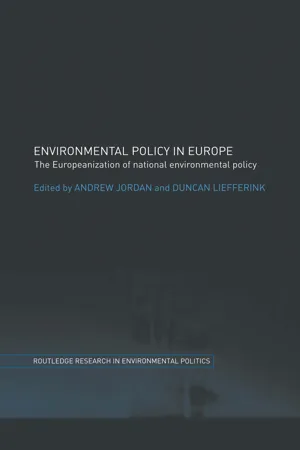
The continuing development of the European Union (EU) is transforming policy and politics in its member countries, and possibly in an even larger number of potential members. This book offers a detailed investigation of the Europeanization of national environmental policy in ten western European countries since 1970.By blending state-of-the-art theories with fresh empirical material on the many manifestations of Europeanization, it sheds new light on the dynamics that are decisively reshaping national environmental policy. It also offers an original assessment of how far Europeanization has produced greater policy convergence in western Europe.Throughout, the approach taken is genuinely comparative, drawing on the insights provided by leading country specialists.
- 272 pages
- English
- ePUB (mobile friendly)
- Available on iOS & Android
eBook - ePub
Environmental Policy in Europe
About this book
Trusted by 375,005 students
Access to over 1.5 million titles for a fair monthly price.
Study more efficiently using our study tools.
Information
1 The Europeanization of national environmental policy
Andrew Jordan and Duncan Liefferink
Introduction
The European Union (EU) affects domestic politics, policies and administrative structures. Even ten years ago, this statement might have generated controversy in some quarters. But today, it is almost axiomatic that the EU 'matters', some times hugely, in the daily political life of bureaucrats, parliamentarians, pressure group campaigners and members of the wider public. The recognition of this fact has helped to open up a new and important research frontier in European studies, which has been termed 'Europeanization' (Featherstone and Radaelli 2003a). The Europeanization 'turn' is exciting because it provides a fresh perspective on some very old debates within European studies, and also an extension of newer ones on topics such as policy transfer, multi-level governance and policy convergence. But Europeanization has also been recently described in more negative terms as a 'faddish' concept (Featherstone 2003: 1), and 'not so much a theory as a distinct set of processes in need of an explanation' (Featherstone and Radaelli 2003b: 333). Furthermore, Europeanization has also developed very rapidly into a somewhat 'disorqerly' (Olsen 2002: 922) field of research, in which there are no widely accepted definitions of key terms, let alone a grand explanatory 'theory'.
Part of the problem is that, while they are undoubtedly important, theoretical debates about the precise meaning and analysis of Europeanization have, in our view, run too far ahead of detailed empirical research. In this book we seek to offer a detailed comparative empirical test of some of the most important theo ries and models of Europeanization. In approaching this task we have opted to employ a relatively simple, top down view of Europeanization, which we define as the impact of the EU on its member states. Many member state characteris tics can, in theory, be Europeanized by the EU, such as party politics, public policy and administrative structures, through to less tangible features such as interest group representation, cognitive structures and belief patterns. For the sake of simplicity, we have elected to focus somewhat narrowly on national policy, which we have nonetheless defined broadly enough to capture several important features of national polity and politics. By 'policy' we mean the content of policies (the paradigms of action, the objectives and the policy instruments), the legal and administrative structures that have been established to oversee them, and the dominant style in which policy is made and implemented. Finally, we measure the extent of domestic change on a five-point scale ranging from nega tive change (i.e. retrenchment) through to significant national adaptation (i.e. transformation). We explain all these terms more fully below and in the next chapters.
This book has two main aims. First, we attempt to document the Europeanization of national policy since 1970 in ten European states, namely Austria, Finland, France, Germany, Ireland, the Netherlands, Norway, Spain, Sweden and the United Kingdom (UK). Given our wish to explore how far common policies adopted by the EU are refracted by national institutional forms, we have opted to focus on just one policy sector - the environment - rather than look at the Europeanization of many sectors in one single country. Interestingly, our sample of ten states includes a number of lesser known cases such as Finland, Norway, Austria and Spain, which lie outside the already heavily researched core of the EU. Crucially, because our sample includes states that joined at different times (i.e. in 1957, 1973, 1981 and 1995) and one (i.e. Norway) that is still not a full member, it should reveal the extent to which the length of membership has affected the overall pattern of Europeanization. Importantly, it should also help us to disentangle the EU's influence from other causes of change such as domestic drivers.
Unlike many existing Europeanization studies, which tend to track the impact of relatively small numbers of individual directives over relatively short time periods, we seek to explore the combined impact of the entire environmental acquis over a thirty-year time period (i.e. 1970-2000). Hopefully, this should reveal the full pattern of domestic changes, including those which are often held to take place very slowly if at all (namely those to policy style and administrative structures) Gordan 2003). Having set up the study in this way, an obvious ques tion to ask is which aspects of national policy have been the most significantly Europeanized - national structures, styles or policies? Has Europeanization proceeded faster and further in some sub-sectors (e.g. water) than others and what are the causal factors? Moreover, has Europeanization affected the relation ship between different national actors, both vertically (i.e. between levels of governance - European, national and sub-national) and horizontally (i.e. between environment and cognate policy sectors such as transport and energy). Finally, as ours is a political analysis of Europeanization, we will also seek to assess the overall pattern of losers and winners to emerge from the EU's effect on national policy systems. The existing literature, which is reviewed more exten sively in the next two chapters, claims that national parliaments, sub-national bodies and foreign ministries have been the prominent losers, whereas Europeanization appears to have empowered national sectoral departments and pressure groups. In this book we explore how far these trends are also discernible in the environmental sector.
The second aim of this book is to look across the ten countries and measure how far Europeanization is causing their national policies to converge. Simply put, are national policies moving towards a common, European model of gover nance, or do pre-existing differences (if, indeed, that was the dominant pattern) remain resolutely in place? In the very early literature, Europeanization was often uncritically elided with strong convergence, but now scholars are beginning to appreciate that it can generate many possible outcomes including conver gence, divergence and even persistence (i.e. neither convergence nor divergence). Page (2003: 163) distinguishes between Europeanization 'as an impact of what ever sort' and Europeanization 'as having a homogenizing impact... across a wide range of state activities'. This is a useful distinction because some elements of policy (e.g. style) could well be converging, while others (e.g. structure) may be remaining the same.Just to complicate matters still further, Europeanization may or may not be the main cause of any of these domestic changes.
At this point, it is important to explain why we consider the environment to be such a good policy area in which to pursue the two aims identified above. The first reason is that the environment is one of the EU's most well-developed areas of competence. Although a small selection of environmental measures were adopted prior to the 1972 Paris Summit, that meeting formally launched EU environmental policy. The thirty years that have elapsed since then give a suffi ciently long time-frame comprehensively to assess the extent to which Europeanization is implicated in any policy convergence which we observe across the countries. It would be more difficult to study the Europeanization of sectors in which the EU does not have such a long history of involvement, such as defence or foreign affairs.
Second, in contrast to the view of Moravcsik (1994), national policy was already relatively well developed in the late 1960s. This means we can construct a policy 'baseline' (see Chapter 3) for each of the ten countries (c. 1970) against which we can more systematically measure: (1) any subsequent EU induced effects (i.e. Europeanization); and (2) the development of national policy over time relative to other states (i.e. convergence-divergence). By using this approach, we should be able to test the often untested assumption that national environmental policies used to be dissimilar but have gradually become more similar. It would be much harder (though not impossible) to study Europeanization in sectors where there was no pre-existing policy to Europeanize (i.e. where it is difficult to identifY a baseline or where one is totally absent). Dyson and Goetz (2003) refer to these as 'policy voids'.
A huge amount of good empirical work has already been conducted on the implementation of EU environmental policy, much of it originally written by the chapter authors. The third and final reason for selecting the environment is therefore to use this substantial empirical base to assess popular models of Europeanization and convergence.
The remainder of this introductory chapter is structured as follows. The next section outlines the intellectual origins of the Europeanization 'turn' and briefly reviews the literature which has emerged around the interlinked concepts of Europeanization and policy convergence. Section three draws upon this review to offer five competing defmitions of the term 'Europeanization'. It reveals that the debate about Europeanization is extremely lively but not always systemati cally organized, with advocates offering a competing set of definitions, each with its own theory, epistemology and ontology. In section four we justifY our decision to adopt one of these definitions - 'Europeanization as a top down process of domestic change' - and explore its methodological and theoretical underpin nings in some detail. The fmal section introduces the remainder of the book.
The Europeanization 'turn' in the social sciences
In the 1990s the first generation of Europeanization research emerged in three separate but closely related streams of social science analysis. The first addressed the process of European integration at the European level. In the mid-1990s EU scholars began to shift away from looking at European integration as exclusively an EU-level activity, to analyse its 'rebound effect' on states. Mter all, one way to determine how far states control integration (an analytical puzzle that continues to stimulate much integration analysis) is to examine how far its diverse outcomes (i.e. Europeanization) reflect their initial preferences. Crucially, however, the new Europeanization literature treats European integration as an independent rather than a dependent variable, tracing its impact down through multiple levels of governance to the sub-state level.
The second stream analyses the implementation of individual EU policies. By the 1990s this field had progressed from being an essentially empirically driven exercise in assessing (top down) the implementation of EU directives, to devel oping broader hypotheses based on more detailed comparative work (Knill and Lenschow 2000). One particularly influential line of analysis argues that imple mentation problems arise when the EU asks states to do what they cannot, or do not want, to do. In other words, they emerge when EU requirements 'misfit' with national practices (Heritier et al. 1996; Knill 1998; Knill and Lenschow 1998; Boerzel 1999). The misfit concept is an integral part of more top down accounts of Europeanization (see below). Interestingly, it first arose in detailed empirical studies of the environmental sector.
The final stimulus has been the desire to catalogue and explain the European sources of domestic political, policy and administrative change. Today scholars of national political systems increasingly accept that domestic politics cannot be understood without some reference to EU politics. The full extent of the ED's impact is now being uncovered by more nationally framed studies inter alia of national administrative, parliamentary, policy and socio-cultural change.
Starting in the mid-1990s a second generation of Europeanization work began to synthesize and theorize the insights generated by the three streams of analysis identified above. Some of the frrst systematic Europeanization studies were actually completed by lawyers and influential research consultancy bodies in the late 1980s, but they were not centrally concerned with Europeanization per se. In fact, some of the authors involved (e.g. Haigh 1984; Siedentopf and Ziller 1988) might still resist attempts to label their work as Europeanization. In the 1990s the literature proliferated under the banner of Europeanization.
Studies were undertaken of single countries {Jordan 1998; Schmidt 1997; Liefferink 1996; Radaelli 1997; Aguilar Fermindez 1994), but more recent ana lyses compare two or more countries (e.g. Knill 2001; Boerzel 2002). Some analysts have compared the Europeanization of particular aspects of the nation state, such as sub-national government (Boerzel 2002), administrative structures (Page and Wouters 1995; Kassim 2003; Goetz 200la/b; Demmke and Unfried 2001; Bossaert et al. 2001), national parliaments (Maurer and Wessels 2001), and even national cultures (Risse 2001). Attempts are now being made system atically to compare the Europeanization of different sectors in one country (Dyson and Goetz 2003), or across different sectors within several countries (Featherstone and Radaelli 2003a), but at the time of writing there are still no published studies which, like ours, systematically compare the Europeanization of one sector across a selection of countries.
In spite of its enormous vitality, Europeanization research remains essentially 'ad hoc' in nature (Radaelli 2000: 19). Even a fairly cursory inspection of the corpus of existing work is sufficient to reveal the enormously different questions asked, methods used and theories invoked. The literature on convergence is simi larly fragmented. Much of it is to be found in the field of comparative politics, but even though it shares a surprisingly common research agenda with the field of Europeanization, the two have not been systematically linked in the way that we propose to offer in this volume. The convergence literature (which we review in Chapter 2) argues that some elements of national policy are converging, whereas others seem to be resilient to centripetal forces, thus producing a highly differentiated pattern- what Cowles et al. (2001: 1) refer to as 'domestic adapta tion with national colors'.
More recent Europeanization studies have begun to explore the links between Europeanization and convergence in an increasingly systematic fashion. Thus, national policy appears to be homogenizing in several important respects, whereas national structures appear to be fairly resilient (Bulmer and Burch 1998; Rometsch and Wessels 1996; Harmsen 1999; Kassim et al. 2000 and 2001; Dimitrakopolous 2001; Wessels et al. 2003: xv). However, these studies do not yet add up to a coherent or complete picture, because they do not employ the same analytical terms, or compare similar mixes of countries and/or sectors. By employing consistent definitions to construct policy baselines for the ten coun tries, we hope that this book will help to fill a gap in the research record by generating a set of comparable snapshots of national policy development over a thirty-year period.
What is 'Europeanization'?
Europeanization research has generated a bewilderingly large number of defini tions. Developing definitions is not simply a semantic exercise, because definitions dictate how social phenomena are conceived and ultimately studied empirically. P...
Table of contents
- Front Cover
- Enviromnental Policy in Europe
- Environmental Politics/Roudedge Research in Environmental Politics
- Title
- Copyright
- Dedication
- Contents
- List of illustrations
- List of contributors
- Foreword by Caroline Jackson (MEP), Chairman rif the European Parliament's Environment Committee
- Preface and acknowledgements
- Abbreviations and acronyms
- 1 The Europeanization of national enviromnental policy
- 2 Europeanization and policy convergence: a basis for comparative analysis
- 3 Measuring Europeanization and policy convergence: national baseline conditions
- 4 Austria: inducing a philosophy of 'no unnecessary efforts'
- 5 Finland: a realistic prapatist
- 6 France: getting between the vertical
- 7 Germany: from enviromnental leadership to partial mismatch
- 8 Ireland: the triwnph of policy style over substance
- 9 The Netherlands: the advantages of being 'Mr Average'
- 10 Norway: top down Europeanization by fax
- 11 Spain: old habits die hard
- 12 Sweden: reluctant but enviromnentaily ambitious
- 13 The United Kingdom: from policy 'taking' to policy 'shaping'
- 14 Europeanization and convergence: comparative conclusions
- Index
Frequently asked questions
Yes, you can cancel anytime from the Subscription tab in your account settings on the Perlego website. Your subscription will stay active until the end of your current billing period. Learn how to cancel your subscription
No, books cannot be downloaded as external files, such as PDFs, for use outside of Perlego. However, you can download books within the Perlego app for offline reading on mobile or tablet. Learn how to download books offline
Perlego offers two plans: Essential and Complete
- Essential is ideal for learners and professionals who enjoy exploring a wide range of subjects. Access the Essential Library with 800,000+ trusted titles and best-sellers across business, personal growth, and the humanities. Includes unlimited reading time and Standard Read Aloud voice.
- Complete: Perfect for advanced learners and researchers needing full, unrestricted access. Unlock 1.5M+ books across hundreds of subjects, including academic and specialized titles. The Complete Plan also includes advanced features like Premium Read Aloud and Research Assistant.
We are an online textbook subscription service, where you can get access to an entire online library for less than the price of a single book per month. With over 1.5 million books across 990+ topics, we’ve got you covered! Learn about our mission
Look out for the read-aloud symbol on your next book to see if you can listen to it. The read-aloud tool reads text aloud for you, highlighting the text as it is being read. You can pause it, speed it up and slow it down. Learn more about Read Aloud
Yes! You can use the Perlego app on both iOS and Android devices to read anytime, anywhere — even offline. Perfect for commutes or when you’re on the go.
Please note we cannot support devices running on iOS 13 and Android 7 or earlier. Learn more about using the app
Please note we cannot support devices running on iOS 13 and Android 7 or earlier. Learn more about using the app
Yes, you can access Environmental Policy in Europe by Andrew J. Jordan, Duncan Liefferink in PDF and/or ePUB format, as well as other popular books in Politics & International Relations & Comparative Politics. We have over 1.5 million books available in our catalogue for you to explore.