eBook - ePub
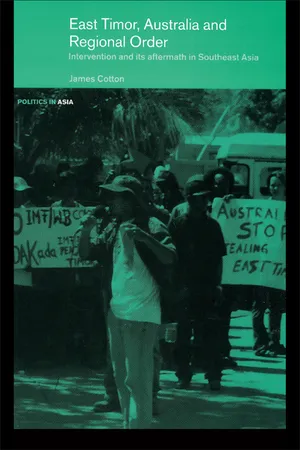
East Timor, Australia and Regional Order
Intervention and its Aftermath in Southeast Asia
- 208 pages
- English
- ePUB (mobile friendly)
- Available on iOS & Android
eBook - ePub
East Timor, Australia and Regional Order
Intervention and its Aftermath in Southeast Asia
About this book
This book explains the exceptional nature of the East Timor intervention of 1999, and deals with the background to the trusteeship role of the UN in building the new polity. All of these developments had an important impact on regional order, not least testing the ASEAN norm of 'non-interference'.Australian complicity in the Indonesian occupation o
1 East Timor and Australia
The 25-year policy legacy
The fact that the issue of East Timor dominated the foreign and security policy debates in Australia in 1999 is the point of departure for this account. The social and political crisis which gripped Indonesia following the economic meltdown in Asia was justifiably a topic of major concern and prompted preparations for security contingencies as well as programmes of economic and political support. Yet it seemed that almost as much attention was devoted to a territory of some 14,874 km2 with a population of around 800,000, a minor part (albeit unwillingly) of Indonesia since 1976. To understand why East Timor was the focus of such attention it is necessary to consider first the various Australian interests – and interested publics – that were involved.
Australian interests in East Timor
Although not a major issue in earlier times, economic interest in East Timor is as old as Australian federation. While it was far from a profitable business, the first oil concession sought by an Australian business dates from 1905 (Hastings 1999). In more recent times, seabed oil and gas reserves in the Timor Gap have proven sufficiently large to justify a programme of exploration and recovery. The bulk of the proven reserves are of gas, of which there is presently a global abundance, but longer term this will comprise a significant resource. Most of the fields are in the area of joint exploration as defined by the 1989 Timor Gap Treaty. With the change in its political status, new arrangements have had to be negotiated with independent East Timor.
Timor has been a concern to Australians for reasons of security for as long as it has been a subject of commercial interest. Rumours of Portuguese plans to abandon, or Japanese intentions to acquire, East Timor were recurrent in the decades before World War II. A small Australian expeditionary force was sent to pre-empt Japanese occupation in 1941, and a bloody guerilla campaign – in which many Timorese supporters of the Australians lost their lives – ensued. In 1975 – the year of communist victories in the Indochina states – a powerful factor conditioning some attitudes to the political forces emerging in East Timor was the conviction that they might seek to establish a communist-aligned regime, thus perhaps offering a foothold for a Russian or Chinese presence 500 kms from
Australia’s shores. From 1998, the spectre of a disunited or ‘Balkanized’ Indonesia has similarly haunted policy makers. An independent East Timor might open the way to other regions seeking a separate political identity. The resulting disorder might generate refugee flows as well as military uncertainty. In May 1995, a boat carrying 18 East Timorese asylum seekers arrived in Darwin, the first ‘boat people’ to arrive from the territory.
East Timor has also functioned as something of a test for the notion of regional engagement and especially the long-standing policy of seeking closer relations with Indonesia. A stronger identification of Australia with the region means little without a comprehensive accord with Indonesia, and to this end aid, investment, security and political ties have all been sought by successive Australian governments. An influential Indonesia lobby long argued in favour of a realist acceptance of the ‘New Order’ as the only basis for fruitful cooperation. And yet Jakarta’s policy in East Timor ran counter to so many of the fundamentals held by Australians regarding good governance and humanitarian values. The army was used as an instrument of rule, the human rights of those who contested Indonesian sovereignty were systematically violated, political and even cultural expression were constrained. Every crisis in the territory stirred debate on the desirability and morality of seeking systematic accord with such a regime. And the range of opinions expressed on the issue was exceedingly broad, with some alleging that critics of Indonesia were engaged in a ‘vendetta’, while others characterized Australian policy as nothing less than ‘Finlandization’ (Arndt 1979; Wheeldon 1984).
The question of East Timor, in the process, became a major item in domestic politics. Timor provided the substance for major differences that have been as much inter- as intra-party, differences which were as important in 1999 as they were in the 1970s. Even within the Labor Party, the Whitlam policy of 1975 was soon regarded as acquiescing in Indonesian occupation and was repudiated after a bitter internal debate, and from that time until the recognition by the Hawke government in 1985 of Indonesian sovereignty, differences between the party leadership and some members of the rank and file were pronounced. The Timor Gap Treaty, and the policy adopted towards East Timor refugees, who the Labor government insisted were citizens of Portugal and thus ineligible for refugee status, continued to keep the issue alive in the party. In opposition, Andrew Peacock was critical of Whitlam’s policy, though as foreign minister (from November 1975) he rapidly accommodated to the control of the territory by Indonesia at a time (in 1978) when strategies of forcible resettlement and resultant famine were being used in an attempt to break the resistance led by the pro-independence FRETILIN (Frente Revolucionária do Timor-Leste Independente: Revolutionary Front for an Independent East Timor) movement. In the 1998 elections the emphasis accorded to human rights issues in the Labor Party platform, and especially the statement in support of ‘self-determination’ for the East Timorese, moved the party again towards potential disputation with Indonesia as well as with its own record.
There is a sense in which Foreign Minister Alexander Downer’s energetic efforts to contribute to a settlement of the issue were in the ‘activist’ mould of his predecessor. This marked a continuation across administrations of differing party complexion of the strategy whereby Australia’s interests, especially in matters of regional concern, are furthered by devoting exceptional resources to issues neglected by others, or where the country possesses some special expertise. At the same time they were in marked contrast since, while Downer similarly acknowledged the vital importance of the relationship with Indonesia, his recognition of the legitimate aspirations for self-determination on the part of the people of East Timor were strongly at variance with many of the policies pursued by Gareth Evans when foreign minister in the Hawke and Keating Labor governments.
Australia’s concern with East Timor therefore also reflected unease and disquiet regarding past failures. From the first, Australian eye-witnesses and East Timor hands, including Jill Jolliffe, Roger East, Greg Shackleton, Michael Richardson and, most importantly, Jim Dunn, provided sophisticated and influential accounts of events in the territory (Dunn 1983; Jolliffe 1978). The presence of East Timorese refugees in the country served to remind Australians of those failures, just as it also focused attention on each new outrage by the Indonesian administration. The Balibo incident in 1975, and the widespread belief in the journalistic community that the Australian government knew almost immediately that Indonesian forces were directly involved in the deaths of the journalists there but withheld this information in the interests of better relations with Indonesia, undoubtedly encouraged interest in the Timor issue among the media.
In all, over a considerable period of time the Timor issue has been able to mobilize many interest groups and publics. For some in 1999, the focus was upon the security impact of the creation of a new and aid-dependent close neighbour, or upon the consequences that a new political status for East Timor would have for the regions of Indonesia as that country proceeded in its uncertain way to the reordering of its political system in the post-Suharto era. All of these matters are of the greatest importance for Australia, and the choice of policy to deal with them and their implications has been a major national priority. But for others, the Timor debate was not so much about the future but about the past. Its focus was on the record of successive governments in their handling of the Timor issue, but especially on the role then Prime Minister Gough Whitlam played – or did not play – in the events which led to the occupation of East Timor by Indonesian forces in December 1975. It was also, to that extent, focused not primarily upon Timor but upon Australia, and thus on the success and failure of leaderships and political institutions.
Debating Australia’s past role
While the remarks of President Habibie in June 1998 that Indonesia was considering granting special status to East Timor, and the pro-independence demonstrations that ensued in the territory itself, stimulated this second debate about the past, it had proceeded almost from the time of Indonesian annexation. Like a water course that slows to a trickle but never quite disappears beneath the sands, the debate was kept alive through the 1980s by internal Labor Party
disputation, the public reaction to the Timor Gap Treaty of 1989, the Santa Cruz Cemetery massacre of 1991, and the new testimony that appeared in 1999 on the fate of the five Australian-based newsmen killed in Balibo in October 1975. Internal party dynamics played their part. It received perhaps its greatest impetus from the statement of the Labor foreign affairs spokesman of the time, Laurie Brereton, who reflecting upon his party’s record on the Timor issue, had the following judgement to offer:
it is a matter of enduring regret that Whitlam did not speak more forcefully and clearly in support of an internationally supervised act of self-determination as the only real means of achieving a lasting and acceptable resolution of East Timor’s status. At best Whitlam’s approach was dangerously ambiguous, and by mid 1975 increasingly unsustainable. (Brereton 1999: 6)
Whitlam’s response was an acerbic attack on an individual he described as ‘a shallow, shabby, shonky foreign affairs spokesman’ (Shanahan 1999). Whitlam maintained he had always been emphatic that, in one form or another, an act of self-determination would have to be effected in the territory. At the same time, documents appeared in the public domain providing further details of Whitlam’s diplomatic dealings with Suharto, most notably a letter written to the president in February 1975, and the record of the Whitlam–Suharto exchange in Yogyakarta in September 1974 (Shanahan 1999; Whitlam Documents, Sydney Morning Herald 1999). Both were extensively analyzed, though this historical chapter is by no means closed.
To some degree, there is room for differences of opinion on the pragmatics of these exchanges. When, for example, Whitlam says in February 1975 that ‘no Australian Government could allow it to be thought . . . that it supported’ Indonesian ‘military action against Portuguese Timor’, it could be alleged that this referred to the appearance of the matter as opposed to its reality, which could be different, an issue which has moved many Australian columnists to comment (Sheridan 1999: 17; McDonald 1999; Juddery 1999: 9). This interpretation is supported when the likely extent of Whitlam’s knowledge of Indonesia’s campaign to orchestrate integration is taken into account. But setting these matters aside at this stage, what is readily apparent in these and the other records like them is that Whitlam’s preferences were clearly stated and evidently grounded in principles of national policy he regarded as important and which he believed or hoped would be understood by his interlocutors (Viviani 1997: 99–109).
Whitlam made it clear that he believed the best course for Timor after Portuguese control was relinquished was to become part of Indonesia. At the same time he held that the future of Timor should be a matter for the people themselves to decide through an act of self-determination. The principles in question were, respectively, the recognition of Indonesia’s national aspirations and claims in a manner consistent with a post-colonial approach to regional policy on the part of Australia, and an affirmation of the importance of self-determination. Both of these principles were advanced because they were desirable as general rules. Self-determination accorded with the egalitarian inheritance of the Labor Party as well as comprising one of those yardsticks which External Affairs Minister Dr H. V. Evatt had sought to apply in the 1940s to the workings of the United Nations, thereby defending the role of smaller countries and populations against the claims of the major powers (Lee 1997: 48–61). But self-determination was a difficult principle to apply in a territory so poorly prepared for independence. Moreover, Whitlam’s critical if not disparaging remarks on the predominant role of mestiço political leaders in East Timor suggested that he believed that an act of self-determination would hardly lead to a result that truly reflected the opinions of the majority.
Anti-colonialism, on the other hand, provided a much clearer standard for Australian policy. Indonesia was a state formed after a long and bitter struggle against colonialism during which Australia (under a Labor government) played a positive role in pressuring the Netherlands to relinquish its claims. Indonesia was an important actor in the non-aligned world, and whatever shape the Southeast Asian region would assume in the future would depend significantly upon choices made in Jakarta. Friendship with Indonesia – however favourable to Australia’s material interests – was therefore also an affirmation of Australia’s determination to support a post-colonial regional order. Moreover it was Whitlam’s personal assessment, an assessment he repeated in his statement on the UDT (União Democrática de Timor: Timorese Democratic Union) coup of 11 August 1975, that East Timor was ‘in many ways part of the Indonesian world’ (Parliament of the Commonwealth of Australia, Debates, House of Representatives 1975: 493). Though this assessment had some historical basis, what was of greater significance was that it was held by an individual with a keen historical sense who was inclined to pay especial attention to historical claims.
Lest this position not appear as one of principle, it should be seen in the context of the contemporary alternative. For a long period the Australian government supported the presence of the Netherlands in Irian Jaya because it was considered that this was of strategic advantage to Australia. The claims of the inhabitants for self-determination were not stressed, and Indonesia’s assertion that it represented the decolonized successor state to all the territories of the Netherlands East Indies was rejected (Verrier 1976). Whitlam criticized this view as a perpetuation of a colonial arrangement, and supported the acquisition of Irian Jaya by Indonesia. He seems to have seen East Timor in the same light. As early as 1963 he referred to Portuguese East Timor as ‘an anachronism’ and warned that ‘we would not have a worthy supporter in the world if we backed the Portuguese’ (Whitlam 1963: 13).
In 1974, both of these preferences could be stated without any apparent contradiction between them. With the emergence of indigenous political movements in the territory, and especially the rise of FRETILIN, along with a hardening of Indonesian resolve to influence the outcome in East Timor, a choice presented itself. Sufficient material was available in 1999 to show that the government was very well informed on Indonesian military operations inside Indonesia. Material from the highly classified US National Intelligence Daily, the sources of which were conveyed to Australia under the UK/USA intelligence sharing agreement (and which indeed depended in part on Australian intelligence assets) showed that by the end of August 1975 Indonesian determination to invade East Timor was clear, and all that was wanting was an appropriate pretext (Toohey and Wilkinson 1987: 146–54). Knowing that an Indonesian campaign of de-stabilization was underway, and that an attempt to assess East Timorese opinion on the issue of integration with Indonesia would be unlikely to produce a positive result, the principle of self-determination was abandoned. These issues are discussed in greater detail in the following chapter, especially in relation to foreign affairs documents de-classified in 2000.
There were differences between Whitlam, Foreign Minister Willesee and Ambassador Woolcott on the equanimity with which these developments should be received; there was also the fact that with regard to this aspect of national policy, if not others, the prime minister was determined to have his head. But the drift of policy was clear enough. It must nevertheless have come as a great surprise to the Indonesian leadership that the deaths of the journalists at Balibo in October 1975 did not elicit a stronger reaction (Sherman 1999: 95–7). Although the surviving documentation now available does not, apparently, support their recollections, two of the former intelligence officers interviewed by Tom Sherman in 1998 stated that intelligence sources had reported the arrival of the journalists in Balibo, their subsequent capture, and within ‘a day and a half’ the fact that they were ‘executed’ (Sherman 1999: 95–7). By this stage, however, Australia was immired in a domestic political crisis so grave as to unseat the government in the following month.
In the framing of policy towards Indonesia, Richard Woolcott, who became Australian ambassador in March 1975, played a major role. Woolcott penned Whitlam’s first remarks, after he had won the 1972 election, on the subject of the intended reform of foreign policy (Freudenberg 1993: 201), and his advice from Jakarta was a powerful influence upon the prime minister’s policy. Woolcott’s views, as he unashamedly admitted, were based upon a pragmatic or realist approach to international affairs. By August 1975, if not before, he had formed the view that ‘it is Indonesia’s policy to incorporate Timor’, a point he repeated in many of his cables to Canberra. That being so, he advocated a policy of ‘disengagement’ and allowing ‘events to take their course’. And this would have a payoff, as he noted, in the form of presenting an opportunity then to negotiate Australia’s territorial claims to the seabed resources of the Timor Sea. The closing thus of the ‘Timor Gap’ could be expected to reap a reward in the form of energy supplies. The basis of the policy advice he was offering was therefore clear. As he candidly admits: ‘I know I am recommending a pragmatic rather than a principled stand but that is what national interest and foreign policy is all about’ (Walsh and Munster 1980: 200, 197, 217). So strongly held was Woolcott’s view that nothing should be done to deter the Indonesian invasion since this would provoke a rift with Jakarta that, when transmitting to the Indonesian government the Ministerial Statement to the Senate by Willesee on 30 October 1975 (on the eve of the Indonesian landing at Dili) which referred to ‘widespread reports that Indonesia is involved in military intervention in Portuguese Timor’, he deleted this passage (Willesee 1999: 15; Parliament of the Commonwealth of Australia, Debates, House of Representatives 1975: 1609–10).
In the diplomacy of states it is rare for realism and idealism to be mutually supportive. But in this instance, the advice that Woolcott was proffering on pragmatic grounds and the principles which caused Whitlam to prefer the outcome of an Indonesian East Timor happened to coincide.
If Australia was never in a position to assert a claim to be a ‘party principal’ in the resolution of the Timor issue, why did self-determination loom so large in Australian diplomacy? This raises the question of the assumptions that Whitlam brought to the discussion with Suharto of the question of ‘self-determination’ for East Timor. Here, perhaps, Whitlam’s chosen principle was seriously at odds with the realities of power in Jakarta. It should be recalled that Indonesia’s own record on self-determination was not impressive. Australian forces were committed to the defence of the Borneo states of Malaysia in 1964 as a result of Indonesia’s rejection of the consultative processes of the Cobbold Commission which had been used to determine that the inhabitants of Sabah and Sarawak wished to join the federation. As well as the direct infiltration of Indonesian forces into Sarawak, Jakarta, in an operation masterminded by the military, also used money and other inducements to create a fifth column, the task of which was to de-stabilize the political order. The fall of Sukarno led to an improvement in Indonesia’s relations with its Southeast Asian neighbours and the end of ‘confrontation’ with Malaysia, but the realization of another of Sukarno’s projects, the incorporation of Irian Jaya through an extremely dubious ‘Act of Free Choice’ conducted in 1969, demonstrated that his successor was committed to many of the same methods and ins...
Table of contents
- Cover Page
- Title Page
- Copyright Page
- Acknowledgements
- Acronyms
- Introduction
- 1 East Timor and Australia
- 2 Australian relations with Indonesia and the East Timor issue
- 3 The failure of Indonesian policy
- 4 The East Timor intervention, humanitarian norms and regional order
- 5 Australia’s East Timor commitment
- 6 Australia’s East Timor
- 7 Outcomes
- 8 Conclusion
- References
Trusted by 375,005 students
Access to over 1.5 million titles for a fair monthly price.
Study more efficiently using our study tools.
Frequently asked questions
Yes, you can cancel anytime from the Subscription tab in your account settings on the Perlego website. Your subscription will stay active until the end of your current billing period. Learn how to cancel your subscription
No, books cannot be downloaded as external files, such as PDFs, for use outside of Perlego. However, you can download books within the Perlego app for offline reading on mobile or tablet. Learn how to download books offline
Perlego offers two plans: Essential and Complete
- Essential is ideal for learners and professionals who enjoy exploring a wide range of subjects. Access the Essential Library with 800,000+ trusted titles and best-sellers across business, personal growth, and the humanities. Includes unlimited reading time and Standard Read Aloud voice.
- Complete: Perfect for advanced learners and researchers needing full, unrestricted access. Unlock 1.5M+ books across hundreds of subjects, including academic and specialized titles. The Complete Plan also includes advanced features like Premium Read Aloud and Research Assistant.
We are an online textbook subscription service, where you can get access to an entire online library for less than the price of a single book per month. With over 1.5 million books across 990+ topics, we’ve got you covered! Learn about our mission
Look out for the read-aloud symbol on your next book to see if you can listen to it. The read-aloud tool reads text aloud for you, highlighting the text as it is being read. You can pause it, speed it up and slow it down. Learn more about Read Aloud
Yes! You can use the Perlego app on both iOS and Android devices to read anytime, anywhere — even offline. Perfect for commutes or when you’re on the go.
Please note we cannot support devices running on iOS 13 and Android 7 or earlier. Learn more about using the app
Please note we cannot support devices running on iOS 13 and Android 7 or earlier. Learn more about using the app
Yes, you can access East Timor, Australia and Regional Order by James Cotton,James S Cotton in PDF and/or ePUB format, as well as other popular books in History & Asian History. We have over 1.5 million books available in our catalogue for you to explore.