- 208 pages
- English
- ePUB (mobile friendly)
- Available on iOS & Android
eBook - ePub
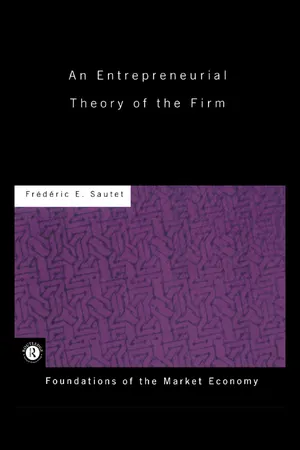
An Entrepreneurial Theory of the Firm
About this book
This original, provocative work makes a thorough and comprehensive enquiry into the relationship that exists between firms and markets, with separate, in-depth examinations of both the existence and inner organisation of the firm. Sautet develops an accomplished and convincing theory that encompasses a wealth of existing literature and leads it in
1: THE ECONOMICS OF THE FIRM, THE MARKET THEORY PROBLEM AND TRANSACTION COST ECONOMICS
Economists usually ascribe the order which competition produces as an equilibrium—a somewhat unfortunate term, because such an equilibrium presupposes that the facts have already all been discovered and competition therefore has ceased.
Friedrich A.Hayek (1978:184)
Presumably it is the existence of a considerable measure of order and stability in the real economic world around us that engenders faith that equilibrium can in fact be realized, but here it is most important to remember that the conditions of the real world are not those of perfect competition and that, if they were, it might no longer be possible for this order to be produced.
George B.Richardson (1990 [I960]:12)
INTRODUCTION
The realm of economic theory is to explain what can be observed as the result of human actions in the market system. More specifically, there is an aspect of reality that has to be explained by economists: the existence of long term hierarchical contracting relations, commonly called firms. Although there are many aspects of reality, other than firms, which require economic explanations, explaining why human activities take place within firms rather than directly in the marketplace is a question that economics cannot avoid.
There are four basic explanations of the existence of the firm in the marketplace. The purpose of this chapter is briefly to present these rationales and to assess those that are relevant to my entrepreneurial theory of the firm. This will allow me to use the relevant approaches as a foil, or a contrast, with my own view of the problem.
THE FOUR RATIONALES OF THE FIRM
Understanding the different approaches to the firm, and their similarities and differences is complex. However, four main categories of the different approaches to the firm can be found in the literature (Alchian and Woodward 1988; Holmström and Tirole 1989).
- A first approach is a technological explanation. Firms exist because certain definite production processes cannot be separated, they have to be performed together. The rationale of the firm is that it makes sense to bind the individuals who perform these operations together.
- A second approach is to deny (more or less) that firms have a distinct nature. Firms and markets can be viewed as having the same nature. There is no basic difference between the power of customers to stop patronizing a store and the power of an employer to fire his or her employees. The same types of actions are available to both and it is a delusion to think that there is a fundamental difference of nature between the two. Firms are just a certain kind of market contract (Cheung 1983).
- A third view is to explain that there are costs associated with the use of the price mechanism and therefore it is sometimes efficient to avoid the direct use of the market system and to isolate certain relationships within a firm (Coase 1993a [1937]). The transaction costs view has been developed in two related directions (Alchian and Woodward 1988:66; Langlois and Robertson 1995:27): the measurement-cost approach on the one hand, and the asset-specificity approach on the other. The first direction emphasizes issues surrounding administering, directing, negotiating and monitoring the performances of teams (Alchian and Demsetz 1972). The second direction emphasizes (post-)contractual agreements issues: moral hazard, holdup, bounded rationality and opportunism (Williamson 1985).
- A fourth approach revolves around the notion of rent and evolutionary theory. It says that the source of the firm is to be found in the existence of potential rents that can be created by a team of individuals working together. In order to capture these rents, one must establish a firm, that is to say a long-term bidding relationship among the members of the team which will be governed by some kind of hierarchy. Rents can also be related to capabilities or capacities, which are, in a way, the most precious assets a firm may possess (Penrose 1995 [1959]). This body of theory is also intertwined with evolutionary (Foss 1997b) and knowledge-based views of the firm. These theories rest on a series of assumptions describing the behavior of individuals (or groups of individuals) in relation to their environment. It is assumed that there is an environmental mechanism that interacts with individuals’ past behavior and internal properties. An evolutionary approach is meaningful as it emphasizes individuals’ imperfect understanding of the environment and the adaptation of group members to local circumstances (“routines” and “capabilities”, for instance, are biological analogies). Thus, even if an optimization approach is convenient in some cases, understanding agents as problem solvers that can adapt to circumstances is more fruitful. This fourth approach argues that firms emerge because they are the locus of accumulation of specialized and idiosyncratic resources. Thus, accumulation of resources occurs independently of contractual considerations, these theories therefore stand out in contrast to the “contractual approach” (the third view).
Following Williamson (1975, 1985) one can argue that the first view of the firm is not really part of economics, even if it has some influence on economic issues. At most, the first view can explain the existence of production plants, but not why these technical processes must take place within the same firm, instead of in the marketplace. It also cannot explain why unrelated or remotely related technical processes can be found within the same firm. As a consequence, I will not deal with the technological approach in the following pages.
The second approach, which denies a specific nature to the firm, provides little value in the development of an economics of the firm. In this work, I will follow a Coasean approach in the sense that the firm will be seen as an island of planning in which individuals are end-related, rather than means-related as in the marketplace (Hayek 1976). That is to say, the firm can be said to have a goal (or many goals) given by its chief officer (the one who chooses), whereas the marketplace, in and of itself, has no specific goal. I reject the view that claims there is no economic problem of the firm (firms are just special cases of more general instances, markets).
The third and the fourth views are relevant to my quest to develop an entrepreneurial theory of the firm. They are valid rationales of the firm and therefore will be the focus of study of this first chapter (although I will not study the transaction costs approach as two separate lines of thought, but as a single body). However, as I show below, these approaches are limited. Thus, the goal of my analysis is to enrich and complete these views, which do not describe the reality of the living economy as they cannot account for the emergence of the firm in an entirely satisfying manner. This is why I find a market theory problem (henceforth MTP) in the modern literature on the firm.
THE MARKET THEORY PROBLEM
In order to present my view of the MTP, I first need to introduce an analysis of the ways in which the concept of equilibrium is (or has been) used in economics. We will then see the different characteristics of the MTP and how these characteristics apply to transaction cost economics and resource-based theory.
The use of the equilibrium concept in modern economics
Following Kirzner (1973), Fink and Cowen (1985), Cowan and Rizzo (1996), Boettke (1997a, 1997b) and Machovec (1995), I would like to show that what I call the market theory problem can be seen, to a certain extent, as part of a bigger problem of contemporary modern economics: the misuse of equilibrium analysis in the understanding of the competitive process. Until the 1930s, the perfect competition model was used as a method of contrast to enlighten the positive role of institutions in the market economy (Boettke 1997b). That is the way Ludwig von Mises (1966:236–50) thinks economists should proceed, for the only way to understand the complexity of a changing world is by isolating the change under study and keeping the rest of the world constant (in a mental experiment1). The formalist revolution that took place from the 1940s onward witnessed the emergence of new uses of the concept of equilibrium. As well as an ideal type, the concept of equilibrium came to be used as a description of reality (descriptive use) and as a critical standard (indictment) (Boettke 1997b:22–3).
In the ideal-type2 version, equilibrium is used as a foil, i.e. a method of contrast (Boettke 1997b), which has no other purpose than allowing the economist to think in a simple and clear way—by abstracting from change and by introducing a specific factor conducive of change. This is the argumentum a contrario (Mises 1966:250)3. In this approach, “equilibrium is a postulate that is not necessarily effected in the real world” (Boettke 1997b: 44). This approach is entirely realistic in the sense that economists do not use assumptions as instruments in order to predict certain results, they try to isolate change in order to understand the complexity of the economy.
The use of equilibrium as a description of reality was demonstrated by the Chicago school in the 1950s and 1960s, which, under the influence of George Stigler and Milton Friedman, came to understand equilibrium in a different and more subtle way.
- Equilibrium can be used as a description of reality. Models of competition are not simply used in mental experiments, they are supposed to represent an accurate description of what the world is. As Melvin Reder explains in his discussion of the notion of tight prior equilibrium: “in applied work, adherents of [tight prior equilibrium] have a strong tendency to assume that, in the absence of sufficient evidence to the contrary, one may treat observed prices and quantities as good approximations to their long-run competitive equilibrium values. Call this the ‘good approximation assumption’” (Reder, 1982:12). In this view, real-world markets, as Boettke puts it, “act as if they were in competitive equilibrium” (Boettke 1997b: 23). The assumption is that markets are always in equilibrium, for if we include the relevant costs in the analysis, an efficient-always situation obtains. Economic problems are therein perceived in terms of costs and benefits, and the goal of economics is to understand the relevant costs without committing the fallacy of comparing an ideal state with incomplete observations about the world.
- This use of equilibrium as a description of the world was completed by the use of equilibrium as an instrumental approach aimed at predictions. As Reder puts it: “Hard use of the good approximation assumption is a hallmark of Chicago applied research; but the assumption is not tested directly. Instead of investigating the descriptive accuracy of this assumption, or the precise extent of the resources misallocation caused by its failure to hold exactly the Chicago style is to treat it as a maintained hypothesis [i.e. not tested] and apply it, using the resulting research findings as a test of [tight prior equilibrium]” (Reder 1982:12–13). As Friedman (1953) explains in Essays in Positive Economics, the use of equilibrium becomes purely instrumental, for it is aimed at explaining—predicting—the effects of certain changes in the economy. This approach does not need to have assumptions that conform to reality, for even if the assumptions are totally unrealistic, the goal is to be able to predict. Just like in the description of reality approach, the instrumental use of equilibrium sees markets in equilibrium always4. The economy is perceived as an ontologically-closed universe in which every economic aspect of human life can be seen as the result of rational choice under constraints, if the relevant costs are included5.
The various types of Keynesian schools of thought have come to use the equilibrium concept as an indictment, i.e. a standard for criticizing reality (Boettke 1997b). This version of equilibrium does not make room for adjustment processes but still maintains that what the models describe can be attained through deliberate state intervention. In this view, the model is seen as a benchmark against which the real world must be assessed. Indeed, there are imperfections in reality and the role of models is to highlight them so that they can be corrected. “The desire [in the 1930s] to build a new science dedicated to evaluating comparative positions of static general equilibrium,” writes Machovec, “led neoclassical economists to adopt the perfectly competitive endstate as a normative ‘benchmark’” (Machovec 1995:159). The modern versions of the indictment approach also see the economy as an ontologically-closed universe in which every economic aspect of human life can be seen as the result of rational choice under constraints. Grossman and Stiglitz’s paradox is a good example. Assessing the work of Hayek, they contend that if prices are sufficient statistics (as they think Hayek says), nobody will have the incentive to produce information that could be obtained for free, just by looking at prices. As a result, a “noisy” equilibrium will arise where prices do not convey all the available information6.
According to Boettke (1997b), modern economics has sacrificed the heuristic value of equilibrium analysis on the altar of formalism. As a result, most modern economic theory navigates between, on the one hand, an equilibrium-always world in which adjustment processes are assumed away, and, on the other hand, a market-failure approach which contends that departures from equilibrium are not only possible but also definitive7.
What is the Market Theory Problem?
The MTP is the inconsistency involved in trying to answer questions that would not exist in an equilibrium-always world. This implies that the MTP exists in theories that use the equilibrium concept as a benchmark (i.e. as an indictment), as a description of reality or as an instrument (as in the positivist approach of the Chicago school). The MTP is therefore characterized by the absence of the fundamental attributes present in the modern Austrian theory of the market process (which uses the equilibrium concept as a foil). This is important, for the MTP occurs when the analysis tries to cope with the problems tackled by the Austrian approach, without using its necessary attributes. As a method of contrast, I identify below a series of concepts that represent the core of the Austrian market theory and show that their absence represents the distinguishing marks of the MTP.
Uncertainty
As we saw above, the Chicago use of the equilibrium concept entails the notion of an equilibrium-always world. This view replaced the old notion of competition around the period of the Second World War, thereby replacing Marshallian economics and the classical notion of competition as a rivalrous process (Machovec 1995). The economy is seen as being in a state of permanent equilibrium provided that the relevant costs are included in the analysis. An equilibrium-always theory entails a closed view of the universe. In such a system, there is no room for genuine uncertainty.
A usual reference for the definition of uncertainty is Kenneth Arrow’s work.
Uncertainty means that we do not have a complete description of the world which we fully believe to be true. Instead, we consider the world to be in one or another of a range of states. Each state of the world is a description that is complete for all relevant purposes. Our uncertainty consists in not knowing which state is the true one.
Arrow (1974:33)
However, a definition of uncertainty where there is only uncertainty over which state of the world is true does not help us understand the economic problem8.
Austrian economists understand genuine uncertainty as Knight saw it. Knightian uncertainty means that genuine changes can take place within the system under study. These changes are not determined by the state of the system at any moment and cannot be assigned (objective or subjective) probabilities. Therefore, they cannot be modeled and are beyond the realm of prediction: the universe is open-ended9. An open-ended view of the universe entails that new knowledge can come into existence within the system, for sheer ignorance and genuine error are possible10. As Brian Loasby (1976), quoting Karl Popper, shows, the notions of objective and subjective probabilities are in themselves quite controversial11. He also argues that economists, when they deal with uncertainty, generally do not understand it the way the layman does. As Loasby puts it: “When someone says that he is uncertain, what he usually means is not just that he doesn’t know the chances of various outcomes [subjective probability], but that he doesn’t know what outcomes are possible [Knightian uncertainty]” (Loasby 1976:9).
For Mises, the “uncertainty of the future is already implied in the very notion of action. That man acts and that the future is uncertain are by no means two independent matters, they are only two different modes of establishing one thing” (Mises 1966:105). Moreover, “entrepreneur means acting man in regard to the changes occurring in the data of the market” (Mises 1966:255). Following Kirzner, we recognize the tendency for individuals to come to notice that which is in their interest to notice, and this tendency resides in their entrepreneurial alertness (which can also be interpreted as individuals’ capacity to imagine the future). “Alertness must, importantly, embrace the awareness of the ways the human agent can, by imaginative, bold leaps of faith, and determination, in fact create the future for which his present acts are designed” (Kirzner 1985a: 56).
In the market, the incentive for entrepreneurial activity is largely provided by the existence of pure profit opportunities. These opportunities, in fact, correspond to gains obtained from acting in accordance with the realized future. An individual’s alertness is switched on by the prospect of pure profit and that enables him/ her to find his/her way in an uncertain world. With alertness, individuals can pierce the fog of Knightian uncertainty and discover opportunities fo...
Table of contents
- COVER PAGE
- FOUNDATIONS OF THE MARKET ECONOMY
- TITLE PAGE
- COPYRIGHT PAGE
- FIGURES
- FOREWORD
- ACKNOWLEDGMENTS
- GENERAL INTRODUCTION
- 1: THE ECONOMICS OF THE FIRM, THE MARKET THEORY PROBLEM AND TRANSACTION COST ECONOMICS
- 2: THE LACHMANNIAN PROBLEM, THE PROMOTER AND THE EMERGENCE OF THE FIRM
- 3: CAPABILITIES, ENTREPRENEURSHIP, CENTRAL PLANNING AND THE GROWTH OF THE FIRM
- GENERAL CONCLUSION
- NOTES
- BIBLIOGRAPHY
Trusted by 375,005 students
Access to over 1.5 million titles for a fair monthly price.
Study more efficiently using our study tools.
Frequently asked questions
Yes, you can cancel anytime from the Subscription tab in your account settings on the Perlego website. Your subscription will stay active until the end of your current billing period. Learn how to cancel your subscription
No, books cannot be downloaded as external files, such as PDFs, for use outside of Perlego. However, you can download books within the Perlego app for offline reading on mobile or tablet. Learn how to download books offline
Perlego offers two plans: Essential and Complete
- Essential is ideal for learners and professionals who enjoy exploring a wide range of subjects. Access the Essential Library with 800,000+ trusted titles and best-sellers across business, personal growth, and the humanities. Includes unlimited reading time and Standard Read Aloud voice.
- Complete: Perfect for advanced learners and researchers needing full, unrestricted access. Unlock 1.5M+ books across hundreds of subjects, including academic and specialized titles. The Complete Plan also includes advanced features like Premium Read Aloud and Research Assistant.
We are an online textbook subscription service, where you can get access to an entire online library for less than the price of a single book per month. With over 1.5 million books across 990+ topics, we’ve got you covered! Learn about our mission
Look out for the read-aloud symbol on your next book to see if you can listen to it. The read-aloud tool reads text aloud for you, highlighting the text as it is being read. You can pause it, speed it up and slow it down. Learn more about Read Aloud
Yes! You can use the Perlego app on both iOS and Android devices to read anytime, anywhere — even offline. Perfect for commutes or when you’re on the go.
Please note we cannot support devices running on iOS 13 and Android 7 or earlier. Learn more about using the app
Please note we cannot support devices running on iOS 13 and Android 7 or earlier. Learn more about using the app
Yes, you can access An Entrepreneurial Theory of the Firm by Frédéric Sautet,Frederic Sautet in PDF and/or ePUB format, as well as other popular books in Business & Business General. We have over 1.5 million books available in our catalogue for you to explore.