eBook - ePub
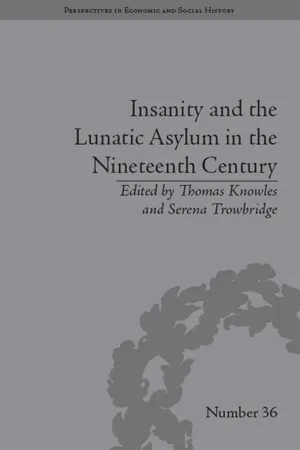
Insanity and the Lunatic Asylum in the Nineteenth Century
- 256 pages
- English
- ePUB (mobile friendly)
- Available on iOS & Android
eBook - ePub
Insanity and the Lunatic Asylum in the Nineteenth Century
About this book
The nineteenth-century asylum was the scene of both terrible abuses and significant advancements in treatment and care. The essays in this collection look at the asylum from the perspective of the place itself – its architecture, funding and purpose – and at the experience of those who were sent there.
1 ‘HORRIBLE DENS OF DECEPTION’: THOMAS BAKEWELL, THOMAS MULOCK AND ANTIASYLUM SENTIMENTS, c.1815–60
‘The dreadful disclosures made before a Committee of the House of Commons, some forty years ago’, wrote Thomas Mulock in British Lunatic Asylums in 1858, ‘drew the public attention to the famous mismanagement of the most noted institutions for the reception of the insane, and enthusiastic reformers were loud in their reprobation of old abuses, and confident in their anticipation of a new system full of human kindness’.1 This was not strictly true. Thomas Bakewell gave evidence to this 1815 Parliamentary Select Committee, which considered ‘the better Regulation of Madhouses in England’.2 He stated that the plan to erect new and extensive sites for the care of pauper lunatics was
an extremely bad one … there should be a discrimination between new cases, or those that can be called curable, and those that are incurable … a large public Asylum, in which all descriptions of Lunatics are admitted, is a great deal more calculated to prevent recovery than to promote it…3
Bakewell then published A Letter, Addressed to the Chairman of the Select Committee, choosing his words carefully for maximum impact. A public asylum system, he complained, was
at best a scheme to organize by law indiscriminate coercion, from which there is no appeal, under the ostensible plea of humanity … packing together, and keeping in close confinement, criminal Lunatics, dangerous Idiots, pauper Lunatics, curable and incurable, those under the most violent paroxysms of madness, and those under the depressions of melancholy, they must do great injury; and greatly add to the misery they were intended to relieve.4
Moreover, argued Bakewell, ‘County Asylums [would] generally be County Jobs’.5 In 1858 Thomas Mulock agreed. ‘What is the good of a flourishing institution if public funds cannot be made to dribble into private pockets? Therefore, with all the prudent machinery of committees and auditors, county asylums afford a wide scope for profitable jobs’.6 Mulock’s charges of profiteering ran to asylum doctors. ‘The grand business of these accredited quacks [was] to hunt out eccentricities’, thereby gaining patients and revenue.7 Alongside eccentrics, alleged Mulock, public asylums were used to harbour criminals who belonged in prison8 Such facilities were thus ‘[warped] … from their legitimate purposes, and … converted into horrible dens of deception, where the sane and insane are confined together in compulsory commixture’.9
While the hues of their arguments differed, the Thomases’ central concerns about county asylums were rooted in the same anxieties: the potential for misuse and personal profit, and the bundling together, without appeal, of diverse inmates, including criminals. Their disquiet was not the only thing the two men had in common. Bakewell (1761–1835) was a lecturer and published poet and author; Mulock (1789–1869), father of the celebrated children’s writer Dinah Craik, was a public speaker and prodigious author of poetry and prose. Both wrote against the Highland Clearances,10 but a primary target for their ire was Staffordshire General Lunatic Asylum; an ostensibly curative institution in Stafford – the county town of a shire with a mixed economy – which was built on the subscription model for 120 patients of all behavioural presentations and social classes. Yet the authors were not only writing at different times, their experience was also poles apart: Bakewell was a private madhouse proprietor competing with Staffordshire’s public facility; Mulock had been its inmate.
This chapter will use the poetry and polemics of the two men and records from Stafford in turn, to explore the myths and realities of an early nineteenth-century asylum. The boundaries of madness as conceived by the two men and by Stafford will be considered. So too will the extent to which the arguments of Bakewell and Mulock chimed with the dominant sentiments present in the public arena at key points in the national development of mental healthcare, including the furore prior to the 1863 publication of Charles Reade’s Hard Cash, a novel about the wrongful confinement of a sane man and the abuses the asylum system visited upon him.
One hundred years before Hard Cash was published, a Select Committee was convened ‘to inquire into the State of private Madhouses in this Kingdom’.11 A level of public anxiety had been bubbling for some time, agitated by publications and high-profile trials. Daniel Defoe, journalist and author of Robinson Crusoe, wrote in 1728 that well-to-do men secreted their unwanted sane wives in these appalling private facilities, where they were ‘clapped up, stripped, whipped, ill-fed, and worse used’ and had ‘no soul to appeal to but merciless’ keepers.12 The confinement and subsequent 1739 court case and pamphlet of Alexander Cruden – a London-based Scots proof-reader, author and bookseller – as well as his 1754 custody and litigation, manifested similar charges of secrecy, isolation, filth, brutality and mechanical restraint, and suggested wrongful confinement was more widespread. Cruden’s unshakeable Providential belief and exhibitions of devotion, religious and romantic, sealed his 1738 detention in a private madhouse, in ‘a most unjust and arbitrary manner’ by ‘a mere Stranger’;13 potentially ‘a financially interested protector, or a [love] rival’.14 Even the lacklustre 1763 Select Committee concluded that the ‘great Abuses complained of’ were so obvious and generalized, that it urged the ‘Interposition of the Legislature’.15
Official intervention was hardly speedy. Eleven years later, in 1774, Parliament passed the Act for Regulating Madhouses. While this established an official system of local licensing, inspection and admission notification, the limited powers and direction given to local Justices of the Peace meant the Act was largely toothless and primarily focused on protecting wealthier patients.16 Only with the lapse of thirty-three years, and a greater cultural awareness of insanity, was a national template for public asylums introduced. In the interim, King George III had gone ‘mad’ and four lunatics had attempted regicide.17 The last of these attempts – by an ex-soldier under the sway of a Millenarian – in 1800 rewrote the law. James Hadfield’s acquittal for high treason on the grounds of insanity resulted in the Criminal Lunatics Act, which formalized unfitness to plead and orchestrated a mechanism expressly to detain insane offenders. Hadfield was confined in Bethlem Hospital,18 but outside London the law caused fresh problems as criminal lunatics were often detained in gaols. Prison reformers helped promote the 1807 Select Committee investigations, which in turn created the 1808 County Asylums Act ‘for the better Care and Maintenance of Lunatics, being Paupers or Criminals, in England’.19
Although comparatively swift-moving, Parliament had again introduced permissive legislation, enabling the establishment of asylums, but leaving the decision to build to local authorities. Even so, the 1808 Act enshrined the pre-requisites for moral therapy: a system that rejected abuse, indiscriminate confinement and excessive mechanical restraint. The legislation empowered local magistrates to raise a county rate (tax) and to mortgage the money raised, permitted voluntary donations, and forbade magistrates from profiting by asylum contracts.20 It recommended ‘an Airy and Healthy Situation, with a good Supply of Water’, close to ‘constant Medical Assistance’; separate wards, day rooms and airing grounds for men and women, convalescents and incurables; ‘and dry and airy Cells for Lunatics of every Description’.21 Admissions were made if individuals were ‘dangerous to be at large’ or criminal, but Parish Overseers were permitted to arrange with a Justice the admission of ‘any Lunatic, Insane Person, or Dangerous Idiot’.22
A change in attitude was already afoot at the few existing public facilities in England, including St Luke’s, London (opened 1751), and Manchester Lunatic Hospital (opened 1766),23 but it is the York Retreat – a philanthropic institution for Quakers, founded in 1794 by the Tukes, a Quaker family – that has become synonymous with ‘moral treatment’. The Retreat’s progressive therapeutic regimen was established in response to rumours of poor care at York Asylum, which had opened in 1777 under reformative and curative ideals.24 The subscription institution for patients of all descriptions and social classes had descended into squalor through unchecked, profiteering medical management.25 Local 1813 investigations heard evidence of physical and sexual abuse in cramped, filthy, dark and damp confinement. Pandora’s Box was further prised open by a fatal 1814 fire and the campaigning local magistrate, Godfrey Higgins.26
Moral treatment, such as that outlined in Samuel Tuke’s influential Description of the Retreat (1813),27 recognized the potential curability of insanity. Confinement, mechanical restraint and the traditional ineffective medical methods of habitual purges and bleedings were rejected; the instillation of selfrestraint would hasten recovery. People with mental illness were treated as capable of rational thought and sensible of their surroundings, though were also separated by gender and behavioural presentation. The asylum building was, then, paramount to ideals of care, comfort and classification. Extensive grounds soothed troubled minds, and occupation here or indoors distracted from negative or disordered thoughts. Observing personal appearance and social etiquette rebuilt self-esteem and laid the path back to the community.28
Dotted across England, a number of private facilities were created to reflect such sentiments. In 1792, for example, Dr Thomas Arnold, the son of a Baptist preacher, founded Belle Grove at Leicester. In 1804, Edward Long Fox, a Quaker physician, opened Brislington House near Bristol. In 1808, Thomas Bakewell – an erstwhile skilled weaver turned lay practitioner, who had been trained by his grandfather and uncle – launched Spring Vale in Staffordshire. His grandfather’s and uncle’s madhouses had been established in the county. It was where another probable relative managed his asylum in genteel Lichfield, the Prouds ran their madhouse in the industrial surrounds of Wolverhampton – and where the progressive Justices announced within weeks of the 1808 legislation the foundation of a publicly-supported asylum at Stafford, just eleven miles away from Bakewell’s new venture.
Bakewell’s concern about the lack of public understanding of mental health issues had been simmering for some time before Spring Vale was purchased. In 1805, he published anonymously The Domestic Guide, in Cases of Insanity. Uncluttered by ‘learnedly obscure’ language and ‘at a price within the reach of the poorest family’,29 the text was early publicity for moral treatment and the dangers of public asylums. The book promoted the prevention of madness, the considerate tending of those in mental distress, and the curability of the recently insane. Bakewell advised the careful and tailored seclusion (including physical coercion) of individuals at their most ill; once recovery came, this also ensured the patient would not be so shamed by memories of their behaviour that they would ‘sink … into incurable melancholy’.30 Care in such bespoke, intimate surroundings would ‘do much more, than … where there are numbers to attend to’ and ‘success may … be looked for, with greater confidence than the gloomy reports of Bethlem would warrant’.31 ‘When I first read these reports’, Bakewell noted, ‘I was struck with horror at the gloomy picture of human wretchedness’ where ‘little more than … one out of three, recover’,32 due to ‘Exposure to the cold and the constant company of others that are mad. Yet this is the very state in which the insane are kept in … public mad-houses’.33
Just as the 1807 Select Committee was taking evidence, Bakewell’s preoccupation resurfaced in the publication of two volumes of poetry, partly titled after his alter ego, The Moorland Bard. Literary academic Michelle Faubert argued that Bakewell used ‘verse to popularise and debate psychological issues’.34 While he later became an established ‘‘popular’ psychiatrist’, as L. D. Smith has demonstrated,35 seemingly the anthology was not the medium through which Bakewell successfully generated public awareness of psychological issues. Contemporaries were almost universally disparaging about what they considered the poor, even uncouth, themes and quality of the poetry, with one commenting it ‘ought not to have been published’.36 Amid the personal Recollections of a Weaver in the Moorlands of Staffordshire on love and nature, were nestled a few allusions to mental distress and, in particular, capacity. ‘Lines, Written after a Dispute Respecting the Insanity of a Man Who Made the Attempt on the Life of Our Sovereign’,37 or rather its accompanying footnote, help inform why Bakewell was so against public asylums like Stafford, designed to detain criminal lunatics.38 Written with Hadfield in mind, Bakewell agreed he was ‘a maniac’.39 Nine out of ten maniacs, he argued, were able to learn from mistakes, yet when faced with execution for their offence criminal lunatics would most likely reply ‘I am a madman, and therefore “not an accountable creature”’; the knowledge of acquittal led to the commission of crimes and enabled sane offenders to escape the noose.40 The answer was simple: punish both the same and only permit ‘the plea of insanity … when the murderer was well known to be totally divested of the reasoning power’ – Bakewell’s one maniac in ten.41
A year after Spring Vale was purchased and adapted to Bakewell’s family home and business, a second edition of The Domestic Guide was published with an advertisement.
Spring Vale is a most delightful and healthy situation, the building is fire proof … supplied with … artificial light and heat … [and] furnished with a compleat [sic] set of baths … no chains will be used, nor any severities whatever exercised, and while proper social amusements are provided … no patient (not absolutely incurable) will be permitted ...
Table of contents
- Cover Page
- Half Title page
- PERSPECTIVES IN ECONOMIC AND SOCIAL HISTORY
- Title Page
- Copyright Page
- Contents
- Acknowledgements
- LIST OF TABLES
- List of Contributors
- Introduction
- 1 ‘Horrible Dens of Deception': Thomas Bakewell, Thomas Mulock and Antiasylum Sentiments, c.1815–60
- 2 ‘This Most Noble of Disorders': Matilda Betham on the Reformation of the Madhouse
- 3 The Legacy of Victorian Asylums in the Landscape of Contemporary British Literature
- 4 Building a Lunatic Asylum: ‘A Question of Beer, Milk and the Irish'
- 5 ‘Just can't Work them Hard Enough': A Historical Bioarcheological Study of the Inmate Experience at the Oneida County Asylum
- 6 ‘Always Bear in Mind that You are in Your Senses': Insanity and the Lunatic Asylum in the Nineteenth Century – from Keeper to attendant to Nurse
- 7 ‘Atrophied', ‘Engorged', ‘Debauched’: Degenerative Processes and Moral Worth in the General Paralytic Body
- 8 ‘Attitudes Passionelles': The Pornographic Spaces of the Salpêtrière
- 9 ‘The Poison that Upsets my Reason': Men, Madness and Drunkenness in the Victorian Period
- 10 ‘Madness and Masculinity': Male Patients in London Asylums and Victorian Culture
- 11 ‘Straitjacket': A Confined History
- Notes
- Index
Trusted by 375,005 students
Access to over 1.5 million titles for a fair monthly price.
Study more efficiently using our study tools.
Frequently asked questions
Yes, you can cancel anytime from the Subscription tab in your account settings on the Perlego website. Your subscription will stay active until the end of your current billing period. Learn how to cancel your subscription
No, books cannot be downloaded as external files, such as PDFs, for use outside of Perlego. However, you can download books within the Perlego app for offline reading on mobile or tablet. Learn how to download books offline
Perlego offers two plans: Essential and Complete
- Essential is ideal for learners and professionals who enjoy exploring a wide range of subjects. Access the Essential Library with 800,000+ trusted titles and best-sellers across business, personal growth, and the humanities. Includes unlimited reading time and Standard Read Aloud voice.
- Complete: Perfect for advanced learners and researchers needing full, unrestricted access. Unlock 1.5M+ books across hundreds of subjects, including academic and specialized titles. The Complete Plan also includes advanced features like Premium Read Aloud and Research Assistant.
We are an online textbook subscription service, where you can get access to an entire online library for less than the price of a single book per month. With over 1.5 million books across 990+ topics, we’ve got you covered! Learn about our mission
Look out for the read-aloud symbol on your next book to see if you can listen to it. The read-aloud tool reads text aloud for you, highlighting the text as it is being read. You can pause it, speed it up and slow it down. Learn more about Read Aloud
Yes! You can use the Perlego app on both iOS and Android devices to read anytime, anywhere — even offline. Perfect for commutes or when you’re on the go.
Please note we cannot support devices running on iOS 13 and Android 7 or earlier. Learn more about using the app
Please note we cannot support devices running on iOS 13 and Android 7 or earlier. Learn more about using the app
Yes, you can access Insanity and the Lunatic Asylum in the Nineteenth Century by Serena Trowbridge, Thomas Knowles,Serena Trowbridge in PDF and/or ePUB format, as well as other popular books in Economics & Economic Theory. We have over 1.5 million books available in our catalogue for you to explore.