eBook - ePub
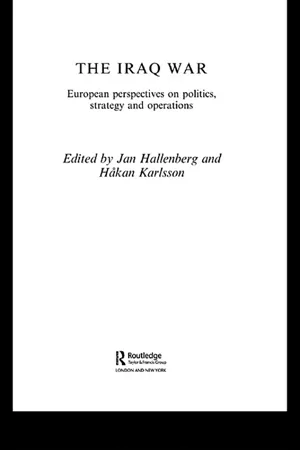
The Iraq War
European Perspectives on Politics, Strategy and Operations
- 272 pages
- English
- ePUB (mobile friendly)
- Available on iOS & Android
eBook - ePub
The Iraq War
European Perspectives on Politics, Strategy and Operations
About this book
We are living amidst the fallout of the most controversial conflict of our times. This book is a tough examination of how and why it was fought and of its continuing effects.
This major new work contains analysis of the Iraq War from several different academic, as well as military perspectives. Its emphasis is on the links between US foreign policy, US strategy and the US conduct of war and it also covers Iraqi grand strategies, the consequences of the War for transatlantic relations, and includes a chapter on the International Law dimension. In scrutinzing the war and the behaviour of its main parties, the editors draw upon international relations, political science, strategic thought and military theory, plus international law and media studies. For those wishing to understand the Iraq war from a very wide range of rigorous perspectives, this is a must-read.
1
PUZZLES AND PROPOSITIONS OF THE IRAQ WAR
Jan Angstrom
Introduction
The war in Iraq in 2003—and the political process which led up to it—challenged the conventional wisdom of international politics, strategy, war and warfare in several ways. For example, the traditional understanding of war and peace rests uneasily with the notion of an ‘inter-war’ period of peace between the Gulf War in 1991 and the Iraq War in 2003, considering that coalition forces carried out air strikes on average every third day during the period, including launching over 500 Tomahawk missiles against targets in Iraq.1 Moreover, considering that the Iraqi forces were most likely aware that they faced a technologically superior and heavily mechanized enemy, it would have made sense to prepare and destroy bridges early so as to hamper the advancement of the coalition forces. But they did not. Why? The Iraq War did, however, also conform to other expectations more commonly found in analyses of international discord and collaboration. For example, the US attempt to build an international coalition before the war followed an established post-cold war pattern of US policy-makers searching for burden-sharing in military operations. Hence, there are also important continuities that need to be taken into consideration when analysing the Iraq War. How should the Iraq War be approached? What are its central puzzles and propositions?
This chapter aims to address three central puzzles in the study of modern war and their connection to the war in Iraq. Although the three puzzles are partly interrelated, this broad categorization will help to introduce the chapters in this volume as well as set studies of the Iraq War within a broader scholarly framework. The notion of a ‘puzzle’ is intimately, although not exclusively, linked to inconsistencies with what Stephen Toulmin has termed ‘ideals about the natural order’.2 The puzzle is therefore often framed as an anomaly—a departure from the norm. Arguably, the puzzle’s great worth in scientific study is that it drives scholars to search for explanations. This chapter poses some research questions for the study of the Iraq War. Specifically, the central puzzles here are to explain when the war actually took place, why it took place, and how it was fought. Even though the discussion in this chapter is mainly conceptual, it will not impose a conceptual hierarchy for the rest of the chapters. It will, however, provide an analytical framework within which the different contributions to the book can be usefully examined. The concluding chapter, therefore, returns to the when, why and how of the Iraq War and on the basis of the contributions suggests possible answers to the overall puzzles.
It should be pointed out that a final assessment of the Iraq War is still premature. In itself this is hardly surprising, and studies of the Iraq War suffer no more in this respect than studies of other contemporary wars. It is still important, though, to realize that sources and data on the Iraq War are provisional at best, and part of the parties’ attempt to manipulate information for operational or political purposes at worst. In turn, this raises questions regarding the quality of conclusions that can be drawn from early studies of the Iraq War. This is no easy matter to decide without the benefit of hindsight. Hence, caution is in place.
The discussion is also related to a more general question of how farreaching conclusions about warfare can be drawn from the Iraq War. At least two positions need to be considered. On the one hand, one can argue that hardly any conclusions for future warfare can be drawn, as the coalition forces were overwhelmingly superior to the degraded Iraqi forces, which had gradually been starved of resources, training and equipment throughout the 1990s. Karl Mueller recently made a similar point when arguing that caution is necessary since there are hardly any replicas of Warsaw Pact-organized armed forces around anymore. The Iraq War, therefore, may be the last of its kind.3
On the other hand, one can argue that the Iraq War is perhaps the way of the future. At the moment, it is difficult to envision any potential challengers with capabilities equal to those of the US forces (or any US-led coalition). Hence, as has been suggested, the post-cold war era may be one of ‘hegemonic wars’ and ‘expeditionary warfare’, characterized not by campaigns and battles between equally organized and equipped armed forces but between highly trained and well-equipped professionals on one hand, and poorly equipped low-tech irregulars (or regulars), on the other. In this interpretation, the Iraq War, together with the war in Afghanistan, may be the rule rather than the exception. This is not to say that warfare is turning one-sided, however. Despite their great strength, even US forces can still encounter resistance which is difficult to overcome—as developments in Iraq subsequent to the end of major conventional warfare have demonstrated.
This chapter proceeds as follows. First, I discuss the puzzle of when wars take place. This has immediate importance for the Iraq War, as assumptions of when the war took place partly determine what we can consider caused it. This puzzle is also inextricably linked to questions about the nature of war. Second, I discuss the causes of war and how this question relates to the Iraq War. Considering that wars are costly and risky, why did the second war between the US and Iraq break out? What theoretical questions and propositions can be formulated when approaching the possible causes of the Iraq War? Third, I discuss the conduct of the war and introduce analytical approaches for understanding how the war in Iraq was fought. This puzzle naturally focuses on identifying the balance between practising force economy (as even superpowers have limited resources) and achieving the goals of military operations. And how should the conduct of the war be understood and explained?
When did the war in Iraq take place?
The first issue to be considered when attempting to analyse any aspect of the Iraq War is to determine, or at least make an assumption about, when the war took place. This, of course, is just another way of framing the question of what war is, but it also serves to pinpoint a potential weakness in studies of war in general, which more often than not treat this issue only tacitly.4 Its importance is obvious in that the understanding of the term ‘cause’ implies that it occurs before its effect. Consequently, it is necessary to delineate the dependent variable, not only spatially but also temporally in studies of the causes of war. In this way, assumptions on when the war in Iraq occurred influence our notion of what caused it. Moreover, the notion of jus in bello assumes that there is a distinction between war and peace, which the actors in the war can identify. These notions are rendered meaningless if war and peace cannot be separated. Accordingly, it is appropriate to begin an analysis of puzzles in the Iraq War with a discussion of when the war took place.
Dating wars—as with other historical events—requires that it is possible to determine both when they break out and when they stop.5 In European wars, the parties have traditionally used declarations of war and peace treaties as means to clear any lingering confusion as to whether or not they are at war. This custom, in turn, provided analysts with a means to date wars. However, Kalevi Holsti has noted that the practice of formally declaring war has gradually decreased. Instead, armed conflicts since the Second World War have largely been characterized by the absence of immediate crises preceding the outbreak of hostilities, the absence of declarations of war, and the absence of formal peace treaties (in favour of more or less adhered-to ceasefires) to end hostilities.6 In itself, this fact does not suggest that we live in an era of perpetual war—or peace—but it does suggest that the conventions on how both analysts and parties separate these phenomena have changed.
As Christopher Coker has pointed out, even when these conventions were used by the parties in their interaction, it was far from problem-free for analysts to use them as indicators to determine when wars took place.7 While Coker uses difficulties to date the Second World War to illustrate his point, his argument is easily transferred to current world politics. The US-proclaimed ‘war on terrorism’ highlights additional problems. Lawrence Freedman has suggested that: ‘wars are fought between opposing political entities and not against tactics’.8 The inherent problem with this concept is that war as a term entails the possibility of a beginning and an end, but does a war against a tactic—or, for that matter, against drugs—have a conceivable end? When wars occur, therefore, depends on how we understand war (and peace).
The first issue on the agenda in the search for new indicators for dating war is, quite naturally, to understand what is meant by war and peace. Perhaps the most commonly found notion depicts war and peace as opposites on a scale of possible ways that states (or other social actors) can relate to each other. In this view peace is a state in which individuals, groups, or states pursue their goals through dialogue, the rule of law and, normally, non-armed competition. During war, meanwhile, using force and violence is the rule, rather than the exception.9 This understanding, however, may not be helpful in describing the relationship between the US and Iraq in the past 15 years considering that Western forces carried out air strikes, including Tomahawk missile strikes on a number of occasions, during the interim period between the two major outbreaks of large-scale military operations. Should Clausewitz’s dictum be reversed insofar as peace being the continuation of war with similar means to accommodate US-Iraqi relations?
Traditionally, war has been conceptualized as ‘organized large-scale armed conflict’ or simply ‘organized large-scale violence’.10 Although war is usually understood to be a phenomenon intimately connected to the state, there is no apparent contradiction in incorporating other actors as well.11 The traditional understanding follows Carl von Clausewitz’s influential ideas of war as a rational and political phenomenon. Following his famous dictum that war is a continuation of politics by other means,12 the term ‘organized’ signifies that war is a controlled rational and collective phenomenon with more or less developed (and adhered to) norms which govern the parties’ behaviour, rather than chaotic, irrational and random acts of violence.13 In this interpretation, it makes sense to talk of war as a tool to achieve an end. What Clausewitz had in mind was a political end, but David Keen among others has suggested that war could be understood as a means to an economic end.14 Nevertheless, both these interpretations emphasize the fact that war is essentially a tool, which in turn suggests that making the Iraq War intelligible comes down to identifying ends which the war may serve. A central query is, therefore, investigating the rationale of the Iraq War, either through analysis of its conduct to identify operational patterns, which may indicate what the war is about, or through analysis of the political pretext for the war.
There are, however, other ways of understanding the meaning of war. Closely related to the understanding of war as a tool is the notion that war occurs between actors. It is a social phenomenon. This means that war pre-supposes reciprocity. At ‘the heart of the matter’, Clausewitz argued, ‘war is a violent “duel”; two forces of will, standing opposed to each other, each trying to overpower the other’.15 In this context, some aspects of the Iraq War seem puzzling. Why, for example, did Iraqi forces not prepare and destroy bridges to hamper the advance of coalition forces? To what extent did Iraqi commanders consider contingencies for post-Saddam Iraq? Although a fully evolved Clausewitzian ‘duel’ may not have materialized during ...
Table of contents
- Cover Page
- Title Page
- Copyright Page
- Notes On Contributors
- Preface
- List of Abbreviations
- 1: Puzzles and Propositions of the Iraq War
- Part I: Politics and Strategy Before the War
- Part II: Theory and Strategy During the War
Trusted by 375,005 students
Access to over 1.5 million titles for a fair monthly price.
Study more efficiently using our study tools.
Frequently asked questions
Yes, you can cancel anytime from the Subscription tab in your account settings on the Perlego website. Your subscription will stay active until the end of your current billing period. Learn how to cancel your subscription
No, books cannot be downloaded as external files, such as PDFs, for use outside of Perlego. However, you can download books within the Perlego app for offline reading on mobile or tablet. Learn how to download books offline
Perlego offers two plans: Essential and Complete
- Essential is ideal for learners and professionals who enjoy exploring a wide range of subjects. Access the Essential Library with 800,000+ trusted titles and best-sellers across business, personal growth, and the humanities. Includes unlimited reading time and Standard Read Aloud voice.
- Complete: Perfect for advanced learners and researchers needing full, unrestricted access. Unlock 1.5M+ books across hundreds of subjects, including academic and specialized titles. The Complete Plan also includes advanced features like Premium Read Aloud and Research Assistant.
We are an online textbook subscription service, where you can get access to an entire online library for less than the price of a single book per month. With over 1.5 million books across 990+ topics, we’ve got you covered! Learn about our mission
Look out for the read-aloud symbol on your next book to see if you can listen to it. The read-aloud tool reads text aloud for you, highlighting the text as it is being read. You can pause it, speed it up and slow it down. Learn more about Read Aloud
Yes! You can use the Perlego app on both iOS and Android devices to read anytime, anywhere — even offline. Perfect for commutes or when you’re on the go.
Please note we cannot support devices running on iOS 13 and Android 7 or earlier. Learn more about using the app
Please note we cannot support devices running on iOS 13 and Android 7 or earlier. Learn more about using the app
Yes, you can access The Iraq War by Jan Hallenberg,Håkan Karlsson in PDF and/or ePUB format, as well as other popular books in History & Middle Eastern History. We have over 1.5 million books available in our catalogue for you to explore.