eBook - ePub
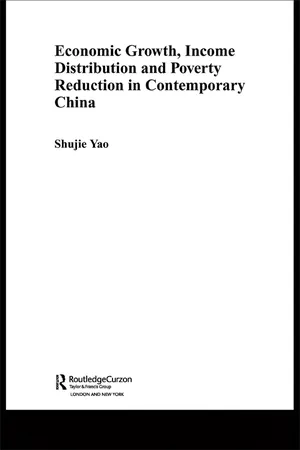
Economic Growth, Income Distribution and Poverty Reduction in Contemporary China
- 176 pages
- English
- ePUB (mobile friendly)
- Available on iOS & Android
eBook - ePub
Economic Growth, Income Distribution and Poverty Reduction in Contemporary China
About this book
China has experienced over a quarter century of rapid economic growth, which has had a phenomenal impact on the global economy. Entering into the twenty-first century implies that China has begun a new phase of economic and social development. Yao reviews the economic development history of contemporary China from 1949 to the present, paying special attention to growth, inequality and poverty reduction. A real Chinese economic miracle should have two important features: high income growth and a fair distribution system so that poverty can be eradicated.
1 Introduction
1.1 A brief history of contemporary China
The twentieth century was probably the most turbulent but fascinating period of China’s history of civilisation which spans more than 5,000 years. The country first underwent a tumultuous end to the dynastic and feudalistic system, when the last emperor, Pu Yi, was first forced to move to the hometown of Qing Dynasty, the Manzhouli in northeast China, and was then removed from power altogether by the republican movement, led by Dr Sun Zhongshan, founder of the Republic of China. The seeds of the total collapse of the dynastic system were planted during the second half of the nineteenth century when Britain successfully launched two opium wars on China and signed a number of unfair bilateral treaties, including that to rent Hong Kong Islands for 150 years.
For more than 60 years, from the mid-nineteenth century to 1911, China experienced a humiliating history of a semi-colonial and semi-feudal system, where the populace, the vast majority of whom were petty farmers, were oppressed by the corrupt officials of the Qing Dynasty, invaders from the west and Japan, and the landlords. The period from 1911 to 1937 witnessed numerous civil strikes which held together a heavily wounded society caught between the two main political parties, the Nationalist and the Communist. During the Second World War, China was occupied by the Japanese, whose slaughter of more than 300,000 people in Nanjing angered the entire nation, leading to an unusual coalition between the two otherwise hostile parties against the invaders. The victory of the anti-Japanese war in 1945 became an opportunity for the two parties to eliminate each other. In the end, the Communists won the three years long civil war and the Nationalists, led by Chiang Kai-shek, retreated to Taiwan in 1948. Since then, China has been separated by a narrow water strip of about 30–50 miles, guarded by America’s 7th Fleet of Battleships in the Pacific Ocean.
The year 1949 was the most significant turning point in China’s contemporary history, which had the following features. First, it was a genuine beginning of a republic system in which the fortunes of people’s lives were not determined by one single person, the emperor, but by a large political party, which by now had a membership of over 66 million. Second, the country was free of external suppression from western imperial powers. Third, the Communist party redistributed land almost equally to all rural families, stripping off the ownership once and for all from the land-owning classes.
China’s most influential political figure was Chairman Mao, who led the Communist Party from the mid-1930s to its grand victory over the Nationalist Party in 1949. He continued his leadership until he died in 1976. Mao was famous for his tireless attempts to modernise China in his own way, rooted in his feudalistic family background. He launched the land reform in 1949–52 to distribute land equally to all rural households. There had been no other world leader who had been able to do exactly the same thing in such a large country. The effect of land reform on China’s economic progress was immense and permanent. Even now after over 25 years of economic reforms, China still retains almost the same system of land ownership and usufruct, as it was over 50 years ago.
Land reform was to give everyone a chance to move out of poverty. To this end, Mao was successful and he should be heralded for his courage, ability and deep concern for the poor. In the early years of Mao’s leadership, one of his chief ambitions was to rebuild China into a world power again after over 100 years of humiliation, hunger and disease. He wanted to show to the world that the Chinese people were a great people and that China could catch up with the United Kingdom and the US in decades. Although Mao was right in his thought, his tactical approach to economic development was flawed due to his misunderstanding of human nature: its selfishness. He advocated Lei Feng as a model of selflessness to be followed by the whole nation, based on the naïve assumption that collectivisation was the best form of economic organisation to quickly change China from a poverty-stricken nation to a world class power. Hence, the years following the land reforms saw collectivisation, culminating in the People’s Commune, in which many hundreds of households pooled their resources together to produce a restricted set of agricultural products, particularly cereals and cotton. In the cities, state investments were concentrated in the state-owned enterprises (SOEs) after private firms were involuntarily merged or taken over by the state from 1956. Private enterprises were prohibited, since they were regarded as an ownership form which did not fit in well with the socialist ideology of economic development and construction.
The People’s Commune faced a tremendous setback in the first three years of the movement. Poor weather and disastrous crops from late 1958 triggered China’s largest famine and loss of life in the following three years (Lin, 1992; Chang and Wen, 1997; Yao, 1999a). It was estimated that 18.5 million people died, and there were 30.1 million fewer births over the famine period (Yao, 1999a). To rectify the situation, Mao asked Liu Shaoqi, Deng Xiaoping, Chen Yun and a number of other senior officials to implement a recovery programme. One key element of the recovery programme was an institutional reform consisting of two main policies. One was to modify the commune system so that a three-tier ownership and operational structure was created, that is, the commune, the production brigade and the team, the other was a household responsibility system in the production team. In a sense, decision making became significantly less centralised under the new system, and agricultural production started to recover from 1962. The famine was over by the end of 1962, and by 1965 grain output had fully recovered to its prefamine level.
Mao’s second important political movement was the Cultural Revolution, which was launched shortly after the country recovered from the famine crisis. During the Cultural Revolution, Liu, Deng and Chen were prosecuted for their recovery policies implemented during 1962–5, as Mao accused them of following the capitalist road by introducing the household responsibility system. The Cultural Revolution started in 1966 and ended with the death of Mao in 1976. The whole decade of the Cultural Revolution had brought the Chinese economy to a total stagnation thereby subjecting the vast majority of the rural people to absolute poverty. The higher education system was also seriously affected because formal university entry examination was abolished and all the universities were forced to recruit students from workers, peasants and soldiers who were selected without clear academic criteria.
In retrospect, Mao’s political life was full of vicious political movements to remove his political contenders, because of his single-minded determination to make China powerful through collectivisation and common prosperity. The outcome, however, was totally different from what had been intended. China managed to create and maintain a highly egalitarian society, although there was an apparent division between the urban and rural populations. The Gini coefficient among the urban residents was typically around 0.20, and that among the rural population was around 0.22 throughout most of the pre-reform era. However, income equality was brought about at a high price; the whole country was poor despite tremendous growth in industrial output and a structural change in the national economy. By 1978, 80 per cent of the population still lived in the rural areas, and 70 per cent of the labour force was agriculture-based. Officially, the government stated that 270 million of the rural population lived in absolute poverty in 1978, but an unofficial estimate shows that at least 75 per cent of the rural population, or about 600 million were absolutely poor (Yao, 2000).
Contemporary China scholars and researchers would regard the pre-reform period 1949–78 to be a disastrous period in modern Chinese history. This is true if the performance in that period is compared with the spectacular growth in the post-reform era. However, if it is compared to the pre-liberation period from the later half of the nineteenth century until 1949, China had made a significant advance not only in industrial and agricultural output, but also in health and education.
According to Peter Nolan (2003),
from the mid-1950s, when the collectivisation of agriculture was accomplished and industrial planning implemented, through to the mid-1970s, China made enormous progress in many key aspects of social and economic development. The growth rate of national product was faster than in most developing countries… . In normal times, the mass of the people enjoyed a high degree of livelihood security. Most impressive of all, the country achieved enormous advances in health and education. For many economists, the key indicators of development are ‘basic needs’ in nutrition, health and education. By the mid-1970s, China’s levels of infant mortality and child death rates had fallen to exceptionally low levels compared with other developing countries. Infant mortality had fallen to just 71 per thousand compared with 124 per thousand in low income countries (excluding Indian and China) and 81 per thousand in middle-income countries. Life expectancy at birth, arguably the most important single indicator of development, had risen from 36 years pre-1949 to 71 years in 1981, an extraordinary achievement (Nolan, 1995: 49). The system also provided a high degree of security, drastically reducing the age-old fear of an unforeseen personal, natural or economic disaster that was the reality for every farm family and for a large fraction of the urban workforce in pre-Revolutionary China.
1.2 Comparison of economic performance in modern China
China’s achievements in the pre-reform era were heralded by numerous Western scholars as evidence that equal distribution of income could help the poor countries to achieve high levels of life quality and social development.
The most fundamental problem of the pre-reform period was not growth, but inefficiency. Over 50 per cent of state investments were concentrated in heavy industries, which generated limited employment. China’s failure in this period was probably the very low level of allocative efficiency and the inability of the state industries to create jobs. In other words, China failed to exploit its comparative advantage through developing the labour intensive industrial sectors. As a result, industrial growth was high but the market was short of consumer goods and agricultural products. To finance the development of capital-intensive industries, the state had to impose high levels of taxes on agriculture through direct land tax and indirect taxes using the so-called price scissors, which paid low prices to agricultural goods and charged high prices for rural consumer goods and agricultural production materials. As a result, output growth in agriculture did not lead to improvement in farm income. By 1978, per capita rural income was only 134 yuan per annum, which was $78.8 given an exchange rate of 1/1.7 in 1978, or only $0.21 per day, just over one-fifth of the international poverty line of $1 per day defined by the World Bank. Even if income was calculated in PPP terms, it would be still significantly less than $1 per day. Using the most conservative measurement of a poverty line, it was estimated that at least 75 per cent of the rural population, or about 600 million rural people lived in absolute poverty in 1978. This level of poverty was significantly greater than the official and World Bank estimates which shows 30 per cent of the rural population, or 270 million rural people were absolutely poor in 1978, compared to around 190 million in 1957 (Nolan, 1995).
Institutional economists, including some writers like Justin Lin, Peter Nolan and Nicholas Lardy, argued that the most disturbing outcomes of the pre-reform policies were a severe erosion of work incentives and frequent disruptions to the production schedules and plans by political events. Furthermore, numerous ill-conceived capital construction projects, notably the ‘backyard iron and steel campaign’, and the heavy industrial projects in the third-front areas (inland and remote from the coast), caused an immense waste of scarce resources, which were largely tapped from agriculture and the rural sector.
Although Mao made many mistakes in his economic policy, he could still be regarded as the pre-eminent political figure in twentieth-century China. In hindsight, Mao left China with many valuable achievements: equal distribution of land, greatly improved standards of general health and basic education, a society with limited levels of corruption, a country free of many deadly diseases, a people with a strong spiritual belief, a comprehensive industrial production system, and an effective agricultural production infrastructure, especially the irrigation system. All these achievements were the foundation of a spectacular economic growth in the post-Mao period from 1978, led by China’s second towering political figure of the twentieth century, Deng Xiaoping. For the sake of academic debate it may be attractive to emphasise the achievements of the Maoist period. Indeed, many aspects of the Maoist period are worthy of study. However, it is not a development path to which China is likely to return, nor would many Chinese people wish it to.
Economic reforms started from 1978 after the Gang of Four was brought to justice and Deng Xiaoping resumed his political leadership within the Party. Deng was a fascinating and controversial political leader in the Communist Party history. During wartime, he was a great hero, party leader, army political commissar and commander. He worked closely with many army generals, especially General Liu Bochen. During the civil war from 1946–9 against the Nationalist Party Army, Liu was commander and Deng was political commissar of the Third Field Battle Force of the People’s Liberation Army (PLA). When people said the Liu-Deng Army, they meant the Third Field Battle Force, which was probably the most powerful fighting regiment of the PLA. Deng’s biggest contribution during the civil war was when he became general commander of a special forefront force to cross the Changjiang River in order to take control of south China from the Nationalist Party Army after the grand victory of the famous Three Big Battles of Liaoning-Shenyang, Beijing-Tianjin and Huaihai.
Deng became a senior party official after 1949 and worked as a deputy to Premier Zhou Enlai. At the end of the great famine, Deng worked with Liu Shaoqi and Chen Yun to help the country recover from the disastrous famine, but along with the others, he fell victim to Mao’s political struggle at the beginning of the Cultural Revolution. Deng disappeared to a remote village in Jiangxi Province until 1973 when he was called back by Mao to help run the country. From 1966 to 1972, China abolished the closed-book examination tradition throughout the country from primary to higher education. In 1973, soon after Deng came to power again, he resumed the examination system at the primary and secondary education levels. Henceforward, entry from junior high school to senior high school was through examination competition. Deng also encouraged farmers to retain their private plots of land and relaxed the restriction on rural and urban free markets. However, shortly after Zhou died in early 1976, the Gang of Four forced Deng out of politics through the order of Mao, who was very frail and sick but clear-headed enough to keep Deng’s party membership, which was crucial for him to be restored to power one year later.
In July 1977, Deng was restored to power during the Third Plenum of the Tenth National Congress of the Chinese Communist Party Central Committee (CCPCC). On 10 August 1977, he became deputy chairman of the CCPCC and deputy chairman of the Military Committee of the CCPCC during the First Plenum of the Eleventh National Congress of the CCPCC. In March 1978, Deng became chairman of the Chinese People’s Political Consultative Congress. In 1981, he became chairman of the Military Committee of CCPCC. Deng was never the chairman of the CCPCC itself, which was the number one position of the party and the country, but he was de facto the most influential figure within the party and the People’s Congress. It was him who should be credited with the success of China’s economic reforms. He was famous for his own proverb, ‘A cat is a good cat as long as it can catch mice, it does not matter whether it is black or white.’ He used this proverb indirectly to criticise Mao’s rigid philosophy that socialism must be based on public ownership, that the bigger the enterprise the better, and his emphasis on self-reliance, and his closed-door policy. To break the deadlock of Mao’s doctrines and his legendary influence on people’s thinking, Deng launched a nationwide study campaign to debate that ‘truth must come from practice’, not from a prescribed teaching and narrowly defined socialism offered by Marxism, Leninism and the thoughts of Mao Zedong. Deng advocated that as long as China was to become rich, as long as people’s living standards were to be significantly improved, it did not matter if the country did not maintain dominant state ownership, total equality, or the principle of self-reliance and of maintaining a closed door to international competition.
The easiest place for reform, however, was the countryside and agriculture, for various reasons. First, almost all the poor people lived in the countryside, depending on crop farming for their living, the cities and industries being heavily protected and subsidised by the state. Hence, there were strong incentives for farmers to participate in the reform programme. In fact, many production teams in south China had secretly (and illegally) carried out some forms of production responsibility and free (black) market activities. The official reform policy was just to legalise what some had been doing for years and encouraged all production teams to sign production contracts with individual households. Second, Deng had some experiences gained from the recovery period of 1962–5 when he was a member of the leading team in the economic recovery programme. The essence of the recovery programme in the early 1960s was the so-called ‘three freedoms and one contract’, meaning free local markets, free production decisions by production teams, self-responsibility for losses and profits, and household production contract responsibility. The ‘three freedoms and one contract’ became the reform package to be implemented throughout China from 1978. From 1979, the first political directive issued each year by the CCPCC was all about agricultural and rural reform. By 1983, the household production responsibility system was implemented throughout the whole country.
Apart from institutional reforms, the price system was also changed. From the second half of 1979, the prices of many agricultural products, particularly grains, were raised so that state procurement prices moved close to free market prices, providing significant financial incentives for farmers to raise production. Grain output rose from 300 million tons in 1978 to over 400 million tons in 1984. Per capita farm incomes rose dramatically by almost 15 per cent per year over the same period, which was probably the golden epoch of rural China, not only for the reform period, but also for the entire Chinese history of many thousand years. It was in this period that rural hunger and malnutrition were finally eliminated in the vast majority of the Chinese rural areas. The incidence of poverty was brought down from 75 per cent to about 7.3 per cent; the total number of rural poor declined from 600 million to less than 58 million using a low and official poverty line (Yao, 2000). In fact, the incidence of rural poverty reached its lowest point in 1984 over the entire reform period from 1978 up to today. This remarkable achievement set a cornerstone in the history of rural development not only in China, but also in the world. The initial success of agricultural reform was remarkable and unanticipated, even Deng Xiaoping himself said that he could not believe that the reforms could lead to such an improvement on people’s living standards and agricultural productivity.
Urban and industrial reforms followed in the footsteps of agricultural reforms, starting from the early 1980s. Urban reforms were focused on the state-owned industrial sector, which was renounced for its inefficiency and loss-making, nurtured by the lack of property rights and soft budget constraints. Since SOEs could not be easily privatised, similar reform measures like those implemented in agriculture were used to reform SOEs, particularly the production responsibility and contract system. The wages system was also reformed as bonus payments were introduced to stimulate production incentives among workers. To tackle the principal–agent problem, a compromise measure was the director’s responsibility, which specified that the party secretary of each enterprise would not interfere with production decisions, which should be the sole responsibility of the director, whose promotion and reward would be closely related to firm performance. The profit system was replaced with a taxation system so that firms would no longer deliver all their profits to the state, but could retain part of the profit after taxation. Retained profits could be used for bonus payments, capital investment, pension and other social benefits given to employees.
Various reform measures implemented in the 1980s appeared to have had some effect as far as production incentives were concerned but they failed to fundamentally solve the problem of SOEs (Hay et al., 1994; Groves et al., 1994; and Yao, 1997c). They continued to make huge losses and retained profits always involved an intensive bargaining process between individual firms and their higher authorities. This was because the market was not competitive, as input and product prices were heavily distorted by government policies. Firms were responsible for the employees’ pensions, housing, healthcare and the education of their children. Such a social burden implied that SOEs could not compete with non-state firms, which did not exist prior to reforms, but were encouraged to compete with the state economy after reforms. Non-state enterprises, particularly the rural township and village enterprises (TVEs) and foreign invested enterprises (FIEs) had the advantage of employing cheap labourers from the countryside without making any commitment to their job security and social benefits. Newly established firms and foreign invested firms were also given tax reduction and exemption in the first three to five years.
Due to the ineffectiveness of various reform measures tried out throughout the 1980s, the government started to contemplate some more radical reforms in the 1990s. The first radical reform was the privatisation of some small and medium-sized enterprises while the large ones continued to be state-owned. Many loss-making small and medium enterprises were allowed to become bankrupt, or be taken over or merged with non-state firms, or even sold to foreign companies. Large-scale enterprises were allowed to form joint-stock companies, or joint ventures with both domestic and foreign firms. The joint-stoc...
Table of contents
- Cover Page
- Routledge studies in the Chinese economy
- Title Page
- Copyright Page
- Figures
- Tables
- Preface
- Acknowledgements
- Abbreviations
- 1 Introduction
- 2 Economic performance in contemporary China: An overall assessment
- 3 Agricultural and rural development
- 4 Openness and economic performance
- 5 Decomposition of Gini coefficients by population class and income source: A spreadsheet approach and application
- 6 Rural—urban and regional inequality in output, income and consumption under reforms
- 7 Regional inequality and diverging clubs
- 8 Understanding income inequality in China: A multi-angle perspective
- 9 Further study on inequality and poverty reduction
- 10 Unemployment and urban poverty
- 11 Is migration a way of escaping poverty in China?
- Notes
- Reference
Trusted by 375,005 students
Access to over 1.5 million titles for a fair monthly price.
Study more efficiently using our study tools.
Frequently asked questions
Yes, you can cancel anytime from the Subscription tab in your account settings on the Perlego website. Your subscription will stay active until the end of your current billing period. Learn how to cancel your subscription
No, books cannot be downloaded as external files, such as PDFs, for use outside of Perlego. However, you can download books within the Perlego app for offline reading on mobile or tablet. Learn how to download books offline
Perlego offers two plans: Essential and Complete
- Essential is ideal for learners and professionals who enjoy exploring a wide range of subjects. Access the Essential Library with 800,000+ trusted titles and best-sellers across business, personal growth, and the humanities. Includes unlimited reading time and Standard Read Aloud voice.
- Complete: Perfect for advanced learners and researchers needing full, unrestricted access. Unlock 1.5M+ books across hundreds of subjects, including academic and specialized titles. The Complete Plan also includes advanced features like Premium Read Aloud and Research Assistant.
We are an online textbook subscription service, where you can get access to an entire online library for less than the price of a single book per month. With over 1.5 million books across 990+ topics, we’ve got you covered! Learn about our mission
Look out for the read-aloud symbol on your next book to see if you can listen to it. The read-aloud tool reads text aloud for you, highlighting the text as it is being read. You can pause it, speed it up and slow it down. Learn more about Read Aloud
Yes! You can use the Perlego app on both iOS and Android devices to read anytime, anywhere — even offline. Perfect for commutes or when you’re on the go.
Please note we cannot support devices running on iOS 13 and Android 7 or earlier. Learn more about using the app
Please note we cannot support devices running on iOS 13 and Android 7 or earlier. Learn more about using the app
Yes, you can access Economic Growth, Income Distribution and Poverty Reduction in Contemporary China by Shujie Yao in PDF and/or ePUB format, as well as other popular books in Business & Business General. We have over 1.5 million books available in our catalogue for you to explore.