- 284 pages
- English
- ePUB (mobile friendly)
- Available on iOS & Android
eBook - ePub
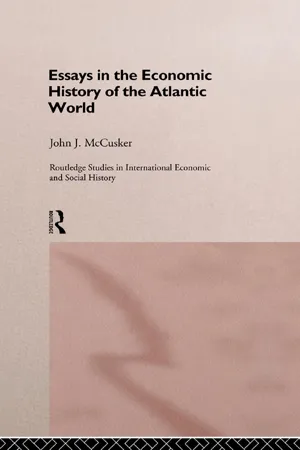
Essays in the Economic History of the Atlantic World
About this book
Written by one of the leading authorities on trade and finance in the early modern Atlantic world, these fourteen essays, revised and integrated for this volume, share as their common theme the development of the Atlantic economy, especially British America and the Caribbean. Topics treated range from early attempts in medieval England to measure the carrying capacity of ships, through the advent in Renaissance Italy and England of business newspapers that reported on the traffic of ships, cargoes and market prices, to the state of the economy of France over the two hundred years before the French Revolution and of the British West Indies between 1760 and 1790. Included is the story of Thomas Irving who challenged and thwarted the likes of John Hancock, Samuel Adams, Alexander Hamilton, George Washington and Thomas Jefferson.
1
GUIDES TO PRIMARY SOURCES FOR THE HISTORY OF EARLY BRITISH AMERICA
It should come as no surprise to historians of early British America that the resources for the subject are not only rich and diverse but also widely scattered.1 In an era of cheap air fares and fast photocopies, this last characteristic creates less of a burden than in the days of George Bancroft or Charles M. Andrews—provided, of course, that we can first identify what we need to see. Fortunately, scholars have come forward with guides and handbooks that make such research both easier and potentially more comprehensive than in the past.
The purpose of this essay is to discuss a variety of published guides to primary materials—particularly manuscript materials—and to place them in the context of what had been done earlier. The exercise seems especially necessary because the major journals in American history no longer regularly review such guides as they appear. In addition, I hope that this notice will encourage the creation of more guides, since all students of the period benefit greatly from them. Many a fine book has been made possible by the existence of good guides to the sources. Preparing the best of these handbooks is as much an intellectual attainment as is the realization of any monograph based upon them.
A continuing point of reference in all such endeavors is the classic Carnegie Institution of Washington manuals produced early in the twentieth century under the direction of J.Franklin Jameson.2 The Carnegie Institution guides and manuals dealt largely with manuscripts in European archives, but the latest fever seems to have worked its effect both here and abroad. Accordingly, some attention will be paid herein to guides to resources in this hemisphere, though the primary concern will be with the other side of the Atlantic. The intention is to notice all published guides to documentary resources for the study of pre-1800 British America.
There are, of course, other primary sources besides manuscripts. Historians of early British America are becoming increasingly aware of the breadth of published materials available to them. While lists of these other items are not the principal focus of this essay, they are guides to primary sources and many very worthwhile ones have appeared of late. Indeed, in large measure the historians’ new awareness is the direct result of the preparation of such guides.
It seems strange to think that only in the last fifty years have historians generally been able to make full use of newspapers published in the Thirteen Continental Colonies. Clarence S.Brigham’s guide to early newspapers,3 the microform collections based on the Brigham guide,4 and the Cappon and Duff index to the Virginia Gazette5 have all been published since World War II. Much the same point can be made about the books and pamphlets published in the colonies during the seventeenth and eighteenth centuries. Charles Evans’s American Bibliography, finally completed in 1959, has already been supplemented, extended into the nineteenth century, and made the basis of a microform edition of the works Evans listed.6
Materials published in Europe have also become more easily accessible. Several catalogues and bibliographies have been compiled that have become the stimulus for microform reproduction projects similar to the one based on the Evans bibliography. The two classic catalogues of early English language publications—Pollard and Redgrave’s Short-Title Catalogue…1475–1640 and Wing’s Short-Title Catalogue…1641–1700—are the prototypes for the “Eighteenth-Century Short Title Catalogue,” which continues its progress. It has recently been renamed the “English Short-Title Catalogue” (“EngSTC”) to reflect a widening of the inclusiveness of its database, which is commercially available on-line over the network. There are microform editions of the works listed in both Pollard/Redgrave and Wing, and the first units of microfilm of the eighteenth-century portion of the “EngSTC” have appeared. As was the case with Pollard and Redgrave and with Wing, the impact of the latest segment of the “EngSTC” will be felt both as a research tool and as the agent provocateur of new research and analysis.7
All three catalogues just mentioned try to include everything published in any language in the British Isles and all English language publications in Europe and the British colonies during their respective periods. Although there are no similar projects for materials in other languages, some valuable guides to such publications have been prepared on other bases. From the European perspective, much that had to do with the colonies was economic, broadly speaking, and thus collections of economic literature from the period frequently contain a great deal that concerns early British America. Another microfilm project has made available the holdings of the Kress Library of Business and Economics at Harvard University and the Goldsmiths’ Library at the University of London. It is based on the published catalogues of both libraries and is supplemented by a combined catalogue of its own.8 John Eliot Alden and Dennis Channing Landis have published a fine example of the bibliographer’s art, European Americana, that seeks to identify, describe, and locate copies of anything printed in Europe that even so much as mentioned the Western Hemisphere.9 Two bibliographies very carefully compiled by Thomas R.Adams have offered many new insights into the pamphlet literature that appeared on both sides of the Atlantic during the American Revolution.10 The publication of the catalogues of the major national libraries has made it much easier for researchers to locate copies of the items cited in these several guides and handbooks.11 No scholar can fail to benefit from the help such works offer.12
Authors of guides to archives and libraries usually take either a thematic or an institutional approach. The Carnegie Institution manuals were organized thematically; they discussed the documents available for American history, place by place. Other guides describe collections in one archive or library. Neither arrangement provides a guide organized perfectly for historians, but both can lighten the work of the researcher. Indeed, most modern manuals merely supplement rather than replace the Carnegie Institution guides. Thus we are not in a position of trading new lamps for old; to see our way clearly, we need both.
The principal European repositories of manuscripts dealing with British America are in the nations that colonized the New World. Great Britain is the first in any such list, but we would be silly to ignore France or Spain. There is a surprising amount in archives in Germany and Italy. Archives in The Netherlands and Denmark can be searched profitably for specific topics. Of late, effective guides have been published to many of the archives in these countries.
The archives and libraries of the United Kingdom have always—and quite rightly—been the starting point for the historian of early British America. Four books in the Carnegie Institution series dealt with British archives: Charles M.Andrews on the holdings of the Public Record Office (PRO) to 1783; Andrews and Frances G.Davenport on the manuscript collections of the British Museum (now the British Library [BL]) plus some other London repositories and some of the libraries of Oxford and Cambridge; Charles O.Paullin and Frederic L.Paxson on London archives for the period after 1783; and Herbert C.Bell and David W.Parker on collections in London and the West Indies relating to the Caribbean colonies.13
The great value of these four works was compromised to a degree by deficiencies that the compilers themselves were the first to point out. The most severe limitation is that they concentrated almost exclusively on London, within London on the BL and the PRO, and within the PRO on only the more apparent and more accessible record groups. One of the first projects of the British Association for American Studies (BAAS) after World War II was to try to obviate these deficiencies by preparing a guide to materials for the whole of United States history in all British and Irish archives. That guide, compiled and edited by Bernard R.Crick and Miriam Alman, along with its supplements, served the post-war generation of historians of early America very well indeed.14 It not only revealed the existence of notable collections in university, county, and city archives outside London, but it also alerted the archivists at those institutions to the significance of their collections for early Americanists. All of this has been reinforced for both groups by John W.Raimo’s revision of the Crick and Alman guide, also completed under the auspices of the BAAS.15
We run the risk of seeming ungrateful to Andrews and his collaborators, to Crick and Alman, and to Raimo if we point out what still remains to be done, since they have done so much so well. Yet an essay designed to help historians find their way must point out what even the brightest beacons leave poorly illuminated. Ironically, in view of the observation made above about the Carnegie Institution series, the chief limitation of the new BAAS guides concerns their treatment of the major London repositories, particularly the PRO. For the materials that Andrews described, the BAAS guides add nothing. For materials accessioned since Andrews saw the collections, the discussions in the BAAS guide are neither as broad nor as thorough as the comparable coverage in the Carnegie Institution volumes. For instance, both Crick and Alman and Raimo omit any consideration of the British colonies in the Caribbean.16 But the major problem with the treatment of the PRO materials in the BAAS guides is their failure, however understandable, to fill in the gaps left by Andrews and those who worked with him.17
The value of the PRO for early British American history cannot be overestimated, yet it is underutilized and its potential is not fully recognized, largely because of the lack of adequate guides and manuals. The most obvious collection, the Colonial Office Records, is so important to early British American history as to justify the kind of help that only complete calendaring offers. Yet the rate of publication of the Calendar of State Papers, Colonial seems now to have slowed to one volume every twenty-five years.18 For the period after 1739 Andrews and Bell and Parker are of limited usefulness; the BAAS guides offer nothing more. K.G.Davies has only whetted our appetite with his fine calendar of this record series for the Revolutionary War period.19 Even Davies, one man after all, chose to omit some germane Colonial Office files and to exclude altogether any West Indian records. (How can one deal with the American Revolution and ignore the Caribbean?)20
Similar things can be said about the Treasury Office Records, which are second only to the Colonial Office Records in their utility for the historian of early British America. While there are calendars prepared for the Treasury Office records covering their earlier years, there is only a very limited calendar/index to them and then only for part of the time after the full, published calendars stop.21 In addition to these records, there are great bodies of documents for which Andrews and his co-workers are still our sole recourse—the War Office, the Admiralty Office, the State Paper Office—and still larger classes that, as they themselves noted, they never even examined for the purposes of their guides.22 And then there are the collections that have been added to the PRO since the Carnegie Institution people worked there. The BAAS guides notice some but not all of these. For instance, Raimo never mentions the Prerogative Court of Canterbury records. Until we have adequate guides, the time necessary to explore the PRO will still be considerable, even for a circumscribed subject.
Despite all these shortcomings, the Crick and Alman and the Raimo guides represent a significant advance over the manuals prepared for the Carnegie Institution because of their inclusion of British and Irish repositories outside London, Oxford, and Cambridge. So successful were the BAAS guides in this regard that they induced others to supplement or extend their coverage. Some prepared more detailed guides and manuals that describe the general collections of a particular repository with readily apparent early American connections. Among them are guides to the collections of Anglican church records dealing with the colonies and guides to special libraries such as that in Rhodes House.23 Others have sorted through larger collections to identify items of special interest to Americanists. Among these are the lists of American manuscripts in the Scottish Record Office and in the Cornwall Record Office to take the two geographical extremes.24
There are also a good many guides that answer in a systematic way the need posed by the modern, lamentable omission of the West Indies from compilations on early British America. Fortunately, Latin Americanists include the Caribbean in their sphere of interest, and manuals such as Peter Walne’s Guide to Manuscript Sources for the History of Latin America and the Caribbean in the British Isles do not neglect the British West Indies.25 In addition, an increasing number of works locate materials relevant to the history of a particular island or group of islands, usually both in the British Isles and at home.26 Worthy of being singled out is Jerome S.Handler’s Guide to Source Materials for the Study of Barbados History because of its informed, intelligent annotations, its inclusiveness, its locations of extant copies, its full index, and its regular supplements. The book is a model of its kind, prepared by a scholar who has actually used most of the items listed.27
Fortunately one major resource that has been underutilized in the past by historians of eighteenth-century British America has recently become much more accessible. While scholars have long known of the existence of the House of Commons sessional papers—the printed reports and accounts generated for the use of Parliament—their unavailability to anyone not in London and their daunting mode of citation have combined to deter all but the most intrepid. The massive bibliography of all sessional papers that Sheila Lambert compiled makes them very much simpler to find and use.28
All of the separately printed sessional papers were originally published.29 They are sometimes referred to as the “Papers Printed by order of the House of Commons.” Until the nineteenth century, however, there was no move to collect and preserve the many items produced by the Parliamentary printers. A few reports were selected and reprinted in the Reports from Committees of the House of Commons, Re-Printed by Order of the House30 but this eighteenth-century effort—sometimes called the First Series—was far from complete. Soon after the beginning of the next century Charles Abbot, the Speaker of the House of Commons from 1802 to 1817, directed Luke Hansard to assemble a collection of Parliament’s printed papers. Hansard gathered multiple copies of as many as he could find and bound the collected papers covering the years 1731 to 1800 into four 110-volume sets. Three sets were kept in Parliament to be used there; a fourth set was delivered to the library of the British Museum. Hansard grouped 963 “Bills” (in thirty volumes), 174 “Reports” (in eighteen volumes), and 1,032 “Accounts and Papers” (in sixty-two volumes) in rough chronological sequence. His efforts have been called the Second Series.31
Sheila Lamb...
Table of contents
- Cover
- Half Title
- Title Page
- Copyright Page
- Dedication
- Table of Contents
- Figures
- Tables
- Acknowledgments
- Abbreviations
- 1 GUIDES TO PRIMARY SOURCES FOR THE HISTORY OF EARLY BRITISH AMERICA
- 2 THE WINE PRISE AND MEDIEVAL MERCANTILE SHIPPING
- 3 THE TONNAGE OF SHIPS ENGAGED IN BRITISH COLONIAL TRADE DURING THE EIGHTEENTH CENTURY
- 4 WEIGHTS AND MEASURES IN THE COLONIAL SUGAR TRADE: THE GALLON AND THE POUND AND THEIR INTERNATIONAL EQUIVALENTS
- 5 THE RATE OF EXCHANGE ON AMSTERDAM IN LONDON, 1590–1660
- 6 THE ITALIAN BUSINESS PRESS IN EARLY MODERN EUROPE
- 7 THE BUSINESS PRESS IN ENGLAND BEFORE 1775
- 8 NEW YORK CITY AND THE BRISTOL PACKET: A CHAPTER IN EIGHTEENTH-CENTURY POSTAL HISTORY
- 9 COLONIAL CIVIL SERVANT AND COUNTER-REVOLUTIONARY: THOMAS IRVING (1738?–1800) IN BOSTON, CHARLESTON, AND LONDON
- 10 THE CURRENT VALUE OF ENGLISH EXPORTS, 1697–1800
- 11 SOURCES OF INVESTMENT CAPITAL IN THE COLONIAL PHILADELPHIA SHIPPING INDUSTRY
- 12 THE AMERICAN INVASION OF NASSAU IN THE BAHAMAS
- 13 MONEY SUPPLY, ECONOMIC GROWTH, AND THE QUANTITY THEORY OF MONEY: FRANCE, 1650–1788
- 14 THE ECONOMY OF THE BRITISH WEST INDIES, 1763–1790: GROWTH, STAGNATION, OR DECLINE?
- Bibliography
- Index
Trusted by 375,005 students
Access to over 1.5 million titles for a fair monthly price.
Study more efficiently using our study tools.
Frequently asked questions
Yes, you can cancel anytime from the Subscription tab in your account settings on the Perlego website. Your subscription will stay active until the end of your current billing period. Learn how to cancel your subscription
No, books cannot be downloaded as external files, such as PDFs, for use outside of Perlego. However, you can download books within the Perlego app for offline reading on mobile or tablet. Learn how to download books offline
Perlego offers two plans: Essential and Complete
- Essential is ideal for learners and professionals who enjoy exploring a wide range of subjects. Access the Essential Library with 800,000+ trusted titles and best-sellers across business, personal growth, and the humanities. Includes unlimited reading time and Standard Read Aloud voice.
- Complete: Perfect for advanced learners and researchers needing full, unrestricted access. Unlock 1.5M+ books across hundreds of subjects, including academic and specialized titles. The Complete Plan also includes advanced features like Premium Read Aloud and Research Assistant.
We are an online textbook subscription service, where you can get access to an entire online library for less than the price of a single book per month. With over 1.5 million books across 990+ topics, we’ve got you covered! Learn about our mission
Look out for the read-aloud symbol on your next book to see if you can listen to it. The read-aloud tool reads text aloud for you, highlighting the text as it is being read. You can pause it, speed it up and slow it down. Learn more about Read Aloud
Yes! You can use the Perlego app on both iOS and Android devices to read anytime, anywhere — even offline. Perfect for commutes or when you’re on the go.
Please note we cannot support devices running on iOS 13 and Android 7 or earlier. Learn more about using the app
Please note we cannot support devices running on iOS 13 and Android 7 or earlier. Learn more about using the app
Yes, you can access Essays in the Economic History of the Atlantic World by John McCusker in PDF and/or ePUB format, as well as other popular books in Business & Business General. We have over 1.5 million books available in our catalogue for you to explore.