The book presents state of the art research on women's current position in European labour markets. It combines analysis of the latest trends in employment, occupational segregation, working time, unpaid work, social provisions (especially care provisions) and the impact of the financial crisis, with overall assessment of the actual impact of the European Employment Strategy and the specific impact of key policies, such as taxation and flexicurity.
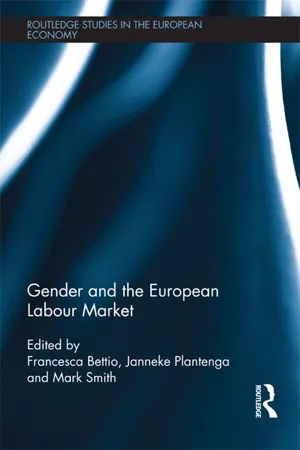
- 248 pages
- English
- ePUB (mobile friendly)
- Available on iOS & Android
eBook - ePub
Gender and the European Labour Market
1 A new vision for gender equality in Europe?
More than a decade into the twenty-first century, the issue of gender equality remains important in the European Union. Without a clear analysis of gendered processes in paid and unpaid work, policy making, and structural change, we cannot fully grasp the performance of European labour markets over the last quarter-century, nor the impact of the economic crisis that is still with us, or the challenges that will face Europe in the coming decades. Gender gaps are still visible in almost all areas of economic life within the EU and even if some gaps are closing, for example in relation to employment rates, new gaps are emerging and others persist, for example in the job quality domain. Yet on the international scoreboard of gender equality, the European Union fares moderately well. Its Nordic members consistently feature among the top ten countries for gender equality in three of the latest worldwide indices of gender equality. And if we take the simple average of each index across EU member countries, the European Union performs roughly as well as the United States and better than Japan, though worse than Australia.1
European social policy ought to be given part of the credit. Gender equality has always been a constituent part of the European Social Model, although the focus and the actual policies may have differed over time (for an overview, see Rees 1998). The principle of equal pay for equal work was there from the very beginning, although the emphasis on equal wages was primarily inspired by the fear of unfair competition between men and women rather than any concerns about inequality per se. Over time the focus shifted towards positive action in acknowledgement of the fact that specific programmes are needed in order to overcome some of the barriers that impede equality. Positive-action programmes should have enabled women to compete more effectively in the European labour markets, but they actually proved unable to widely and effectively challenge the existing socio-economic framework. This very challenge was at the core of the third and most radical approach, gender mainstreaming, which was brought into European policy in the mid-1990s. Policies based on gender mainstreaming are premised on the recognition that efforts to improve the position of women in the labour market should no longer be seen as a separate policy item. Rather, an embedded approach is advocated in which gender issues form an integral part of any major labour market policy. At a more practical level, this also implies that male behaviour at work should not be seen as the standard against which to define female atypical work.
Since the turn of the century, however, it is less clear whether gender equality has a defined focus. Actual measures changed in content and over time, and the transformative agenda of gender mainstreaming narrowed, with a tendency for policies not to be grounded in a discourse about gender and equality but rather in an analysis of economic efficiency. The launch of the European Employment Strategy (EES), in full swing at the 1998 Luxembourg Jobs Summit, conferred a much stronger emphasis on increasing the female participation rate as a means to promote gender equality and social inclusion, but also as a way to increase economic competitiveness and to broaden the tax base of European welfare states. An ageing European population has put further pressure on attempts to attract more women into the labour market. If Europe wants to expand its potential for growth and ensure sustainability of pensions and welfare benefits, it must be able to count on higher employment rates for older workers and women.
Overall, past developments and the changing policy discourse might be rated rather positively from the standpoint of women's emancipation. Paid work generated access to income, social security, power, independence and a sense of purposefulness. At the same time, however, the economic imperative to increase female labour employment has resulted in a rather instrumental vision of gender equality. Gender equality becomes a means to the end of higher female participation, which in turn is required to keep the economies of the EU Member States healthy and to feed the EU social model. One of the side-effects of this instrumental vision is that the gendered division of paid and unpaid work is side-stepped or downplayed. Women still perform most of the unpaid work, as a result of which their position within the labour market remains fundamentally different from that of men. Brought to the labour market in greater numbers, they are still too likely to be trapped into part-time, flexible and marginal jobs. The position of gender equality in the EES is an illustration that equality goals may now be more fragile within wider policy making at the EU and nation-state level. The rallying cry of ‘more and better jobs’ that launched the EES seems far away from the current focus on the quantity of jobs, just as the position of equality as a social and democratic goal has withered to a largely instrumental approach. This approach and the accompanied shift of focus from job quality to job quantity have renewed support for the view that equality stands in opposition to economic efficiency. The question therefore arises whether the economic case for gender equality is still strong enough to effectively challenge this view. In Chapter 2, Smith, Akram-Lodhi and Bettio survey the literature to provide the answer.
As the authors clarify early on in the chapter, the economic case is different from the business case. The latter has recently taken centre stage in topical debates about the gains from a diversified workforce or from a more balanced representation of women in company boards. The business case draws attention to the benefits that firms can reap from equality practices that also suit organisational objectives. The economic case identifies advantages of gender equality that go beyond individual firms to accrue at the macroeconomic level, often in the guise of positive externalities. The economic case has been widely advocated for developing countries, giving rise to a considerable body of literature. Fewer contributions have focused on developed countries and on Europe in particular. Nevertheless, the authors’ choice in reviewing the literature has been to prioritise contributions on developed countries, in line with the European focus of the present volume.
Core arguments on the supply side are that investing in policies that narrow labour market gaps between men and women yields positive growth returns via higher female labour market participation, full exploitation of human capital and the removal of rigidities caused by segregated skill formation and employment choices (although segregation may boost or protect female employment in the short run). On the demand side, raising female earnings may enhance human and social capital, given women's higher propensity to spend on children's development. For those who believe it is time to prioritise well-being rather than simply growth, there is evidence that narrowing gender gaps in paid and unpaid work also increases well-being. In the UK, for example, employment appears to boost life satisfaction among men and women, while care of children and adults tends to decrease satisfaction among women. Furthermore, a dual-earner pattern is the best insurance against income shocks, which increases well-being of all family members in the presence of risk aversion. Evidence has also accumulated for some time now to suggest that another important spin-off of gender equality is demographically balanced growth – that is, the ability to sustain female employment and fertility at the same time. In all these cases actual dividends depend on institutions and the choice of policies: one telling example in this respect is when fiscal systems tolerate a large informal sector, thus lowering fiscal and GDP dividends from higher female employment. Smith, Akram-Lodhi and Bettio find that, while not conclusive, the evidence suggests a case for the economic benefits of gender equality.
Any advancement towards a goal benefits from stocktaking and monitoring progress. This is the basic rationale for developing reliable instruments to measure and compare the actual level of gender equality in the different EU Member States. Equally important is the opportunity to forge a measure directing attention to the gender equality concerns that ought to lie at the heart of the European Social Model. In Chapter 3, Plantenga and Remery view Nancy Fraser's ideal of the ‘universal caregiver’ as the best expression of such concerns and the European Union Gender Equality Index (EUGEI) as best at translating into actual scores the degree to which each EU country adheres to Fraser's vision.
In updating the EUGEI and comparing its outcomes with those from its international companions, the authors guide the reader through the algebra of the various measures, but also the philosophical ideals of gender equality underpinning the calculations. The findings show considerable convergence between the EUGEI and the other indices in identifying countries at the top of the within-Europe ranking. There is more variability in the bottom group of countries, but Southern and Eastern European countries tend to feature more frequently at the lower end. The findings also confirm that the priority for Europe is to level gender equality upwards by reducing the considerable distances that still separate its member countries. As the authors conclude, ‘there is still a world to win if gender equality is taken seriously’.
The universal caregiver may serve as an ideal precisely because the largest gender asymmetries are still to be found in care work, paid or unpaid. The next four chapters review and analyse new trends in care and work patterns in Europe today. Chapter 4 focuses on the extent of unpaid work and the different ways of measuring it. With women taking the task of reconciliation primarily upon themselves, it is unsurprising that the sharing of unpaid housework and care has been slow to change. Francavilla, Giannelli, Mangiavacchi and Piccoli resort to harmonised time used data for Europe in combination with EU-SILC panel data to tell a story that is partly familiar and partly new. The more familiar part recounts the European variety of the gender asymmetry in household tasks. For example, here we find confirmation that in all European countries but Sweden, total working time (paid plus unpaid) is higher for women, with Italy recording the largest amount of daily unpaid work among women, while the UK and Poland top the ranking for unpaid, female childcare time. Among the less familiar findings is the fact that the gender gap in (unpaid) childcare time rises with the level of education since childcare hours increase among the well educated, and so disproportionately among women.
The specific contribution of Chapter 4, however, lies elsewhere. The authors estimate the value of unpaid work for men and women in the 25 EU countries represented in the EU-SILC panel. Alternative estimation methodologies are extensively discussed, which may be appreciated by readers interested in satellite accounts (Ironmonger and Soupourmas 2009). The main finding is that unpaid family work accounts for between 27.7 and 36.5 per cent of EU GDP, depending on the choice of estimation. This order of magnitude is impressive and issues a warning that any policy which ignores or underestimates unpaid family work is bound to miss economic efficiency. An additional finding is that there is no clear-cut relation between economic development in GDP terms and the value of unpaid family work. Clearly, history and culture matter and ought to be taken on board in any economic analysis or policy formulation bearing on the intra-household division of labour.
Issues of unpaid work increasingly encroach upon issues of flexibility in paid employment. Chapter 5 focuses on the relationship between flexibilisation and equal opportunities as the last decades witnessed an increased emphasis on the importance of flexible working arrangements. On the demand side of the labour market, increased employment flexibility is deemed to be a vital element in the efforts to reduce European unemployment; the current crisis has been used to underline this argument. On the supply side, flexible working arrangements may be seen as a response to the growing demand of employees for leisure and/or caring time. This trend is connected with the growing diversity of lifestyles and the rise of dual-earner families. Women, especially, have expressed their interest in tailor-made working time arrangements matching their personal needs for flexibility. Yet, as Plantenga and Remery state in Chapter 5, the relationship between flexible working time arrangements and gender equality is rather ambivalent, as a disproportionate engagement of women in flexible working arrangements might also entail gender inequality in income, responsibility and power. Drawing on comparative data, the authors chart the different configurations of flexibility and gender equality within the EU and assess the different realities from an equal opportunities point of view. The main message is that there is no fixed relationship between the two dimensions. Put differently, policy matters and employment flexibility at work may be organised in a more or less gender-equal way.
In comparison with employment flexibility, suitable childcare services have more pros than cons, but this still remains a matter for debate. Within the context of the European Union, there is growing awareness of the importance of formal care strategies towards children, especially from a work/family point of view. Yet there is no common European policy in this respect. In Chapter 6, Plantenga and Remery illustrate the highly diversified European scene with respect to employment patterns and reconciliation policies among EU Member States. Although most EU Member States emphasise the importance of a higher female employment rate, each country appears to have its own unique care infrastructure, consisting of services and facilities such as leave arrangements, daycare centres, kindergartens, family-type care arrangements, childminders at home, (pre)school education system, etc. Despite the diversity, the results bear out a certain clustering. Some countries, most notably the Scandinavian ones, but also France, Belgium and Slovenia, combine rather high female employment rates with a well-developed system of leave arrangements and affordable childcare facilities. Other countries, especially within the Mediterranean area, demonstrate a low female employment rate and a low level of services, with most parents relying on informal solutions. The Eastern European countries stand out with high (but declining) female employment rates. In these countries low availability of childcare services is combined with very long leaves. A fourth cluster seems to include the UK, Ireland and the Netherlands. In these countries, the female employment rate is relatively high, whereas the reconciliation policies are relatively underdeveloped. Here the flexible labour market and specific working time models seem to act as an alternative to an explicit reconciliation policy. The specific policy mixture has, of course, an important impact on the lives of men and women. Despite all the effort and despite all the improvements, the reconciliation of work and private life still remains problematic for a large part of the European workforce.
While some progress has been made in the EU towards a coherent approach to childcare, this is less true for eldercare, where the different countries share a marked transition from institutional to home care, as well as a growth in services, but pathways differ considerably from one country to the next. In Chapter 7 Simonazzi and Picchi examine key developments in this sector in European countries over the past 10–20 years. They investigate the different strategies that were enacted to resolve the trade-off between providing good-quality care and making it affordable to families, show how different answers to this trade-off affected employment in the sector, and conclude that some subsidisation is needed if formal and regular employment with decent working conditions are to be created. Contrast the cases of France and Belgium with that of Italy for an illustration. Like other Mediterranean countries, Italy has relied heavily on migrant care workers in eldercare, mostly women, enacting repeated but ‘ad hoc’ ‘regularisations’ to convert informal employment relations into regular, formal ones. Paradoxically, this kept bringing additional illegal migrants into the country with the expectations that they would eventually be given some regular status, and with the consequence of pushing wages, working conditions and quality of care down to what Simonazzi and Picchi categorise as a ‘low road’ to employment and care. Belgium and France have adopted an integrated approach which combines subsidising the cost of care workers to families and firms by setting up institutional machinery that helps demand meet supply, offers training and sets and monitors professional standards. In the Belgian case the extent of the subsidy is high, with the government contributing almost two-thirds of the total labour costs. The interesting finding, however, is not only the success of the Belgian and French approach in terms of formal employment creation, but also the fact that, in Belgium for example, the final cost to public finances is 40 per cent lower than the original disbursement by the government (thanks to lower unemployment benefits and higher tax receipts and social contributions). The central message of Chapter 7 may thus be summarised as follows: investing in good-quality care and employment pays for itself to a considerable extent.
In the third part of the book, the emphasis changes from trends in work and care towards policy developments. The economic crisis in Europe has highlighted the weaknesses of the EES in relation to employment and equality goals. This major policy initiative goes back to the Delors’ White Paper in 1993, was launched in 1997 and was replaced by the so-called 2020 Strategy in 2010. In Chapter 8 Villa elaborates the view that the EU equality agenda for the labour market has largely been instrumental to employment goals, and takes it further. She argues that actual policy commitment to gender equality waned as the original employment strategy was first revised in the attempt to enhance effectiveness and finally dismissed in favour of a new agenda. Nesting the evolution of gender equality measures within the deployment of the employment strategy, Villa tells a story of progressive retrenchment. Gender equality featured prominently in the first stage of the EES. It was made into one of the four ‘founding pillars’ of the EES and was soon translated into a demand on Member States that each and every major labour market policy be brought in line with equality goals and targets – gender ‘mainstreamed’ in the terminology of the EC. The second stage coincides with the first revision of the EES. Numerical targets were formulated for female employment and childcare coverage, but the gender equality pillar was downgraded to a less consequential ‘guideline’, though the emphasis on mainstreaming was preserved. In the third and final stage the gender equality guideline disappeared, to be replaced by ‘scattered references … to the need to close gender pay gaps, to promote women's employment, and to expand childcare’. Villa's story ends with the implementation of the new 2020 Strategy, the de facto separation between the equality and the employment agendas and many question marks on actual commitment to the gender equality goals first outlined at the inception of the EES.
In Chapter 9 Bettio and Veraschachagina narrow down the policy focus from the EES strategy to taxation and are thus able to analyse policy options in some detail. The primary objective of the authors is to audit current European tax-benefit systems from a gender perspective and ascertain if and how the fiscal leverage has been used to foster female employment. The authors rely primarily (not exclusively) on the OECD tax-benefit model to simulate fiscal outcomes, and on the related country files to provide harmonised fiscal data. They find that tax-benefit systems still retain a variety of gender biases that may discourage female employment, undermine women's financial independence and positively encourage a traditional division of labour within the household.
Perhaps the best-known bias is the so-called second or secondary-earner bias which stems from joint taxation (i.e. where the ...
Table of contents
- Cover Page
- Half Title page
- Title Page
- Copyright Page
- Contents
- List of illustrations
- Notes on contributors
- Preface
- Acknowledgements
- 1 A new vision for gender equality in Europe?
- Part I The economics of gender equality
- Part II Care and work in Europe today
- Part III Policy Promoting change or eroding equality?
- Index
Trusted by 375,005 students
Access to over 1.5 million titles for a fair monthly price.
Study more efficiently using our study tools.
Frequently asked questions
Yes, you can cancel anytime from the Subscription tab in your account settings on the Perlego website. Your subscription will stay active until the end of your current billing period. Learn how to cancel your subscription
No, books cannot be downloaded as external files, such as PDFs, for use outside of Perlego. However, you can download books within the Perlego app for offline reading on mobile or tablet. Learn how to download books offline
Perlego offers two plans: Essential and Complete
- Essential is ideal for learners and professionals who enjoy exploring a wide range of subjects. Access the Essential Library with 800,000+ trusted titles and best-sellers across business, personal growth, and the humanities. Includes unlimited reading time and Standard Read Aloud voice.
- Complete: Perfect for advanced learners and researchers needing full, unrestricted access. Unlock 1.5M+ books across hundreds of subjects, including academic and specialized titles. The Complete Plan also includes advanced features like Premium Read Aloud and Research Assistant.
We are an online textbook subscription service, where you can get access to an entire online library for less than the price of a single book per month. With over 1.5 million books across 990+ topics, we’ve got you covered! Learn about our mission
Look out for the read-aloud symbol on your next book to see if you can listen to it. The read-aloud tool reads text aloud for you, highlighting the text as it is being read. You can pause it, speed it up and slow it down. Learn more about Read Aloud
Yes! You can use the Perlego app on both iOS and Android devices to read anytime, anywhere — even offline. Perfect for commutes or when you’re on the go.
Please note we cannot support devices running on iOS 13 and Android 7 or earlier. Learn more about using the app
Please note we cannot support devices running on iOS 13 and Android 7 or earlier. Learn more about using the app
Yes, you can access Gender and the European Labour Market by Francesca Bettio,Janneke Plantenga,Mark Smith in PDF and/or ePUB format, as well as other popular books in Business & Business General. We have over 1.5 million books available in our catalogue for you to explore.