eBook - ePub
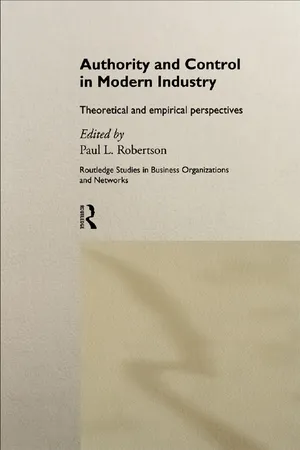
Authority and Control in Modern Industry
Theoretical and Empirical Perspectives
- 264 pages
- English
- ePUB (mobile friendly)
- Available on iOS & Android
eBook - ePub
About this book
This book takes a variety of theoretical and empirical approaches to the issue of organization and authority in the modern corporation. Including contributions from scholars in the US, Germany and Japan, it considers such relations, and the possible advantages of family ownership. The book combines historical and contemporary case studies from a ra
1
THE RISE OF THE FACTORY SYSTEM IN BRITAIN
Efficiency or exploitation?
S.R.H.Jones
Introduction
One of the most striking developments to have occurred during the Industrial Revolution in Great Britain was the rise of the factory system. Until the closing decades of the eighteenth century the majority of manufactured goods were produced by the domestic or putting out system. At the heart of the domestic system was the cottage workshop where the domestic artisan, often assisted by journeymen, apprentices and family members, used simple tools to perform one or more stages of the manufacturing process. The materials processed might belong to the artisan but they were frequently supplied by a merchant capitalist who paid for the work to be done on a piece rate basis. By 1871, however, the situation had radically changed, for the bulk of manufactured goods was now produced in the factory. This was certainly true for textiles, by far the largest single source of employment, whilst considerable quantities of pottery, hardware and other items of consumption also came from the factory (Usher 1921:362). The control of production had also changed, the role of the domestic artisan being taken over by the manufacturer who now supplied the plant and machinery as well as the materials and directed a factory labour force that might number hundreds of workers.
Although factories came to dominate production in many trades during the course of the nineteenth century, substantial manufacturing activity continued to take place elsewhere. Even in the cotton industry, the archetypal factory industry, outworkers were weaving cloth on handlooms well into the second half of the nineteenth century, while for woollens the spinning jenny and handloom continued to be employed in homes and workshops even longer. In some trades, such as garment manufacture, outwork was never entirely superseded. The flexibility conferred by a mixture of factory production and outwork was welcomed by most factory masters as the existence of a corps of outworkers/small subcontractors enabled them to cope with short runs or fluctuations in demand without incurring the fixed and quasi-fixed costs associated with factory production. Moreover, outwork and subcontract labour possessed the advantage that it was generally cheap, especially when it included large numbers of women and children (Jones 1987:87–8; and Hudson 1992:31)
Yet it would be wrong to view the domestic and subcontractors’ workshops that existed in mid-Victorian England as little more than marginal units of production. It is quite clear that in a number of trades, particularly those catering for a growing body of middle-class consumers who typically placed a premium on quality, craftsmanship and fashion, the small workshop represented the optimal unit of production (Samuel 1977:56–70). This was the situation in the small-arms trade where the market for sporting guns remained the preserve of small makers who relied extensively on subcontract and outwork. Large military orders for cheap, standardised products, on the other hand, were filled by firms such as the Birmingham Small Arms Company which operated a large mechanised factory at Small Heath especially to meet this segment of the market (Timmins 1967:430–1; Allen 1966:116–19).
The relationship between factory, workshop and outworker during the process of industrialisation was thus an exceedingly complex one. Where production might be located was the result of interaction between a variety of factors, including the nature of technology, the characteristics of the market, and relations between capital and labour which, on occasions, might block technical change (Jones 1987:85; Robertson and Alston 1992:330–2). Nevertheless, there was a general trend towards increasing factory production for most of the nineteenth century.
What exactly constituted a factory is difficult to say. Indeed, the debate over the definitional characteristics of the factory is almost as old as the factory system itself. Most early commentators believed that the presence of power-driven machinery was an important distinguishing feature of the factory. Thus in 1835 Andrew Ure wrote
The term Factory, in technology, designates the combined operations of many orders of work people, adult and young, in tending with assiduous skill a system of productive machines continuously impelled by a central power.
(Ure 1967:13)
Not all were persuaded that plants using power-driven machinery should be necessarily described as a factory. ‘I am engaged in scribbling, carding and fulling,’ complained Joshua Robinson, the operator of a West Riding woollen mill, ‘it is no factory—neither am I manufacturer but work the mill for country and domestic manufacturers.’ Early legislators, it seems, were not in the least concerned whether mill operators owned the materials they processed or not, deeming factories and mills to be synonymous for the purposes of inspection and regulation (Jenkins 1975:11–13). Nevertheless, they did agree that the use of powered machinery was an important feature of factory production, and factory inspectors were instructed to collect details of the nature and extent of power employed.
The Factory Acts were gradually extended to cover a wide range of plants, many without machinery, and this necessarily gave rise to doubts about the usefulness of defining factories in strictly technological terms. Cooke-Taylor, writing in 1891, argued that the term ‘factory’ should be applied to all plants
where several workmen are gathered together for the purpose of obtaining greater and cheaper conveniences for labour than they could procure individually in their own homes for producing results by combined efforts which they could not accomplish separately; and for saving the loss of time which the carrying of an article from place to place during the several processes necessary to complete its manufacture would occasion.
(Cooke-Taylor 1891:1)
Scale and efficiency, therefore, not technology, should be the defining characteristics of the factory.
Given the variety of definitions, it is not surprising that there should be some disagreement concerning the origins of the factory system. Contemporaries, who marvelled at the complexity of machinery introduced by the likes of Thomas Lombe and Richard Arkwright, were inclined to regard the spread of factories as the necessary concomitant of advances in technology. They were well aware that not all factories contained machinery, and that sometimes masters adopted factory production merely to sweat labour. For the majority, however, the triumph of the factory system was inextricably linked to the introduction of new technology (House of Commons Committee on the Woollen Manufacture of England 1806:9–11; Reports from Assistant Commissioners, Handloom Weavers 1840:434–58; Ure 1967:12–13; Wing 1967: v-viii).
Economic historians, too, have tended to point to the technological origins of the factory system. Mantoux, writing at the beginning of the twentieth century, was quite unequivocal. ‘The factory system’, he states, ‘was the necessary outcome of the rise of machinery’ (Mantoux 1961:246). Most have followed in the Mantoux tradition. Heaton, whose research was conducted a few years later, concludes:
the major part of the economic advantage of the factory springs from the use of machinery capable of performing work quickly, and the use of power which can make machinery go at high speed.
Until these elements of speed became possible, the factory system did not possess any great advantage over the cottage industry.
Until these elements of speed became possible, the factory system did not possess any great advantage over the cottage industry.
(Heaton 1965:352)
And finally David Landes, in a recent restatement of his position: ‘No, what made the factory successful in Britain was not the wish but the muscle: the machines and the engines. We did not have factories until these were available, because nothing else would have overcome the advantages of dispersed manufacture’ (Landes 1986:606–7).
The view that the rise of the factory system was due to the superior efficiency of the new factory-based technology has attracted increasing criticism since the mid-1970s, especially from those who are not economic historians. Stephen Marglin, for example, writing from the perspective of the New Left, focused on the exploitative aspects of the factory system. According to Marglin, factories were introduced not because they were technologically superior, but because they enabled capitalists to control the work process more closely and thereby extract greater output from workers for a given cost. Capitalists (who Marglin suggests were irrelevant to the productive process, be it the putting out or the factory system) were thus able to obtain an even ‘larger share of the pie’ (Marglin 1974:62).
New institutional economists, while rejecting the exploitation thesis of the New Left, have also questioned the technological underpinnings of the factory system. Oliver Williamson, for example, argues that putting out was superseded by the hierarchically organised factory because the latter economised on transactions costs. Economies were achieved as factory production enabled transportation and inventory costs to be cut, embezzlement to be reduced and manufacturers to respond more readily to changes in fashion and demand. For Williamson, therefore, the main reason why the factory system was adopted was that it was organisationally more efficient than putting out and other earlier modes of production (Williamson 1980:28–9).
These challenges to traditional explanations for the rise of the factory system have not remained unanswered. Landes, for example, has questioned the empirical basis of Marglin's work, arguing that, while Marglin's argument is logically elegant, it explains what might have happened rather than what actually did happen (Landes, 1986). Williamson has been criticised on a number of counts, including the use a model that uses dubious aggregative techniques, a lack of appreciation of the nature of British labour markets, and other empirical deficiencies (Jones 1982, 1983). Attempts by Rick Szostak to resuscitate Williamson's work by arguing that a fall in transport costs led to a shift in comparative advantage from putting out to the hand factory in the late eighteenth century are subject to similar methodological and empirical criticism (Jones, 1992). Rather more satisfactory has been Gregory Clark's recent work linking the introduction of new technology with a somewhat involuntary increase in work intensity, indicating that, in the modern factory system, efficiency and exploitation often went hand in hand (Clark, 1994).
That the debate has continued unresolved for almost twenty years is not entirely surprising, for there is disagreement as to what is actually meant by ‘the factory system’, when it is supposed to have emerged, whether the empirical evidence has been properly addressed, and what was typical and what was not. Before we examine the merits of the various arguments, therefore, it might be helpful to establish the broad outlines of factory development in the centuries leading up to and including the Industrial Revolution.
Factories before the Industrial Revolution
Factories that employed scores of workers using simple hand technology can be found in England as early as the sixteenth century. The most celebrated of these, perhaps, are the woollen textile factories of William Stumpe and Jack of Newbury, but there were similar establishments elsewhere (Patterson 1967:151–2). How cost effective these early factories were is difficult to say, although their ability to survive may well have been due to the unusual demand conditions of the time. Suffice it to say that they disappeared in the second half of the sixteenth century, the collapse in demand together with anti-factory legislation probably hastening their demise (Heaton 1965:90– 1).
For the next two centuries the putting out system was increasingly adopted by those industries where processes were divisible, technology was simple and semifinished materials were not costly to transport. Rural labour surpluses encouraged this development, with a system of outriders and agents emerging that enabled capitalists to put out work to underemployed and unemployed labour throughout the countryside. Putting out work was not only confined to the countryside, for a number of urban trades came to rely on outwork too, but it was cheap rural labour that underpinned the growth of the putting out system. In some industries, technological non-separabilities and other characteristics meant that production in the domestic workshop was inappropriate. Manufacturers of iron, porter, glass, paper and sea-salt, for example, required plants of a certain scale if they were to realise production economies. For many goods, however, the small workshop with its simple technology constituted the least-cost mode of production. Certain stages of the manufacturing process, such as fulling cloth, might require more capital-intensive technology, but it was often possible to integrate this within the broad structure of domestic production.
Putting out offered significant advantages to the merchant capitalists who organised production. Labour was usually cheap, fixed costs were low, an extensive division of labour could be practised, and, in times of depression, production could be easily curtailed. Despite these advantages, however, the hand factory or manufactory, which utilised essentially the same technology as that employed by outworkers, began to appear in a variety of trades from the end of the seventeenth century onwards. The term ‘proto-factory’ has been coined by Freudenberger and Redlich to describe these technologically simple factories but, given its wider connotations within the proto-industrialisation debate, it will not be adopted here (Freudenberger and Redlich 1964:381).
Some of the earliest factories were established as a means of setting the poor to work. The view that the poor might be usefully employed by the parish gained ground during the course of the seventeenth century, and by 1700 pauper factories run by the parish had come into being in London, Bristol and elsewhere (Furniss 1957:108–10; Thirsk and Cooper 1972:301–2). Philanthropists also set up factories in order to alleviate the twin evils of poverty and unemployment (Heaton 1965:354–5). The history of pauper factories, however, is scarcely a glowing testament to their efficiency. A study of forty-five workhouses-cum-factories undertaken in 1725 revealed that none earned sufficient to cover the costs of maintaining their inmates (Furniss 1957:108–9). Nevertheless, paupers continued to be set to work, often performing tasks in the workhouse on materials supplied by a manufacturer and under the supervision of an agent. This was particularly common in that archetypal factory industry, pin-making, where manufacturers continued to contract with overseers of the poor (and with gaols) to supply work well into the nineteenth century.
An increasing number of manufacturers also employed paupers on their own premises (Rose 1989:5–29). One of the earliest factories in the hosiery industry, that of Samuel Fellowes of Nottingham, employed more than forty parish apprentices by the early 1720s. Few other Nottingham hosiers followed suit, not even in the 1760s when competition was at its fiercest, and domestic outwork continued to dominate the hosiery trade until the 1840s (Aspin and Chapman 1964:34; Nelson 1929–30:469).
At the same time that experiments were being carried out with pauper factories, a growing number of hand factories came into being that relied on free labour. One of the earliest was that established by Ambrose Crowley at Winlaton, near Newcastle, which was set up in 1691 to manufacture nails. Expansion soon followed with a new, vertically integrated plant being erected in nearby Swalwell, and ultimately the firm possessed blast furnaces, slitting mills and a range of large workshops producing numerous items of hardware and ships’ chandlery. The Crowley enterprise was undoubtedly ‘a giant in the age of pygmies’. It also represented an attempt to break new ground by extending factory production to a hardware industry hitherto organised on traditional domestic lines. Yet in spite of the advantages of a reduction in embezzlement, an improvement in scheduling, better quality control and the evident profitability of the Crowley empire, few manufacturers sought to emulate Ambrose Crowley. Thus most items of hardware continued to be produced in small domestic workshops for a century or more. Indeed, the Crowley ironworks found it increasingly difficult to compete with domestic nailmakers of the West Midlands, the production of nails finally ceasing at Winlaton in 1816 (Flinn 1962:94, 184–93, 252–4).
There were, nevertheless, examples of factory production in other hardware trades, especially in the production of fancy boxes and japanned ware. Among the first manufactories to appear was that of Charles Osborne, a tobacco box maker of Wolverhampton who set to work ‘a large shop of workmen’ during the 1720s. Others in the Birmingham district also gathered workers into the factory, including John Baskerville—who, by 1745, employed 300 hands in japanning—and the celebrated firm of Boulton and Fothergill. Yet in spite of contemporary interest in large factories, few manufacturers were prepared to adopt them. As Marie Rowlands points out: ‘[t]he large workshop with elaborate machinery and numerous employees aroused the admiration of visitors in the mid-eighteenth century precisely because it was exceptional. Only a minority of the workforce were employed in such places’ (Rowlands 1975:155–7). This continued to be the case well into the nineteenth century.
Technology and the factory
At the same time that the hand factory was beginning to make an appearance in the Midlands, a very different type of factory was coming into being in the silk trade. This took the form of a multi-storeyed, water-powered silk throwing mill. The first English silk mill was erected in Derby by Thomas Lombe who, with his brother John, had acquired, improved and patented Italian tech...
Table of contents
- Cover Page
- Title Page
- Copyright Page
- Figures
- Tables
- Contributors
- Acknowledgements
- Introduction
- 1: The Rise of the Factory System in Britain
- 2: The Coevolution of Technology and Organisation in the Transition to the Factory System
- 3: Class Structures and the Firm
- 4 Knowledge, Information and Organisational Structures
- 5: Technological Change, Transaction Costs, and the Industrial Organisation of Cotton Production in the US South, 1950–1970
- 6: The Maintenance of Professional Authority
- 7: Men and Monotony
- 8: Management and Labour in German Chemical Companies Before World War One
- 9: Buddenbrooks Revisited
Trusted by 375,005 students
Access to over 1.5 million titles for a fair monthly price.
Study more efficiently using our study tools.
Frequently asked questions
Yes, you can cancel anytime from the Subscription tab in your account settings on the Perlego website. Your subscription will stay active until the end of your current billing period. Learn how to cancel your subscription
No, books cannot be downloaded as external files, such as PDFs, for use outside of Perlego. However, you can download books within the Perlego app for offline reading on mobile or tablet. Learn how to download books offline
Perlego offers two plans: Essential and Complete
- Essential is ideal for learners and professionals who enjoy exploring a wide range of subjects. Access the Essential Library with 800,000+ trusted titles and best-sellers across business, personal growth, and the humanities. Includes unlimited reading time and Standard Read Aloud voice.
- Complete: Perfect for advanced learners and researchers needing full, unrestricted access. Unlock 1.5M+ books across hundreds of subjects, including academic and specialized titles. The Complete Plan also includes advanced features like Premium Read Aloud and Research Assistant.
We are an online textbook subscription service, where you can get access to an entire online library for less than the price of a single book per month. With over 1.5 million books across 990+ topics, we’ve got you covered! Learn about our mission
Look out for the read-aloud symbol on your next book to see if you can listen to it. The read-aloud tool reads text aloud for you, highlighting the text as it is being read. You can pause it, speed it up and slow it down. Learn more about Read Aloud
Yes! You can use the Perlego app on both iOS and Android devices to read anytime, anywhere — even offline. Perfect for commutes or when you’re on the go.
Please note we cannot support devices running on iOS 13 and Android 7 or earlier. Learn more about using the app
Please note we cannot support devices running on iOS 13 and Android 7 or earlier. Learn more about using the app
Yes, you can access Authority and Control in Modern Industry by Paul L. Robertson in PDF and/or ePUB format, as well as other popular books in Business & Business General. We have over 1.5 million books available in our catalogue for you to explore.