eBook - ePub
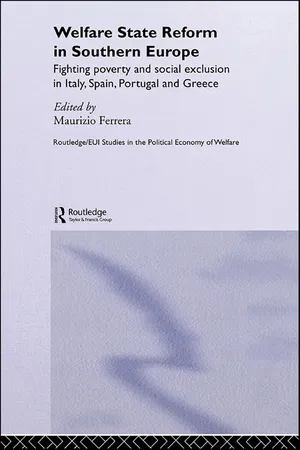
Welfare State Reform in Southern Europe
Fighting Poverty and Social Exclusion in Greece, Italy, Spain and Portugal
- 320 pages
- English
- ePUB (mobile friendly)
- Available on iOS & Android
eBook - ePub
Welfare State Reform in Southern Europe
Fighting Poverty and Social Exclusion in Greece, Italy, Spain and Portugal
About this book
This new study delivers a detailed analysis of the efforts being made to reduce poverty and social exclusion in Portugal, Spain, Italy and Greece. After an initial discussion of the 'southern model' of the welfare state, the situation of each country is clearly illustrated. This book also discusses how the experience of southern Europe might bear upon the situation of the East European accession countries. This is excellent reading for those interested in social change across Europe and beyond.
Information
1
Welfare states and social safety nets in Southern Europe
An introduction
Maurizio Ferrera
Welfare states and safety nets
The metaphor of the “safety net” was first coined by acrobats to designate a large, strong and flexible piece of fabric ready to catch them if they fell or jumped from their trapeze. Later it started to be used in the sphere of financial transactions and insurance markets in order to indicate clauses of basic guarantee for investors, often covered by legal contracts. In both cases, the metaphor suggests a sense of protection: from involuntary accidents, in the first case; from the unforeseeable hazards of markets, in the second. It also evokes the idea of a commitment: the pledge (a legal one, in the case of financial contracts) of a minimum security against potential failures.
In the past few decades, this evocative metaphor has been adopted by international social policy debates. The establishment of “social safety nets” has started to be advocated as a priority goal for many developing countries, in the framework of aid programmes sponsored or funded by international organizations such as the World Bank (Deacon 2000; Vivian 1995; World Bank 2000). In this context, the metaphor has been used to designate a set of compensatory measures meant to mitigate the shortterm negative effects of structural adjustment policies or severe conjunctural crises. But the term “social safety net” has also been increasingly used with reference to the experience of Organization for Economic Cooperation and Development (OECD) countries, as a possible novel brand of traditional social assistance policies in general and for means-tested, “last resort” schemes in particular, such as minimum income schemes.1 These schemes do in fact respond to situations of “accidental fall”, often linked to market hazards, by offering basic protection to individuals and households as a matter of right (the “guarantee” aspect).
The link between the safety net notion and guaranteed minimum income schemes has grown particularly strong in Europe, in the wake of two distinct developments: (1) the emergence of a new generation of social assistance schemes at the national level, on the one hand; and (2) the increasing role and activism of the European Union in the social policy realm, on the other.2
As is well known, the modern welfare state emerged in Europe out of a long-standing tradition of localized and discretionary poor relief, codified in Northern Europe under specific “poor laws” (Alber 1982; De Swaan 1987). With the birth, consolidation and expansion of social insurance (whether of the universalistic, “Beveridgean” sort, or the occupational, “Bismarckian” sort), traditional ad hoc interventions of public relief gradually lost functional and financial salience in most countries, especially during the so-called Trente Glorieuses. Between the 1960s and 1970s, however, a new generation of social assistance schemes and benefits made their appearance, with two main objectives: (1) to fill the coverage gaps at the margins of the extant social insurance programs, in particular for some categories of people and for some new types of need; and (2) to establish a minimum guarantee—a safety net, precisely—for the whole citizenry, below which nobody would be allowed to fall.
The novelty of these new schemes and benefits in respect of the discretional social assistance of the past lies in their right-based nature. Protection is offered to individuals, conditional upon the assessment of a manifest need (selectivity) and on the impossibility of these individuals to cope with such need with their own resources (residuality). Eligibility is not linked to prior contributions, and funding typically comes from general revenues. Despite selectivity and residuality, the protection offered rests on subjective and judiciable rights and on codified administrative procedures, which orient and constrain public decisions on individual cases.
The poor elderly were among the first category to be targeted by this new generation of policies, through the establishment of “social pensions” open to all the aged who could not access ordinary, insurance-based benefits. The long-term unemployed, the disabled with special needs, single mothers, needy students have been other prominent social groups for which categorical schemes of means-tested social assistance have been set up in various countries. As regards the general “safety net”, the UK pioneered developments on this front by establishing a National Assistance scheme as early as in 1948 (subsequently re-labelled Income Support). But most countries have followed suit, introducing some sort of generalized minimum income guarantee between the 1960s and the 1990s, as a means of filling the gaps left by existing means-tested categorical schemes and thus contrasting situations of extreme indigence (Eardley et al. 1996; Guibentif and Bouget 1997).
The second development has been the increasing prominence of the issues of poverty and social exclusion on the agenda of the European Union and the Commission in particular. This development started during the 1980s, with the launch of three subsequent Poverty Programmes and the establishment, in 1990, of an Observatory on National Policies to Combat Social Exclusion. The turning point was, however, 1992: in that year, Recommendation 92/441 officially recognized that “social exclusion and the risk of poverty have become more prevalent and more diversified over the last 10 years” and, more importantly, invited the member states to institutionalize “the basic right of a person to sufficient resources and social assistance”, in order to be able to live in a manner “compatible with human dignity”. The presence of a generalized safety net was, in other words, indicated to be an essential ingredient of the European social model—in all its national institutional variants. In 1997, with the Treaty of Amsterdam, the fight against exclusion became an official objective of the EU and “the integration of persons excluded from the labour market” became an area in which the Community could support and complement the activities of the member states (Art. 137). In the context of the Lisbon strategy, in December 2000 a “social inclusion process” was eventually launched, based on the open method of coordination, aimed at promoting four ambitious objectives (known as the Nice objectives): (1) to facilitate participation in employment and access by all to the resources, rights, goods and services; (2) to prevent the risk of exclusion; (3) to help the most vulnerable; and (4) to mobilize all the relevant bodies. The launch of the social inclusion process has enhanced the symbolic visibility and the institutional salience of anti-poverty policies—and of minimum income schemes in particular—at both the supranational and national levels (Ferrera et al. 2002), underlining the importance not only of cash transfers, but also of accompanying measures favouring social and labour market integration.
The Southern European countries have played an active part in promoting the EU agenda on poverty and social exclusion. This is especially true of Portugal, which has played a pivotal role in the launch of the inclusion process during its Presidency in 2000. At the domestic level, however, policy innovation has been rather difficult in this area. For Italy, Greece, Portugal and Spain, the building of a safety net at the bottom of their welfare edifices has been (and still partly is) a very demanding challenge, for reasons which have to do with their socio-economic contexts, social and political cultures and the institutional configuration of their social policy regimes. Yet important reforms or at least experiments have been carried out in the past decade, which have created a more fertile ground for the consolidation of minimum income schemes and thus a more effective fight against poverty and exclusion (Moreno 2003).
The aim of this volume is to illustrate and discuss the Southern European path towards the establishment of a generalized social safety net within the welfare states of Greece, Italy, Spain and Portugal in the wider context of the traditional policies of social assistance and targeted benefits. The specific focus will be on reforms, experiments and debates with regard to the guarantee of a minimum income to individuals and households lacking sufficient resources. The experience of each country will be covered by a distinct chapter, organized around a common grid: welfare state development from a historical perspective; poverty trends and anti-poverty policies; and debates and initiatives in the field of minimum income. An additional chapter will illustrate developments occurring in the countries of Eastern and South Eastern Europe. This chapter will also discuss to what extent the experience of Southern Europe can provide useful “lessons” for these countries. The book is the final product of a research project on “Fighting Poverty and Social Exclusion in Southern Europe”, funded by the European Commission under the Fifth Framework Programme.3 In the remainder of this Introduction, I will outline the overall context of our project, starting with a brief presentation of the features and problems of Southern European welfare, with specific reference to social assistance, then summarizing developments in the four national cases and finally drawing some comparative conclusions.
Southern European welfare and the delayed development of social assistance
The distinctiveness of Southern Europe with respect to other macro-areas of the continent has been highlighted by a rich historical and social science literature.4 The nations of Southern Europe have followed a specific path to modernization (in the broad sense of the concept) and still share a number of common traits in their cultural backgrounds and political economies. There are, of course, significant differences between the four countries of the region: the intra-area variation is certainly greater than in the Nordic context, though probably lower than in Central Continental Europe. It would be difficult to deny that the notion of “Southern Europe” has not only a geographical, but also a substantive, cultural and politico-economic connotation.
The idea that this area is distinct also as regards social policy and the labour market has come to be widely shared in recent debates.5 We can try to capture this distinctiveness by referring to the three grand achievements accomplished (or at least pursued) by the various OECD countries during the three decades after the Second World War (Scharpf and Schmidt 2000), i.e.:
- full employment with “good jobs” for all (men) who were expected to work for a living;
- social insurance of workers against the risk of sickness, invalidity, unemployment and old age, coupled with generous family benefits;6
- social assistance to prevent the poverty of those without other sources of support.
On each of these three crucial fronts, Southern Europe has indeed attempted to move in the direction followed by the other, more advanced countries. But this effort has encountered great obstacles and the policy solutions that were put in place in the 1960s and 1970s have occasionally worked to exacerbate, rather than overcome, these very obstacles.
As far as the first objective is concerned, i.e. the promotion of an inclusive “Fordist” labour market, the four Southern European countries have lagged chronically behind, both in terms of employment levels and in terms of an adequate supply of good jobs for those in employment.7This is partly due to a difference in starting conditions: in the 1940s and 1950s these countries were still predominantly based on agriculture and self-employment, with a very high incidence of the informal economy. The transition to industrial Fordism was much more complex than elsewhere and was still under way when the oil shocks hit the Western economies in the 1970s, increasing their vulnerability and structurally undermining the viability of Fordist arrangements as such. A number of institutional choices made during the Southern European transition to Fordism, however, set these countries on a somewhat distinctive labour market route, characterized by a pronounced insider-outsider cleavage. The highly protective employment regimes put in place for those working in the core sectors of the economy (e.g. the public sector and large industrial enterprises) operated as differentiating devices, gradually segmenting the Southern European labour markets into three juxtaposed sectors, hugely different in terms of working conditions and job security: (1) the “regular”; (2) the “irregular” or “peripheral”; and (3) the “underground” sectors (Ferrera 1996; Moreno 2000; Peréz-Diaz and Rodriguez 1994). The size and distinctiveness of the latter two sectors and the ensuing degree of polarization between guaranteed and non-guaranteed workers have seen no parallel elsewhere in Europe.
As far as social insurance is concerned, the four Southern European countries did proceed with the establishment and consolidation of the standard social insurance programmes but, again, following a rather distinct path (Ferrera 1996; Rhodes 1997). To begin with, social insurance co-evolved with a segmented labour market, and thus acquired its own degree of internal polarization: generous entitlements for the regulars, modest benefits for the irregulars, and only meagre crumbs (if anything at all) for those workers who were unable to establish any formal contact with the regular labour market. In addition, Southern European social insurance over-privileged from the very beginning the risk of old age (at least in terms of legal formulas) and reserved only a marginal role for family benefits. In line with the conservative-corporatist tradition, it also privileged transfers over services and promoted the proliferation of differentiated schemes, tied to occupational status. It has to be noted, however, that the link with the Bismarckian tradition was broken in the field of health care (Guillén 2002). All four countries established national health services during the 1970s and 1980s: a rather rare but very significant instance of “path shift”, which has worked to smoothen the profile of the welfare state edifice and has contributed to upgrading the allocative and distributive efficiency of social expenditure in these countries.
Social assistance and the fight against poverty have been, finally, the weakest front of achievement for our four countries—at least up to the late 1980s. The Southern European safety net evolved slowly, through a sequence of fragmented and mainly categorical additions (orphans, widows, disabled, poor elderly, etc.) with disparate rules and differentiated benefit amounts, with a low (if not altogether lacking) degree of integration between cash benefits and services and with wide holes in the overall fabric of public provision. It is therefore not surprising that poverty levels after transfers remain very high in Southern Europe: 22 per cent in Greece, 20 per cent in Italy and Portugal, 19 per cent in Spain, as against an EU average of 16.8 per cent (excluding Southern Europe) (see Table 1.1). As we shall explain below, the worst implications of such high poverty levels have been traditionally alleviated by strong ties of microsolidarity within the extended family—a defining trait of Southern European social life.
Poor anti-poverty performance is partly linked to the limited reach of those in a situation of economic need: in Greece and Italy, where the problem is the most serious, only about one-third of people in the lowest income quintile typically receive “social benefits other than pensions” (Marlier and Cohen-Solal 2000). Many poor households are ineligible for social assistance because they fail to fulfil the narrow conditions set out by the various categorical programmes. Needless to say, those affected by this syndrome include the largest groups of outsiders: the long-term unemployed, the new entrants into the labour markets, the irregulars and underground workers and—increasingly—immigrants.
Which factors explain the marginal role of social assistance within Southern European systems of social protection? Why have these countries paid little attention to the third grand objective of the (European) welfare state project? This is, of course, a central question: a detailed reconstruction of the dynamics responsible for this syndrome will be offered by each of the national chapters in this book. A summary answer can, however, be sketched at this stage.
The first factor that must be called into question is of a “developmental” nature. In all Bismarckian countries social assistance has tended to remain the Cinderella of social policy: minimum income schemes only saw the light of day in the 1970s and 1980s; Southern European welfare states are still in maturation and will eventually catch up—the argument goes—also in this field. Even though it contains a grain of truth, this developmental explanation is not fully adequate. The relative neglect of a comprehensive anti-poverty dimension in Southern Europe has in fact coincided with a steady growth of total social spending: if anything, as mentioned, certain social programmes (most notably pensions, es...
Table of contents
- Cover Page
- Title Page
- Copyright Page
- Illustrations
- Contributors
- Acknowledgements
- Abbreviations
- 1: Welfare states and social safety nets in Southern Europe: An introduction
- 2: Greece—fighting with hands tied behind the back: Anti-poverty policy without a minimum income
- 3: Italy—striving uphill but stopping halfway: The troubled journey of the experimental minimum insertion income
- 4: Spain—poverty, social exclusion and “safety nets”
- 5: Portugal—a virtuous path towards minimum income?
- 6: Poverty and the safety net in Eastern and South-Eastern Europe in the post-communist era
Trusted by 375,005 students
Access to over 1.5 million titles for a fair monthly price.
Study more efficiently using our study tools.
Frequently asked questions
Yes, you can cancel anytime from the Subscription tab in your account settings on the Perlego website. Your subscription will stay active until the end of your current billing period. Learn how to cancel your subscription
No, books cannot be downloaded as external files, such as PDFs, for use outside of Perlego. However, you can download books within the Perlego app for offline reading on mobile or tablet. Learn how to download books offline
Perlego offers two plans: Essential and Complete
- Essential is ideal for learners and professionals who enjoy exploring a wide range of subjects. Access the Essential Library with 800,000+ trusted titles and best-sellers across business, personal growth, and the humanities. Includes unlimited reading time and Standard Read Aloud voice.
- Complete: Perfect for advanced learners and researchers needing full, unrestricted access. Unlock 1.5M+ books across hundreds of subjects, including academic and specialized titles. The Complete Plan also includes advanced features like Premium Read Aloud and Research Assistant.
We are an online textbook subscription service, where you can get access to an entire online library for less than the price of a single book per month. With over 1.5 million books across 990+ topics, we’ve got you covered! Learn about our mission
Look out for the read-aloud symbol on your next book to see if you can listen to it. The read-aloud tool reads text aloud for you, highlighting the text as it is being read. You can pause it, speed it up and slow it down. Learn more about Read Aloud
Yes! You can use the Perlego app on both iOS and Android devices to read anytime, anywhere — even offline. Perfect for commutes or when you’re on the go.
Please note we cannot support devices running on iOS 13 and Android 7 or earlier. Learn more about using the app
Please note we cannot support devices running on iOS 13 and Android 7 or earlier. Learn more about using the app
Yes, you can access Welfare State Reform in Southern Europe by Maurizio Ferrera in PDF and/or ePUB format, as well as other popular books in Politics & International Relations & Politics. We have over 1.5 million books available in our catalogue for you to explore.