1 Think tanks and policy advice
Big Pluralistic America. It’s the noisiest political debating society in the world: a babble of voices airing contrary opinions on how this country should be run. For this democracy, where every view is permissible and each faction seeks to persuade – Republicans, Democrats, left, right and centrist. Lobbyists, journalists, scholars, religionists. And think tanks. Dissonant, protean, cacophonous, they are yeast in the ever-fermenting discussion.1
Public policy research, analysis, and engagement organizations (also known as think tanks) play a vital role in political and policy arenas at the local and national level in the United States. Their function is unique, as they provide public policy research, analysis, advice, and operate independently from governments and political parties. While the primary function of these nonprofit civil society organizations is to help government understand and make informed choices about issues of domestic and international concern, they also have a number of other critical roles, including:
- mediating between the government and the public;
- building confidence in public institutions;
- serving as an informed and independent voice in policy debates;
- identifying, articulating, and evaluating policy issues, proposals, and programs;
- transforming ideas and emerging problems into policy issues;
- interpreting issues, events, and policies for the electronic and print media, thus facilitating public understanding of domestic and international policy issues;
- providing a constructive forum for the exchange of ideas and information between key stakeholders in the policy formulation process;
- facilitating the construction of “issue networks”;
- providing a supply of informed personnel for the legislative and executive branches of government;
- challenging the conventional wisdom, standard operating procedures, and “business as usual” of bureaucrats and elected officials.
The activities involved in fulfilling these functions involve balancing research, analysis, and outreach. The range of activities that think tanks engage in include: framing policy issues; researching and writing books, articles, policy briefs, and monographs; conducting evaluations of government programs; disseminating their research findings (public testimony before Congress, media appearances, and speeches); organizing various outreach activities; creating networks and exchanges via workshops, seminars, and briefings; and supporting mid-career and senior government officials when they are out of office (being what I describe as a “government in waiting tank” or a “holding tank”).
Think tanks are a diverse set of institutions that vary in size, financing, structure, and scope of activity. There are currently 1,736 think tanks or political research centers in the United States, around half of which are university-affiliated institutions and approximately one-third of which are located in Washington, DC. Those think tanks that are not affiliated with academic institutions, political parties, or interest groups are described as freestanding or independent think tanks.
The 25 to 30 top think tanks in the United States have highly diversified research agendas that cover a broad range of policy issues on both the domestic and international fronts. However, since 1980 the vast majority of new think tanks are specialized. These “specialty” or “boutique” think tanks focus their activities on a single issue (i.e. global warming) or area of public policy (i.e. national security). There is a large constellation of progressive and conservative state-based think thanks that are also part of this general trend toward specialization.
Think tanks often play the role of insiders and become an integral part of the policy process, such as The RAND Corporation and The Urban Institute, which provide research and analysis for key agencies within the government. They can also act as outsiders in the mold of The Economic Policy Institute and The Heritage Foundation, which attempt to incorporate their ideas into policy by conducting research and analysis that is then aggressively marketed to policy elites and the public. There is often a clash within these institutions and in the policy community between those who believe that think tanks should be “scholarly and objective” and those who feel they must be “policyrelevant,” disseminating their research to policymakers in order to have any value. This is an age-old tension between the world of ideas and the world of policy. This tension is best expressed by Plato in the Republic when he writes, “There can be no good government until philosophers are kings and the kings philosophers.”2 The academic-oriented school believes that think tanks should adhere to academic research standards and focus on big-picture and longer-term issues, while the policy-relevance school believes that think tanks should concentrate on the needs of policymakers and current policy issues.
2 The history of think tanks in the United States
Think tanks have long played an important role in the formulation of domestic and international policy in the United States. The origins of think tanks can be traced to America’s Progressive-era traditions of corporate philanthropy, its sharp distinction between legislative and executive branches of government (which creates few barriers to entry into the policymaking process), the desire to bring knowledge to bear on governmental decision-making, and the inclination to trust the private-sector to “help government think.” As think tanks have grown in number and stature, scholars, and journalists have begun to examine more closely the many factors that have led to their proliferation:
- The division of power between the three branches (legislative, executive, and judicial) and levels (state and federal) of government.
- A political system that has weak political parties that exhibit little to no party discipline.
- A highly developed philanthropic and civil culture.
- A public that maintains a healthy distrust of public officials and prefers a limited role for government.
- Citizens’ proclivity to join and support interest groups rather than political parties to represent their interests and express their policy preferences.
- A political system that has many points of access.
- The public’s tendency to embrace independent experts over politicians or bureaucrats.
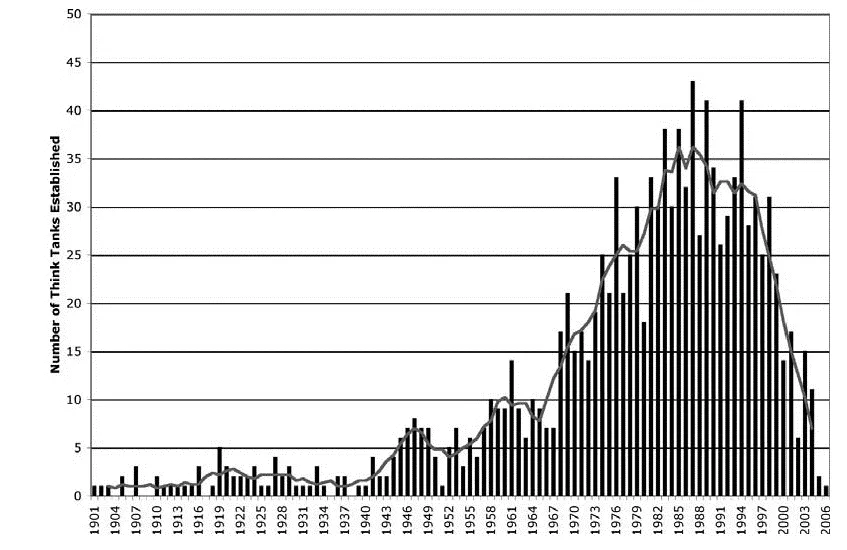
While the history of think tanks in many countries spans, at most, only the last 30 to 40 years, the United States has been home to think tanks for more than 100 years. The impressive growth of US think tanks is clearly illustrated by Figure 2.1, which is based on the preliminary results of the 2006 Global Survey of Think Tanks. Yet, as can be observed, the growth in number of think tanks was far from equal over the twentieth century. Most think tanks were established in waves. In fact, the tendency curve of Figure 2.1, which depicts a moving average over 5 years, clearly identifies the four major periods of think tank growths in the United States: the end of the First World War, the end of the Second World War, the early 1960s, and the 1980s. During the latter, an average of around 35 institutions were created every year, making it by far the largest growth period for United States’ think tanks. Conversely, within the past decade there has been a sharp decrease in the number of think tanks established per year. The reasons for the diminishing numbers are not well known and will be investigated in a later study. However, intuition suggests that part of the answer lies in a “crowding out” effect through which new policy influence channels have been favored at the expense of think tanks, and so numerous that newcomers must struggle to find their place. Moreover, the recent economic downturn and fundraising difficulties have certainly had an adverse effect on the creation of new think tanks, for whom it is difficult to compete with more stable and well-established organizations.
Table 2.1 Budget growth from 1983–2005
Figure 2.1 Number of new think tanks established per year
Note: The figure is based on preliminary data from the 2006 Global Think Tank Survey. The final data may diverge slightly from this data.