eBook - ePub
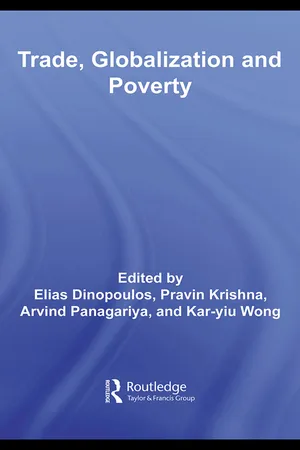
Trade, Globalization and Poverty
- 272 pages
- English
- ePUB (mobile friendly)
- Available on iOS & Android
eBook - ePub
Trade, Globalization and Poverty
About this book
An outstanding work, written to celebrate the seventieth birthday of Jagdish Bhagwati; the foremost defender of free trade and its role in developing economies in the world today, this rigorously academic and critical volume represents an important contribution to the understanding of many aspects of globalization. The editors, affiliated with four
Part 1
Poverty and wages
1 Globalization and poverty*
T. N. Srinivasan
Introduction
In his latest best seller, In Defense of Globalization, Jagdish Bhagwati (2004) devotes a chapter entitled, “Poverty: Enhanced or Diminished” to the effects of globalization on the poor. He points out that most policy makers in the twentieth century were acutely aware of the poverty in their midst and passionately wanted to eliminate it. In his view, the central question is not about lack of awareness of or commitment to eradicate poverty, but whether globalization as it is commonly understood is an integral part of any poverty eradication strategy as proponents of globalization insist.
Jagdish’s colleague at Columbia University, Joseph Stiglitz, in his own earlier best seller, Globalization and Its Discontents (2002), categorically asserts
Globalization today is not working for many of the world’s poor. It is not working for much of the environment. It is not working for the stability of the global economy. The transition from communism to a market economy has been so badly managed that, with the exception of China, Vietnam, and a few Eastern European countries, poverty has soared as incomes have plummeted.
(p. 214)
Jeffrey Sachs, another of Jagdish’s colleagues at Columbia, directed the United Nations Millennium Project. The report of the project (referred to as the Sachs Report by the media), submitted to the UN Secretary-General on January 17, 2005 (UN Millennium Project, 2005a), recommends (Recommendation 8, p. xvi) that
High-income countries should open their markets to developing country exports through the Doha trade round and help Least Developed Countries raise export competitiveness through investments in critical trade-related infrastructure, including electricity, roads and ports. The Doha Development Agenda should be fulfilled and the Doha Round completed no later than 2006.
It recognizes that
Trade is among the most politically charged of international issues for development. Though hugely important, it is far from a magic bullet for achieving development. The slogan “trade, not aid” is misguided, particularly in the poorest countries. Trade reforms are complementary to other parts of development policy, such as infrastructure investments and social programs to develop a healthy and well educated workforce.
(p. 46)
It further suggests that
To establish an overarching framework for progress, we recommend that global political leaders first agree to a conveniently distant long-term target (for example, 2025) for the total removal of barriers to merchandise trade, a substantial and across-the-board liberalization of trade in services, and the universal enforcement of the principles of reciprocity and nondiscrimination.
(p. 46)
It is clear that, its caveats notwithstanding, the Sachs report, and even more forcefully the other report of the Millennium project, Trade, Development and WTO: An Action Agenda for the Doha Round (UN Millennium Project, 2005b), by a task force coordinated by Patrick Messerlin and Ernesto Zedillo, both endorse Jagdish’s analysis. Stiglitz’s assertion has to be dismissed out of hand—the very exceptions he mentions, which include China and Vietnam (and I would add India and other East Asian countries—whose success was based on globalization according to Stiglitz himself on the same page) are the countries in which an overwhelming majority of the world’s poor live. The Sachs report implicitly rejects Stiglitz’s assertion in recognizing the importance of trade, though it does not resist striking down a straw man in saying it is far from a magic bullet. Related to Jagdish’s central question is: are there examples of countries which pursued an inward-oriented (outward-oriented) development strategy and yet succeeded (failed) in significantly reducing poverty? Jagdish’s chapter addresses this question as well. He points out that, first, countries such as China and India were able to reduce poverty significantly only after shifting to an outward-oriented development strategy from an earlier inward-oriented one. Second, he argues, drawing on his justly celebrated work on domestic distortions, that the potential causes of the failure, where it occurred, of an outward-oriented development strategy in reducing poverty are almost always the consequences of domestic distortions of various kinds.The literature on globalization and poverty is vast. Winters et al. (2004) survey the evidence. Brookings Institution’s Trade Forum, held during May 13–14, 2004, was devoted to “Globalization, Poverty and Inequality: What Do We Know and Where We are Going.” The papers presented at this forum, including, in particular, that of Goldberg and Pavcnik (2004), also survey some of the evidence. Part II of the Annual Report of the WTO (2003) was devoted to trade and development, with a subsection on trade liberalization and poverty alleviation. Of course, given its mandate, the United Nations Conference on Trade and Development (UNCTAD) has published several reports on trade and development, including a recent publication Trade Liberalization and Poverty in India (www.unctadindia.org) launched at the Eleventh Session of UNCTAD at Sao Paolo, Brazil during June 13–18, 2004.
Jagdish’s own contributions to poverty and development go way back to his The Economics of Underdeveloped Countries (McGraw-Hill, 1966), perhaps the only one of his many books that has photographs illustrating development projects.
Its opening chapter is entitled, “Poverty and Income Distribution.” In this remarkable short book he discusses many aspects of trade and development that continue to be relevant. For example, Jagdish decries tariff escalation and tariff peaks in rich countries against developing country exports. The two issues are on the Doha Round Agenda. The book also shows that even Jagdish, prescient as he has always been, did not quite see then the problems with central planning in poor countries and with developing countries not having to reciprocate industrial country offers in bargaining over tariff reductions in the GATT! I cannot hope to do justice in this chapter to his many contributions which we are celebrating, or to add much to what has already been said by others in the vast literature on trade and poverty.
What I propose to do instead is to highlight some of the analytical and measurement issues in exploring the trade-poverty nexus. The issues relating to the meaning and measurement of poverty are important to recognize and allow for in assessing the burgeoning empirical literature on globalization and poverty. Of course, any empirical econometric analysis, to be credible, has to be founded on sound theory. This being the case, the mechanisms that, in theory (or theories), are behind the globalization—poverty liberalization links have to be well-understood, as well as factors other than trade that might reinforce or blunt the operation of these mechanisms. Unfortunately, the cross-country regressions that are proliferating like amoeba show very little understanding either of the data and measurement issues that plague poverty estimates or of the need for a sound analytical foundation before putting data from diverse countries, sources and time periods into a common regression.
Poverty: concepts and measurement
Conceptual issues1
Any study of poverty has to begin with what Sen (1981) calls an exercise of “identification,” a method that distinguishes the poor from the nonpoor in a population that includes the poor. The most widely used method of identification is to define a norm or set of norms and classify anyone who does not meet the norm or norms as poor. Both the poverty norm and the population will be distinguished by time and spatial dimensions. Given a norm for identifying whether each member of a specified population at a specified time and place is poor, there is the further issue of deriving a poverty measure that aggregates the member-specific poverty status over the specified population, over space and over time.
Sen (1981, p. 21) sees the measurement of poverty as “an exercise of description assessing the predicament of people in terms of the prevailing standards of necessities. It is primarily a factual rather than an ethical exercise, and the facts relate to what is regarded as deprivation.” By basing measurement on social norms, that is, “prevailing standards of necessities,” this view would seem to eschew welfarism; that is, the idea that an individual’s welfare, as judged by that individual, should be the basis from which any assessment of the state of affairs in a population, (e.g. the extent of poverty in that population) is to be made. However, in his subsequent discussion of the income based method of identification, Sen (1981, p. 27) argues that “if the poverty level income can be derived from behavior norms of society, a person with a higher income who is choosing to fast on a bed of nails can, with some legitimacy, be declared to be nonpoor.” If indeed such a person can be presumed to fast because he prefers it to consuming the bundle constituting the prevailing standards of necessities, then classifying him as nonpoor is welfarist.
Whether or not one takes a welfarist view, one could reasonably argue that the identification exercise should preferably encompass an individual’s lifetime: an individual who meets the prevailing poverty norm by borrowing in the present should nevertheless be deemed poor if servicing the debt will push him into poverty in the future. A welfarist approach involves deep ethical and philosophical problems regarding what constitutes individual welfare, and whether a minimum degree of comparability of the chosen welfare measure across individuals can be postulated so that a meaningful aggregation over individual members of a population is possible. Sen himself (1973, 1976, 1981, 1984, 1985, and 1987), among others, has written extensively on these matters. However, these are essentially theoretical issues. There is not much an empirical study can contribute in this regard. However, an empirical study can explore the implications of alternative poverty norms, whether or not they have any welfarist connotations.
Measurement issues2
In the poverty literature, it is customary to define a threshold level of per person real income or consumption as the poverty line, with anyone having real income or consumption below the poverty line deemed as poor. This does not necessarily imply that dimensions of poverty other than income or consumption are not as important or more important, particularly deprivations in health, education, and democratic rights. However, there are difficult measuremen...
Table of contents
- Cover Page
- Title Page
- Copyright Page
- List of figures
- List of tables
- List of contributors
- Acknowledgments
- Introduction
- PART 1 Poverty and wages
- PART 2 International technology transfer and multinational firms
- PART 3 Policies and institutions
Trusted by 375,005 students
Access to over 1.5 million titles for a fair monthly price.
Study more efficiently using our study tools.
Frequently asked questions
Yes, you can cancel anytime from the Subscription tab in your account settings on the Perlego website. Your subscription will stay active until the end of your current billing period. Learn how to cancel your subscription
No, books cannot be downloaded as external files, such as PDFs, for use outside of Perlego. However, you can download books within the Perlego app for offline reading on mobile or tablet. Learn how to download books offline
Perlego offers two plans: Essential and Complete
- Essential is ideal for learners and professionals who enjoy exploring a wide range of subjects. Access the Essential Library with 800,000+ trusted titles and best-sellers across business, personal growth, and the humanities. Includes unlimited reading time and Standard Read Aloud voice.
- Complete: Perfect for advanced learners and researchers needing full, unrestricted access. Unlock 1.5M+ books across hundreds of subjects, including academic and specialized titles. The Complete Plan also includes advanced features like Premium Read Aloud and Research Assistant.
We are an online textbook subscription service, where you can get access to an entire online library for less than the price of a single book per month. With over 1.5 million books across 990+ topics, we’ve got you covered! Learn about our mission
Look out for the read-aloud symbol on your next book to see if you can listen to it. The read-aloud tool reads text aloud for you, highlighting the text as it is being read. You can pause it, speed it up and slow it down. Learn more about Read Aloud
Yes! You can use the Perlego app on both iOS and Android devices to read anytime, anywhere — even offline. Perfect for commutes or when you’re on the go.
Please note we cannot support devices running on iOS 13 and Android 7 or earlier. Learn more about using the app
Please note we cannot support devices running on iOS 13 and Android 7 or earlier. Learn more about using the app
Yes, you can access Trade, Globalization and Poverty by Elias Dinopoulos, Pravin Krishna, Arvind Panagariya, Kar-yiu Wong, Elias Dinopoulos,Pravin Krishna,Arvind Panagariya,Kar-yiu Wong in PDF and/or ePUB format, as well as other popular books in Business & Business General. We have over 1.5 million books available in our catalogue for you to explore.