- 176 pages
- English
- ePUB (mobile friendly)
- Available on iOS & Android
eBook - ePub
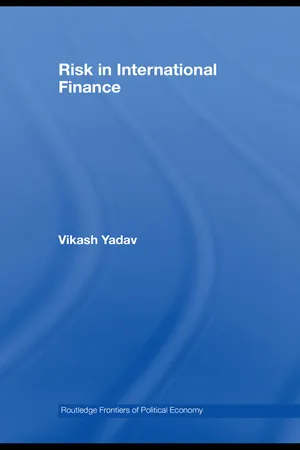
Risk in International Finance
About this book
This book analyzes the evolution and impact of the concept of risk on processes of transnational banking and financial market regulation, as well as the externalities generated by speculative financial activity in developing and emerging market economies. The author provides an alternative theory for the study of international financial market regu
I Introduction
The history of the contemporary international monetary order is punctuated by financial crises. In recent years, the volatility of exchange rates and asset prices in international financial markets has threatened to shred the economic, political, and social fabric of several countries around the world.1 Speculative attacks on currencies have imposed costly restrictions on the policy options of sovereign states.2 Currency assaults and a host of other speculative transactions have been fueled by the development of complex financial instruments and interlinked marketplaces that allow institutions to hedge financial risks and/or speculate for profit. Ironically, this sphere of speculative economic activity has been authorized by governments, rationalized by neo-liberal ideology, and propelled by communications technology. To the extent that a speculative assault may create, intensify, or prolong a loss of confidence in national financial systems and across multiple interconnected markets,3 the state/market nexus and its ideological apparatus seem to have sown the seeds of their own destruction. Given this apparent catastrophic potential, the real puzzle is: how has this monetary order been able to operate and reproduce itself for so long? How does the monetary order regulate the ‘‘risks’’ it produces and what are the economic, social, and political consequences?
The term ‘‘monetary’’ is not meant to imply a narrow focus on the relationships between national currencies regulated by states, but the entire financial system under which credit is solicited, created, monitored, regulated, allocated, taxed, and used.4 In fact, exchange rates between currencies are intimately related to the broader financial system. The term ‘‘order’’ indicates only that subjects behave in a certain way because of the de facto recognition of the distribution of abstract rights to property and from the particular mode of balancing interests.5
A ‘‘speculative’’ financial transaction generally involves:
- The execution of a financial transaction based upon an estimation of the possibility and speed of growth/decline in the market value of an asset or currency (as opposed to the execution of a financial transaction based on evidence of an increase/decrease in productivity); and/or
- The purchase of a financial instrument that does not confer legal claims on the current or future earning from a specific material asset or service; and/or
- The failure to purchase a financial instrument that offsets the exposure of existing assets to probabilistic market dynamics (i.e., insurance).
The paradox is that financial institutions must purchase speculative financial instruments as a form of insurance in order to offset, at least in part, the aggregate effects of speculative financial activities. Speculative financial instruments are commonly labeled as ‘‘derivative’’ financial contracts, because the value of the contract is derived from the prices of underlying contracts, such as equities, bonds, currencies, and commodities. Derivative financial instruments are essentially time-bound contracts (1) to permit the purchase, sale, or exchange of specific financial products such as stocks, bonds, currency, or indexes of other financial products; and/or (2) to offset the effects of a change in value of other financial products. There are several thousand sub-species of derivative contracts that have been articulated, such as financial futures, options, stock indexes, swaps, swap-options, inverse floaters, etc., to produce the specific utility effects demanded by financial institutions. In other words, these financial instruments are sold as mechanisms that are designed to offset the exposure of existing assets to specific risks.
Although speculative financial activity seems to imply a mediated or subordinate relationship with processes of production and trade,6 speculative activity has moved to center stage in the post-Bretton Woods monetary order. Derivative financial instruments do not represent ‘‘exotic,’’ marginal, or super-structural aspects of the international political economy; they are central to the operation of the current monetary order, because they are designed to facilitate exchange in an uncertain and volatile global market. The articulation of these new financial instruments has had the effect of transforming more and more components of finance or financial assets into marketable instruments. Since the early 1980s, there has been an enormous increase in liquidity and in the circulation of financial capital through the marketing of financial instruments rather than lending.7
Speculative financial instruments are commonly marketed as sophisticated devices to reduce specified categories of risk, even though the actual aggregate effect of these instruments may be to increase volatility and proliferate risk. The technology of financial risk is related to and draws strength from other positive discourses on risk in society (e.g., health risks, sexual risks, insurable risks, military risks). Building upon an array of risk-management technologies first pioneered by actuarial science, statistics, and probability theory, complex financial instruments have transformed the ‘‘risk elements’’ of any financial contract into separate, manipulable components that can be sold and purchased on the market as a commodity. Interconnected market institutions and sophisticated financial instruments have been developed to disperse risk to those financial intermediaries that will accept risk in exchange for a fee and a potentially large profit margin. Banks, brokerage firms, insurance companies, corporations, governments, and individual investors use derivative financial instruments. Even average home and car buyers participate in derivative contracts when they sign mortgages or loans with fixed or adjustable interest rate charges, since the bank usually purchases a financial instrument to hedge against interest rate changes and it securitizes loans, particularly loans to subprime borrowers (i.e., borrowers with poor credit histories). The exchange of derivative contracts impacts the price of many materials used by ordinary consumers on a daily basis such as petroleum, natural gas, heating oil, and electricity. Where derivative financial instruments are legally recognized as a form of insurance, these contracts allow banks, securities firms, and insurance companies to cut costs associated with the maintenance of sufficient capital reserve holdings and therefore offer more competitive rates for customers. In fact, there is little choice for large financial institutions except to participate in the derivatives market. As Susan Strange observed, ‘‘… whereas people who go to the racecourses or bet on the races actually enjoy gambling, the great majority of participants in the speculative financial markets of our times are there involuntarily because they are risk-averse and do not want to gamble. They are afraid of uncertainty and they are keen to hedge against it.’’8
Of course, the potential profits from purchasing the risk of other institutions (i.e., speculating on interest rates, foreign exchange rates, or other assets) do represent a highly lucrative mechanism for institutions to increase revenue. For example, in 2006 US commercial banks generated $18.8 billion in trading revenues mainly due to derivatives trading, this represents a 90 percent increase in revenue from 2004, according to the Office of the Comptroller of Currency (OCC). If all derivatives contracts were immediately liquidated, the net current credit exposure of US insured commercial banks would be $185 billion; the notional (i.e., the nominal or face) value of all the derivatives contracts held by US insured commercial banks was $131.5 trillion at the end of 2006 – a figure ten times greater than the US gross domestic product (GDP). The total number of outstanding derivatives contracts increased by 30 percent in 2006 compared to the previous year, indicating an increase in business activity.9 The top ten investment banks, which hold the overwhelming bulk of all derivatives contracts, increased their trading revenue by 13 percent in the last quarter of 2006, a 45 percent increase from the same period in the previous year.10 Revenue from trading derivatives encompasses a significant portion of the top US investment bank’s gross revenue: JP Morgan Chase earned 9.7 percent of its fourth quarter earnings in 2006; HSBC Bank USA earned 5.1 percent; Citibank 3.9 percent; Bank of America 1.9 percent; and Wachovia 0.3 percent.11
At the same time, derivatives trading is also responsible for some of the most spectacular losses in the post-Bretton Woods era (see Table 1.1).
Even though current profit and loss levels may be anomalous, it is apparent that derivatives are growing in importance.
Table 1.1 Dramatic losses from derivatives trading activity
There is no end in sight for the expansion of this multi-trillion dollar market. This lucrative business supports and is supported by the perpetual discovery of new risk, in the words of one trade journal: ‘‘… the creation of new risk always seems to be racing just one step ahead of the abilities of banks to control it.’’12 Market participants and financial media pundits are well aware that if existing risks are tamed, new risks will need to be discovered or invented. Edgar Meister, a representative of the German Bundesbank on the Basel Committee for Banking Supervision writes:
Once the transition period is over, market opportunities will decrease, but the security of the new products will increase in practice and with experience. Product innovation will then be the market solution to develop further business, which, in line with basic marketing ideas, will open up new opportunities for some time owing to the imperfection of the new market segments. However, this process often leads to new problems and risks.13
Speculation occurs even in the absence of voluntary participation in derivatives markets. Where no action is taken to counter or hedge a known category of risk, the financial firm engages de facto in ‘‘speculation’’ on its exposed assets. Of course, risk management experts of a financial firm may deliberately assume that exchange rates or interest rates will remain the same or move in their favor in the near future and therefore consciously choose to forgo the use of particular risk-management instruments.14 Financial firms may choose to speculate passively because there is a cost, in terms of premiums and commissions, associated with hedging all open exposures.
The institutionalization of risk management and diversification strategies also seems to encourage market institutions to engage unwittingly in higher-risk activities. Peter L. Bernstein writes:
The introduction of portfolio insurance in the late 1970s encouraged a higher level of equity exposure than had prevailed before. In the same fashion, conservative institutional investors tend to use broad diversification to justify higher exposure to risk in untested areas – but diversification is not a guarantee against loss, only against losing everything at once.15
In essence, the struggle to offset or exploit risk has become unavoidable.
There appears to be a pattern to the all-encompassing spirals of speculation and insurance characteristic of this monetary order. The post-Bretton Woods monetary order operates and reproduces itself through an intertwined and ever-expanding technology of risk. The technology of risk simultaneously increases the opportunities for speculative financial activity and provides remedies at the various sites of financial vulnerability revealed by each speculation-induced crisis. The insurance functions of risk are developed to match each additional speculative opportunity, and speculative instruments are developed to transgress each insurance function. Volatility must be perpetually generated and countered. Financial instruments designed to manage risk would not have any value or use in the absence of volatility and uncertainty. Financial volatility without dampening mechanisms would rattle the monetary order apart.
The result of the unending search to discover the sources of risk is that financial institutions have come to be understood as risk-bearing entities; they are considered to be fabricated with risk. For example, Edward Furash writes,
‘‘… risk is often unconsciously built into the way the business is run. So it may be assumed that the business is running well, its risks are properly controlled. However, this assumption is wrong. Unanticipated risk is what is usually deadly. And in many circumstances, the true risk inherent in the business is rarely expressed, understood, or measured.’’16
Risk continues to appear where it is least expected leading practitioners to believe that risk is the essence of the firm. Each of the innumerable interactions within the firm, with clients, with regulators, and between firms appears to be a source of risk.
While risk is productive and profitable when disentangled and commodified, by the late 1980s and early 1990s the ‘‘production of risk’’ began to be perceived as a danger to the entire financial system. As one financial magazine noted in the context of the release of an industry think-tank’s report on the derivatives market:
The report, originally commissioned in August 1992, was prompted by the debate which had been raging over whether the various derivative markets … were in control of their various products. Or are they in the worst case creating a Frankenstein’s monster over which they may lose control, with the consequent systemic risk this represents to all financial markets?17
Press reports reveal that even senior executives in financial firms began to see derivatives as a potential source of a financial disaster.
Derivatives are ‘‘a time bomb that could explode just like the LDC crisis did, threatening the world financial system,’’ warned Royal Bank of Canada chairman Allan Taylor at the International Monetary Conference in May. And Lazard Frèeres & Co. senior partner Felix Rohatyn was quoted in this magazine’s 25th Anniversary issue in July as worrying that ‘‘26-year-olds with computers are creating financial hydrogen bombs.’’18
Regulatory officials believed that derivative contracts posed a threat to the international financial system because,
… derivatives have been a major factor in tightening linkages among markets and potentially altering the transmission of economic and financial shocks. If a firm that was very active in these markets came under extreme financial stress, regardless of the source of its difficulties, the unwinding of its outstanding derivatives positions and related positions in other financial markets could pose significant challenges both to the firm and to regulatory authorities seeking to contain the effects of its difficulties.19
In other words, the complexity, value, and fixed temporal nature of derivative contracts make it difficult to unwind positions quickly during a crisis. As most derivatives contracts are traded between banking institutions, the unexpected termination of a derivative contract or default of a counter-party would theoretically transmit losses to other interlinked counter-parties setting off a ripple effect across the banking system. The danger perceived by regulatory officials was that this complex web of interdependence was not visible. As Alexandre Lamfalussy, the General Manager of the Bank for International Settlements, conceded:
‘‘We do not know the web of interconnections between banks that has been established through derivatives,’’ [ … ] ‘‘The market is losing transparency, and we do not know who is dependent on whom anymore. Now we will only know after the fact, and by then it could be too late.’’ [ … ] ‘‘At least with the LDC crisis we had an indication of the order of magnitude (of the problem). You had a photograph at any one time of the relationships.’’20
States believed that transparency in derivative financial transactions would increase their ability to monitor and regulate the invisible ties that bind market participants to one another.
Of course, some market participants mocked the obsession of state regulators with systemic risk, Karen Shaw Petrou, President ISD/SHAW ...
Table of contents
- Cover Page
- Title Page
- Copyright Page
- List of tables
- Preface
- Acknowledgments
- 1 Introduction
- 2 Surfaces of inscription
- 3 Theory of risk
- 4 Theory of regulation
- 5 Regulating risk
- 6 The political arena
- 7 Conclusion
- Notes
- Bibliography
Trusted by 375,005 students
Access to over 1.5 million titles for a fair monthly price.
Study more efficiently using our study tools.
Frequently asked questions
Yes, you can cancel anytime from the Subscription tab in your account settings on the Perlego website. Your subscription will stay active until the end of your current billing period. Learn how to cancel your subscription
No, books cannot be downloaded as external files, such as PDFs, for use outside of Perlego. However, you can download books within the Perlego app for offline reading on mobile or tablet. Learn how to download books offline
Perlego offers two plans: Essential and Complete
- Essential is ideal for learners and professionals who enjoy exploring a wide range of subjects. Access the Essential Library with 800,000+ trusted titles and best-sellers across business, personal growth, and the humanities. Includes unlimited reading time and Standard Read Aloud voice.
- Complete: Perfect for advanced learners and researchers needing full, unrestricted access. Unlock 1.5M+ books across hundreds of subjects, including academic and specialized titles. The Complete Plan also includes advanced features like Premium Read Aloud and Research Assistant.
We are an online textbook subscription service, where you can get access to an entire online library for less than the price of a single book per month. With over 1.5 million books across 990+ topics, we’ve got you covered! Learn about our mission
Look out for the read-aloud symbol on your next book to see if you can listen to it. The read-aloud tool reads text aloud for you, highlighting the text as it is being read. You can pause it, speed it up and slow it down. Learn more about Read Aloud
Yes! You can use the Perlego app on both iOS and Android devices to read anytime, anywhere — even offline. Perfect for commutes or when you’re on the go.
Please note we cannot support devices running on iOS 13 and Android 7 or earlier. Learn more about using the app
Please note we cannot support devices running on iOS 13 and Android 7 or earlier. Learn more about using the app
Yes, you can access Risk in International Finance by Vikash Yadav in PDF and/or ePUB format, as well as other popular books in Business & Business generale. We have over 1.5 million books available in our catalogue for you to explore.