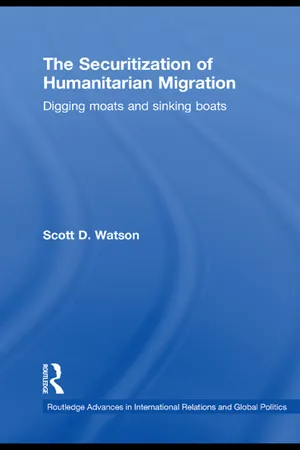
This book examines how western liberal states are progressively restricting access to refugees and asylum seekers, even though these states have signed international agreements obliging them to offer protection to those fleeing persecution and to advocate the spread of human rights and humanitarian principles. Watson examines how refugees and asylum seekers have come to be treated so poorly by these states through the use of policies such as visa requirements, mandatory detention and prevention/return policies. Providing extensive documentary analysis of debates on 'restrictive' refugee policies in Canada and Australia, the author addresses the relationship between security and migration, an issue of increased importance in the aftermath of 9/11 and the war on terror. He then examines hotly-contested policies such as detention and the forceful return of asylum seekers to demonstrate how attempts to securitise these issues have been resisted in the media and by political opposition. Given the importance of providing refuge for persecuted populations, not only to ensure the survival of targeted individuals, but also to maintain international peace and security, the erosion of protective measures is of great importance today. The book will be of interest to students and scholars of international security, international relations, migration and human rights
eBook - ePub
The Securitization of Humanitarian Migration
Digging moats and sinking boats
- 12 pages
- English
- ePUB (mobile friendly)
- Available on iOS & Android
eBook - ePub
About this book
Information
1 Migration and securitization
The association of human migration with insecurity is not new; this connection is evident throughout history dating back to biblical times. In the seventeenth and eighteenth century, fears over the movement of people prompted the erection of town walls and the creation of passports to control migration (Torpey, 2000: 22–23). And in current times, concerns over international migration have contributed to a wide range of initiatives, from international cooperation on migration matters, to the expansion of supra-national organizations like the EU (Rudolph, 2006: 10–11), to the rise of right-wing antiimmigrant parties (Fetzer, 2000). Throughout history and in many states, societies and other forms of political collectivities, migration has often been portrayed and perceived as threatening, producing real political effects. During the Cold War, emigration from the Eastern bloc states was regarded as a matter of national security, and great efforts were expended to prevent it. In the Western states however, for much of the Cold War period, migration was relegated to the realm of low politics and off the security agenda, which was associated primarily with military security (Waever, 1995: 59; Hollifield, 2000).
The resurgence of migration back onto the security agenda in the Western states of Europe and North America coincided with the end of the Cold War. With the end of the political–military divide that had structured international politics since the end of the Second World War, increased focus was placed on identifying and responding to emerging security threats. Consequently, a number of non-military threats began to feature prominently in the study of security, including environmental degradation, health epidemics and pandemics, and migration (Dalby, 2002; M. Levy, 1995; Price-Smith, 2001; Weiner, 1995; Waever et al., 1993). In most cases, the reason for including issues like environmental degradation and international migration on the security agenda has been to provide a prima facie case that the issue does present a threat to national security and to encourage states to devote more resources to control and manage it. Migration has been linked with security in a variety of ways; from contributing to violent conflict and environmental degradation (HomerDixon, 1994), producing a backlash in receiving states (Teitelbaum, 1980), concerns over control of borders and the absorptive capacity of receiving states (Weiner, 1995) to the survival of civilizations (Huntington, 1996). Though some of these connections have proven less convincing than others, together they highlight the fears of social and political upheaval that migration flows have evoked.
The expansion of the concept of security to include non-military security threats like immigration has faced entrenched opposition from neo-realists who have held a near monopoly on defining security within the English language security studies field. The privileged position of neo-realism and its focus on military security is a product of a Weberian understanding of the state-building process in the West. Making war and protecting citizens and/or subjects from military threats has been the fundamental building block at the core of the nation-state building process (Poggi, 1978; Tilley, 1990). It should come as no surprise therefore that the activities of the state’s security apparatus have been devoted to providing security from military threats. Resistance to the depiction of migration as a security threat has emerged from the neo-realist school of thought that contends that the inclusion of non-military security threats such as migration undermine the conceptual clarity of the concept, and detracts from more important military issues (Mearsheimer, 1994; Walt, 1991; Freedman, 1998).
The ongoing debate over the inclusion of migration and other non-traditional issues in the security agenda, as part of the “broadening” of the field of security studies (Krause and Williams, 1996) is characterized by an objectivist approach to the study of security. This perspective treats threats as objective and existing externally to individual perceptions (Sjostedt, 2008: 9), thus issues do or do not represent a threat, regardless of whether or not individuals perceive and respond to them as such. Consequently, scholars who seek to broaden the concept of security as well as those who resist this broadening, base their arguments on the claim that one can objectively observe and measure the level of threat posed by migration and the costs that states face should they fail to confront these developments. In making these objectivist claims, analysts seek to acquire additional resources to combat the potential threat (Krause and Williams, 1996; Mutimer, 1999).
One problem with the objectivist approach to the study of security and the place of international migration in that field of inquiry is that it reifies the identity of the receiving and sending societies and the motivations and reasons for human migration. This is problematic because the representation of migration as a source of insecurity is not a constant throughout history nor is it held universally across all states or societies. At times, states such as Israel and Germany have used migration as a means of ensuring the continuation and survival of an ethnically based view of their societies (Levy and Weiss, 2002; Joppke and Rosenhek, 2002). Similarly, in settler states such as Australia and Canada, the growth associated with migration has been regarded as essential for the survival of these states. Even today, as populations in Western states age and decline, there is a growing sense that migration will be needed to ensure the existence of these societies (Teitelbaum, 1987; Straubhaar and Zimmerman, 1993). And, as noted earlier, during the Cold War, the migration of people out of the communist states of Europe was part of larger security agenda associated with the victory of the capitalist “West” (Loescher, 1993; Goodwin-Gill and McAdam, 2007). These cases demonstrate that migration has and can be constructed in various ways, indeed as a source of security rather than insecurity.
A similar sort of objectivist reasoning is evident in the literature that has emerged to explain the formation of migration control policies. The body of work devoted to explaining the implementation of “restrictive” border control policies claims that such policies were implemented in response to observable and identifiable changes in the character of refugee flows in the late 1980s and early 1990s: larger numbers, different source countries and changing motivations of migrants from humanitarian to economic. In its most basic form, the argument proceeds as follows: during the Cold War, there were very few refugees, under three million in 1976. By 1990, the number of refugees had reached 17.2 million, a rapid increase that was interpreted as a growing threat (Weiner, 1995: 3). Prior to this explosion of the refugee population, most Western industrialized states received few asylum claims in any given year, with the exception of a few notable incidents such as Hungary (1956) and Czechoslovakia (1968) (Keely, 2001: 308). It was not until the mid-to-late 1980s that the number of asylum seekers began to climb significantly. The particular problem that larger numbers posed for many Western states was that the existing refugee determination systems had been created with small numbers in mind and whose primary solution was permanent incorporation into the receiving society (Keely, 2001: 304–5; Toft, 2007: 141). The rapid increase in the number of asylum seekers produced large backlogs of claims, and a general sense that the system was incapable of dealing with large flows. The devotion to permanent rather than temporary protection resulted in large numbers of refugees being admitted, which was portrayed as threatening to the social balance in states whose primary historical experience with migration was emigration (Toft, 2007: 143).
Even more problematic was another set of objective changes in the character of refugee flows: source countries had changed and the skill set and assimilability of refugees themselves had declined. During the Cold War, most refugees came from the communist states of Eastern Europe. Beginning in the mid-1980s, this began to change and by the mid-1990s, the majority of individuals seeking protection in the Western states were non-European. Furthermore, refugees from communist Eastern Europe were viewed as “enterprising, skilled, well educated and a potential source of vital intelligence” on the domestic and foreign policy of their home states (Toft, 2007: 143). With the end of the Cold War and as the source countries of refugees changed, most refugees now lacked high levels of formal education and did not possess work skills that were in high demand in receiving states (Weiner and Munz, 1997: 25–26). In other words, they were not regarded as enterprising, skilled, well educated nor a potential source of vital intelligence on their home states.
The attractiveness of such explanations is their parsimonious account of how objective changes in refugee flows led to changing behavior in refugeereceiving states. The problem is that this objectivist approach cannot explain why these developments were interpreted as they were or why other strategies were not adopted. Furthermore, these explanations make the implementation of restrictive border policies appear natural and unproblematic. Of central importance is how these developments and changes in refugee flow patterns were constructed and perceived by receiving states. By re-orienting the analysis to how actors in receiving states have constructed these changes in international patterns of refugee flows, greater attention is paid to the discursive practices that give significance to these changes, rather than treating them as changes that would inevitably produce identifiable and predictable consequences for which there was only one reasonable type of policy response. The response to changing migration patterns is based on subjectively held views of the significance of those changes, not on the changes themselves.
The idea that security encompasses subjectively held feelings is hardly new in the study of security. Among the earliest treatments of the subjective nature of security is Arnold Wolfers’s seminal article on national security (Wolfers, 1952). Wolfers contends that security consists of both objective and subjective elements, and he admits that security threats can never be measured objectively, it is always a matter of subjective evaluation and speculation (Wolfers, 1952: 485). The varying perceptions of insecurity between nations and groups within nations facing similar external circumstances arise as a result of unique cultural and historical experiences (Wolfers, 1952: 486; Katzenstein, 1996, Roe, 1999). Thus, the extent to which a change in migration flows will be interpreted as threatening or not is partially dependent upon how migration has historically been situated in the society’s historical myths and symbols. Thus, settler societies such as the United States, Canada and Australia can be expected to be open to most forms of migration, whereas traditional states such as Germany and France can be expected to be less receptive (Freeman, 1992, 1995, 2006). Clearly, shared historical experiences and myths concerning immigration in a society profoundly influence the receptiveness of that society to migration presently. Yet, too strong a focus on cultural factors risks obscuring the increasing convergence in policy responses in states with different historical experiences with migration. Furthermore, without an understanding of the mechanism whereby culture and history contribute to the construction of insecurity, the focus on cultural factors runs the risk of cultural determinism and the reification of a particular cultural identity.
When dealing with political collectivities such as states, societies, religious groups, ethnic groups, etc., (in)security cannot simply be reduced to subjectively held feelings based on one aspect of their communal history. Individual members of a society may play host to a variety of subjective fears or phobias independently arrived at (though this is highly debatable), but threats to human collectivities do not simply emerge as the aggregated sum of individual phobias. Nor do all individual members who share a specific group identity feel equally threatened by similar developments, though a few primordialists and evolutionary biologists view group feelings of insecurity as natural and shared by all members of the group.1 Rather, individuals who share a social identity do not respond naturally or uniformly to developments. Among scholars who study the nature of group identity and its relationship to “ethnic” or intra-state conflict there has emerged a near consensus that nations, and the developments that may threaten them, are socially constructed and contextual rather than natural and universal (Anderson, 1983; Gellner, 1983; Breuilly, 1994; Kaufman, 2001). However, there is no consensus on how nations (or some members thereof) come to view themselves as threatened. As Fearon and Laitin argue, the observation that collective identities, and thus threats, are socially constructed explains very little, because it does not incorporate agency (Fearon and Laitin, 2000: 845–46). What is required is a theory that explains how particular actors use culture and the content of the collective imagining in the construction of identity/threats. This forces the analyst to consider the role of argumentation, coercion and persuasion in the construction of collective identities and the threats to them. In short, it forces us to consider how threats are intersubjectively established, rather than subjectively held by all members of a political community.
Intersubjectivity and securitization
Securitization theorists claim that (in)security is intersubjectively established through a process known as securitization (Buzan et al., 1998: 25). In this process, an issue is presented as an existential threat by political and societal elites, and becomes regarded as a security threat only if and when the audience accepts it as such (Buzan et al., 1998: 25). For such claims to be successful, these securitizing agents must persuade an audience of the legitimacy of the claim. In democratic states, and likely in non-democratic states, there is a need to argue one’s case since securitization can never only be imposed (Buzan et al., 1998: 23; Vuori, 2008: 68). Incorporating the role of persuasion and argumentation in the construction of threats overcomes the problems that plague objectivist and subjectivist accounts of security because it incorporates cultural factors that help explain differing responses between states to similar developments and identifies a significant role for agency in the construction of threats.
The most significant drawback to the communicative action approach put forward in securitization theory has been specifying who the audience of the securitizing claim is: who is it that needs to be convinced that a particular development represents a threat to the state or society? Securitization theory and its emphasis on an intersubjective view of security remains vague and under-theorized in this regard as the audience that is to be convinced of the security claim remains unspecified. In many instances, the entire voting population of the state seems to be the relevant audience, as Buzan, Waever and de Wilde claim that some security claims must be argued in the public sphere (Buzan et al., 1998: 28). By making such a claim, Buzan et al. implicitly identify the “public” as an important audience of securitizing claims. At other times they cast doubt on the “public” as a relevant audience, noting that some securitizing practices do not take place out in the public arena at all (Buzan et al., 1998: 28). Elsewhere, Waever has argued that successful securitization need not require acceptance by the public, just that security measures avoid the escalation of public opinion (Waever, 1995: 58). Here, the public need not accept or believe or even know about the securitizing move, the primary requirement is that the public does not actively oppose it. Other scholars accord the public almost no role whatsoever, and focus almost exclusively on specialized agencies as securitizing actors, with governing elites as their relevant audience (Bigo, 2000: 195; C.A.S.E. 2006: 457–58). From this perspective, specialized agencies are empowered to identify and counteract threatening developments and their sole audience is the governing elite. In both cases, the audience is fairly limited, and the public largely excluded.
Subsequent work on the issue of the audience has more thoroughly explored which groups are the target audience of securitizing claims. Balzacq suggests that securitizing actors actually target multiple audiences, including the “public” as well as institutional bodies whose attitude have a direct causal connection with the desired goals, such as parliament or the Security Council (Balzacq, 2005: 185). The audience to whom the securitizing claim is made depends upon the purpose of the speech act, which can vary from efforts to raise an issue on the agenda, to deter certain actions or to legitimate past or future acts (Vuori, 2008: 84). Consequently, even in democratic societies, the “public” is only one of a number of relevant audiences, and one whose primary role is that of moral support or evaluating political legitimacy (Balzacq, 2005: 185; Vuori, 2008: 84–85). According to Vuori, the audience has to be such that that they have the ability to provide the securitizing actors with whatever they are seeking to accomplish with the securitization, in the Waeverian model, legitimacy for actions that go beyond regular liberal-democratic practices of policy making (Vuori, 2008: 72).
One problem with this formulation is that it makes it seem as though the securitizing actor is free to target the audience of their choice, and conversely to avoid other audiences when desired. This is especially the case during crisis decision-making, when the process may be restricted to an inter-elite audience (Vuori, 2008: 72). However, in these cases, even if most other potential audiences are excluded from the process of argumentation that produces a decision on the appropriate policy measures, the implementation of these measures themselves are difficult to hide and can thus result in a test of their legitimacy. Additionally, noting that there are multiple audiences encourages greater exploration into the relationship between these audiences. Under what circumstances do securitizing claims and the emergency measures implemented in response suffer legitimacy problems that in turn require political elites to garner support from the general public? And under what conditions are securitizing actors, such as specialized security agencies and political elites, free to securitize without public “consultation” or tests of legitimacy?
The ability of governing elites to limit the discussion over appropriate policy measures during crisis periods is based on the construction of a certain development as constituting a crisis, which in turn, legitimates the narrowing of discussion and audience. This seems a crucial step in the securitization process. Thus, rather than focusing solely on governing elites and identifying who their audience consists of, the analysis of securitization requires the examination of the institutional structures and the discursive practices that produce “relevant” audiences in the first place.
This requires the analysis of other actors besides the executive branch, the governing elites and the specialized agencies to whom they have delegated authority to identify threatening developments, which have dominated the study of securitization (Williams, 2003: 527). Three actors that are key to the securitization process but have been neglected thus far are: the media, the political opposition and the judiciary. In most democratic states, and even in some non-democratic states, these three institutions possess sufficient social capital to question securitizing claims and act in some way as a check on the political legitimacy of actions undertaken by the executive branch of the state, and thus stand as the most significant obstacles to the success of securitizing attempts. Other actors, such as NGOs and religious organization may also question the legitimacy of securitizing claims, but in most instances they lack the political capital to do so on their own—they require one of these organizations to pursue their claims. Consequently, I focus on the distinct roles that these three actors play in the securitization process.
Several securitization theorists have commented on the importance of the media in the process of securitization (Williams, 2003: 527–28; Buzan et al., 1998: 124), though few have actually addressed its role in significant detail. The role of the media in the process of securitization is complex and multifaceted. The media plays an instrumental role in the reproduction of society and in the maintenance of dominant constructions of the self and others (Kellner and Durham, 2006; Herman and Chomsky, 1988). Consequently, it plays an instrumental role in securitization, it constructs an “us” and “them,” tells us what the conflict is about and what can be done to stop it. But its role as an agent is not altogether clear. Is it merely a site through which elite claims are communicated? Because the media deals almost exclusively in attributed opinions, it relies heavily on subject matter specialists and political leaders to shape the general orientation of their coverage (Zaller, 1992: 315–17). In most Western democracies, media coverage of many issues, including migration, has been dominated by the claims of the governing elites (Statham, 2003; Statham and Geddes, 2006). As Vultee notes, the media originates few if any frames themselves but instead selects from among those made available to them—primarily from elites. It does, in some cases, form perceptions of audience interests or concerns as well (Vultee, 2007: 26).
Therefore, to treat the media simply as a mouthpiece for governing elites ignores the important role it can play as a securitizing actor by forcing issues onto the policy agenda of political elites (Entman, 2004; Jones and Baumgartner, 2005; Iyengar and Kinder, 1987) or as a desecuritizing actor that interrogates certain aspects of the security claims of political elites. Thus, the media can serve a variety of functions in the securitization process. It can communicate the securitizing claims of other actors, it can make securitizing claims of its own and it can expose securitizing claims to contesting views. In most cases, it serves all three purposes.
Examination of media coverage during crisis periods provides important insight into the dynamic of securitization. Heavily contested issues tend to figure prominently in news coverage. In the case that a securitizing claim is heavily contested, media coverage is a critical site in the securitization process, serving to aid the securitization attempt or to contest its legitimacy. The importance of media coverage in...
Table of contents
- Cover Page
- Title Page
- Copyright Page
- List of tables
- Acknowledgements
- Introduction
- 1 Migration and securitization
- 2 Norms of the international refugee regime
- 3 Detention and naval interception in Canada
- 4 Naval interception and detention in Australia
- 5 Visa requirements in Canada and Australia
- Conclusion
- Notes
- Bibliography
Trusted by 375,005 students
Access to over 1.5 million titles for a fair monthly price.
Study more efficiently using our study tools.
Frequently asked questions
Yes, you can cancel anytime from the Subscription tab in your account settings on the Perlego website. Your subscription will stay active until the end of your current billing period. Learn how to cancel your subscription
No, books cannot be downloaded as external files, such as PDFs, for use outside of Perlego. However, you can download books within the Perlego app for offline reading on mobile or tablet. Learn how to download books offline
Perlego offers two plans: Essential and Complete
- Essential is ideal for learners and professionals who enjoy exploring a wide range of subjects. Access the Essential Library with 800,000+ trusted titles and best-sellers across business, personal growth, and the humanities. Includes unlimited reading time and Standard Read Aloud voice.
- Complete: Perfect for advanced learners and researchers needing full, unrestricted access. Unlock 1.5M+ books across hundreds of subjects, including academic and specialized titles. The Complete Plan also includes advanced features like Premium Read Aloud and Research Assistant.
We are an online textbook subscription service, where you can get access to an entire online library for less than the price of a single book per month. With over 1.5 million books across 990+ topics, we’ve got you covered! Learn about our mission
Look out for the read-aloud symbol on your next book to see if you can listen to it. The read-aloud tool reads text aloud for you, highlighting the text as it is being read. You can pause it, speed it up and slow it down. Learn more about Read Aloud
Yes! You can use the Perlego app on both iOS and Android devices to read anytime, anywhere — even offline. Perfect for commutes or when you’re on the go.
Please note we cannot support devices running on iOS 13 and Android 7 or earlier. Learn more about using the app
Please note we cannot support devices running on iOS 13 and Android 7 or earlier. Learn more about using the app
Yes, you can access The Securitization of Humanitarian Migration by Scott D. Watson in PDF and/or ePUB format, as well as other popular books in Politics & International Relations & Human Rights. We have over 1.5 million books available in our catalogue for you to explore.