eBook - ePub
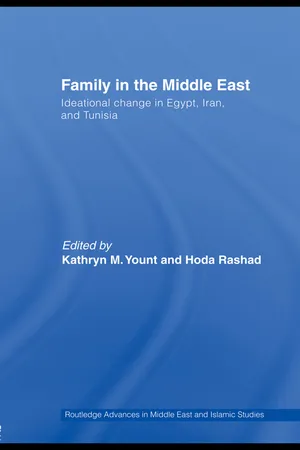
Family in the Middle East
Ideational change in Egypt, Iran and Tunisia
- 288 pages
- English
- ePUB (mobile friendly)
- Available on iOS & Android
eBook - ePub
About this book
Explores, from a historical comparative perspective, the globalization of dominant myths of 'modern' family and society, and their effects on families in Egypt, Iran, and Tunisia uniquely contributing to sociological debates about globalization.
Information
Part I
Introduction
Historical orientations to the study of family change
Ideational forces considered
Kathryn M. Yount and Hoda Rashad
Have Western ways of understanding family ties and family change affected perceptions about these human ties in Middle Eastern populations? Have Western understandings of family also affected how people in Middle Eastern cultures understand themselves? The essays in this collection address questions like these, which academics have only recently begun to ask.
Of course, the changing nature of family life has captured the interest of scholars for centuries. In the social sciences, some of the most studied features of family life around the world have included attitudes and behaviors related to childbearing and family size, the formation and dissolution of marriage, and the nature of gender relations within intimate unions, including the division of household and non-household labor. Other heavily studied features of family life around the world have included the structure and composition of households, and the relationships between parents and their children. Although most scholars have studied specific aspects of family change, the idea of a great “family transition” held sway at one time (Davis 1948). This “great transition” was believed to have consisted of several discrete changes in family life, including, for example, the shifts from early to late marriage, from arranged to companionate marriage, from extended to nuclear households, and from familistic to individualistic kinship relations.
Historically, the most prominent explanation for this presumed transition was that industrialization – or the shift from hunting to herding, to agriculture, and then to manufacturing – drew people away from family production. This change lessened the control of patriarchs over the activities of other family members. With respect to the American family, for example, family sociologist Frank Furstenberg (1966, 326) has explained that:
Analysts … assumed and asserted that the transition from an agricultural to an industrial economy is accompanied by the weakening of a family system characterized by low social and geographic mobility, high parental authority over children, marital harmony and stability, dominance of husband over wife, and close ties within the extended family. It is similarly assumed that the modern family possesses few of the characteristics of the pre-industrial family … and that the modern family serves the needs of an industrial economy.
Complementary explanations for similar changes in the family have included, but are not limited to, the process of urbanization, the expansion of education, the growth of state power, and the rise of democracy.
For Western social scientists from the 1700s through the mid-1900s, the conceptual glue between these societal and family changes was the “developmental paradigm” (Thornton 2001, 2005). According to this paradigm, all societies have progressed at various paces through the same stages of development. Historically, scholars of mostly European descent believed that the “most advanced” societies were those in northwestern Europe and the northwestern European diasporas. By contrast, other societies occupied “less advanced” positions on a singular pathway of “development.” Based on observations of cross-sectional variation in familial organization and demographic behavior in northwestern Europe and elsewhere, these scholars believed that they could infer the developmental trajectories of all societies and families over time. That is, at some time in the past, “developed” nations and “modern” families had been like their “less developed” and “traditional” contemporaries, and at some point in the future, the “least developed” nations and “most traditional” families would become like their “more advanced” neighbors (Thornton 2001, 2005).
In the wake of this period, family sociologist William Goode (1963) proposed four revisions to theories about the causal role of industrialization in global family change: (1) there are indigenous sources of change in family systems before the advent of industrialization; (2) the relations between industrialization and family patterns are complex and not fully understood; (3) the family system itself may be an independent source of change facilitating the transition to industrialization; and (4) some apparently recent characteristics of the family may in fact be old social patterns. Since this seminal critique, many scholars have challenged the assertions about societal and familial change that earlier scholars made using the developmental paradigm and cross-sectional comparative methods (e.g., Camilleri 1967; Holmes-Eber 1997; Margavio and Mann 1989; Schnaiberg 1970a, 1970b). Despite these critiques, beliefs in developmental theories of societal and family change have persisted to this day, and the consequences of such beliefs are arguably twofold.
First, adherence to such beliefs may have stalled the growth of new theory about the actual triggers of family change (Smith 1993). An over-emphasis on structural determinants, for example, may have marginalized the role of ideology in the process of family change. Indeed, some scholars have argued that the spread of values including secularism and materialism have been fundamental determinants of family change in Europe (e.g., Lesthague and Meekers 1987). A second consequence of (over-) attachment to the “developmental” paradigm is that its repeated use may have produced a set of dominant “myths” or “ideals” about family and family change. Here, we use the term “myth” or “ideal” in the same way that anthropologist Bradd Shore has done, to refer to “false beliefs … that are idealized or otherwise distorted for ideological ends.” Such myths use the “appearance of fact to mask a fiction.”
Sociologist and demographer Arland Thornton (2001, 2005) has argued that the spread of four specific developmental myths, which together he calls “developmental idealism,” have affected families around the world. According to Thornton (2001, 2005), the first of these myths is that “modern society” is good and attainable. Here, “modern society” refers to a setting that other scholars have labeled as “developed” because it is characterized by a high level of industrialization, urbanization, education, wealth, and gender equality in public life. The second myth is that “modern family” is good and attainable. “Modern” family here refers to a family that other scholars have called “non-traditional” because it is characterized by individualism, nuclear living arrangements, consensual marriage preceded by courtship, youthful autonomy, and a high valuation of women. The third myth is that “modern family” is a cause and an effect of “modern society,” and the fourth myth is that individuals are free and equal and social relationships are based on consent.
Thornton (2001, 2005) has posited that these four propositions, regardless of their empirical merits or shortcomings, came to embody a powerful system of beliefs that were propagated widely in more and less coercive ways. Some mechanisms of dissemination, for example, included Western and European colonialism, revolutionary social movements, and international women’s movement(s). Other mechanisms included the establishment of schools in pre- and post-colonial societies, as well as the training of “non-Westerners” at institutions in northwestern Europe and its diasporas. Still other mechanisms included industries such as mass communications, transportation systems, and the media. And, finally, various governmental and non-governmental “development” projects, including in particular “modern” family planning programs, have propagated these myths about “modern” family and society.
Lisa Pollard’s (2003) historical research on Egypt, for example, corroborates Thornton’s (2001, 2005) argument about the ideological role of colonialism and revolutionary social movements:
In Egypt, as in India, sub-Saharan Africa, and elsewhere, the family under British colonial occupation served as a symbol for those things about Egypt that were not Western, Christian, or modern – as the British defined them. The shape of the family was made synonymous with the ability of the nation to govern itself. The condition of the familial realm was used as a yardstick by which Egyptian backwardness (or, by contrast, progress) was measured, and by which further colonial tutelage was legitimated. Egyptian nationalists later took on British definitions for quite different ends – using the familial metaphor as a means of critiquing problems inherent to their own political system, or defining themselves as modern, and finally, of demonstrating to the West they there were ready for independence.
(Pollard 2003, 37–38)
In this vane, Thornton (2001, 2005) has argued that the endorsement of developmental idealism by key political actors likely led to the establishment of the institutions through which developmental ideals were spread. An important empirical question that this volume addresses is whether the co-dissemination of competing ideals of “modernity” enhanced or thwarted popular acceptance of the above “myths” of “developmental idealism” in the countries under study.
This volume explores, from an historical comparative perspective, the globalization of developmental ideals about family and society, and the effects of these exposures on family life in three contexts in North Africa and the Middle East – Egypt, Iran, and Tunisia. These countries offer an outstanding set for analysis because their populations have varied widely in their receptivity to “Western” versus “Islamic” notions of “family” and “progress.” Sensitive to these historical and contextual contingencies, the contributors to this volume debate fundamental questions about the existence and content of global, developmental myths about family and nationhood, as well as the ways in which specific myths have been disseminated in these countries during the twentieth century. Collectively, the essays in this volume also reveal varied responses by ordinary people, including their acceptance, adaptation, and rejection of developmental myths about family and nationhood. The authors convincingly show that personal responses to encounters with developmental myths occur in the face of competing discourses about family and society, and within local opportunities and constraints to endorse competing typologies.
To lay the groundwork for these debates, the remainder of this introduction first evaluates the empirical record regarding the existence and dissemination of “developmental ideals” about family and society, as proposed by Thornton (2001, 2005). Second, we discuss some of the motivations, emphases, and limitations of “family studies” in North Africa and the Middle East. Finally, we outline the main contributions of this volume to the study of family change in the region, by demonstrating the complexity, and explanatory power, of competing global ideologies about family life and nationhood.
“Developmental idealism” and the global empirical record
In the empirical literature, schooling has been a major mechanism by which people have encountered the developmental ideals of “modern” family and “modern” society. Pollard (2003, 23), for example, has described early twentieth century ideals about the family, which the civil servants of British-occupied Egypt (effendiyya) linked to nationalist struggles for independence and disseminated through the textbooks used in public schools:
Early 20th century textbooks were highly prescriptive about what kinds of family relations were proper and fitting to the national struggle. First, children were instructed that the proper home consisted of a father, mother, and their obedient children. Polygamy was very clearly discouraged, as was the habit of having extended family share the domicile. Thus, the family was redefined to fit the models of Victorian domesticity; Arabic readers often contained lessons … in which very precise definitions for household relationships were laid out…. Thus the process of liberating Egypt was cast as a family affair….
To complement these macro-historical studies, population-based surveys have shown that schooling can be associated with accepting certain features of “modern family” life, including gender equality in public life, youthful autonomy, and consensual relations. In rural Bangladesh and Egypt, for example, women with more secular schooling have tended to favor activities measuring women’s autonomy (Balk 1994; Kishor 1994). In poor neighborhoods in Cuernavaca, Mexico, higher maternal schooling also has correlated with having higher professional aspirations for sons and daughters (Levine et al. 1991). In Canada, Australia, and Norway, men’s and women’s schooling have been positively associated with favoring gender equality in public and private life, as has women’s schooling in the United States and Sweden (Baxter and Kane 1995). These associations have been weaker among married men and women, however and, among Taiwanese university students and Egyptian adolescents, attitudes about gender roles have been more egalitarian among women than men (Chia et al. 1986; El Tawila et al. this volume). “Western” education has correlated with favoring gender equality among teenage males in Kano, Nigeria, whereas the number of years of religious schooling has been negatively associated with this value orientation (Armer and Youtz 1971). Compared to their less schooled peers, more schooled male workers in India, Israel, and Bangladesh have more often favored youthful autonomy, but have not more often favored women’s equality in public life (Miller 1984).1 Finally, parental education has been positively associated with the preference that young people select their own spouse in urban China and Shiraz City, Iran (Logan and Bian 1999; Mehryar and Tashakkori 1978).
Thus, the ideational effects of schooling have to some extent been inconsistent. Scholar...
Table of contents
- Cover Page
- Title Page
- Copyright Page
- List of illustrations
- Author biographies
- Acknowledgments
- PART I Introduction
- PART II Transnationalism, nationalism, and new family ideals
- PART III Continuity and change in daily family life
- PART IV Concluding remarks
- Glossary
Trusted by 375,005 students
Access to over 1.5 million titles for a fair monthly price.
Study more efficiently using our study tools.
Frequently asked questions
Yes, you can cancel anytime from the Subscription tab in your account settings on the Perlego website. Your subscription will stay active until the end of your current billing period. Learn how to cancel your subscription
No, books cannot be downloaded as external files, such as PDFs, for use outside of Perlego. However, you can download books within the Perlego app for offline reading on mobile or tablet. Learn how to download books offline
Perlego offers two plans: Essential and Complete
- Essential is ideal for learners and professionals who enjoy exploring a wide range of subjects. Access the Essential Library with 800,000+ trusted titles and best-sellers across business, personal growth, and the humanities. Includes unlimited reading time and Standard Read Aloud voice.
- Complete: Perfect for advanced learners and researchers needing full, unrestricted access. Unlock 1.5M+ books across hundreds of subjects, including academic and specialized titles. The Complete Plan also includes advanced features like Premium Read Aloud and Research Assistant.
We are an online textbook subscription service, where you can get access to an entire online library for less than the price of a single book per month. With over 1.5 million books across 990+ topics, we’ve got you covered! Learn about our mission
Look out for the read-aloud symbol on your next book to see if you can listen to it. The read-aloud tool reads text aloud for you, highlighting the text as it is being read. You can pause it, speed it up and slow it down. Learn more about Read Aloud
Yes! You can use the Perlego app on both iOS and Android devices to read anytime, anywhere — even offline. Perfect for commutes or when you’re on the go.
Please note we cannot support devices running on iOS 13 and Android 7 or earlier. Learn more about using the app
Please note we cannot support devices running on iOS 13 and Android 7 or earlier. Learn more about using the app
Yes, you can access Family in the Middle East by Kathryn M. Yount,Hoda Rashad in PDF and/or ePUB format, as well as other popular books in Social Sciences & Ethnic Studies. We have over 1.5 million books available in our catalogue for you to explore.