eBook - ePub
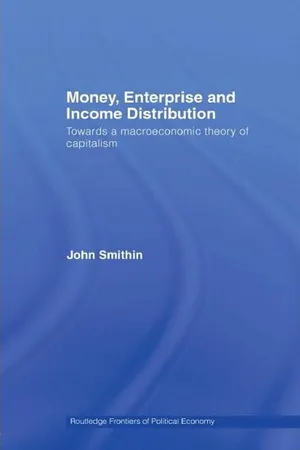
Money, Enterprise and Income Distribution
Towards a macroeconomic theory of capitalism
- 222 pages
- English
- ePUB (mobile friendly)
- Available on iOS & Android
eBook - ePub
About this book
Mainstream neoclassical economics tells us that money is essentially a commodity, has no other social meanings or consequences, and (therefore) exists only as a medium of exchange to lubricate/facilitate barter. This book takes the view that money is definitively a social relation between private persons or legal persons. As such, it is one of
1
Money and alternative visions of capitalism
Introduction
According to Margaret Thatcher (2002, 412n.): “…‘capitalism’ … is one of the few words which the right have appropriated from the left rather than vice versa”. The former British Prime Minister is clearly using the terms left and right in their standard meanings in late twentieth/early twenty-first century politics, and the inference is that conservatives have actually adopted the expression capitalism as a term of approbation for the sociopolitical system they favor, as opposed to the negative spin put on it by generations of Marxists and socialists. The positive associations that Thatcher wants to suggest are neatly summed up, for example, by the titles of Milton Friedman’s two famous books, Capitalism and Freedom (1962) and Free to Choose (1980).
What is quite striking about recent intellectual history, however, is that many of those officially or professionally charged with the investigation of economic questions, namely the academic economics establishment, seem much less enthusiastic about the study of capitalism as such, and specifically capitalism conceived as a ongoing socioeconomic system, than do some of the politicians (Friedman possibly having been the exception that proves the rule in this case). In a series of books and papers published in the last decade of the twentieth century, for example, Heilbroner (1990, 1992, 1999, 2000) and Heilbroner and Milberg (1995), eloquently complain about the lack of “vision”, or more accurately the lack of an adequate vision, of the capitalist economic process, on the part of the orthodox academic economists of the day. In citing these references, it is not the intention to suggest that this problem was confined to the 1990s. Quite the contrary, up to the time of writing nothing has changed, and nobody, presumably, would suggest that the contents of the supposedly “top-tier” economics journals of the present day differ markedly from those of a few years back.1 It is just that these writers set out the issue in a particularly clear-cut and persuasive manner. Moreover, Heilbroner and Milberg themselves suggest that the beginning of the malaise, as they see it, dates back to at least the late 1960s or early 1970s. Similarly, Davidson (2003/04, 256–7) asserts that, after about 1970, articles expressing heterodox or dissenting views (that by definition must have some sort of vision, positive or negative), were systematically excluded from the most prestigious academic journals. So, granted its existence, the problem is a longstanding and continuing one.
The term vision is derived originally from Schumpeter, referring to the “pre-analytical cognitive act” (Schumpeter 1954, 41, quoted by Heilbroner 1990, 1109),2 which is nonetheless an indispensable precursor to analysis. According to Heilbroner (1990, 1109n.), vision necessarily has an ideological character, but in itself the word is free of the pejorative connotations usually associated with the term ideology. That said, there is still really no alternative to using the term “capitalism” to refer to what remains the ruling economic order, even while agreeing (for different reasons) with Hayek (1988, 110–11), for example, that the term is a misleading and politically loaded one. The main problem with the terminology is the vague, ambiguous and ultimately vacuous, nature of the concept of capital itself. Is this supposed to be a sum of money, a collection of machines or a set of personal or social characteristics (as in “human capital” or “social capital”)? It is very rare indeed that writers on economic issues feel the need to clarify these points, yet they write extensively on things such as the capital stock, the accumulation of capital, the marginal product of capital and the capital/labor ratio, as if everyone knows exactly what these terms mean. Often the very same writers use all the different concepts of capital interchangeably. As suggested by the opening quotation, however, the usage that describes the economic system as capitalism is simply too well established to be avoided. The only way out of these difficulties is to be clear precisely “what one feels one means by capitalism” (Keynes, quoted by Plumptre 1975, 248) in each specific context. Weber’s definition of capitalism, as “the provision of human needs by the method of enterprise, which is to say by private business seeking profit” (quoted by Collins 1986, 21–2), is perhaps one of the most sensible, as it realistically describes the actual situation, and studiously avoids any attempt to pin down the elusive notion of “capital” itself. Hayek (1988, 110) moreover, points out that there are analogous problems with terms like “socialism”, liberalism”, etc., but that these are similarly indispensable in practice.
Is a “vision” really necessary?
Reading between the lines of (for example) the Heilbroner and Milberg critique, it seems that one of the main reasons why the adherents of the neoclassical mainstream in contemporary academic economics feel no need of a vision of capitalism as such, is that, after all, they are not actually all that much interested in their ostensible subject matter, that is the behavior of the economy itself. They seem not to be fundamentally concerned with “the economy” and it vicissitudes, in the sense in which (say) business economists, or investors in the stock market, would be interested in it. Nor, typically do they wish their activities to be seen as part of the broader project of social science, in particular if the latter term is understood to mean any detailed investigation of the social structures and institutions that condition economic and other social activity. Instead, to many of its practitioners, the point of economics as an academic discipline is seen as simply the construction of a pure theory of rational choice, apparently altogether regardless of the institutional context.
This stance is quite consistent with the narrow definition of the discipline of economics as set down by Robbins (1932) in the 1930s, which restricted the subject to a study of “human behavior as a relationship between given ends and scarce means which have alternative uses” (as quoted by Blaug 1978, 4), but not with the much broader definitions that tend to be favored by most scholars from the other disciplines studying economic problems – such as economic sociologists, for example (Trigilia 2002, 2–3). Those alternative definitions would be closer in spirit to Adam Smith’s (1776) original “inquiry into the nature and causes of the wealth of nations”. The current mainstream definition of what the subject of economics is all about is much more restrictive than this, and surely at variance with what the intelligent layperson would imagine to be involved in the study of economic systems. Searle (2005, 1), for example, quotes another line from Robbins to the effect that: “economics is a study of the disposal of scarce commodities”, and quips that “two dogs fighting over a bone, or two schoolboys fighting over a ball are also engaged in the disposal of scarce commodities”. Moreover, in the six decades and more since the publication of Samuelson’s mathematical treatise on the Foundations of Economic Analysis (1947), a further requirement, that the pure theory of choice be capable of some form of mathematical expression, has also grown stronger and stronger. The preferred vehicle for the mathematics, in turn, is subject to various fads and fashions, be it “optimal control”, “linear algebra”, “game theory” or whatever. The focus of interest of academic research then comes to be simply the development of the various mathematical techniques with which the theory can be depicted. Actual economic events are interesting only to the extent to which they can be explained by one or other of the agglomeration of mathematical choice theories. Otherwise, they (the actual events) can be put to one side as a “puzzle”.
In short, economics comes to be defined solely by the methods it uses rather than its subject matter, and this much seems to be actually confirmed by the Nobel prizewinner Lucas (2001, 6) in a recent professional memoir. In discussing works written by two academic opponents, Lucas states that both Heilbroner’s Worldly Philosophers (cited above in a later edition), and Galbraith’s American Capitalism (1952), are: “books written for people who dislike economics and want their prejudices entertainingly humored. Neither book gives any clue as to what economics is or what economists do.” The purpose of this citation is not to engage Lucas in debate about the substantive merits of the two works discussed. Regardless of their merits, the point is that the specific criticism made by Lucas would make sense if, and only if, “economics” is being defined precisely as the use of a particular method (that favored by Lucas). That approach to theory (the mathematical choice theory) must be what “economics is and what economists do” on this view. Otherwise, whether or not the Heilbroner and Galbraith volumes are good or bad books, from the subjective point or view of any individual reader, they quite obviously are both devoted to the topic of economics in general. Similarly, in an earlier statement Lucas (1987, 107–8) deprecates the subject of “macroeconomics” in favor of “microeconomics”:
The most interesting recent developments in macroeconomic theory seem to me describable as the reincorporation of aggregative problems such as inflation and business cycles within the general framework of “microeconomic theory”. If these developments succeed, the term “macroeconomic” will simply disappear from use and the modifier “micro” will become superfluous. We will simply, speak, as did Smith, Ricardo, Marshall and Walras of economic theory.
(original emphasis)
Once again, the purpose of the quote is not primarily to point out the obvious anachronism that Smith and Ricardo, at least, would presumably have spoken of political economy rather than economics. The latter term did not come into use until towards the end of the nineteenth century. (In a way, however, this slip really says it all in terms of the gulf between their worldview and that of Lucas.)3 The essential point, rather, is that the microeconomic theory is favored because it is the locus of the desired choice theory, whereas traditional macro-economics, dealing as it does with the “laws of motion” (in Marx’s memorable phrase) of the system as a whole, seemingly inevitably also has to deal with a whole range of sociological, political and historical issues (Ingham 1996b). On the definition of economics favored by mainstream economists in contemporary academia, such things as these should be avoided at all costs. The upshot of all this, therefore, is that such writers are unlikely to feel any need for a vision of a particular social system such as capitalism. Economics is meant to be a “hard science”. It is supposed to consist of little more than a behavioral science involving rational choice, and, in principle, is valid for all time and places, just as the results of a physical science would be. Orthodox economists are therefore not particularly concerned with the modus operandi of any type of social system as such, and this lack of interest extends even to the ways in which different social systems conduct economic activity. The bottom line is that any situation in which an individual finds herself or himself must, by definition, have been “chosen” by that individual, given the constraints that they face. That they make the choice, and how they make the choice, is supposedly more interesting or fundamental than how the constraints themselves came into being.
Types of economic system
In a similar vein to the above, Heinsohn and Steiger (2000, 72) quote the following rhetorical question from Demsetz (1998): “What has mainstream economics being doing for 200 years if it has not been studying capitalism?” The 200 year time frame for the implied negative response is probably a bit of an exaggeration, but as suggested above, the implicit answer is that for a good chunk of this time, basically since the marginalist revolution of the 1870s, the mainstream has not been studying the system in its entirety at all, but rather focusing on the rational choice theory outlined above, and on how such choices are reflected in the operation of the price mechanism. According to Demsetz (again, as quoted by Heinsohn and Steiger 2000, 72): “The property rights system … is only implicitly involved in the theory that emerged. This theory … takes the property rights foundation of capitalism for granted. It does not investigate the role of property rights arrangements.” It will be argued below that the theory also takes much else for granted besides property rights; and in particular the nature and role of money as the key social institution in capitalism. However, for now, we note that there is a heavy irony about the methodological stance of economic orthodoxy, as also stressed by Heilbroner (1992) and Heilbroner and Milberg (1995), for example. One of the most telling points made by these authors is that there would not actually be much need for economic theory, or the particular skills of the economist, outside of the institutional framework of capitalism. Indeed, there was no systematic economic theory, or political economy, before the system itself came into being (Heilbroner 1992; Triglia 2002). Therefore, the methodological stance of contemporary economists is actually a self-denying ordinance of major proportions.
Following the work of Polyani (1944) in particular, it has often been argued that, in spite of the diversity in detail of the different methods that various societies and cultures have used in the attempt to solve the economic problem, at the most fundamental level there have been just three “distinctive systems of material reproduction” that have existed in history (Heinsohn and Steiger 2000, 68; Heilbroner 1992, 10–16; Triglia 2002, 17–19). In the terminology of Heinsohn and Steiger, these are:
• the customary or tribal society
• the command or feudal society
• the property-based society.
In the customary, tribal or “traditional” society production and distribution are organized according to the time-honored rules and procedures of the particular collective. They differ in specific content from case to case, but are based essentially on the principle of reciprocity. The individuals who make up the society, however, are not “free” in a legal sense, as there is no independent system of law to which they could appeal to enforce the rules of reciprocity. In the command society, meanwhile, (examples of which would be ancient systems of slavery or feudalism, but would also include the state socialisms, and other totalitarian systems, of the twentieth century), the reigning principle is not reciprocity but coercive redistribution. In these cases, production and distribution are basically organized by a ruling class, caste or cadre, who extract levies from a subordinate class of serfs. Obviously the latter are not free, and have no independent system of justice to which they could appeal in the case of disputes over shares. Finally, in the property-based society, production is organized by monetary exchange and a system of contracts between free individuals, who can indeed appeal to independent courts of law in the enforcement of these contracts (Heinsohn and Steiger 2000, 68).
Each of these systems obviously involves economic activity in the sense of provisioning. They must each have some method of producing the means of subsistence and of distributing the resulting goods and services in some way. However, it is doubtful if all of them could be said to involve an “economy” in the full sense in which that term might be used today (for example) in the business section of a newspaper. Each system is also capable, to a certain extent, of change and adaptation. In the case of the customary ...
Table of contents
- Routledge frontiers of political economy
- Contents
- Illustrations
- Preface
- 1 Money and alternative visions of capitalism
- 2 Economics and politics
- 3 Methodological issues in monetary economics
- 4 The role of money in the economy
- 5 The determination of interest rates
- 6 A theory of profit
- 7 A theory of wages
- 8 Effective demand, income distribution, and economic growth
- 9 Endogenous money, monetary policy, and inflation
- 10 A complete macroeconomic model of output growth, inflation, and income distribution
- 11 Notes on fiscal policy and the public finances
- 12 Concluding remarks
- Notes
- Bibliography
- Index
Trusted by 375,005 students
Access to over 1.5 million titles for a fair monthly price.
Study more efficiently using our study tools.
Frequently asked questions
Yes, you can cancel anytime from the Subscription tab in your account settings on the Perlego website. Your subscription will stay active until the end of your current billing period. Learn how to cancel your subscription
No, books cannot be downloaded as external files, such as PDFs, for use outside of Perlego. However, you can download books within the Perlego app for offline reading on mobile or tablet. Learn how to download books offline
Perlego offers two plans: Essential and Complete
- Essential is ideal for learners and professionals who enjoy exploring a wide range of subjects. Access the Essential Library with 800,000+ trusted titles and best-sellers across business, personal growth, and the humanities. Includes unlimited reading time and Standard Read Aloud voice.
- Complete: Perfect for advanced learners and researchers needing full, unrestricted access. Unlock 1.5M+ books across hundreds of subjects, including academic and specialized titles. The Complete Plan also includes advanced features like Premium Read Aloud and Research Assistant.
We are an online textbook subscription service, where you can get access to an entire online library for less than the price of a single book per month. With over 1.5 million books across 990+ topics, we’ve got you covered! Learn about our mission
Look out for the read-aloud symbol on your next book to see if you can listen to it. The read-aloud tool reads text aloud for you, highlighting the text as it is being read. You can pause it, speed it up and slow it down. Learn more about Read Aloud
Yes! You can use the Perlego app on both iOS and Android devices to read anytime, anywhere — even offline. Perfect for commutes or when you’re on the go.
Please note we cannot support devices running on iOS 13 and Android 7 or earlier. Learn more about using the app
Please note we cannot support devices running on iOS 13 and Android 7 or earlier. Learn more about using the app
Yes, you can access Money, Enterprise and Income Distribution by John Smithin in PDF and/or ePUB format, as well as other popular books in Business & Business General. We have over 1.5 million books available in our catalogue for you to explore.