This book argues, against the dominant orthodoxy in the history of economic thought, for the originality of Carl Menger's contribution to the development of the Austrian school of economics. Situating the evolution of Menger's thought in the tradition of classical political economy, the author documents the emergence of a Mengerian logic and its contribution to the formation of a distinctly Austrian tradition of economics.
In its bold elucidation of the shaping of a tradition in economic thought, Tradition and Innovation in Austrian Economics provides a fresh and challenging perspective on the Austrian school which will be of interest to researchers in Austrian economics and the history of economic thought.
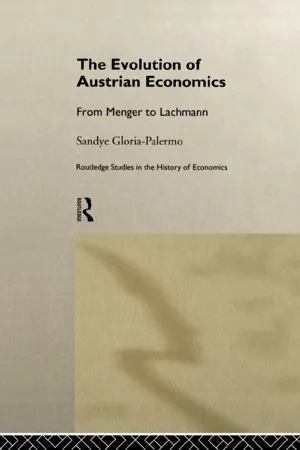
- 208 pages
- English
- ePUB (mobile friendly)
- Available on iOS & Android
eBook - ePub
About this book
Part I
The originality and foundations of Menger’s logic
The object of Part I is to demonstrate that we are justified in referring to a Mengerian logic in its own right. Our intention is to define the analytical and methodological originality attached to Menger’s analysis, in order to identify the foundations upon which the Austrian tradition would progressively be built. The major implication here consists in questioning traditional interpretations which turn Menger into a marginalist author, so that he may be associated with an original and distinctive approach.
Whatever the interpretations given or terms used, the majority of historians of economic thought are in agreement that the end of the nineteenth century was the stage for a particularly important theoretical revolution upon which Menger is presented without discrimination as one of the essential figures, along with Jevons, Marshall and Walras.1 Our aim is to bring to light the traits which denote Menger’s originality with regard to the marginalist tradition within which the author is so generally and indistinctly included.
1 A particular interpretation of Menger
The object of this chapter is to provide foundations for a study of Menger’s work which differs somewhat from traditional interpretations. The main problem encountered by the commentator lies in the identification of the analytical aim sought by Menger. In our view, the solution consists in reading the analytical developments of the author in the light of his later methodological considerations. If, on the contrary, Menger’s methodological writings are limited, as is often the case, to an attack on the German historical school, two problems will be created. First, it will lead to a fallacious appraisal of Menger’s relationship with the German economic tradition, and second, to an underestimation of the coherence of Menger’s overall project.
Limits of traditional interpretations
The main work of Menger, the Grundsätze der Volkswirtschaftslehre, gives rise to different and basically incompatible interpretations. This certainly arises from the fact that the author never states the analytical goal pursued. Menger never clearly defines the object of his reasoning, unlike Walras and Jevons who state that their aims are, respectively, to elaborate a pure theory of the determination of relative prices in a context of perfect competition and to define economics as an exercise in the maximisation of individual satisfaction. Nothing of this nature appears with Menger and we never know precisely if the logic of his developments emanates from exchange – determining prices and repartition – or from production – how to increase overall wealth. Hence it is natural to see a clash between two totally different interpretations of Menger’s work: one of them, traditional, places Menger in a central role within the marginalist revolution (Stigler, 1941) whilst the other, heterodox, considers the Grundsätze as a contribution to the logic of production (Streissler, 1972).
More precisely, Streissler reveals the dynamic aspect of Menger’s analysis and offers an interpretation centred on the problem of determining the causes which govern the level of wealth. In fact, according to Streissler, Menger is said to have reopened the programme begun by Smith in The Wealth of Nations. However, in place of the principle of the division of labour, Menger is said to have substituted the process of acquisition of information as a means likely to increase the well-being of agents. Stigler, on the contrary, reads Menger through the neoclassical prism. In his opinion, the author’s problematic is a typical example of resource allocation. The emphasis is on the unification of the principle of value based on marginal utility. The theory of imputation enables marginalist logic to be extended to the realm of production.
For various reasons, neither of these two interpretations satisfies us. As far as marginalist interpretations are concerned, two types of problems may be outlined. First, they do not deny the presence within Menger’s logic of elements belonging to an alternative analytical framework than that of allocation. We are referring here to the temporal dimension of the production process, to the importance given to elements of uncertainty, to the process of acquisition of information, to qualitative and extra-economic aspects which come into the analysis – so many elements, which are difficult to introduce in the marginalist logic and hardly fit into the Walrasian framework. In fact, marginalist commentators explain that these elements appear in the initial chapters of the Grundsätze and that they only represent ‘introductory considerations’ which are subsequently abandoned. Menger is then situated, without any doubt, within the static framework of a problem of the allocation of resources. We shall demonstrate how these elements were on the contrary to make up the very core of Menger’s originality.
Neoclassical commentators, instead of questioning their interpretation, denounce the weakness of Menger’s theory: they blame the author for omitting the hypothesis of decreasing returns to scale, which is essential for the coherence of the marginalist view; Menger is said to use an imprecise terminology;1 the author does not express the theorem of Euler according to which the total product is entirely used up by the amount of productive contributions from various factors. We believe that these criticisms may also be interpreted as sufficient counter-arguments in the face of the marginalist interpretation. Had Menger really held such a view of the economic system, the representation he gives of it would indeed be somewhat succinct.
As far as the interpretation of Streissler is concerned, two limits deserve to be emphasised. First, the Menger–Smith link may appear a priori surprising to the extent that the Grundsätze are clearly out of balance with classical tradition and this opposition itself represents a point where it is akin to the German economic tradition. This argument should not be overestimated, however, in the sense that the target of criticism common to German authors and Menger concerns to a lesser extent the Smithian logic than the objective theory of value in the manner in which it was developed by the Ricardian school. In reality, the criticisms Menger directs at Smith are much more selective: for instance, Menger’s disapproval of Smith’s justification of exchange on the basis of a possible ‘natural propensity to exchange’ inborn in man. Menger turns exchange into the essential desire for the search to satisfy individual needs.
Nevertheless, Menger’s logic presents a certain number of affinities with the developments of Smith. Remember, for instance, that the lectures Menger gave to the Austrian Crown Prince Rudolf in 1876 abound with passages taken from The Wealth of Nations.2 Streissler’s interpretation brings one fundamental aspect of Menger’s thought to the fore, this being the division of knowledge. However, this does not, in our opinion, constitute the central element of the Grundsätze.
It is clear that, for Menger, the roots of progress are not in an improved allocation of resources – and here he is in total agreement with Smith – but in a better use of resources thanks to an improved knowledge of production processes.
If this is the major theme of the book, then it is curious to notice that, subsequently, Menger’s interest falls on questions of the value and the determination of relative prices and that the author henceforth makes no further reference to questions of production. Would Menger so accurately reproduce the outline of Smith in the way that Kaldor presents it? In his famous article Kaldor ([1972] 1989, p. 378) clearly locates the moment when economics began to stray in the wrong direction: in the middle of the fourth chapter of the first book of The Wealth of Nations, where ‘[Smith’s] interest gets bogged down in the question of how values and prices for products and factors are determined’, the author loses sight of the goal he gave himself at the outset, that is, to explain how it is possible to increase the level of national wealth.
Reminiscent of Smith, Menger discusses the production process, the causes governing its improvement in the sense of greater well-being for society and goes on, with no logical transition regarding this aim, to interest himself in the question of the value of goods.
The interpretation of Smith given by Kaldor is relevant to the extent that the author of The Wealth of Nations had clearly defined his goal and context of analysis beforehand. It is true that the importance given to the theory of value seems exaggerated when we consider the initial objective of the author. However, an ambiguity remains in Menger’s writings, in the sense that the author never explicitly defines his analytical objective. Be that as it may, the rest of the book, which is more than half, is given over to the problem of value, the determination of prices and money. It is clear that this is the section favoured by marginalist commentators.
The marginalist interpretation, and to a lesser degree that defended by Streissler, does not do full justice to the originality of Menger’s thought. Indeed, both leave to one side the importance, in our opinion, of the theme of institutions within the logic of Menger. This fact originates from circumstances common to both marginalist and heterodox interpretations: they are both mainly based on the analysis of the Grundsätze and consider the fundamental points of Menger’s contributions to economics, from an analytical point of view, to be contained therein. The second work of Menger, the Untersuchungen über die Methode der Socialwissenschaften, is considered solely as a contribution to the realm of methodology as it represents the answer to the critics of German historicists and illustrates the war of methods which divides them.3
Our aim is to grasp the originality of Menger’s logic and to reject positively the notion of Menger as being vague and unclear, in whose writings a most varied number of elements are to be found. This impression may well emerge precisely following the clash between marginalist and heterodox interpretations. In this perspective, it appears essential to base our work systematically on the author’s two books.4 Indeed, there is without doubt a continuity in the reasoning between the Grundsätze and the Untersuchungen.5 In fact, it is only during the developments of the second book that Menger finally reveals the object of his analysis: economics comes within the scope of the social sciences and, in that light, the economist’s major objective should tend towards the understanding of the origin and evolution of complex economic phenomena. Such an aim is in total harmony with the specific methodological position to which Menger adheres.
Essentialism and causality: the two bastions of Menger’s methodological position
In the preface to the Grundsätze, Menger never specifies his analytical objective, thereby paving the way for distinct interpretations, as we have already pointed out. The author only clarifies at this stage the methodological approach he considers relevant for economics and which will later underlie the whole of his analyses in a coherent manner.
In Menger’s view, economics belongs to the group of theoretical sciences, which means that it automatically receives the status of an exact science. This concept of economics as an exact science clashes fundamentally with the position of the German historical school, which favours a historical approach with the intention of highlighting empirical regularities. For Menger, on the contrary, the status of exact science stems from the fact that it is possible to develop precise and universal theoretical laws to explain economic phenomena. The scientific approach defended by Menger is thus purely analytical and consists in breaking down complex economic phenomena into their most simple elements, a logical decomposition in terms of relations of causality. On a methodological level, his objective is thus:
to reduce the complex phenomena of human economic activity to the simplest elements that can still be subjected to accurate observation, to apply to these elements the measure corresponding to their nature, and constantly adhering to this measure, to investigate the manner in which more complex phenomena evolve from their elements according to definite principles.
(Menger, [1871] 1950, pp. 46–7)
In reality, the individual and his or her behaviour are the most basic elements by means of which Menger will explain, through the relation of cause and effect, the most complex economic phenomena and draw up universal laws.
The introductory remarks of Menger cease here. The author does not venture outside the realm of methodology and does not clarify his approach on an analytical level. The first chapter of the Grundsätze begins with the general theory of goods with no further explanation. In fact, from the outset Menger ([1871] 1950, p. 51) seeks to apply the previously defined methodological orientations and opens the chapter by declaring that ‘all things are subject to the law of cause and effect. This great principle knows no exceptions, and we would search in vain in the realm of experience for an example to the contrary.’
Here Menger insists on the idea that any dynamic process, any change in state, is governed by the principle of causality. In economics, at the simplest level of the individual, the primary cause explaining behaviour reflects the human need to have certain goods at one’s disposal in order to live, this translating into the search to satisfy one’s needs. Throughout his work, Menger emphasises the individual as a starting point for the causal explanation of all economic phenomena. The author considers human behaviour which seeks to satisfy needs as the most simple premise upon which everything may be built. This is defined as the principle of ‘economizing’.6
Economics, considered as a theoretical science, falls into the group of social sciences and, in this respect, must be construed using the same methodological principles. The scientist’s approach should thus be guided by the search for universal laws which enable acquisition of a general knowledge of phenomena by means of a causal breaking down into their basic elements.
If, with the Grundsätze, Menger reveals the methodological approach he intends to develop, it is not until the Untersuchungen, published more than a decade later, that the author finally clarifies the analytical object that, in his view, is covered by economics.
In his 1883 work, Menger continues and goes deeper into the methodological foundations which, in his opinion, should underlie any theoretical science and economics in particular. Essentialism and universalism, which were already present in the developments of the Grundsätze, are here confirmed and justified. The scientific approach, whose ultimate aim is to acquire general knowledge about phenomena (in contrast to concrete and particular knowledge), consists in systematically researching ultimate causes which are the very essence of these phenomena, by establishing general laws that have a universal character, that is, know no exceptions:
The goal of scholarly research is not only the cognition, but also the understanding of phenomena. We have gained cognition of a phenomenon when we have attained a mental image of it. We understand it when we have recognized the reason for its existence and for its characteristic quality (the reason for its being and for its being like it is).
(Menger, [1883] 1963, p. 43)
Menger’s analytical objective and the importance of the theme of institutions
The scientific approach outlined above is applied to a particular area of economics: the analysis of organic institutional phenomena. As Hayek (1934) points out, the interest of the Untersuchungen should not be confined to questions of a purely methodological nature. According to Hayek (ibid., p. 405), the Untersuchungen is just as much an accomplishment as the Grundsätze and, in his view, the basic interest of the work lies in the precision with which Menger addresses the question of the origin and nature of economic institutions:7
Probably it [the Untersuchungen] did more than any other single book to make clear the peculiar character of the scientific method in the social sciences, and it had a very considerable effect on professional ‘methodologists’ among German philosophers. But to me, at any rate, its main interest to the economist of our days seems to lie in the extraordinary insight into the nature of social phenomena which is revealed incidentally in the discussion of problems mentioned to exemplify different methods of approach, and in the light shed by his discussion of the development of the concepts with which the social sciences have to work. Discussions of somewhat obsolete views, as that of the organic or perhaps better physiological interpretation of social phenomena, give him an...
Table of contents
- Cover Page
- Title Page
- Copyright Page
- Figures
- Acknowledgements
- Introduction
- Part I The Originality and Foundations of Menger’s Logic
- Part II The Progressive Neglect of Menger’s Originality
- Part III Menger’s Legacy
- Part IV Which Way Forward?
- Conclusion
- Notes
- Bibliography
Trusted by 375,005 students
Access to over 1.5 million titles for a fair monthly price.
Study more efficiently using our study tools.
Frequently asked questions
Yes, you can cancel anytime from the Subscription tab in your account settings on the Perlego website. Your subscription will stay active until the end of your current billing period. Learn how to cancel your subscription
No, books cannot be downloaded as external files, such as PDFs, for use outside of Perlego. However, you can download books within the Perlego app for offline reading on mobile or tablet. Learn how to download books offline
Perlego offers two plans: Essential and Complete
- Essential is ideal for learners and professionals who enjoy exploring a wide range of subjects. Access the Essential Library with 800,000+ trusted titles and best-sellers across business, personal growth, and the humanities. Includes unlimited reading time and Standard Read Aloud voice.
- Complete: Perfect for advanced learners and researchers needing full, unrestricted access. Unlock 1.5M+ books across hundreds of subjects, including academic and specialized titles. The Complete Plan also includes advanced features like Premium Read Aloud and Research Assistant.
We are an online textbook subscription service, where you can get access to an entire online library for less than the price of a single book per month. With over 1.5 million books across 990+ topics, we’ve got you covered! Learn about our mission
Look out for the read-aloud symbol on your next book to see if you can listen to it. The read-aloud tool reads text aloud for you, highlighting the text as it is being read. You can pause it, speed it up and slow it down. Learn more about Read Aloud
Yes! You can use the Perlego app on both iOS and Android devices to read anytime, anywhere — even offline. Perfect for commutes or when you’re on the go.
Please note we cannot support devices running on iOS 13 and Android 7 or earlier. Learn more about using the app
Please note we cannot support devices running on iOS 13 and Android 7 or earlier. Learn more about using the app
Yes, you can access Evolution of Austrian Economics by Sandye Gloria-Palermo in PDF and/or ePUB format, as well as other popular books in Economics & Economic Theory. We have over 1.5 million books available in our catalogue for you to explore.