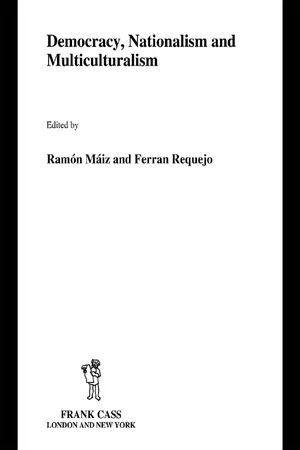
Democracy, Nationalism and Multiculturalism provides an up-to-date review of subnational and multicultural issues in Western multinational states. The book includes normative, institutional and comparative accounts of key issues such as:
* politics and policies of accommodation
* multiculturalism
* recognition of group rights
* federalist reforms and debates in Canada and European states
* the political construction of the European Union.
- 176 pages
- English
- ePUB (mobile friendly)
- Available on iOS & Android
eBook - ePub
Democracy, Nationalism and Multiculturalism
About this book
Information
1
Dialogue between cultures
Bhikhu Parekh
In this chapter I argue that the collective affairs of a multicultural society are best conducted by means of what I call a dialogically constituted democracy. I begin with a brief discussion of contemporary multicultural societies and explore the nature and logic of multiculturalism as a philosophical and political movement. I then go on to analyse the nature and limits of intercultural dialogue, and end with a brief characterization of a dialogically constituted multicultural democracy.
Multicultural society
Culture refers to a historically inherited system of meaning and significance in terms of which a group of people understand and structure their individual and collective lives. It defines both the meaning or the point of human activities, social relations and human life in general, and the kind and degree of significance or value to be attached to them. A culture’s system of meaning and significance is articulated in a body of beliefs and practices, which collectively constitute its content and identity. A multicultural society is characterized by a plurality of cultures. Its members subscribe to different systems of meaning and significance and structure their lives differently. Although some of their values invariably overlap, others do not. And even so far as the former are concerned, they sometimes define and prioritize them differently. Unlike a culturally homogeneous society, members of a multicultural society do not share a common substantive vision of the good life, and disagree about the value to be assigned to different human activities and relationships.
Almost all societies today are multicultural – some, no doubt, more so than others. Immigrants whose labour and skills are often badly needed and who generally belong to different cultural groups represent one source of diversity. Refugees who most societies admit as part of their international obligation are another. The inescapable exposure to new ideas and sensibilities brought about by the processes of globalization, and the conscious or unconscious absorption of at least some of them, is yet another source of diversity. The disintegration of the traditional consensus on life’s guiding principles creates both a space and a need for moral and cultural experimentation, and gives rise to new ways of understanding and organizing human life. Economic, technological, demographic and other changes too are a source of cultural diversity. Since different individuals and groups within a society understand and respond to them differently, and since these differences cannot be easily reconciled and integrated into a coherent cultural whole, new forms of life continue to spring up. Since cultural diversity thus has both endogenous and exogenous sources, modern societies would remain multicultural even if all immigration were to cease.
It is sometimes argued that multicultural societies are a passing phase in history and do not merit the enormous attention given to them in contemporary discussions. Immigrants and refugees are bound to integrate and even assimilate over time, and to cease to be a source of cultural diversity. The capitalist economy, the bureaucratically structured state, compulsions of international competition, the need to legitimize political authority, and so on, require considerable cultural homogenization and thus flatten cultural diversity. Although individuals remain free to make their choices of lifestyles, these are largely superficial and do not give rise to deep cultural diversities. It is argued that, for these and other reasons, all modern societies are ultimately heading towards a single homogeneous culture based on individualist, consumerist, technological and bourgeois values.
There is only limited evidence to support this view. Although some immigrants do assimilate, others do not. And even in the former case, their children and grandchildren sometimes seek to revive aspects of their ancestral culture. Furthermore, given the demographic trends in Western societies, immigration is going to be needed for years to come and will remain a source of deep diversity. Despite three several centuries of systematic homogenization, nation-states have not succeeded in suppressing regional, ethnic and cultural diversities; indeed, the latter have experienced something of a revival in response to the impersonal forces of globalization and have become centres of renewed loyalty. Although the capitalist economy has generated a considerable trend towards homogenization, it does not take the same form in different societies, as the cases of East Asian societies show. And even in the West, it has provoked a reaction in the form of demands for sustainable growth, reassessment of the place of economic activity in human life, and new visions of the good life. The decline of religion that many predicted as an inevitable consequence of modernist rationalism has not occurred; in fact, the opposite has happened in many societies, including the United States. And religion itself is undergoing important changes and throwing up new forms. In short, cultural diversity in modern society has not only not diminished but shows every sign of increasing in its range and depth.
Although cultural diversity has characterized all human societies throughout history save perhaps the most primitive and is not new to our age, its historical and ideological context is quite different. In earlier societies, different cultural communities led more or less self-contained lives, and minority communities remained confined to the subordinate legal and social spaces assigned to them by the dominant community. This is no longer possible today because of four historically unique processes. Thanks to the logic of industrialization, different communities are drawn together into a common economic system, compete with each other, participate in common practices, and work in industries and join unions that cut across regional, religious and other boundaries. Thanks to the logic of democracy, they participate in common political institutions, form crosscutting alliances, are mobilized along political and ideological rather than ethnic and cultural lines, demand equal rights, and use their electoral power to promote their collective interests. Thanks to the logic of liberalism, members of cultural communities cherish their individuality, enjoy and exercise the right to make their own choices and resent communal constraints, and so on, thereby weakening the solidarity and the homogeneity of their respective communities. Finally, thanks to the logic of globalization, no community today can avoid the relentless flow of new ideas, beliefs, cultural movements, tourists and artistic products, and the profound impact that these have on its self-understanding and way of life.
As a result of the cumulative influence of these and other factors, multicultural societies today are historically unique. Their constituent groups and communities can no longer lead self-contained lives; they necessarily interact in different areas of life and see themselves as members of a single political community. For earlier multicultural societies, cultural diversity was a morally and politically marginal fact of social life; the former because it did not affect the values and the vision of the good society that animated the mainstream society, the latter because it gave minority communities no or little say in the conduct of collective affairs. By contrast, cultural diversity is a central moral and political fact of modern life, influencing all areas of life and posing problems that require urgent and untried answers.
Cultural diversity is not only an ineradicable fact of modern life but also a value worth cherishing. It adds to the variety of life and has an aesthetic significance. It increases our range of choices and widens the ambit of our freedom. In so far as it alerts us to the fact that the good life can be lived in several different ways, cultural diversity highlights the contingency and mutability of our beliefs and practices. Since no culture is perfect and since each represents only a limited vision of the good life, it needs others to complement and enrich it. Cultural diversity is therefore an important constituent of human well-being. Since other cultures provide us with vantage points from which to look at our own, they enable us to appreciate its strengths and limitations and increase our capacity for self-consciousness, self-criticism and self-regeneration. The diversity of cultures alerts each to the diversity within it, guards it against the dangers of essentialization and homogenization, and encourages a most welcome internal debate between its different strands. Cultural diversity and the intracultural and intercultural dialogue it fosters thus expand and deepen our capacity for rationality by highlighting our conscious and unconscious cultural assumptions, and giving us the space and the power to challenge them.
Cultural diversity is a necessary but not a sufficient condition of intercultural dialogue. No dominant culture likes to take the risk of a dialogue, both because the outcome of the dialogue cannot be predicted and because the dialogue requires it to justify assumptions that it has long taken for granted and whose validity it cannot always be sure of establishing. The dialogue can occur only under certain conditions, two of which are particularly relevant to our discussion. First, the dominant culture should face criticism or at least serious questioning from within and create space for an internal debate. It is then no longer monolithic and self-righteous, and some of its members are likely to be inclined to look outside for new sources of inspiration. Second, non-dominant cultures should have the self-confidence and the courage to challenge the hegemony of the dominant culture and to demand respect for their values and visions of the good life. They then question its assumptions, moral vision and values, ask it to justify them, and precipitate a dialogue.
Both these conditions are present today, which is why there is a considerable interest in a dialogue between cultures, civilizations and religions. Thanks to the two world wars, the fascist, Nazi, and the communist tyrannies, the ecological threat posed by rampant industrialization, the moral crisis created by unchecked individualism and consumerism, and the social havoc caused by globalized capitalism, the dominant Western culture today faces considerable internal criticism and entertains different degrees of self-doubt. And thanks to decolonization, the spirit of democratic equality, the growing self-confidence and the increasing prosperity of some of the hitherto marginalized and inferiorized cultures, the latter are beginning to assert themselves, to challenge the dominant culture’s universalist claims, and to call for a dialogue of equals.
Multiculturalism
This is the historical context in which what is infelicitously called multiculturalism has emerged as a distinct cultural movement. Multiculturalism is basically a theory about human freedom and well-being and rests on a distinct conception of the good life. It is grounded in the three-fold belief that human beings are culturally embedded, that every culture represents a limited vision of the good life and benefits from a dialogue with others, and, finally, that a good society should foster conditions of intercultural dialogue and should ideally be dialogically constituted. While appreciating that human beings are culturally embedded and need a stable cultural home, multiculturalism also stresses the importance of active engagement with other cultures. For it human beings need both stability and openness, both a culture of their own and access to other cultures. It values intercultural dialogue not as a way of coping with the fact of cultural diversity, but rather to exploit the value of cultural diversity and to reap its ontological, epistemological, moral and other benefits.
The fact that multiculturalism values cultural openness and intercultural dialogue does not commit it to the view that a culturally self-contained life has nothing to be said for it. Although the latter lacks the vitality and energy of a culturally interactive life, it does provide the conditions of a good life and deserves respect. Furthermore, a way of life cannot be judged in the abstract, and we need to take into account the traditions, historical circumstances, and so on, of the community concerned. A culturally homogeneous society that has not developed the habit and tradition of reflective individual choice has little use for cultural diversity. It neither has this diversity nor knows what to do with it. It would therefore be pointless and even disastrous to require the Australian aborigines or the Amazonian Indians to become multicultural. Since multiculturalism recognizes that the good life can be lived in a monocultural society as well, it does not insist that the multicultural society alone is rational and truly human, for that would be to fall prey to monoculturalism and to betray its own inspiring principle. And nor does it insist that a multicultural society is always to be preferred over the monocultural, for that depends on the cultural and historical context of the society concerned. All it maintains is that all societies today are increasingly and inescapably becoming multicultural and that multiculturalism is the best way to organize them. Like all moral visions, multiculturalism makes sense and holds valid only under certain historically created cultural, moral and other conditions.
Since multiculturalism is often misunderstood and all kinds of views are subsumed under it by both its defenders and detractors, it would be useful to point out what it does not imply. First, multiculturalism does not mean that we are determined by or are prisoners of our culture. To stress the value and the formative influence of culture is not to suggest that we cannot criticize or rise above it. Furthermore, if we were determined by our culture, we simply would not be able to benefit from a creative interaction with other cultures, and then there would be no case for cultural diversity or multiculturalism.
Second, multiculturalism does not imply that every society is or should remain divided into neatly self-contained cultures, each morally self-sufficient and possessing all the necessary resources for a good life. Multiculturalism takes the opposite view, which is why it insists on the value of cultural diversity and intercultural dialogue.
Third, multiculturalism does not imply that all cultural beliefs and practices deserve respect. The fact that a culture means much to its members, is a source of their stability and identity, and deserves respect does not mean that all its beliefs and practices are morally worthy and immune to criticism. Although we have an obligation to understand other cultures sympathetically and not to judge them too hastily, we cannot abdicate our responsibility to evaluate them. It is precisely because multiculturalism appreciates the limitations of each culture and the need for self-criticism that it stresses intercultural dialogue.
Fourth, although multiculturalism cherishes cultural diversity, it is not committed to maintaining its existing forms. Intercultural dialogue is bound to encourage cultural experimentation and throw up new forms of diversity. For a multicultural-ist, cultures are not museum pieces but living systems of meaning. As such they can last only as long as they have the ability to command the allegiance of their members, and cannot be artificially propped up or kept alive.
Fifth, multiculturalism does not imply that cultures are totally distinct and closed worlds with nothing in common. If that were so, they would have no resources with which to understand, interact and engage in a dialogue with each other.
Sixth, multiculturalism does not imply relativism or the view that all moral judgements are relative to a culture and that the latter cannot be criticized from outside. While insisting that different cultures represent different visions of the good life and systems of values, multiculturalism also maintains that these visions and values are necessarily limited and benefit from a critical dialogue with others, as also, since cultures are human creations, our shared humanity gives rise to a body of universally shared thin but nevertheless significant values.
Seventh, multiculturalism is not committed to the view that all cultures are equal in the sense of being equally good. Such a view implies that we have a transcultural standard by which all cultures can be judged equal. While acknowledging that certain values are universal, multiculturalism insists that these values can be interpreted and combined differently and that there are other values that are specific to each culture. It therefore rules out the possibility of an abstract and mechanically applied universal yardstick by which to judge whole cultures and declare them equally good. All it says is that all cultures deserve respect, partly because they mean much to their members and partly because each represents a vision of the good life and has something to offer to others.
Eighth, multiculturalism does not imply that the state may not intervene in the internal life of a cultural community and ban some of its unacceptable practices. Non-intervention is usually advocated either on the relativist ground that the state has no means of judging other cultures, or on the autonomist ground that each cultural community has a right to lead its own life. As we have seen, both are untenable. We can judge other cultures, and no cultural community can claim an absolute right to non-intervention. When a community’s practices prevent it from living peacefully with others by inciting racial, religious or ethnic hatred or rebellion against the state, or when they pose a threat to public hygiene or violate norms of public decency, they may legitimately be banned, as all multicultural societies have generally done with the broad approval of their constituent communities.
In recent years some feminist writers have been among the most fierce critics of multiculturalism. In their view it requires respect for or at least tolerance of all kinds of cultural practices, including the unequal treatment of women endemic in many a non-Western culture. The feminist critique is mistaken because, as we saw, multiculturalism implies no such thing. All it requires is that we should first understand other cultures from within before passing judgements and that the criteria we employ should be shown to be universally valid. The feminist critique also makes the mistake of abstracting gender relations from other social relations and judging them in isolation. A culture might treat women unequally in civil and political matters but give them a superior social and religious status, or treat them as inferior when young or unmarried but revere them when they are old or are grandmothers. Since women at different stages of life or in different relationships are perceived differently and are endowed with different rights in different societies, ‘woman’ is too simplistic an abstraction to allow cross-cultural comparisons of gender equality.
There is also the further question of how women themselves perceive their situation. If some of them do not share the feminist view, it would be wrong to say that they are victims of a culturally generated false consciousness and in need of liberation by well-meaning outsiders. That is patronizing, even impertinent, and denies them the very equality we wish to extend to them. This is not to say that they might not be brainwashed, for sometimes they are, but rather that we should avoid the mistaken conclusion that those who do not share our beliefs about their well-being are all misguided victims of indoctrination. In Britain several well-educated and otherwise liberal white women have in recent years converted to Islam, or returned to...
Table of contents
- Cover Page
- Title Page
- Copyright Page
- Notes on contributors
- Introduction
- 1 Dialogue between cultures
- 2 Interculturalism: expanding the boundaries of citizenship
- 3 Accommodating national differences within multinational states
- 4 Nation and deliberation
- 5 From nation-building to national engineering: the ethics of shaping identities
- 6 Multinational, not ‘postnational’, federalism
- 7 Federalism and secession: East and West
- 8 Dilemmas of stateless nations in the European Union
- 9 The ‘transformation’ of governance: new directions in policy and politics
Trusted by 375,005 students
Access to over 1.5 million titles for a fair monthly price.
Study more efficiently using our study tools.
Frequently asked questions
Yes, you can cancel anytime from the Subscription tab in your account settings on the Perlego website. Your subscription will stay active until the end of your current billing period. Learn how to cancel your subscription
No, books cannot be downloaded as external files, such as PDFs, for use outside of Perlego. However, you can download books within the Perlego app for offline reading on mobile or tablet. Learn how to download books offline
Perlego offers two plans: Essential and Complete
- Essential is ideal for learners and professionals who enjoy exploring a wide range of subjects. Access the Essential Library with 800,000+ trusted titles and best-sellers across business, personal growth, and the humanities. Includes unlimited reading time and Standard Read Aloud voice.
- Complete: Perfect for advanced learners and researchers needing full, unrestricted access. Unlock 1.5M+ books across hundreds of subjects, including academic and specialized titles. The Complete Plan also includes advanced features like Premium Read Aloud and Research Assistant.
We are an online textbook subscription service, where you can get access to an entire online library for less than the price of a single book per month. With over 1.5 million books across 990+ topics, we’ve got you covered! Learn about our mission
Look out for the read-aloud symbol on your next book to see if you can listen to it. The read-aloud tool reads text aloud for you, highlighting the text as it is being read. You can pause it, speed it up and slow it down. Learn more about Read Aloud
Yes! You can use the Perlego app on both iOS and Android devices to read anytime, anywhere — even offline. Perfect for commutes or when you’re on the go.
Please note we cannot support devices running on iOS 13 and Android 7 or earlier. Learn more about using the app
Please note we cannot support devices running on iOS 13 and Android 7 or earlier. Learn more about using the app
Yes, you can access Democracy, Nationalism and Multiculturalism by Ramón Máiz,Ferrán Requejo in PDF and/or ePUB format, as well as other popular books in Politics & International Relations & Politics. We have over 1.5 million books available in our catalogue for you to explore.