eBook - ePub
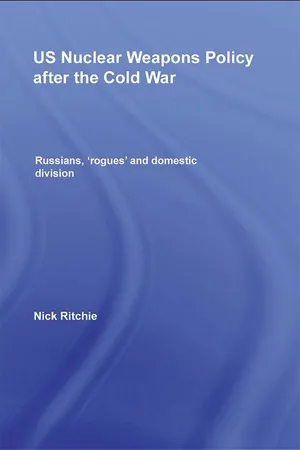
US Nuclear Weapons Policy After the Cold War
Russians, 'Rogues' and Domestic Division
- 228 pages
- English
- ePUB (mobile friendly)
- Available on iOS & Android
eBook - ePub
About this book
This book offers an in-depth examination of America's nuclear weapons policy since the end of the Cold War. Exploring nuclear forces structure, arms control, regional planning and the weapons production complex, the volume identifies competing sets of ideas about nuclear weapons and domestic political constraints on major shifts in policy. It provi
1
The policy-making process
Before commencing a detailed study of America’s nuclear weapons policy it is necessary to outline the agencies and organisations involved. The primary centres of policy-making are the White House, the Department of Defense (DOD), the armed services, the Department of Energy (DOE), and Congress. The national security policy-making process can be usefully conceived as a number of policy rings in which a range of individuals, organisations and agencies are situated.1 This applies equally to nuclear weapons policy.
Actors involved in nuclear weapons policy
At the centre of the nuclear weapons policy-making process stand the White House, in particular the office of the president, and the National Security Council. The president is the ultimate decision-maker but in practice is rarely involved in nuclear weapons-related issues.2 The National Security Council is the President’s principal forum for considering national security and foreign policy matters with senior national security advisers and cabinet members. It often plays a coordinating role as a broker of interagency agreements through both formal and informal processes.3 Like the presidency, the National Security Council has no regular role in nuclear weapons policy but it will be involved in major issues such as the START process with Russia, the nuclear test ban, missile defence policy, and requirements stemming from Congressional legislation. The NSC staff may examine issues affecting nuclear weapons policy initiated by an agency or department, the president or the NSC itself.4
The next policy ring encompasses executive departments and agencies. The two primary government organisations involved in nuclear weapons policy are DOE and DOD. DOE is responsible for administering the nuclear weapons laboratories and the manufacture of nuclear warheads as well as the production of nuclear materials required for the weapons programme. Within DOE responsibility lies with the semi-autonomous National Nuclear Security Administration established in 2000. NNSA is functionally divided into three areas: Defense Programs, Nuclear Nonproliferation and Naval Reactors. Matters relating to the nuclear stockpile fall under the remit of Defense Programs. It is responsible for the safety, security and reliability of the stockpile through the science-based Stockpile Stewardship Program established in 1993. DOE’s three national nuclear laboratories – Lawrence Livermore National Laboratory, Sandia National Laboratory and Los Alamos National Laboratory – also have an influential voice in nuclear weapons policy.
The Office of the Secretary of Defense (OSD) is responsible with the Joint Chiefs of Staff (JCS) and US Strategic Command (STRATCOM) for policy development, budgetary and programming decisions and implementing policy through detailed nuclear employment, deployment and sustainment plans. Within DOD the Assistant Secretary of Defense for International Security Policy (ASD(ISP)) within OSD oversees nuclear weapons policy, amongst many other areas of responsibility. The Under Secretary of Defense for Acquisitions Technology and Logistics (USD(AT&L)), the Assistant to the Secretary of Defense for Nuclear, Chemical and Biological Defense Programs (ATSD NCB), and the joint DOE-DOD Nuclear Weapons Council (NWC) also have a crucial role.
The Nuclear Weapons Council is responsible for preparing the Nuclear Weapons Stockpile Memorandum (see below); developing nuclear weapons stockpile options costs; coordinating programming and budget matters pertaining to nuclear weapons programmes between DOD and DOE; examining safety, security and control issues for existing weapons and any new weapon programmes; providing broad guidance regarding priorities for research on nuclear weapons; and coordinating and approving activities conducted by the DOE for the study, development, production, and retirement of nuclear warheads.5 It comprises USD(AT&L) as chair, a senior representative appointed by the Secretary of Energy, and Vice Chairman of the JCS. ATSD NCB (formerly the Assistant to the Secretary of Defense for Atomic Energy) is the Council’s staff director and principal staff assistant to the Secretary of Defense for nuclear weapons-related matters.6
Within the armed services STRATCOM, the Air Force Directorate for Nuclear and Counter-proliferation (XON), the Navy Strategic Systems Programs (SSP) command and Submarine Warfare Division, and the J5 Strategic Plans and Policy directorate of the Joint Staff are centrally involved in advising civilian policy-makers on nuclear weapons issues, maintaining nuclear forces and preparing operational plans for use of nuclear weapons. STRATCOM coordinates with the supporting Services to monitor the day-to-day status of the stockpile. It sponsors a senior-level Strategic Advisory Group to provide assessments of current and future issues related to the nuclear stockpile and associated systems. Each nuclear weapon type in the stockpile also has a Project Officer Group (POG) to which weapon system specialists are assigned. The POGs are responsible for monitoring the state of the stockpile and submitting recommendations for improving stockpile safety, reliability or security to the NWC Standing and Safety Committee.7 The Navy’s SLBM and non-deployed nuclear-armed Tomahawk Land-Attack Missiles (TLAM/N) are overseen by its SSP command. The Air Force’s XON directorate, established in 1997, oversees the Air Force’s ICBM and air-launched nuclear forces and represents the Air Force on the NWC Standing and Safety Committee.8
The Defense Threat Reduction Agency (DTRA) is also involved in nuclear weapons issues. Its official mission is to reduce the WMD threat to America through a number of programmes that include supporting the nuclear arsenal.9 Under its ‘combat support’ mission DTRA reports on the current status of American nuclear weapons, provides independent assessments of nuclear safety, security and reliability to OSD, NNSA, JCS and the armed services and runs DOD’s Defense Nuclear Weapons School. The Director of DTRA reports to USD(AT&L) and also serves as Director of STRATCOM’s Center to Combat Weapons of Mass Destruction.
On issues of nuclear weapons policy the Secretary and Deputy Secretary will likely consult the Under Secretary of Defense for Policy (USD(Pol)) and the assistant secretaries in that office, and if necessary the Comptroller on budget issues. The Chairman of the JCS and his colleagues, relevant service chiefs of staff, and STRATCOM may also be consulted.10 Nevertheless, it is the Secretary of Defense who is ultimately responsible for nuclear weapons policy and planning, not the JCS, unified commands or individual services.11 It is the budget and programming process under the Secretary’s direction that sets priorities and resources for competing missions and elements of the armed services (discussed further below).12
Within DOD and the services nuclear weapons policy has been guided by what is often referred to as the nuclear weapons policy community. This community generally comprises those civilian and military officials within the Pentagon bureaucracy responsible for nuclear policy, planning and targeting strategy in the policy office of the Office of the Secretary of Defense, STRATCOM and the Joint Staff. It also includes members of Congress and scholars at think-tanks close to government that have involved themselves in nuclear weapons policy issues. A small cadre of civilian and military officials have been extensively involved in crafting operational and declaratory nuclear weapons policy for a number of successive administrations from Reagan onwards. This subset at the heart of the nuclear weapons policy community is often referred to colloquially as the ‘nuclear priesthood’.
Four formal processes guide nuclear weapons targeting policy and planning, nuclear weapons stockpile management, nuclear force sustainment and nuclear weapons safety and security. Broad guidance for nuclear weapons targeting policy and planning is issued by the White House to the Secretary of Defense through periodic presidential directives, such as a National Security Decision Directive. OSD staff, the Joint Staff, and STRATCOM staff use this national guidance to develop the targeting requirements and plans which underpin nuclear deterrence policy.13 The Office of the Secretary of Defense (OSD) issues a policy guidance document for the employment of nuclear weapons (the NUWEP, or Nuclear Weapons Employment Plan) which establishes planning assumptions, attack options and targeting objectives. The Chairman of the JCS develops more detailed guidance that is incorporated into Annex C (Nuclear) of the Joint Strategic Capabilities Plan (now called the Nuclear Supplement) by the Strategic Plans and Policy Directorate (J5) of the Joint Staff. This guidance was used to produce the Single Integrated Operational Plan or SIOP until 2003. Since 2003 the Chairman’s guidance has been used by combatant commanders and Service Chiefs to prepare and coordinate a family of operational and contingency strike plans to deploy and employ nuclear weapons. OPLAN 8044 is the successor to the SIOP and still contains its major pre-planned strike options.14 Civilian oversight of the targeting process lies with OSD’s Office for International Security Policy.15 Civilian reviews focus on the overall consistency of the proposed plan with the basic policy guidance and the responsiveness of military plans to strategy and current conditions. Detailed planning for specific employment plans, including the range of targets, timing, weapon allocation, damage expectancy and so on, is left to military staffs.16
The nuclear stockpile is managed according to a formal annual process. Each year a Nuclear Weapons Stockpile Memorandum (NWSM) or Nuclear Weapons Stockpile Plan (NWSP) is produced by the Nuclear Weapons Council. The plan establishes DOD’s requirements for the mix and quantities of nuclear weapons and materials and the total number of warheads in the stockpile. It aims to balance military requirements with budgets and limits imposed by the production complex and is broadly consistent with requirements set out in successive Nuclear Posture Reviews and strategic arms control agreements. The plan is jointly developed by OSD, DOE and JCS. The Council oversees its implementation and ensures national policy is being efficiently executed.17 It is supported by a Standing and Safety Committee for inter-department coordination on sustainment of the stockpile. Policy for the sustainment of nuclear forces is overseen by USD(Pol).18 Plans for sustaining the nuclear force are developed by DTRA in conjunction with STRATCOM and the armed services. The first Nuclear Mission Management Plan (NMMP) was produced in 2001.19 Its purpose is to provide a ‘comprehensive, integrated DOD roadmap for the sustainment and viability of US nuclear forces, personnel and infrastructure’.20
Since the end of nuclear testing and the signing of the Comprehensive Test Ban Treaty (CTBT) by President Clinton in 1996, the Nuclear Weapons Council has also directed annual assessments of the safety and reliability of the nuclear weapons stockpile based on Safeguard F of Clinton’s August 1997 CTBT policy statement. STRATCOM also provides an independent assessment covering the same topics to the Secretary of Defense.21 The Secretaries of Defense and Energy – advised by the NWC, the directors of the nuclear weapons laboratories, and STRATCOM – report annually to the President to certify to a high degree of confidence whether the nuclear stockpile is safe and reliable. This process is embodied in domestic law.22
The State Department also exerts influence on nuclear weapons policy since it has primary responsibility for negotiating arms control and disarmament treaties. Nuclear arms control and disarmament issues fall under the remit of the Under Secretary of State for Arms Control and International Security having previously been the responsibility of the Arms Control and Disarmament Agency (ACDA) for most of the 1990s. The intelligence community also has a strong role to play in its assessments of the nuclear capabilities of potential adversaries and other strategic targets against which nuclear weapons could be employed. The intelligence community is made up of many different agencies from a variety of government departments, including DOD. These include the Central Intelligence Agency, the Defence Intelligence Agency, the National Security Agency, the State Department’s Bureau of Intelligence and Research, the President’s Foreign Intelligence Advisory Board, and the intelligence elements of the military services.
Outside the executive lies Congress in the next policy ring. Congress consists of the Senate, House of Representatives and judiciary. The sharing of constitutional powers to shape national security policy has resulted in ‘built-in dynamic tensions’ between an increasingly activist Congress and the executive.23 This can be seen in post-Cold War nuclear weapons policy in which Congress has frequently played an important role. Congress exerts influence over national security policy in a number of ways. The most important constitutional Congressional power is the power of the purse: no money can be spent by an administration unless authorised by Congress. Its committees annually scrutinise the administration’s defence spending requests, including those relating to nuclear weapons. Key committees are the House and the Senate Armed Services Committees and Appropriations Committees and the Senate and House committees on energy that also cover DOE’s nuclear weapons activities and budgets. These committees can remove funding for a programme or increase funding if a programme becomes a Congressional priority. The main influence of Congress is negative by denying funding for particular programmes as opposed to taking a positive lead on policy development.24 The Senate Foreign Affairs Committee also has the power to approve, vote down or amend treaties affecting nuclear weapons policy.
Congress can also request policy statements and full-scale reviews on broad national security and specific nuclear weapons issues that can push DOD or DOE in one direction or another and hold administration decisions to account. The Senate and House Armed Services Committees, for example, require annual reporting from the Nuclear Weapons Council as a key tool to enable ‘Congress to perform effective oversight of our nation’s nuclear weapons’.25 Congress...
Table of contents
- Routledge global security studies
- Contents
- Acknowledgements
- Acronyms
- Introduction
- 1 The policy-making process
- 2 American nuclear weapons policy at the end of the Cold War
- 3 Nuclear weapons policy under George H. W. Bush
- 4 Nuclear weapons policy under Bill Clinton
- 5 Nuclear weapons policy under George W. Bush
- 6 Post-Cold War trends in nuclear weapons policy
- 7 The influence of ideas on nuclear weapons policy
- 8 Domestic politics and nuclear weapons policy
- Conclusion
- Notes
- Select bibliography
- Index
Trusted by 375,005 students
Access to over 1.5 million titles for a fair monthly price.
Study more efficiently using our study tools.
Frequently asked questions
Yes, you can cancel anytime from the Subscription tab in your account settings on the Perlego website. Your subscription will stay active until the end of your current billing period. Learn how to cancel your subscription
No, books cannot be downloaded as external files, such as PDFs, for use outside of Perlego. However, you can download books within the Perlego app for offline reading on mobile or tablet. Learn how to download books offline
Perlego offers two plans: Essential and Complete
- Essential is ideal for learners and professionals who enjoy exploring a wide range of subjects. Access the Essential Library with 800,000+ trusted titles and best-sellers across business, personal growth, and the humanities. Includes unlimited reading time and Standard Read Aloud voice.
- Complete: Perfect for advanced learners and researchers needing full, unrestricted access. Unlock 1.5M+ books across hundreds of subjects, including academic and specialized titles. The Complete Plan also includes advanced features like Premium Read Aloud and Research Assistant.
We are an online textbook subscription service, where you can get access to an entire online library for less than the price of a single book per month. With over 1.5 million books across 990+ topics, we’ve got you covered! Learn about our mission
Look out for the read-aloud symbol on your next book to see if you can listen to it. The read-aloud tool reads text aloud for you, highlighting the text as it is being read. You can pause it, speed it up and slow it down. Learn more about Read Aloud
Yes! You can use the Perlego app on both iOS and Android devices to read anytime, anywhere — even offline. Perfect for commutes or when you’re on the go.
Please note we cannot support devices running on iOS 13 and Android 7 or earlier. Learn more about using the app
Please note we cannot support devices running on iOS 13 and Android 7 or earlier. Learn more about using the app
Yes, you can access US Nuclear Weapons Policy After the Cold War by Nick Ritchie in PDF and/or ePUB format, as well as other popular books in History & Military & Maritime History. We have over 1.5 million books available in our catalogue for you to explore.