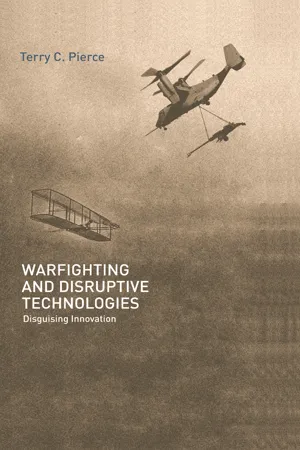
Occasionally, during times of peace, military forces achieve major warfighting innovations. Terry Pierce terms these developments 'disruptive innovations' and shows how senior leaders have often disguised them in order to ensure their innovations survived.
He shows how more common innovations however, have been those of integrating new technologies to help perform existing missions better and not change them radically. The author calls these 'sustaining innovations'. The recent innovation history suggests two interesting questions. First, how can senior military leaders achieve a disruptive innovation when they are heavily engaged around the world and they are managing sustaining innovations? Second, what have been the external sources of disruptive (and sustaining) innovations?
This book is essential reading for professionals and students interested in national security, military history and strategic issues.
- 288 pages
- English
- ePUB (mobile friendly)
- Available on iOS & Android
eBook - ePub
About this book
1 Introduction
This work begins with a puzzle. How can militaries achieve major warfighting innovations when their senior leaders are engaged heavily around the world and focused primarily on improving current capabilities? A related question is whether the approach for managing sustaining innovations is useful for championing new ways of war?
Answering these questions is vital to the security of the state. The ability to establish durable, relevant militaries depends in large part on how senior military leaders integrate breakthrough technologies and transform them into new ways of war. This study focuses on successful, peacetime cases of ‘major innovation’. These new ways of war will be called ‘disruptive innovations’. A disruptive innovation is defined as an improved performance along a war fighting trajectory that traditionally has not been valued. It involves a ‘a change in one of the primary combat arms of a service in the way it fights or alternatively, the creation of a new combat arm’.1 An example is Blitzkrieg tactical warfare, which is disruptive because it required an adversary to respond in an equally novel way or suffer defeat. The disruptive innovation also requires new metrics to measure its performance, because it both bypasses and, eventually, surpasses traditional warfare methods.2
By ‘surpass’, this does not mean to suggest that the new innovation will necessarily outperform the old one using the current measures of performance. Instead, the new innovation wins on some new, heretofore unimportant dimension. As an illustration, the French Maginot Line outperformed the Blitzkrieg in holding established positions and territory; where it fell down was in its lack of mobility – a performance dimension that was not highly valued in the decisions that led to the investments that created the Maginot Line. In this case, Blitzkrieg warfare was disruptive because it merely bypassed the French wall of high technology.
In contrast to disruptive transformation, a ‘sustaining innovation’ results in improved performance along a trajectory that traditionally has been valued.3 Most innovations in the military are sustaining in nature. An example is continuous aim gunfire, which dramatically improved naval gunfire but did not radically change the mission.
Disruptive innovation is a new way to understand self-initiated change in bureaucracies that challenges existing military innovation theory. It is the dependent variable and lies at the heart of this book; but because it is a new term borrowed from the business literature and adapted for use in security studies, its precise meaning may be in doubt.4 For purposes of this study, disruptive innovation can best and most easily be described using a basketball analogy – the three-point shot.5
Reintroduced in 1967 by the old American Basketball Association (ABA), the three-point shot was immediately derided by the established National Basketball Association (NBA) as a gimmick that added no value to the game.6 As with all truly important, breakthrough transformations – or disruptive innovations – mainstream customers (NBA fans) and the organizational culture (the NBA) initially rejected the shot because they saw little use for it. The NBA opted to sustain the game the way that mainstream fans historically had valued it – by recruiting taller players who were capable of scoring two-point shots from near the basket.
The result of the sustaining innovation (i.e., recruiting ever-taller players) was to turn the NBA into a slowdown league dominated by big men. Naturally, these men had not been recruited for their abilities to shoot long-range shots. Thus, by ignoring the three-point-shot innovation, the NBA prevented itself from creating new markets and attracting new fans who were interested in a higher scoring game played by mid-sized players who excelled at both long-range and above the rim – the type of players the NBA ignored as untalented rogues who could not cut it in the big league.7
The NBA’s neglect cleared the way for the ABA to create an entirely new game of basketball. In this game, no leads were safe as smaller, quicker players changed the tempo of the contest. As with all disruptive innovations, the ABA initially underperformed the NBA, but because it had exciting features such as the three-point shot that a few fringe and new fans valued, the ABA survived for nine full seasons.
In June 1976, the two rival professional leagues merged, with the four strongest ABA teams- and the three-point shot – joining the NBA. That disruptive innovation (the three-point shot) not only immediately and forever changed the way basketball would be played in the NBA, but also transformed college and high school play as well.
External and internal causes of innovation
A study of modern warfare suggests that whoever is first to combine new technologies with disruptive doctrine can gain a decisive advantage. Conversely, a military that is slow to adapt new ways of fighting to technological advance opens itself to catastrophic defeat. The historical record shows that disruptive innovation is an exceedingly difficult task. In fact, organizational theory teaches that noninnovation or stagnation is more or less the norm in the military and innovations will be rare.8 Innovation scholars blame uniformed leaders, claiming they resist change because they are overworked and lack the time or the desire to transform.9 James Q. Wilson, however, proposes a different reason why senior military leaders are biased toward stagnation. He notes in his illuminating study of military bureaucracy that senior military leaders ‘are supposed to resist’ innovation because they are responsible for enforcing the standard operating procedures (SOP) that provide the organization’s stability.’10 Considering these negative propositions, security scholars concentrate on the external causes of military innovation (the why and when). External engines of change explanations include: Barry Posen’s civilian intervention; Owen Cote’s interservice competition; Steven Rosen’s intraservice rivalry perspective; and Elizabeth Kier’s cultural perspective. Although understanding the external factors (the why and when) that ignite and fuel the engine of innovation are important, failure to understand the internal factors (the how) that controls the engine can be fatal.
First was the advent of the steel ship in the Navy. Although it was investing aggressively in new technologies, the Navy resisted innovations that it viewed as disruptive.11 Eventually, of course, the obvious advantages of this technological advance overcame internal inertia and caused a paradigm shift – a complete turnaround in the way the Navy fought as well as in the way it structured and organized its units.
Second was President John F. Kennedy’s attempt to convince Army leadership to develop a counterinsurgency capability, which was defeated by classic internal inertia.12 Senior Army officers simply refused to comply because they believed superior, conventionally-trained infantry could win under any circumstances.13
Third was carrier warfare, which is an example of a military inventing a technology but failing to exploit it fully. The British Navy invented the aircraft carrier in 1914 and conducted the first carrier air raid in history. Despite its head start (possessing nearly a dozen carriers of one sort or another at a time when no other naval power had even one), the United Kingdom fell short when it came to developing carrier warfare – something the Japanese and Americans would do with great success during World War II.14
In each of the three examples, failure resulted from internal, not external, mechanisms. The ignition was working and there was plenty of fuel, but a disruptive innovation did not occur because the throttle was stuck in idle. When the external causes are sufficiently present, the success of innovation depends on which hypotheses senior military leaders accept when determining how they will manage change. The aim of this study is to help determine which hypotheses are correct and whether new ones are needed to explain how they should champion disruptive innovation.
The argument
When confronted by military stagnation, scholars generally explain it by focusing on the lack of necessary external stimuli to spur and sustain innovation. In accepting this explanation, one assumes that military innovation is best understood by examining external causes alone. In many successful cases of innovation, this assumption is correct; exploring external drivers is one useful perspective for understanding innovation. This assumption fails, however, to explain those times when external drivers are present yet stagnation persists. External drivers are necessary but not sufficient for disruptive innovation.
This study argues that internal drivers are equally as important as external drivers for innovating. First, it suggests that ‘good management’ of sustaining innovations is the root cause of stagnation.15 In contrast to the traditional doctrine-driven and technology-driven theorists who explain innovation by the presence of certain external factors, these factors may be present and stagnation still may result because of the way product champions manage the innovation process. Second, the evidence shows that management that excels in promoting sustaining improvements along a trajectory valued by the organization almost always fails to support disruptive innovations. Indeed, only when confronted by a disruptive innovation – one that introduces a new performance trajectory – do senior leaders recognize the threat.16 Third, military leaders fail not because they lack foresight or management savvy, but because they champion disruptive innovations as though they were managing sustaining improvements.17 Taken together, these results help explain why the naval services’ capacity to bring about a disruptive innovation is unfavorable and likely to remain so as long as senior naval leaders continue to manage technology-driven changes as sustaining innovations.
Traditional innovation engine models
Ignition and fuel: the why and when
Modern social scientists have generated a number of works examining the origins of disruptive innovations. Although the literature on disruptive innovations is enormous, much of it falls within four main theoretical schools concerning military innovation: civil-military conflict, intraservice conflict, interservice conflict, and organizational culture. Each of these models is derived from two larger theoretical perspectives – balance of power theory and organizational theory – that vie to explain state behavior using different structural sources.18 Balance of power theorists argue that state actions are the result of rational thought, while organizational theorists argue that such actions are best understood as derived from standard patterns of behavior rather than from deliberate choices.19 The first three frameworks argue that disruptive military innovation results from conflict in decisive relationships, and that sustaining innovation results when conflicts are suppressed.20
Civil-military competition
The first school, represented by Barry Posen, attempts to understand innovation as it relates to major changes in the international balance of power and/or the political framework within which wars occur.21 Drawing on this structural realist perspective, Posen identifies external threat and civilian intervention as the greatest determinants leading to innovation. Arguing that balance of power theory has greater explanatory power than organizational theory, he claims that a state’s ability to innovate is a function of its security environment. Since states behave rationally, they react to insecurity by improving either the external balance – by acquiring allies – or the internal balance – by strengthening their militaries.
When security threats are low, Posen argues, civilian leaders are content with incremental improvement. When threats to security are high, however, so are the incentives to achieve a disruptive innovation, and civilian leaders may directly intervene to impose and audit disruptive innovation. Posen offers the development of the Blitzkrieg in Germany during the late 1930s as an example: ‘In my judgment, to the extent that the German Wehrmacht achieved a doctrinal innovation that can be called Blitzkrieg, Hitler’s intervention was decisive. In the absence of his intervention, it seems likely that normal organizational dynamics would have been determinative…[and] events in the Low Countries might have turned out very differently indeed.’22 Posen suggests that civilian intervention produces military innovation either directly or indirectly through officers he calls military ‘mavericks’. Mavericks provide civilians with the military expertise they lack as well as with an insider who can steer the organization down the desired innovation trajectory.
In sum, Posen’s model predicts that insecurity motivates civilian leaders to intervene directly or indirectly using military mavericks as proxies to force the military to change dramatically.23 When security threats are low, civilian leaders are content with incremental improvements.
Intraservice competition
The second broad school of thought, as applied by Steve Rosen, attempts to understand innovation by examining competition between branches of the same service. Drawing on organizational theory, Rosen believes military organizations are capable of innovating on their own. He sees the impetus for reform as coming from within,24 and posits not only that civilian intervention is not required but also that it generally fails.25 Rosen agrees that military organizations are stimulated by changes in the security environment, but he believes that innovation results when branches of the same service vie to become their service’s dominant guarantor of security. When their capabilities overlap, competition arises, and senior military leaders both encourage and moderate these internecine squabbles. Innovation results when an emerging warfighting concept gains support among senior military leaders and then is endorsed by civilian leaders. Rosen also asserts that innovation requires ‘product champions’ – senior officers who advocate innovative approaches to warfare and open promotion paths for other reformers.26
Having analyzed cases from the US Navy and the Marine Corps, Rosen argues that ‘mainstream’ senior military officers consciously adopt a two-part strategy to foster innovation.27 The first part is to challenge old methods for waging war and propose new...
Table of contents
- Cover Page
- Title Page
- Copyright Page
- Foreword
- Series editor’s preface
- Preface
- 1: Introduction
- 2: Explaining disruptive innovations
- 3: US Marine Corps innovation: The development of amphibious warfare
- 4: Post-World War II Marine Corps disruptive innovations: (I) Helicopter warfare
- 5: Post-World War II Marine Corps disruptive innovations: (II) MAGTF warfare–combined arms operations
- 6: US Marine Corps inchoate disruptive innovation: Maneuver warfare
- 7: US Marine Corps sustaining innovations and summary of disruptive Marine Corps cases
- 8: US Navy sustaining innovation: Continuous aim gunfire
- 9: US Navy disruptive innovation: Carrier warfare
- 10: Disruptive innovation: Japanese carrier warfare
- 11: US Navy disruptive innovation: CWC–naval combined arms warfare
- 12: US Navy sustaining innovation: Carrier battle group concept
- 13: US Navy disruptive innovation–aborted: Project 60–defensive sea control warfare
- 14: US Navy disruptive innovation: Maritime action groups–surface land attack warfare
- 15: US Navy disruptive innovation: Tactical collaborative network and a summary of disruptive Navy cases
- 16: Conclusion
- Notes
- Bibliography
Trusted by 375,005 students
Access to over 1.5 million titles for a fair monthly price.
Study more efficiently using our study tools.
Frequently asked questions
Yes, you can cancel anytime from the Subscription tab in your account settings on the Perlego website. Your subscription will stay active until the end of your current billing period. Learn how to cancel your subscription
No, books cannot be downloaded as external files, such as PDFs, for use outside of Perlego. However, you can download books within the Perlego app for offline reading on mobile or tablet. Learn how to download books offline
Perlego offers two plans: Essential and Complete
- Essential is ideal for learners and professionals who enjoy exploring a wide range of subjects. Access the Essential Library with 800,000+ trusted titles and best-sellers across business, personal growth, and the humanities. Includes unlimited reading time and Standard Read Aloud voice.
- Complete: Perfect for advanced learners and researchers needing full, unrestricted access. Unlock 1.5M+ books across hundreds of subjects, including academic and specialized titles. The Complete Plan also includes advanced features like Premium Read Aloud and Research Assistant.
We are an online textbook subscription service, where you can get access to an entire online library for less than the price of a single book per month. With over 1.5 million books across 990+ topics, we’ve got you covered! Learn about our mission
Look out for the read-aloud symbol on your next book to see if you can listen to it. The read-aloud tool reads text aloud for you, highlighting the text as it is being read. You can pause it, speed it up and slow it down. Learn more about Read Aloud
Yes! You can use the Perlego app on both iOS and Android devices to read anytime, anywhere — even offline. Perfect for commutes or when you’re on the go.
Please note we cannot support devices running on iOS 13 and Android 7 or earlier. Learn more about using the app
Please note we cannot support devices running on iOS 13 and Android 7 or earlier. Learn more about using the app
Yes, you can access Warfighting and Disruptive Technologies by Terry Pierce in PDF and/or ePUB format, as well as other popular books in History & Military & Maritime History. We have over 1.5 million books available in our catalogue for you to explore.