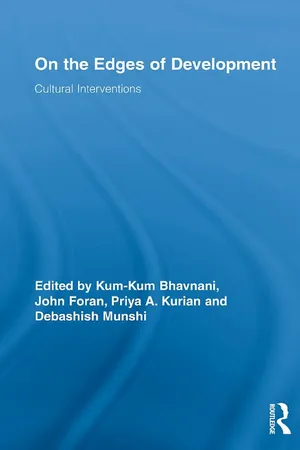
Big business, financial institutions, and capitalist powers have wreaked much havoc on the Third World in the name of development. This book re-imagines development through a careful and imaginative exploration of some of the many ways that culture – in the broadest sense of lived experience and its representation – can recenter resistance, suggest alternative models, and advance critiques of development as it is currently practiced. The diverse group of scholars and activists who contribute chapters to the volume engage with the puzzle of how best to conceptualize an alternative development that improves the living conditions of women and men in different parts of the world and simultaneously demands solutions that focus on the integration of gender, diversity, and development with the realities of people's lives.
eBook - ePub
On the Edges of Development
Cultural Interventions
- 276 pages
- English
- ePUB (mobile friendly)
- Available on iOS & Android
eBook - ePub
On the Edges of Development
Cultural Interventions
About this book
Information
Part I
Refusing Representations of Development
1
October 17, 1961
The failures of development are self-evident everywhere you look. Global justice remains elusive and basic needs such as water and health care are increasingly privatized out of the reach of far too many people. Across the planet, warfare is ascendant, corruption rules, and poverty expands. Clearly the time is long past to examine the idea of Third World development and its relationship to European imperialism. New paradigms are urgently called for, formations of thinking that can mine the truth of how various peoples across the global south (and in the pockets of the global south found in the industrialized north) actually live. In this chapter, I propose that Third World Cultural Studies (TWCS) contains the possibility to break from modernization theory’s colonial past (and present) due to its sensitivities to the historic and lived experiences of subject populations and to the varieties of colonial violence. An engaged TWCS, moreover, seeks to historicize our contemporary condition and to recover lost and hidden histories that remain obscured by the dominant representations of our era. A historical sensibility is essential to the success of TWCS. Amnesia is characteristic of power, which forever seeks to forget all that is inconvenient for its execution, but there can be no justice without memory. To that end, I explore in this chapter the concept of TWCS by turning to one incident, a forgotten moment more than forty years ago when colonial violence invaded the city of Paris.
It was one of those crisp October mornings in Paris, the kind that bring people out in overcoats and hats onto the river bridges. On this day, while the water lapped gently beneath them, several hundred people assembled on the Saint-Michel bridge in the fourth arrondissement, steps away from the Préfecture de Police and the Palais de Justice. They were as still as night, observing a minute of silence in mourning for a group of Algerian dead. Among the crowd this morning was the mayor of Paris and several other elected officials, though the president of the republic was notable by his absence only. Meanwhile, on the other side of the bridge, their access blocked by the police, protesters had amassed noisily and were holding up a sign marked in bold block letters that read “Shame to the FLN collaborators.” This group of the extreme right, stranded on the left bank, bellowed familiar slogans like “Proud to be French!” and “Algérie Française!” (Agence France-Press, October 17, 2001), their belligerent voices easily transported over the diamond waters of the Seine. But there was no violence this time, and the brief ceremony seemed over before it all began. The feelings it embodied, however, felt like they had never ceased.
The day in question was October 17, 1961, a date that had long been forgotten by many in Paris, but the ceremony just described took place forty years later to the day. This time, in 2001, the police protected the protestors, who in turn were not Algerians but French. Forty years earlier, the scene looked quite different. A massive and peaceful demonstration had been planned for that night by the Fédération de France of the FLN (Front de Libération Nationale). Twelve days earlier, on October 5, 1961, the prefect of police, Maurice Papon, now infamous for sending 1,560 Jews off to concentration camps during the Vichy years, had decreed an ethnic-specific curfew on the Algerian population alone: all Algerians, or “Muslim French of Algeria” as they were called, were to be off the streets between the hours of 8:30 p.m. and 5:30 a.m. Cafés were to close at 7 p.m. and, as a police circular stated, “it is highly recommended to the Muslim French to circulate separately, small groups being likely to appear suspect with the rounds and patrols of the police” (Le Cour Grandmaison 2001, 204).
The Algerian war, begun in 1954, had come home to roost in important ways. So much so that Michel Debré, then prime minister, had written in 1958 that the FLN’s capital was Paris (Einaudi 1991, 25). The same year General Raoul Salan stated, “The Mediterranean runs through France as the Seine runs through Paris” (quoted in Vidal-Naquet 1963, 107). (Salan, it should be remembered, became a founding member of the far right OAS—the Secret Army Organization—and was a leader in the failed putsch to assassinate President de Gaulle.) In fact, Debré and Salan’s chronology is slightly off. Thousands of Algerians had been in the French capital as laborers since the beginning of the century, but as the war went on, the center of its conflict increasingly enveloped Paris. Police violence against Algerians in Paris, however, predates the Algerian war. In 1953, police opened fire on a group of peaceful demonstrators from the PPA (Parti Populaire Algérien, a precursor to the MNA, the Mouvement Nationale Algérien) during a demonstration on Bastille Day, killing seven and wounding thirty (Stora 2001, 60). But with the liberation war, the levels of violence escalated dramatically. By the late 1950s, the “café wars” had broken out between two rival national liberation groups, the MNA and the FLN, and this bloody fratricidal conflict between the two groups claimed almost 5,000 lives and 10,000 (overwhelmingly Algerian) wounded, a large number in Paris and its suburbs (Einaudi 1991, 20–21).
By 1960, the FLN emerged victorious, only to face off with a new enemy, a police department heavily populated with former Algerian administrators and deeply infiltrated with OAS sympathizers. Papon himself, who was made prefect in 1958, had served two years in the Algerian city of Constantine before accepting his latest appointment. During extensive operations of surveillance and detention, police systematically arrested and tortured hundreds of Algerians in known locations in Paris. Thousands were detained in four different internment camps set up in France or were removed to camps in Algeria. The FLN responded by firebombing police installations, and the two groups often confronted each other on the street. On June 8, 1961, Papon then issued his police force a pass to carry out whatever repression they felt was necessary. He told them to “take care of your business regarding the Algerians. When it comes [down to it], you will be covered” (Péju 2000, 176). The war between the two groups intensified, and Papon stated publicly on October 2, 1961, that the police force’s “resolution to suppress terrorism [was] unshakeable. For every blow received, we will carry out ten” (Péju 2000, 182). Three days later, he imposed the broad-brushed curfew on the 150,000 Algerians living in and around the city of light, a dark decree of collective punishment and humiliation delivered in the sanctified name of security.
To protest the curfew and its racism, some 30,000 Algerians—men, women, and children—heeded a call by the FLN to organize and began assembling in the heart of the city, knowing they would be challenging the law. By 8 p.m., they had arrived from the bidonvilles and poor neighborhoods of the city, places like Belleville, Montmartre, and Barbès, and from the surrounding suburbs or banlieues, namely Nanterre, Gennevilliers, and St. Denis. Following the FLN’s recommendations, they were wearing their best clothes and were armed only with their collective power. Exactly what happened next is finally in little dispute, but its implications certainly are. The police responded with overwhelming brutality, bludgeoning the demonstrators with batons as they emerged from the metro stations, shooting others, seizing over 11,000 (the police admitted to arresting 11,538 people), carting them away in ready vans to the Palais de Sports, where they endured further torture for days. Later, they would be moved to an internment camp at Vincennes, as the Palais des Sports had to be quickly “disinfected” for a Ray Charles concert on October 20 (Le Cour Grandmaison 2001, 214).
For days, the killing continued, some reportedly at police headquarters itself and under the watchful eye of Papon, and Algerians would continue to be found dead in the nearby woods, hanging from trees. Dozens more were found later floating on the top of the river, their bodies plump with water, their hands bound behind their backs (Vidal-Naquet 1963, 116; Péju 2000, 159).
The massacre of scores—and probably hundreds—of peaceful Algerian demonstrators in the heart of the city, at the hands of the police, and under the half-closed eyes of the Parisians is a horrific event in its own right, but what heaped injury upon even death was what followed in the French public sphere. The massacre was suppressed from the official record as the police began systematically seizing documentary evidence of the evening’s carnage, and politicians aped official denials. Eugène Claudius-Petit, a member of the National Assembly, had demanded an inquiry from the government on October 30, to which Roger Frey, minister of the interior, responded by saying there was not even “a sign of the appearance of a shadow of proof” (Vidal-Naquet 1963, 117). In the municipal council, a vote was put forward for an inquiry, the results being 43 to 39 against such a course of action (Einaudi 2001, 255). Instead, the council adopted a resolution “addressed to the Parisian police expressing our confidence and gratitude” (Einaudi 2001, 247).
Meanwhile, the publisher François Maspero witnessed the event traveling around the city that night. From his bookstore, La Joie de lire, on 40, rue Saint-Severin, he saw what he described as a “neighborhood under siege.” He wrote:
The blows of the nightsticks were taken on the head, then, when the victim fell to the ground, surrounded by several men, the beating continued. The men who were doing the beating did not just have fortified nightsticks but all different types of arms, bludgeons made out of rubber or riding crops. There was no resistance. What made the greatest impression [on me] was the muffled sound of the blows to the skull. (Maspero 1999)
While some French passersby cheered the police, Maspero and a group of others assisted a handful of victims into a nearby pharmacy. Over the next few weeks, Maspero worked on a pamphlet with several other people in order to publish an account of the events. Paulette Péju edited the testimony of dozens of witnesses, and Maspero combined this with six photographs taken by the photographer Elie Kagan that night. The printer refused to print the pamphlet, and the police seized the galley sheets. Jacques Panijel, an amateur filmmaker who witnessed some of the black events of the night, produced a docudrama detailing the demonstration, along with scenes from the difficult daily life of Algerian laborers, the torture room used by the police in 28, rue de la Goutte d’Or, and the ensuing massacre (Panijel 1961). After its initial showing in October 1962, it too was seized. The journalist Pierre Vidal-Naquet published a book in 1963 titled Torture: Cancer of Democracy, in which he details not just the incidents of October 17, 1961, but also the torture chambers found in Algeria and around France during the war years. The book, banned in France, would be published in that country only in 1972. No one, it appeared, wanted to remember. This amnesia pertains not just to that night but basically to the whole of the Algerian war. Let bygones be bygones, the feeling went, for what good would it do? After all, “the essence of a nation is that all individuals have many things in common, and also that they have forgotten many things,” wrote Ernest Renan in 1882 (Renan 1990, 11).
Slowly and resolutely, however, the events of the night of October 17 did come forward, and burning away the fog of collective amnesia is one hopeful aspect of this story. For four decades, there had been no official recognition of these events, until, after years of effort by historians (such as Jean-Luc Einaudi and Mohammed Harbi), novelists (like Leila Sebbar and Didier Daeninckx), and activists (who formed the organization, 17 octobre 1961: Contre l’oubli), the city finally installed the plaque on the Saint-Michel bridge in 2001. It bears the simple inscription: “To the memory of the numerous Algerians killed by the bloody repression during the peaceful demonstration of 17 October 1961,” with its text facing in the direction of the police station. Recognition might bring acceptance, one might believe, but the scene witnessed in 2001—with the familiar refrain of Algérie française—felt rather like regression. If this was about coming to terms with the past, then “What does coming to terms with the past mean?” as T. W. Adorno, in another context, once asked. Answering his own question, Adorno writes: “We will not have come to terms with the past until the causes of what happened then are no longer active. Only because these causes live on does the spell of the past remain, to this very day, unbroken” (Adorno 1986, 29).
Indeed, the October massacre casts its spell over a host of issues, many of which are germane to the chapters in this volume. Why, for example, is a just reckoning of the past repeatedly fought—and worth fighting—for? Why is the contest for memory so important for forging a workable future? And why is it that colonialism’s structures of feeling continue to thrive in a world that has ostensibly recognized the failures of conquest and overseas rule? If we investigate the October massacre and its subsequent history, we may find that the answer to these questions lies in the simple fact that we live in an increasingly single and organized humanity, and that the denial of one’s past equates not just to a blindness, but to the expulsion of one’s place in that very same humanity. There will be more said about this shortly, but there is also something else that we are bound to discover via the October massacre, namely a notion involving the specific configurations of power that made up (in part) 1960s France and that is perhaps frighteningly relevant to our contemporary (globalizing, unipolar, and violent) world.
Fifty years ago, Hannah Arendt raised a provocative question, inquiring into the precise relationship between imperialism and totalitarianism. For her, imperialism was the first act for the subsequent tragedy of World War II and the Holocaust. It was, in her words, “a preparatory stage for coming catastrophes” (Arendt 1968, 123). Combining race-thinking with mob violence, imperialism unleashed a new species of men, colonial administrators, whom she labels “functionaries of violence” (Arendt 1968, 137) and who were given “more latitude than in any Western country” to “create new realities” through violent means (Arendt 1968, 136–137). Joseph Conrad’s Kurtz, from Heart of Darkness ([1902] 1990), is paradigmatic of the lawless and violent colonial administrator for Arendt. The lawlessness and aloofness of colonial rule, along with its brute violence, may have emancipated the bourgeoisie from the economic and moral limitations of the European state, but it also infected the project of living together beneficially in a social polity. “African co...
Table of contents
- Routledge Studies in Development and Society
- Contents
- Diagrams and Figures
- Acknowledgments
- Introduction
- Part I Refusing Representations of Development
- Part II Emergent Discourses of Development
- Part III Fictions of Development
- Contributors
- Bibliography
- Index
Trusted by 375,005 students
Access to over 1.5 million titles for a fair monthly price.
Study more efficiently using our study tools.
Frequently asked questions
Yes, you can cancel anytime from the Subscription tab in your account settings on the Perlego website. Your subscription will stay active until the end of your current billing period. Learn how to cancel your subscription
No, books cannot be downloaded as external files, such as PDFs, for use outside of Perlego. However, you can download books within the Perlego app for offline reading on mobile or tablet. Learn how to download books offline
Perlego offers two plans: Essential and Complete
- Essential is ideal for learners and professionals who enjoy exploring a wide range of subjects. Access the Essential Library with 800,000+ trusted titles and best-sellers across business, personal growth, and the humanities. Includes unlimited reading time and Standard Read Aloud voice.
- Complete: Perfect for advanced learners and researchers needing full, unrestricted access. Unlock 1.5M+ books across hundreds of subjects, including academic and specialized titles. The Complete Plan also includes advanced features like Premium Read Aloud and Research Assistant.
We are an online textbook subscription service, where you can get access to an entire online library for less than the price of a single book per month. With over 1.5 million books across 990+ topics, we’ve got you covered! Learn about our mission
Look out for the read-aloud symbol on your next book to see if you can listen to it. The read-aloud tool reads text aloud for you, highlighting the text as it is being read. You can pause it, speed it up and slow it down. Learn more about Read Aloud
Yes! You can use the Perlego app on both iOS and Android devices to read anytime, anywhere — even offline. Perfect for commutes or when you’re on the go.
Please note we cannot support devices running on iOS 13 and Android 7 or earlier. Learn more about using the app
Please note we cannot support devices running on iOS 13 and Android 7 or earlier. Learn more about using the app
Yes, you can access On the Edges of Development by Kum-Kum Bhavnani,John Foran,Priya Kurian,Debashish Munshi in PDF and/or ePUB format, as well as other popular books in Social Sciences & Development Economics. We have over 1.5 million books available in our catalogue for you to explore.