![]()
1 Introduction
The hopes of radicals for a society in which, as Marx said, human beings could be ‘truly free’ seem to have turned out to be empty reveries.
(Giddens 1994:1)
The left is back. By this I do not mean the revival in interest in Marx and (particularly) Keynes after the international financial/economic crisis from 2007 to 2008 onwards (e.g. Skidelsky 2010; Hobsbawm 2011). After all, rumours of the death of neo-liberalism have been exaggerated – there is little sign (at least yet) of a substantive political or ideological paradigm shift (cf. Gamble 2009). Furthermore, according even to some on the left, the post-crisis ‘age of austerity’ across Europe may indicate that the right is currently winning the crisis (cf. Marquand 2010). This was clearly demonstrated by the European parliamentary (EP) elections in June 2009 when the right gained 47.8 per cent of the vote and the left (including Greens) merely 37.3 per cent. Nevertheless, although the crisis of centre-left social democracy is widely discussed, analysts have missed the longer-term trend that radical left parties (i.e. those defining themselves as to the left of, and not merely on the left of social democracy, which for brevity’s sake I will refer to as RLPs) have, albeit still partially, begun to recover from the collapse of communism.
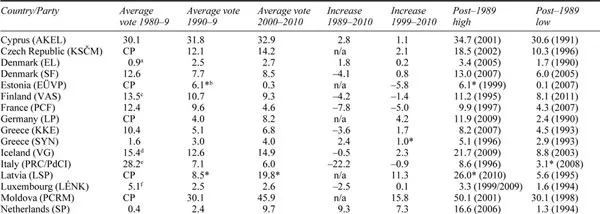
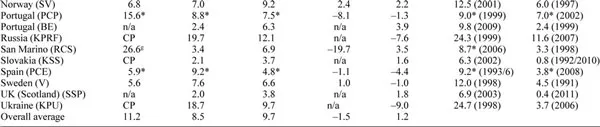
For sure, there have been many widely publicized instances of recent RLP failure (most notably the communist parties (CPs) in France, Italy and Spain). Yet, as Table 1.1 indicates, RLPs remain stable and significant in many countries (such as the Czech Republic, Norway and Sweden), have latterly reached a zenith in others (e.g. Iceland, Portugal, Greece, Denmark, Germany) and have long flourished in yet others (e.g. Cyprus, Moldova). Moreover, RLPs have moved from being marginal pariahs to coalition contenders in many countries. Whereas between 1947 and 1989 only the Finnish Communist Party regularly participated in government, since 1989 no RLP in an advanced liberal democracy has turned down a realistic offer of governmental coalition (Bale and Dunphy 2011). RLPs have been coalition components across Europe (e.g. in Iceland, France, Italy, Finland and Ukraine), dominant governing parties in some countries (Moldova and Cyprus), and in many others (e.g. Sweden, Denmark, Netherlands) their future government participation is far from unfeasible.
Table 1.1 Relevant European radical left parties in parliamentary elections, 1990–2010§
Notes
§ In this and all subsequent tables, ‘relevant’ is defi ned as obtaining at least 3 per cent of the vote and gaining parliamentary seats in at least one election
* signifi es in coalition; CP signifi es ruling Communist Party
a Danish Communist Party (DKP)
b until 2006 as Estonian Left Party (prev. Estonian Social Democratic Labour Party) in coalition with Estonian United People’s Party (EÜRP)
c Finnish People’s Democratic League (SKDL – in 1987 SKDL + Democratic Alternative)
d People’s Alliance (AB) until 1995
e Italian Communist Party (PCI)
f Communist Party of Luxembourg (KPL) until 1999
g Sammarinese Communist Party (PCS).
One would hardly know this from existing academic literature. Although the tide is beginning to change, the radical left is still the poor relation of contemporary party studies, certainly as compared with the number of recent books (not to mention articles) on Christian democratic, Green and social democratic parties. Moreover, dozens of analysts have focussed on manifold aspects of the radical/ extreme/populist right (e.g. Eatwell and Mudde 2004; Ignazi 2006; Mudde 2007; Hainsworth 2008).1 Most works on RLPs are either single country studies or limited cross-country comparisons (e.g. Bell and Criddle 1994; Curry and Urban 2003; Guiat 2003), or focus on one aspect of RLPs such as attitudes to European integration (Dunphy 2004) or governmental participation (Bale and Dunphy 2007, 2011; Hough and Verge 2009; Daiber 2010; Olsen et al. 2010; Dunphy and Bale 2011). The vast majority of comparative studies focus on CPs alone (and only in Western Europe) (e.g. Bell 1993; Bull and Heywood 1994; Botella and Ramiro 2003). Coverage of RLPs in Eastern Europe is dominated by study of so-called ‘successor parties’ (former ruling CPs), most of which have undergone social-democratization, and so are no longer radical (e.g. Racz and Bukowski 1999; Kitschelt et al. 1999; Bozóki and Ishiyama 2002; Grzymała-Busse 2002).
Overall, there are precious few volumes studying RLPs across both Eastern and Western Europe. Those that exist have strengths but significant gaps. Both Hudson (2000) and Backes and Moreau (2008) focus mainly on communists and (non-radical) successor parties, while Hildebrandt and Daiber (2009) has a wide selection of parties but does not cover the former Soviet Union. All three volumes represent worthwhile collections of detailed case studies rather than truly comparative analyses, and all take normative stances towards their subject matter: Hudson (2000) and Hildebrandt and Daiber (2009) are written by party sympathizers, while Backes and Moreau (2008) seeks above all to explain the ‘extremism’ of its subject matter.
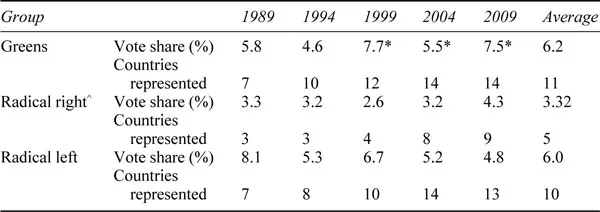
Yet, as Table 1.1 shows, the European radical left in aggregate has been a relatively stable electoral actor since 1989, albeit varied and volatile in its components, and overall it has recovered (if only slightly) since its 1990s nadir. RLP performance in European elections (averaging six per cent support) is markedly less impressive (see Table 1.2), in large part because several countries (such as the UK, Austria and much of Eastern Europe) currently have marginal RLPs. Nevertheless, other so-called ‘niche parties’ (Adams et al. 2006), principally the Greens and radical right, also have a varied geographical spread and a weak European performance (Table 1.2). Judged on electoral performance and governmental participation alike, there is no objective reason why RLPs should be analysed any less than the much-studied Greens and radical right.
Table 1.2 European parliamentary elections: comparative ‘niche party’ performance, 1989–2009
Notes
* Includes regionalist parties; ^ Eurosceptic and Nationalist groups combined; many radical right MEPs traditionally do not affiliate with party groups.
The reasons for this lack of coverage surely reflect that, after the collapse of the USSR in 1990–1, RLPs (chiefly communists) were so divided and in such profound crisis both nationally and internationally that they no longer represented a coherent ‘party family’ (Bull 1994). Moreover, it is nigh-on impossible to begin any work such as this without mentioning the ‘end of history’ thesis (Fukuyama 1989). However discredited it is now, the idea that any significant radical challenges to liberal democracy and neo-liberal capitalism had been confined to the ‘dustbin of history’ was persuasive in the early 1990s, given that the rapid autocombustion of the USSR’s ‘really existing socialism’ appeared to taint even anti-communist ‘democratic socialisms’ and the left as a whole.
Many writers have more or less explicitly accepted the ‘end of history’. For example, Donald Sassoon’s exhaustive history of the twentieth-century West European left (1997) concentrated on Western social democracy, devoted little attention to CPs and largely ignored other RLPs.2 Indeed, the revised edition (2010: xiv) argues that post-1989 ‘social democracy was the only form of socialism left in Europe’. Sassoon regards radicalism as in its ‘last redoubt’ by the 1980s, with the left converging around a neo-liberal consensus; his definition of the contemporary left excludes radicalism altogether, encompassing merely ‘the mainstream socialist, social-democratic and labour parties, including the former communist parties’ (Sassoon 1998: 3). Similarly, the (initial) electoral success of parties such as Britain’s Labour Party and Germany’s Social Democratic Party (SPD), which espoused the so-called ‘third way’ in the 1990s, convinced many others that the neo-liberalism of socialism was inevitable. Anthony Giddens, an architect of the ‘New Labour’ project in Britain, argued that the mantle of radicalism had passed to the iconoclastic Thatcherite/Reaganite right, while the left as a whole had become conservative, trying desperately to defend the remnants of interventionist Keynesian welfarism, without the ability to offer a more forwardoriented vision (Giddens 1994; 1998). This is a powerful critique, but the subsequent decline of the ‘third way’ parties means that it was overdue re-consideration even before the 2007–8 crisis.
Kate Hudson was among the first to dispute the ‘end of history’ thesis, arguing that ‘the rightward movement of social democracy over the last decade … had the entirely predictable result of opening up a large political space to its left’ for parties converging against neo-liberalism (2000: 11). Hudson’s thesis was flawed, partly because of an unjustified expectation that communists would lead the New European Left. But this so-called ‘vacuum thesis’ (proposing that the neo-liberalization of social democracy increases the electoral and issue ‘vacuum’ for the radical left) is also dubious because other parties (including Greens but above all the radical right) have proven abilities to attract voters disaffected with the mainstream centre-left (Patton 2006; Lavelle 2008). Indeed, the rise of the contemporary radical right is often traced to a so-called ‘modernization crisis’: the movement towards a post-industrial economy, the decline of the post-war ‘social democratic consensus’ since the 1970s and the flourishing of globalization provides ample space for new forms of insecurity and protest by the ‘losers of modernization’ associated with the perception of the declining ability of the state to control borders, the economy and welfare (e.g. Betz 1994: Abedi 2004). The perception that contemporary social democracy has no answer to this modernization crisis increases direct defection to the radical right (Coffe 2008).
Nevertheless, Hudson rightly identified the potential for RLPs to mobilize. The ‘end of history’ has demonstrably not resulted in the demise of global inequality, poverty, conflict and oppression. RLPs appear well-placed to benefit from social democracy’s apparent abandonment of traditional causes such as equality, universal welfarism and economic interventionism – albeit the radical right might better express identity concerns such as opposition to Europe and immigration. Socioeconomic discontent returned as a major feature of social mobilization in demonstrations against privatization and welfare cuts in France, Italy and Germany in the mid-1990s. Globally, the ‘Asian crisis’ of 1997–8 revealed the travails of the so called ‘Washington Consensus’ (neo-liberal marketization and trade liberalization promoted by the Euro-Atlantic financial institutions). The rise of the ‘global justice movement’ (GJM), especially after the 1999 Seattle G8 summit, showed the reaction against global neo-liberalism reaching a new high.3 Whatever else Seattle meant (and there has been fierce dispute ever since), RLPs argue that it signified at least the ‘end of the end of history’: the neo-liberal tide beginning to ebb (Klein 2002: 1). ‘Another world is possible’, one of the GJM’s key slogans, recognized that even without a specific programme an alternative could exist theoretically (ibid.). Similarly, the GJM inferred that Margaret Thatcher’s statement that ‘There is no alternative’ to global neo-liberalism was now patently false. The sense of anti-capitalist momentum was further fuelled by the rise of the left in Latin America (above all Venezuela, Bolivia and Brazil), showing an evident loss of support for neo-liberalism in the USA’s backyard and providing new inspiration and models of operation for global activists to replace Cuba’s fading model (e.g. Raby 2006; Kaltwesser 2010).
Although at the time of writing it remains thoroughly unclear whether the international economic crisis can further and lastingly boost the left’s self-confidence, former Dutch Socialist Party (SP) leader Jan Marijnissen’s contention (2006) that RLPs can increasingly turn from pessimism to a ‘new optimism’, because ‘[b]attles may well have been lost, but the war is there to be won’, is no longer so utopian. Contemporary capitalism, even if not doomed to crisis, is certainly riddled with it.
Research Questions
This book aims to provide a broad but detailed overview of the main features of and developments in contemporary European RLPs. It supplements the few recent works that have explicitly sought to reinstate this topic’s validity in the study of both political parties and political radicalism (e.g. March and Mudde 2005; Bale and Dunphy 2011). Like the latter authors, I argue that RLPs now comprise a ‘normal’ party family with enough common policy and practice to justify being brought in ‘from the cold’ to the centre of comparative party study.
The volume aims to make a three-fold contribution to existing literature. Its first two aims are primarily empirical. Unlike most books so far written on the topic, I will focus on RLPs as a whole, and not just on one sub-set of political parties – therefore I include communist and non-communist parties, and address their non-parliamentary and international activity. Second, I will take a pan-European perspective, focusing on both Eastern and Western Europe. Accordingly, I aim to address the often-posed question of ‘what is left of the left?’ (e.g. Sferza 1999) by providing a comparative analysis of key contemporary RLPs, their ideological and strategic positions, and addressing the current state and immediate prospects of the whole European radical left. Third, this study aims to make a theoretical contribution to literature on radical politics more generally. Most literature on the nature of radicalism pertains to the right of the political spectrum. I will outline a clear definition of the term ‘radical left’ and explore the nature of this ‘radicalism’ throughout the book: party platforms and party behaviour will be one focus, as will RLPs’ role within European democratic politics at the national and international level.
Accordingly, the main research questions this book explores are these:
- What are the key ideological and strategic positions of contemporary European RLPs?
- How do these positions differ across countries and regions (i.e. Western and Eastern Europe)?
- What is ‘radical’ about RLPs today? For instance, to what extent do they pose any coherent alternative to capitalism and/or liberal democracy?
- What are the reasons for the electoral success (or lack thereof) of RLPs in different European countries?
- What has been the overall impact of RLPs on European politics, at both the national and international level?
Defining the ‘European Radical Left’
All the concepts in the term ‘European radical left’ are problematic! Therefore a brief discussion is necessary, although this term is nevertheless preferable to any other available.
First, a pan-European view adds a number of complexities (e.g. differing national histories, greater number of cases and related risks of over-generalization). Moreover, by focussing on ‘wider Europe’ beyond the EU, I risk confronting the problem the EU itself faces in defining where Europe ends. However, the lack of significant RLPs in Turkey and the Caucasus, and the absence of political competition in authoritarian Belarus, allows the focus to be narrowed to those countries in Table 1.1. Dividing the continent into Eastern and Western Europe (as I do throughout this book) is still more problematic, not least because many of the countries of the former Eastern Bloc now see themselves as ‘central’ European actors (regardless of geography) and view the appellate ‘East’ as a synonym for backwardness. Actually, there is much evidence that the passage of time, globalization and the EU’s geopolitical pull have caused convergence between Eastern and Western Europe, particularly in the party arena (Lewis 2000; Mudde 2007). Therefore, when I use ‘Eastern Europe’ in this volume, I use it as shorthand for ‘the former communist bloc’, rather than implying any primordial ‘orientalism’. Nevertheless, the East’s state-socialist legacy and the processes of state building provide an undoubtedly different context for RLPs. Generally, since 1989 the Eastern European radical left has been weaker: on one hand, some Eastern European CPs remain the strongest radical left parties across all Europe; on the other hand, post-communist radical left traditions have infinitesimal influence and the radical left is virtually absent in...