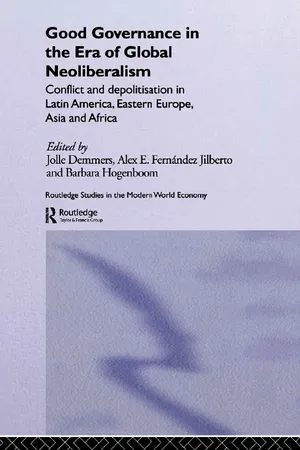
This new collection critically examines the new global policy of 'good governance'. This catchphrase of aid policy and development thinking has been the subject of too little analysis to date. This book redresses the balance. It places the prefix 'good', and exactly what that means, under the microscope and examines the impact of neoliberal governance in a wide range of countries and territories, including Chile, Russia, Argentina and Indonesia.
eBook - ePub
Good Governance in the Era of Global Neoliberalism
- 376 pages
- English
- ePUB (mobile friendly)
- Available on iOS & Android
eBook - ePub
Good Governance in the Era of Global Neoliberalism
About this book
1
Good Governance and democracy in a world of neoliberal regimes
Jolle Demmers, Alex E.Fernández Jilberto and Barbara Hogenboom
Good Governance has become the major buzzword in aid policy and development thinking today. It even seems to have dethroned Sustainable Development as the international policymakers’ mantra. Conceived within the World Bank, the concept has been embraced by the governments of Western countries and by the IMF as both a goal and a condition of official (development) assistance. To lending countries, Good Governance is first of all yet another element of conditionality for indispensable loans, and ultimately for their acceptance as equal participants in the global economy. The transformation of Good Governance from simply a goal to also a condition for development assistance, emergency credits and debt relief coincided with the substantial decrease of North-South redistribution by means of official development funding. It coincided as well with the international compliance of the left with the position that free markets are the primary tool for the development of what were once known as the Second and Third Worlds.
In the early years of neoliberal globalisation, neoliberalism was primarily an economic agenda that included a negative connotation of the state and the public sector. ‘More market and less state’ was in fact the prime objective of both the stabilisation programmes that started in the late 1970s, and the Structural Adjustment Programmes (SAPs) that were vigorously enhanced and extended in the 1980s. The early global neoliberal agenda hardly cared about a country’s political system, its type of government or the participation of its citizens. The Bretton Woods institutions’ main concern was the implementation of economic restructuring, and if necessary the suppression of socialist tendencies—a task that authoritarian regimes and autocratic leaders had generally less trouble with than democratic governments.
However, with the ending of the Cold War a new discourse on governance and the political system arose. Unemployment, poverty, income disparities and the sudden rise of the parallel economy, black marketeers and criminal networks in recently ‘neoliberalised’ countries (particularly the former Soviet Union and large parts of Africa) prompted the idea that global neoliberalism could only successfully proceed in a ‘sound’ governance environment. It was not the neoliberal model that was to blame for the lack of progress, but rather the immature, corrupt and inefficient state administrations. From the early 1990s onwards, the call for less state has gradually been substituted by a call for a better state. This new approach should not be confused with a plea for a return to the strong (Keynesian or socialist) state. Rather it implies better and transparent governance of what is left of the state after neoliberal restructuring has been implemented. Often, the emphasis on ‘good’ governance was combined with a call for democratisation. As with Sustainable Development, the global fashion of Good Governance has proven hard to resist. In both political and academic circles the concept has easily spread and, apart from irritating some sensitivities in developing countries about new mechanisms of imperialist interference, it has largely been well received. But then, who would be against a rather broad and vague concept with the adjective ‘good’ attached to it?
In this introductory chapter we will critically analyse the emergence of Good Governance and democratisation as prioritised issues of the international development agenda, within the context of worldwide neoliberalisation. Apart from the causes, we will consider the political, economic and social consequences of this triad-like political project for free markets, Good Governance and democratisation. Instead of understanding its emergence as a genuine medicine against the illnesses caused by the free market agenda, we see the introduction of the good governance project as a placebo with possibly lethal consequences. Of course, in itself there is nothing wrong with the idea of ‘good governance’. However, as this chapter shows, whereas the concept is explicitly presented as non-political and non-ideological, it strongly favours economic liberalisation. The attractiveness of the concept of Good Governance lies in its capacity to make complex issues seem manageable, to hide disagreement and to provide a practical answer to the disappointing results of the Structural Adjustment Programmes of the 1980s.
Good Governance and the effective state
By the year 2000 Good Governance had been globally accepted as a crucial means to achieve both development and poverty reduction, as is shown by the world leaders’ adoption of the United Nations Millennium Declaration. However, Good Governance is by no means an univocal concept. The foggy and positive aura surrounding Good Governance often blurs the fact that the concept includes at least three different views on development (Leftwich 1993; WRR 2001).
The first and dominant approach is managerial or technocratic. Its main elements are efficiency, authority and accountability of the state. In order to achieve this goal, enhancing a sound economic climate, transparency and the rule of law, and tackling corruption are considered the most important mechanisms. Public institutions and officials should therefore be controlled and held responsible for their functioning. This strictly qualitative improvement of the (small) state is expected to considerably contribute to development, understood as economic growth. The main link between these two is the private sector, as both local and foreign companies are expected to invest more in a country when they have more confidence in its institutions, regulations and officials. The state should therefore ensure market stability, sound monetary and fiscal policies and secure competition.
Compared to this merely economic instrumentality of Good Governance, the other views hold a broader perspective. A second approach considers poverty alleviation as the major goal, and Good Governance as a means to achieve it. Consequently, it stresses the role of effective public institutions dealing with the poor and poverty, and the importance of the poor participating in (the policy of) these institutions. This more socio-economic approach nevertheless remains within the boundaries of the given situation of a small state apparatus and its neoliberal policies while precluding alternatives (e.g. land reform or subsidising or protecting vulnerable producers, sectors or regions).
Third, Good Governance is sometimes used to refer to governance issues from the angle of human rights and democracy. From this perspective, Good Governance is a combination of a separation of powers, an independent judicial system, freedom of organisation, speech and press, free elections and a multi-party political system. The role of civil society is considered to be of great importance, not only through participation but also as the driving force behind equitable development. In this approach development is understood as encompassing economic, socio-economic and political processes, taking place simultaneously. Nevertheless, usually only the basic human and political rights are referred to, while economic, social and cultural rights are left out.
Finally, in some instances, elements of the abovementioned technocratic, poverty alleviation and political approaches are melded together into a broader systemic point of view that encompasses political and economic relations and power. This wider approach acknowledges that governance is about more than formal institutional structures and state authority. Nevertheless, like in each of the three other approaches, open markets and maximum freedom of market actors are the premises. As Leftwich already noted in 1993 (p. 611), even from this systemic perspective ‘good governance means a democratic capitalist regime, presided over by a minimal state which is also part of the wider governance of the New World Order’.
Since Good Governance encompasses three perspectives on the link between governance and development, different actors have adopted the concept and they have been prescribing it for various problems. While multilateral institutions and governments of industrialised countries tend to favour and stress one of these three approaches, when opportune they ‘borrow’ another approach or elements of it. We will later on discuss the downsides of the concept’s flexibility and elasticity, but let us start by shortly reviewing how Good Governance globally sprouted, grew and has come to bloom.
The historical and doctrinal roots of Good Governance
Contrary to the idea of Sustainable Development, which arose in environmentalist circles and was later co-opted and remoulded into sustainable growth by mainstream policymakers and theorists as well as major corporate interests, the notion of Good Governance came from the World Bank itself. The first World Bank publication in which the concept was discussed was a 1989 report on Sub-Saharan Africa. The conclusion of this evaluation of Structural Adjustment Programmes (SAPs) was that a lack of Good Governance explained their disappointing results. This was by no means a repudiation of the Bank’s policy of decreasing the role and size of the state; the report concluded that Africa needed not just less government but better government. The focus on the need for more efficient and professional institutions and bureaucrats hid the more political issue that was involved, that is, the struggle within African countries between those who benefited from and those who suffered from the SAPs. Those who stood to lose and were located in and around the state apparatus formed a serious obstacle for the restructuring process envisioned by the World Bank and other funding agencies and governments. Thus it became clear that the state, paradoxically, had to be both strong and relatively autonomous in order to achieve effective adjustment. Since its Articles of Agreement do not allow for explicitly political lending criteria, the Bank could not but respond in a managerial mode, as it did with the introduction and managerial approach of Good Governance (Leftwich 1993).
It needs to be stressed that the notion of Good Governance was conceived in an evaluating study of the region that not only was facing the most extensive problems with development and governance, but that had also experienced the most destructive effects of the SAPs and declining development support. Rather than critically evaluating all structural causes of Africa’s misery, the report took neoliberal restructuring for an indisputable policy goal. In other words, the real question that was to be answered was how to develop Africa within the limits set by Structural Adjustment; or, what were the main obstacles for the SAPs to be successful? Good Governance was the answer. Only a few years later, the concept was completely integrated into the general (development) policies of the major multilateral organisations (particularly the IMF, but also the OECD through its Development Assistance Committee) and Western governments (cf. Leftwich 1993; Patomaki 1999; Weiss 2000; Woods 2000; WRR 2001). Unlike the Bretton Woods institutions, the latter were not restrained from dealing with more political affairs.
Whereas the definitions differed somewhat, for each of the institutions and countries promoting Good Governance, it had clearly to do with the use of control, authority and power (cf. Weiss 2000). Initially, the World Bank used a technocratic approach that equated Good Governance with sound development management (World Bank 1992), and also France has primarily stressed a technocratic version of the concept. The poverty alleviation approach was represented in the development policy of the English government, with the World Bank partly absorbing this issue later on. The third and more political approach found adherents among the Nordic countries and some of the European development assistance NGOs, while it was also supported by some of the UN institutions, in particular the UNDP.1 In line with its intention to promote human development the UNDP also stressed the intrinsic value of Good Governance. In addition, it stressed the importance of domestic policies and the empowerment of the powerless (Weiss 2000:802).2
The shift in the World Bank with respect to Good Governance took place in the mid-1990s. A 1994 evaluation shows that in the previous years Good Governance lending and research had expanded enormously, concentrated in economic and social dimensions and in Latin American and African countries. The Bank had focused on four areas: public sector management, accountability, the legal framework for development, and transparency and information (World Bank 1994). The fact that participatory approaches and human rights were labelled as ‘linked issues’ indicates that, apart from developing attention for the social side of Good Governance, even some elements of the political approach were used, at least in the Bank’s discourse. This shift became more finely tuned in the World Bank’s World Development Report 1997 that bears the subtitle The State in a Changing World (which will be analysed in the second section of this introduction).
At the time of the gradual shift of the Bank’s Good Governance policies, the IMF adopted the technocratic version of Good Governance. In September 1996, the Interim Committee of the Fund adopted the Partnership for Sustainable Global Growth, which stated that good governance in all its aspects is an essential element for economic growth. These aspects include the rule of law, efficiency and accountability of the public sector, and tackling corruption were to be guiding lines of its policy (IMF 1997:v). This involvement of the IMF focused on transparency of government accounts, effectiveness of public resource management, and stability and transparency (of the economic and regulatory environment for private sector activity). In the late 1990s the IMF and the World Bank joined forces to work on the highly indebted poor countries (the HIPC initiative). After extensive efforts and actions of NGOs and churches for debt relief, the Bretton Woods institutions agreed to write off some of the debts of these countries. In order to apply for this, the governments of these countries first had to have a Poverty Reduction Strategy Paper (PRSP) approved, which—apart from the new principles of ‘ownership’ (i.e. the government has to demonstrate its sense of responsibility for diminishing poverty) and ‘local participation’ in poverty reduction programmes—should include strategies with respect to Good Governance.3
The three ‘attractions’ of Good Governance
Apart from its nice, alliterating sound, there are several reasons for the rapid and wide spreading of Good Governance discourses in the context of neoliberal globalisation. First, it filled a conceptual and policy gap that became apparent after the Structural Adjustment Programmes were implemented. It was clear what the state had to do in terms of allowing, enabling and supporting the private sector’s economic role while strictly limiting its own, but there was not a clear vision on how it had to operate. Good Governance thus came as a practical solution to a pressing problem.
Second, part of the attraction of the idea lies in its tendency to translate complex and sometimes conflicting economic, social, political and cultural processes into manageable issues of governance and policy. By largely restating some sensible, old principles of administration and organisation, and subsequently subscribing them to developing countries, Good Governance may be confused for merely a modern jacket clothing nothing new. However, this redressing involves a major simplification of the understanding of development and even of the technocratic understanding of governance. What is lacking is the recognition that development—as any type of change—can cause new tensions between competing agendas for development. Such a focus on a nonconflict vision is at best naïve. This was also true for the Bank’s early analysis of governance, ‘because it entirely ignores that good governance is not simply available on order, but requires a particular kind of politics to institute and sustain it’ (Leftwich 1993:612). Despite some broadening and refinement of the ideas of the Bank and other important multilateral and national institutions, part of this criticism still holds. While this explains some of the concept’s attractiveness, it is not without risk. That is to say that simplistic assumptions of the time scale and support that are needed to build the institutions and knowledge to achieve Good Governance may after some time cause serious problems and opposition.
Third, Good Governance is a notion that hides important disagreement about the concept and processes of development. While under the umbrella of Good Governance these three views seem to fit together, in reality they may strongly clash. The technocratic call for a minimal state and opening up for the world market often counters demands for socio-economic protection and public investment in health, education and safety. Also the proposals for poverty alleviation and those for neoliberal restructuring tend to be opposite, particularly when it comes to (re)distribution of wealth. As these different views all join the banner of Good Governance, not only this concept but also even the debate on how to achieve just, sustainable and human development is blurred.
Generally presented as a non-political and non-ideological programme, these three attractions of the concept of Good Governance—filling gaps, simplifying complex issues, hiding disagreement—tend to work in favour of economic liberalisation, both by strengthening its supporters and by disarming its critics. Although from the perspective of the political approach of Good Governance there is a clear need and use for democratic decision-making and active citizen involvement in policy-making, in practice the managerial or technocratic approach dominates in multilateral and bilateral relations. And even advocates of this political approach generally eschew calls for economic and social rights, just like the advocates of the poverty alleviation approach stayed away from ideas of redistribution. This more or less implicit defence of the status quo is not only visible in the major multilateral institutions and industrialised governments, but also in most of the developing countries’ governments, in the major political parties around the world and also in many NGOs. Let us move on to consider the contribution of Good Governance policies to national processes of depolitisation around the globe.
Depolitisation with a neo-imperialist touch
The discourse of Good Governance emerged at the time that the promotion of democratisation had already become an important element of the dominant international agenda for development. The emphasis on democracy was triggered by the shift of US foreign policy in the mid-1980s. As soon as the international Communist threat faded, and the risk that the democratisation of non-industrialised countries would be at odds with American economic interests and convictions was strongly diminished, prodemocracy policies and participatory development replaced the anti-communist and therefore frequently pro-authoritarianism policies of the US and the Bretton Woods institutions. Next to the United States Agency for International Development (USAID), the National Endowment for Democracy (NED), which started to operate in 1984, has served as an important channel of democracy promotion.4 Although the mandates of the IMF and the World Bank do not allow for ‘political’ interference in a lending nation, particularly the Bank has been increasingly referring to the importance of participatory development and ‘the voice of citizens’. As a result of the change of the US position, European governments and NGOs, who had previously disguised their support for democratisation in developing countries, could also be more openly active on political issues (cf. Biekart 1999). Over 100 developing and transition countries ended military or one-party rule during the 1990s, and in 1998 more than 60 per cent of the countries had multiparty elections, compared to less than 30 per cent in 1974 (UNDP 2001:10–11).
The limitations of the new dominant democratisation and participation agenda are reflected in the Bretton Woods and US approach to democracy. In US foreign policy, for instance, democracy is restricted to the political sphere and it is not recognised that political power is also a means to transform unjust socio-economic structures, nor that the social and cultural spheres may a...
Table of contents
- Cover Page
- Title Page
- Copyright Page
- Illustrations
- Contributors
- Preface
- 1 Good Governance and democracy in a world of neoliberal regimes
- 2 The political economy of neoliberal governance in Latin America
- 3 ‘Que Se Vayan Todos’
- 4 Governing Mexico’s market democracy
- 5 Triple transition and governance in El Salvador
- 6 Playing Russian roulette
- 7 ‘Good governance’ can make bad government
- 8 Clanism and predatory capitalism
- 9 Between globalisation and sub-national politics
- 10 ‘Bad governance’ under democratic rule in Taiwan
- 11 The political economy of recovery in Indonesia
- 12 China’s transition to industrial capitalism
- 13 From new order to new world order
- 14 Good governance, privatisation and ethnoregional conflict in Cameroon
- 15 Global neoliberalisation and violent conflict
Trusted by 375,005 students
Access to over 1.5 million titles for a fair monthly price.
Study more efficiently using our study tools.
Frequently asked questions
Yes, you can cancel anytime from the Subscription tab in your account settings on the Perlego website. Your subscription will stay active until the end of your current billing period. Learn how to cancel your subscription
No, books cannot be downloaded as external files, such as PDFs, for use outside of Perlego. However, you can download books within the Perlego app for offline reading on mobile or tablet. Learn how to download books offline
Perlego offers two plans: Essential and Complete
- Essential is ideal for learners and professionals who enjoy exploring a wide range of subjects. Access the Essential Library with 800,000+ trusted titles and best-sellers across business, personal growth, and the humanities. Includes unlimited reading time and Standard Read Aloud voice.
- Complete: Perfect for advanced learners and researchers needing full, unrestricted access. Unlock 1.5M+ books across hundreds of subjects, including academic and specialized titles. The Complete Plan also includes advanced features like Premium Read Aloud and Research Assistant.
We are an online textbook subscription service, where you can get access to an entire online library for less than the price of a single book per month. With over 1.5 million books across 990+ topics, we’ve got you covered! Learn about our mission
Look out for the read-aloud symbol on your next book to see if you can listen to it. The read-aloud tool reads text aloud for you, highlighting the text as it is being read. You can pause it, speed it up and slow it down. Learn more about Read Aloud
Yes! You can use the Perlego app on both iOS and Android devices to read anytime, anywhere — even offline. Perfect for commutes or when you’re on the go.
Please note we cannot support devices running on iOS 13 and Android 7 or earlier. Learn more about using the app
Please note we cannot support devices running on iOS 13 and Android 7 or earlier. Learn more about using the app
Yes, you can access Good Governance in the Era of Global Neoliberalism by Jolle Demmers, Alex E. Fernández Jilberto, Barbara Hogenboom in PDF and/or ePUB format, as well as other popular books in Business & Business General. We have over 1.5 million books available in our catalogue for you to explore.