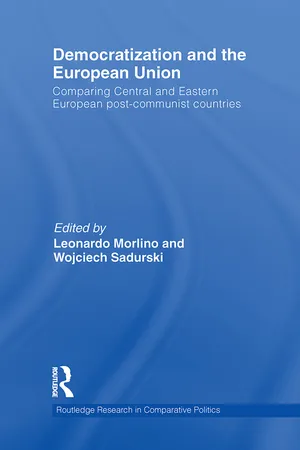
This book examines in depth the impact of the EU on aspects of the quality of democracy in eight selected post-communist countries. Considering both the political and legal aspects of the dynamics among institutions and focussing on inter-institutional accountability, the book analyses how constitutional designs have been effectively implemented to achieve this, and to what extent this was the result of EU action.
In order to make a comparative assessment of the EU on democracies, the book features detailed case studies according to their different status vis-à-vis the EU, including older new member states: Poland and Hungary; newer new member states: Romania and Bulgaria; potential candidates: Albania and Serbia; and neighbour and remote neighbour states: Ukraine and Armenia. Each chapter addresses a range of dimensions and most relevant domains of inter-institutional accountability, that is: executive-legislative relationships; constitutional justice; decentralisation and regionalism; and the role of ombudsman or other relevant authorities.
Seeking to assess how important the role of the EU has been in influencing the modes and characteristic of democracies and fundamental rights established in these regions, this book will be of interest to students and scholars of comparative politics, EU politics, Post-communist studies and democratization studies.
Poland has become a fully independent state and started its transition to democracy in 1989 (Garlicki 2005). The process of constitutionalism in Poland started well before the transformation in 1989, with amendments to the Polish Constitution in 1982 allowing for the creation of the Constitutional Court (CC), with the start of activity by it (in 1986) and by the Ombudsman (in 1987). The landmark date, however, was the partially free elections on 4 June 1989, and subsequent amendments to the Constitution. Most notably, on 29 December 1989, the Polish Constitution was changed to state that the ‘Republic of Poland is a democratic state, ruled by law, and implementing principles of social justice’. In a series of judgments, the CC confirmed principles of non-retroactivity of law, citizens’ trust towards actions of the authorities, proper promulgation of normative acts, protection of legitimate expectations and protection of vested rights etc. (Brzezi
ski and Garlicki 1995: 33). Since 1989 the major objective and strategic goal of Polish foreign and internal policy was membership in the North Atlantic Treaty Organization and in the European Union (EU). Therefore, all reforms in Poland were subordinated to achieve this goal and to meet Copenhagen criteria, namely the creation of (1) a market economy, (2) democracy and (3) the rule of law and protection of human rights.
On its road to the EU, Poland became a member of the Council of Europe (in 1991) and ratified the European Convention on Human Rights (ECHR). In 1993, Poland ratified the Association Agreement with the European Communities and started membership preparations. The turning point was 2 April 1997 when Poland adopted the new Constitution. That Constitution was a result of long political discussions and negotiations (Chru
ci
ski and Osiaty
ski 2001). This modern document created a good framework for the Polish state’s further development and included a modern charter of rights and freedoms. Despite some flaws, after 12 years the Constitution is regarded by many as a good framework for ruling the country: it includes sufficiently precise guarantees of basic rights and freedoms and instruments to protect them. However, current conflicts between the president and the Council of Ministers indicate that maybe the Constitution should now be amended in order to delineate more precisely the key powers.
In the period of transformation, the EU played an important role in reforming the Polish state and improving democracy. First, membership was a great incentive to undertake difficult reforms, especially at a later stage, when both the people and the political elites realized that reforms do not have an immediate effect but are painful. Second, the EU promoted democratic standards. Many reforms, e.g. concerning human rights’ protection, were not motivated by concerns of the Council of Europe, but rather by prospects of membership in the EU. Those reforms were also driven by a difficult communist past and the need to provide guarantees of rights that did not exist before. Third, the EU steadily provided Poland with subsidies supporting different reforms (e.g. Poland and Hungary Assistance for Restructuring their Economies (PHARE)). However, in reforming the economy and the state, one should not underestimate the role played by international organizations, such as the Council of Europe, Organization for Security and Cooperation in Europe or the Organization for Economic Cooperation and Development.
With respect to potential membership in the EU, drafters of the 1997 Constitution created a special ground for the future transfer of certain competences to the EU. The relevant ‘Europe’ clause was contained in Article 90 of the Constitution. Its aim was to find a balance between securing the principle of national sovereignty and at the same time provide for the possibility of EU integration. In particular Article 90 of the Constitution states that the ‘Republic of Poland may, by virtue of international agreements, delegate to an international organization or international institution the competence of organs of State authority in relation to certain matters’.
This provision created a sufficient legal ground for Poland to join the EU. Legality of accession has been challenged before the CC. The Court has relied heavily on Article 90 which states that the Accession Treaty is in compliance with the Constitution.
Nevertheless, the Polish doctrine before accession raised different concerns regarding the de facto sufficiency of constitutional regulation with respect to EU membership, as there are questionable provisions in the Constitution in relation to EU compliance. These have resulted in cases before the CC. They concerned the right of EU citizens to participate in local elections1 and the applicability of the European Arrest Warrant (EAW) to Polish citizens.2
The prospect of EU membership had an important impact on the stabilization of institutions and the relationship between them as well as on constitutional justice. It was also crucial for developing administrative reforms, including the self-government. One may claim that the vision of EU accession in 2004 was a major incentive behind all important changes and reforms. Therefore just after the accession, it is interesting to ask what happened to the quality of democracy, when this major incentive was lacking (because Poland had become a member of the EU). Poland now is just two years past the difficult period of 2005–2007. In this period Poland was ruled by right-wing parties, which questioned basic principles of democracy, including the separation of powers, protection of rights and freedoms, and constitutional values. This difficult period happened just after the accession of Poland to the EU. A symbol of the approach towards the EU in 2005–2007 was the ideological debate concerning the EU Charter of Fundamental Rights. The debate was not caused by real, well-thoughtout arguments, but rather by slogans and ideological fears and constraints.3 Religious issues or discrimination against sexual minorities has been raised as a major concern against the full applicability of the Charter. One may claim that because of these ideological concerns the EU Charter of Fundamental Rights and Freedoms will have restricted applicability in Poland, especially since Poland decided to join the so-called British–Polish Protocol (Barcz 2008).
Parliamentary elections in September 2007 changed the political landscape, as the winner was centrist Civic Platform. After two years of rule by the right-wing, traditional and xenophobic ‘Law and Justice’ Party (and its allies) one expected to see a return to the path of development and democratization and integration with the EU. However, it seems to be a difficult task, since the political scene is very much polarized at the moment. It is a good moment to ask about the influence of accession to the EU on the quality of democracy in Poland, especially in the post-accession period. If we take into account only the period 2005–2007, the picture would be blurred, since political decisions at that time were often influenced by irrational motives.
Relationships between executive and legislative powers
Main political actors
Under the 1997 Constitution, Poland is a parliamentary democracy with a significant role for the president, who is elected in general elections. The president has certain powers to control the parliament (including a right to veto which may be turned down with majority of three-fifths and a right to ask for abstract review of laws before their entry into force) and to dissolve the parliament in certain exceptional situations. The role of the president grows when the parliamentary majority is not significant and is not sufficient to overturn presidential vetoes to laws passed by the parliament. Such a situation took place after September 2007. Clearly the president, Lech Kaczy
ski, was not an ally of the ruling coalition led by the Civic Platform and the prime minister, Donald Tusk.
The Polish parliament consists of two chambers – Sejm and Senate. The latter is sometimes referred to as the chamber of reflection. Its major role is to control laws passed by the Sejm, to propose amendments, but also to propose legislative bills. There are constant discussions in Poland on the liquidation of the Senate. The prime minister is responsible before the Sejm for the activities of his cabinet. However, the parliament may give a vote of no confidence to selected ministers. The Polish Constitution provides for a so-called constructive vote of no confidence to the prime minister and cabinet. If the opposition wants to remove the prime minister it has to propose an alternative candidate for this position. If the opposition does not have such an alternative, a vote of no confidence entails the risk of dissolution of the parliament by the president. Such a constitutional construction creates a possibility for technocratic governments with minority political support to seek a majority in the whole parliament to pass given laws.
The activity of the government may be observed and scrutinized by the parliamentary opposition in many different ways. First, major parliamentary commissions may monitor activities of the respective ministers in the government. Accordingly, key parliamentary commissions are headed by members of the opposition. Parliamentary commissions have broad powers as they work on draft bills submitted by the government. They may also intervene in different actions, give opinions on candidates for different official positions or ask respective ministers for explanations. Also, individual parliamentary deputies may play an important role in submitting amendments to proposed laws or in shaping the final text of the law.4 Second, the opposition may submit its own legislative bills to the parliament. Although usually they do not have a chance to be passed (especially in sensitive areas), their aim is to raise discussion and show alternative solutions to a given problem. Third, the opposition may play an important role in establishing cases for the parliamentary special investigative commission to explain abuses of power or misappropriation of public funds. Individual deputies play an important role in the work of the commission, and to a great extent the result of its work depends upon their personal engagement and motivation. Fourth, the opposition may also lodge motions for votes of non-confidence to particular ministers or even to the whole cabinet. The last option is, however, a ‘risky’ game because it may result in the dissolution of the parliament. Fifth, the parliamentary deputies may submit individual questions to particular ministers and they have to be answered in detail. It is one of the most popular methods used to scrutinize the government.
The most important issue in the Polish democracy, dating back to 1989, is the relationship between the parliament and the Council of Ministers vis-à-vis the president. There were some difficult periods of cohabitation, such as when the president tried to use (or even to increase) his powers in order to curtail the majority in the parliament. The political effectiveness of the president in such periods of cohabitation depends upon two factors: (1) whether the majority in the parliament is bigger than three-fifths, allowing laws to pass despite the veto of the president; and (2) the level of constitutional culture. As an example in the period of cohabitation by the right-wing government with President Aleksander Kwa
niewski, the latter used his veto powers only in rare cases, thus leaving a significant space for the government to operate. The current President Lech Kaczy
ski uses his veto power quite often, and is accused of being too closely associated with aims of the political party of his brother.
A case concerning the division of powers between the president and the prime minister was recently referred to the CC. The prime minister wanted to determine which constitutional organ was responsible under the Constitution for representing Poland at the meetings of the European Council in order to present the position of the state. In May 2009 the CC stated that it is the role of the prime minister to represent Poland at the meetings of the European Council and to present the official position of Poland. The CC emphasized that in certain special cas...
Table of contents
Routledge research in comparative politics
Contents
Illustrations
Contributors
Preface
Introduction
Part I Old ‘new member states’
Part II New ‘new member states’
Part III Potential candidate and neighbour countries
Bibliography
Index
Trusted by 375,005 students
Access to over 1.5 million titles for a fair monthly price.
Study more efficiently using our study tools.
Frequently asked questions
Yes, you can cancel anytime from the Subscription tab in your account settings on the Perlego website. Your subscription will stay active until the end of your current billing period. Learn how to cancel your subscription
No, books cannot be downloaded as external files, such as PDFs, for use outside of Perlego. However, you can download books within the Perlego app for offline reading on mobile or tablet. Learn how to download books offline
Perlego offers two plans: Essential and Complete
Essential is ideal for learners and professionals who enjoy exploring a wide range of subjects. Access the Essential Library with 800,000+ trusted titles and best-sellers across business, personal growth, and the humanities. Includes unlimited reading time and Standard Read Aloud voice.
Complete: Perfect for advanced learners and researchers needing full, unrestricted access. Unlock 1.5M+ books across hundreds of subjects, including academic and specialized titles. The Complete Plan also includes advanced features like Premium Read Aloud and Research Assistant.
Both plans are available with monthly, semester, or annual billing cycles.
We are an online textbook subscription service, where you can get access to an entire online library for less than the price of a single book per month. With over 1.5 million books across 990+ topics, we’ve got you covered! Learn about our mission
Look out for the read-aloud symbol on your next book to see if you can listen to it. The read-aloud tool reads text aloud for you, highlighting the text as it is being read. You can pause it, speed it up and slow it down. Learn more about Read Aloud
Yes! You can use the Perlego app on both iOS and Android devices to read anytime, anywhere — even offline. Perfect for commutes or when you’re on the go. Please note we cannot support devices running on iOS 13 and Android 7 or earlier. Learn more about using the app
Yes, you can access Democratization and the European Union by Leonardo Morlino,Wojciech Sadurski in PDF and/or ePUB format, as well as other popular books in Politics & International Relations & Communism, Post-Communism & Socialism. We have over 1.5 million books available in our catalogue for you to explore.