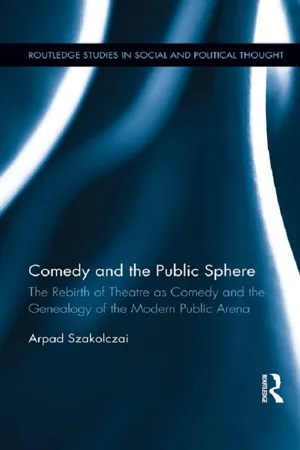
The book aims at reframing the discussion on the "public sphere," usually understood as the place where the public opinion is formed, through rational discussion. The aim of this book is to give an account of this rationality, and its serious shortcomings, examining the role of the media and the confusing of public roles and personal identity. It focuses in particular on the role of the theatrical and comical in the historical development of the public sphere, and in this manner reformulating definitions of common sense, personal identity, and culture.
eBook - ePub
Comedy and the Public Sphere
The Rebirth of Theatre as Comedy and the Genealogy of the Modern Public Arena
- 358 pages
- English
- ePUB (mobile friendly)
- Available on iOS & Android
eBook - ePub
Comedy and the Public Sphere
The Rebirth of Theatre as Comedy and the Genealogy of the Modern Public Arena
About this book
Information
Part I
The Public Sphere as a Theatrical Arena of Mocking Contest
1 | The Public and Its Masks Permanent Hyper-Critique and Hypocritical Performance |
INTRODUCTION
This book is not just about the public sphere but about the modern public sphere as a problem. With such an idea, one enters uncharted waters. The ‘public sphere’ is a central idol of contemporary intellectual and political life, seemingly beyond reproach. This book, however, argues that the problem lies in the ideal of the public sphere—suggesting that this ideal has vital shortcomings and that it is the actual pursuit of this ideal, and not the failure to realise a fully open and free public sphere, that produces the nefarious effects that are all too evident in contemporary politics, just as they are in social life and in the more intimate sphere of human existence.
Such way of posing the problem implies that it is necessary to directly address the ‘public sphere’ and the modern revolutionary tradition of which it is a pivotal part.
HABERMAS AND THE TWO ‘IDEAL TYPES’ OF THE PUBLIC SPHERE
The standard work on the public sphere is Jürgen Habermas’s Structural Transformation of the Public Sphere. Given that Habermas is one of the most important figures of contemporary social theory and that furthermore the book contains, in its first part, a historical account of the rise of the modern public sphere, which has set the agenda for the current debate (Roberts and Crossley 2004: 1), it would be self-evident to consider this work as the starting point for any genealogy of the links between comedy and the public sphere. Unfortunately this is impossible owing to its serious flaws, including its mode of proceeding (methodology) and a series of untenable historical claims, just as its problematic interweaving of substantive analysis with a normative perspective that is taken as a self-evident background, elucidated in later writings, but is itself deeply flawed.
Given the high repute of Habermas’s entire work, such a negative assessment might easily be considered reckless. Habermas, of course, has been criticised, and quite extensively (Calhoun 1992), even—according to his supporters—‘unfairly’ (Roberts and Crossley 2004: 1). However, the aim here is not to take up and continue some of the lines of criticism already expressed, as that would go beyond the scope of this genealogical book; rather, our aim is to argue that the work simply cannot be used as a historical background reference. Before giving concrete reasons for such an assessment, however, two more general problems must be raised concerning the reception of Habermas’s work. The first addresses a basic dimension in the appreciation of Habermas’s work that has so far remained tacit, hidden, unargued; whereas the second expresses perplexities about the publication and reception of the book that might be controversial yet cannot be avoided.
Concerning the first point, parallel to the reception and critical discussion of Habermas’s work, there exists a definite non-reception. A significant section of contemporary social theory simply fails to engage with it. Foucault offers a perfect example. There is an extensive literature on Foucault and Habermas; however, it is largely oblivious to the fact that Foucault did not see any significant parallel between his work and Habermas’s. Didier Eribon’s second book on Foucault contains some relevant evidence (Eribon 1994: 289–96). In 1983, when Paul Veyne invited Habermas to give a series of lectures at the Collège de France, Foucault strongly disapproved. He turned out to be right in the most literal sense, as Habermas started by denouncing all Nietzscheans, knowing well that in France Veyne and Foucault had, for decades, been the main promoters of Nietzsche’s thinking. Foucault repeatedly claimed that for him there were three types of thinkers: those he didn’t know, those he knew, and those he knew but failed to discuss (Foucault 1994, IV: 591–4); thus it can be safely assumed that the latter group certainly included Habermas. Furthermore, given the starting and title theme of this interview, which was Foucault’s pronounced desire to avoid polemics, he might have refrained from discussing the work of Habermas in order to achieve this. Yet the problem remains: Why not render explicit what is wrong with Habermas?
A reason why a large segment of social theorists refrain from addressing directly the work of Habermas is the extreme difficulty of confronting the heart of his position, both at the analytical and ‘normative’ levels. In both areas, and indeed jointly, forming an almost indiscernible whole, Habermas formulates the most trivial commonplaces of intellectual life, which, however, seem to be almost irresistible. Many may feel the banality of this, and sense that something is not quite right with it, yet they are unable to go beyond it. Habermas’s ideas are thus deceptively seductive for some, while they are also unattractive but impossible to oppose for others. After all, we as academics and intellectuals all like free and open discussion, in a forum where we are not subjected to external constraints; and any reference to the dire facts of social reality or power relations is immediately met with the claim that still, ‘ideally’, communication should be perfectly free, and we have nothing better to do than to promote a free and open exchange of ideas. Given that the medium of academic life and education is language, in particular speech, it is practically impossible for social theorists to oppose to this argument. Furthermore, deployed in front of the right kind of audience, at the right moment, one can easily become ‘hooked’ by it—the ‘ideal situation’ for such ‘hooking’ being the lecture hall, full of enthusiastic young students, preferably in a society whose order itself is decaying. The aim of this chapter, and in a way the entire book, is to put a finger on what is so wrong with Habermas.
The second, concrete background point concerns the actual reception of the work. The detailed history of its publication and reception is yet to be written and cannot be attempted here. All that is possible is to indicate a series of perplexities. The most important of these concerns the puzzling delay of its translation into English. The reason, it seems, was Habermas’s unhappiness with certain details of the book, especially the need to update the empirical material. Finally, after 27 years, the book came out at a most timely moment—the collapse of the Berlin wall, but also the English publication of its dangerous competitor, Koselleck’s Critique and Crisis. The strategic targeting of the original edition also raises queries. At that time Habermas was a young scholar, not an iconic figure; furthermore, arguably, by choosing to ‘critique’ Horkheimer and Adorno’s approach to the Enlightenment, he opted for a particularly courageous way of proceeding, his Habilitation not being accepted by Adorno. However, in another sense, the very novelty of the book, its championing of a bridge between ‘bourgeois’ and ‘critical’ social theory, while anticipating the future, also pre-empted a proper assessment. It burst into a gap, creating a new, ‘liminal’ field in between the two dominant discourses; thus it was not and could not have been properly scrutinised by anyone. For ‘mainstream’ historians and social scientists, the book, with its Marxist terminology, was an exercise in left-wing ideology.1 For Marxists, however, Habermas was still ‘one of us’, and Marxist social scientists at the time lacked the competence to enter Habermas’s imported ‘bourgeois’ ideas.2
The surprising outcome of this short overview is that Habermas’s first work was not and could not have been subjected to any serious critical scrutiny, whether in German or in English.
Actually, the situation is even more paradoxical. The book has three main concerns, in two parts. The central of these, dominating the entire work, is the development of a normative theory of the ‘ideal’ public sphere, later expressed in terms like the ‘ideal speech situation’ and more recently ‘discursive ethics’. Although any substantial scrutiny of Habermas’s work is rendered difficult by the continuous evolution of the work, which implies that any ‘external’ critique is supposedly rendered irrelevant by the ‘internal’ critique of Habermas himself, it is also accepted that there is fundamental continuity in the work (Calhoun 1992, Roberts and Crossley 2004); often combined with claims about the foundational role of the first work. It is here that the difference between the two historical parts of the book, devoted to the presentation of two ‘ideal types’ of public sphere, the second and third main concerns of the book, comes to the fore. While the second part, a critique of the contemporary mass media—dominated public sphere, is recognised as too simplistic and largely superseded, the first, background part is still considered as exemplary historical sociology.
The central concern of this book will lie here. It is argued that the background part of the historical chapter is untenable, and seriously misleading; and this book will offer, instead, a proper genealogy of the ‘public sphere’ as it emerged, as a difference, during the Renaissance, in the late medieval period. Concerning Habermas’s work, four specific points will be made. First, it will be argued that Habermas is not merely guilty of imposing a normative framework on the historical material, seriously confusing Max Weber’s term ‘ideal type’ as a tool of historical analysis with a normatively ‘idealised’ type, but that he did this through a perpetual, vortex-like shifting between normative and analytical, contemporary and historical meanings, generating a basic confusion that was consistently hidden by references to evidently universally shared modern normative positions that still are—and especially were at the time of writing—impossible to elucidate and ‘criticise’. Second, Habermas’s historical analysis is based on a contrast between the old, pre-modern, merely ‘representative’ public sphere (politics before the people), and the modern, bourgeois, rational public sphere, based on free and open discussion (politics for the people) (Habermas 1989: 8). The problem is that such a strongly ideological contrast is pure fiction, based on a profound misunderstanding of the medieval idea of participatory representation and of the general anthropological significance of participatory rituals. Third, it will be shown that the ‘ideal speech situation’, both ‘anticipated’ by the earlier historical work and based on this flawed ‘historical’ analysis, is itself a profoundly flawed idea, ignoring basic sociological and anthropological realities. Finally, it will argued that both the historical and theoretical shortcomings of Habermas’s work can be illuminated through the term ‘liminality’. Needless to say, within the limits of this book only a cursory presentation of these points is possible.
The first point can be illustrated through Nietzsche’s recognition of a major error in writing history, the failure to have a proper talent for backward inference. It implies a look at the past through the optic of the present, failing to move back ‘from the work to the maker, from the deed to the doer, from the ideal to those who need it, from every way of thinking and valuing to the commanding need behind it’ (Nietzsche 1974, no. 370). Structural Transformation is literally saturated by mistakes in backward inferences, and the manner in which they were quite systematically deployed renders this practice particularly problematic. The standard logic is the following. Habermas takes up a central concept in social or political thinking that gained a specific contemporary meaning, widely shared by ‘liberal’ and ‘critical-Marxist’ social theorists, and in the broadest possible sense of the terms, in a joint analytical and normative sense; and then extends this meaning backwards to the past, in the same, self-evident but normatively binding sense, even after having given a cursory evocation of the historically specific sense of the meaning given. Let me single out three central terms for attention: Öffentlichkeit (this is what has been translated as ‘public sphere’, but its original meaning and etymology explicitly implies openness, having in German affinity with the word ‘revelation’ (Offenbarung), so central for German Protestantism); Publikum (meaning the public as audience; here again the specific German connotations are important, as in German public openness and revelation are connected to a ‘listening’ audience, corresponding to the manner in which revelation to prophets in the Old Testament tradition was oral, while in Greek mythology, religion and philosophy divine revelation as ‘epiphany’ is a much more visual concern); and ‘representation’. Concerning the first term, Habermas mentions the fact that in German the word was introduced only in the 18th century and considered awkward; yet, literally with a slight of hand (‘nevertheless’ gleichwohl), he considers this fact as irrelevant and immediately retrojects the term, in its exact contemporary meaning, as far back as ancient Greece (Habermas 1989: 2–3; [1962]1990: 55–6). However, this way of proceeding is extremely problematic, as the modern meaning assumes a specifically modern invention, the newspaper, which is based on an earlier and again highly specific technological innovation, the printing press. Any query raised about such anachronism, however, including a simplistic application of the private-public distinction to antiquity, is silenced by a normatively loaded reference to ‘patrimonial slave economy’ (Habermas 1992: 3), which has nothing to do with the argument, but establishes a certain complicity with the reader, feeling oneself as enlightened (this is what can be called, paraphrasing Bruno Latour (1991), the flattering self-identity ‘we moderns’), as opposed to those barbarian Greeks who supported slavery. Thus the fact that Habermas fails to discuss either the specificity of the agora or the significance of theatre for the Greek ‘public life’ and education (Voegelin 1957) remains surreptitiously unnoticed.
The situation is very similar with the term Publikum. Following Erich Auerbach, an important classic author, Habermas notes that the word, before it was connected with newspapers or political speeches, simply meant a theatre audience, following a French usage dating back to 1629 (1989: 256, fn.4; [1962]1990: 90), and that, furthermore, both in European languages and in Latin, the word originally had a different legal and political meaning. Yet the fact that the specifically modern sense of the ‘public’ as an ‘audience’, fundamental for the rise of the ‘public sphere’ in the modern sense, emerged in the early 17th century as a novelty would simply be ignored. The new sense would be taken as a background meaning—as if it had existed eternally.
Finally, something even worse happened with the term ‘representation’. Here again, a footnote referring to the then recent and by now classic work of Gadamer ([1960] 1989) makes it evident that the medieval sense of the word placed emphasis on the concrete aspect of bringing something absent into presence, focusing on participation. However, the entire corpus of the book simply ignores this point and takes the modern meaning of representation as a merely visual illustration as given.3 It is in this sense that a central concept of the book is introduced: ‘representative publicness’ (repräsentative Öffentlichkeit), defined by the English translator as ‘the display of inherent spiritual power or dignity before an audience’ (as in Habermas 1992: xv).
However, it is here that we move from questions of method to the heart of the fundamental substantive problems with Habermas’s early book.
In a standard neo-Kantian manner, making allusions to Max Weber’s ideas but not following in any way the word or spirit of Max Weber, Habermas builds his thesis around a crude dichotomy between the old, ‘bad’, merely representative public sphere and the new, bourgeois public sphere featuring free and open public discussion. It is in the positive assessment given to procedural rationality that the novelty of a work—otherwise written from a radical Marxist standpoint—lay, anticipating the fusion of radical liberal and post-Marxist views on democracy, the taken-for-granted horizon of contemporary political theory, an agenda set up by Rawls (1971). On a closer look, however, this is not so different from the standard Marxist assessment of the revolutionary character of the bourgeoisie, already present in the Communist Manifesto. Since the 1962 book, Habermas’s thinking indeed did not move away from this radical revolutionary agenda, which implied the fluidification or liquefaction of every single stable aspect of social and cultural life—whatever was still left intact by the similarly dissolving chemical activity of the market. Although purportedly attacking only the solidification of market interests through publicity or marketing, the claim concerning ‘refeudalisation’, while at one level purely provocative, at another can be interpreted as a principled hostility to anything that is stable and solid—that cannot be immediately and recurrently altered, subject to the conditions of a ‘reasoned discourse’.
Before further discussing the problems concerning the ‘bourgeois’ public sphere as ideal, in particular the trap set up through the ‘ideal speech situation’, it is necessary to reconsider the other part of the dichotomy. In a fundamentally non-Weberian way, Habermas considers the two ideal types as being both normative and also as constituting a historical sequence—exactly the kind of argument Weber was most opposed to. According to Habermas’s fictional history, the bourgeois public sphere grew out of the eternal and timeless background of ‘representative publicness’.
Habermas’s idea of ‘representative publicness’ has the theatre as its model. Apart from the linguistic discussion referred above, this is best visible in the central claim according to which—before the modern, rational public sphere—politics was done simply in front of the public, thus implying a public as an audience, exactly as in theatre.
However, the problem is not only ...
Table of contents
- Cover Page
- Title Page
- Copyright Page
- Dedication
- Contents
- Preface
- Acknowledgements
- Introduction
- PART I: The Public Sphere as a Theatrical Arena of Mocking Contest: Comedy, Mask, Laughter
- PART II: The Rebirth of Theatre as Comedy out of the Spirit of Byzantium
- PART III: The Effect Mechanism of Commedia dell’Arte: Visions and Realities of Commedifi cation
- PART IV: The Rebirth of Commedia dell’Arte as the Avant-Garde
- Conclusion
- Notes
- Bibliography
- Name Index
- Subject Index
Trusted by 375,005 students
Access to over 1.5 million titles for a fair monthly price.
Study more efficiently using our study tools.
Frequently asked questions
Yes, you can cancel anytime from the Subscription tab in your account settings on the Perlego website. Your subscription will stay active until the end of your current billing period. Learn how to cancel your subscription
No, books cannot be downloaded as external files, such as PDFs, for use outside of Perlego. However, you can download books within the Perlego app for offline reading on mobile or tablet. Learn how to download books offline
Perlego offers two plans: Essential and Complete
- Essential is ideal for learners and professionals who enjoy exploring a wide range of subjects. Access the Essential Library with 800,000+ trusted titles and best-sellers across business, personal growth, and the humanities. Includes unlimited reading time and Standard Read Aloud voice.
- Complete: Perfect for advanced learners and researchers needing full, unrestricted access. Unlock 1.5M+ books across hundreds of subjects, including academic and specialized titles. The Complete Plan also includes advanced features like Premium Read Aloud and Research Assistant.
We are an online textbook subscription service, where you can get access to an entire online library for less than the price of a single book per month. With over 1.5 million books across 990+ topics, we’ve got you covered! Learn about our mission
Look out for the read-aloud symbol on your next book to see if you can listen to it. The read-aloud tool reads text aloud for you, highlighting the text as it is being read. You can pause it, speed it up and slow it down. Learn more about Read Aloud
Yes! You can use the Perlego app on both iOS and Android devices to read anytime, anywhere — even offline. Perfect for commutes or when you’re on the go.
Please note we cannot support devices running on iOS 13 and Android 7 or earlier. Learn more about using the app
Please note we cannot support devices running on iOS 13 and Android 7 or earlier. Learn more about using the app
Yes, you can access Comedy and the Public Sphere by Arpad Szakolczai in PDF and/or ePUB format, as well as other popular books in Politique et relations internationales & Télévision. We have over 1.5 million books available in our catalogue for you to explore.