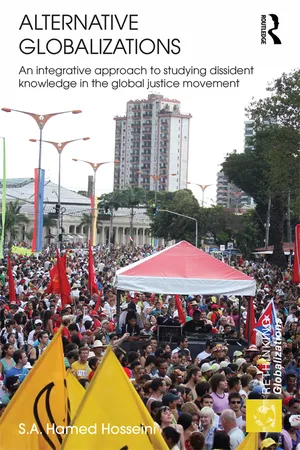
1 A movement of ideas in the global field of resistance
An introduction
Opposition to domination is not enough to create a movement; a movement must put forward demands in the name of a positive attribute.
Alain Touraine (2001: 49)
A global arousal
Between 13 and 15 October 2008, the Asia-Europe People’s Forum, a bi-regional network of over 500 social movements and civil society organizations, held its seventh international meeting in Beijing. This was just one month after the collapse of Wall Street and the spread of financial crisis across the world. The Forum, under the general theme of “For Social and Ecological Justice,” was deeply concerned with the emerging global economic crisis, and called for a redesign of the global financial system. The Transnational Institute and Focus on the Global South, two eminent international Non-Government Organizations (NGOs), convened informal nightly sessions along with the Forum’s meetings and issued a more radical statement signed by more than 300 intellectuals, social movement and non-governmental organizations. The statement defines itself as an initial proposal for debate on global policy reforms and considers the global crisis as an opportunity for transformation (Transnational Institute et al. 2008). The world is experiencing a multiplicity of crises in relation to the economy, food, climate and energy. This will not leave any excuse for authorities to undervalue the alternatives by simply labeling them as idealistic. The growing coverage of crises, mixed with people’s anger and dissatisfaction, will strengthen the global opposition to neoliberalism. According to the statement from the Transnational Institute et al. (2008):
There is a new openness to alternatives. To capture people’s attention and support, they must be practical and immediately feasible. We have convincing alternatives that are already underway, and we have many other good ideas attempted in the past, but defeated. Our alternatives put the well-being of people and the planet at their centre. For this, democratic control over financial and economic institutions are [sic] required. This is the “red thread” connecting up the proposals.
(Transnational Institute et al. 2008)
This statement, as acknowledged by its authors, is only a proposal for further debate and elaboration. Many of the proposed solutions require massive regulations and therefore governmental interventions. Among them are: the full-scale socialization of banks; global taxation; provision of universally accessible basic social services; progressive carbon taxation; investment on public transports and renewable energy; banning the speculations on food commodities; land reforms in support of small land holders, peasants and indigenous communities; guaranteed equal pay for women; and protecting the rights of migrant workers.
The proposal provokes many questions. How different are these alternatives to the welfare state protectionism and socialism? Who are the eligible actors in this process of transition from the current un-democratic, unjust world economy to a just, democratic system? What roles are government, civil society and the private sector supposed to play? How transitory is the role of governments in setting up new regulations and policies? How are today’s powerful economic institutions going to be democratically controlled? How can a global consent over solutions, among a vast diversity of players with different interests, ideologies, and identities, be achieved? How can the current governing economic and political authorities be convinced of the advantages of such radical proposals? What are the best strategies for realizing the goals, should they be reformist or revolutionary, from above or from below? To what extent can dialogues over the alternatives create a sustainable consent? How open are these dialogues and how can many disempowered groups be incorporated?
These questions and many other similar queries are not exclusive to this statement. Since the early stages of the present global resistance to corporate globalization, numerous provocative collective attempts have been made to create a just world economy. Yet many of these alternatives to economic globalization have been left open to endless dialogue and controversy. Despite the solemn nature of these collaborative attempts, the complexities of change and the difficulties of reaching consent have made the resistance vulnerable to attacks by mainstream media and authorities. Corporate media and their relevant intellectuals have described the resistance with simplistic and negative labels, such as “anti-poor,” “anti-trade,” “anti-market,” or “anti-globalization. ” Sympathetic intellectuals have described the movement with more positive, but still moot terms – such as the “movement of movements,” “the movement,” “global justice movement,” “fair trade movement,” or “globalization from below”; but also by way of negative labels such as “anti-capitalist,” “anti-corporate,” “anti-neoliberal” and “anti-Empire.” It seems that the multilateral nature of this historical phenomenon has disqualified any single label from representing it (see Chapter 4).
The new global resistance is shaped around a set of shared concerns. The main concerns are related to the international financial institutions and trade agreements, the World Bank and regional banks’ plans, related domestic and foreign policy adjustments such as privatization, tax cuts and cutbacks, multinational corporations, and the recent war and peace issues (Broad 2002). Although a great number of massive protests across the world (especially in the West since the late 1990s) have given popularity to the resistance, the movement in fact is not limited to these events. The incidence of massive uprisings and protests has experienced ups and downs during the last decade. While the 11 September 2001 terrorist attacks and the following sharp shift in public discourses diverted attention from the movement, it has been able to regain its potency once again, thanks to the rising disappointment with the exhaustive costly war in Iraq and the collapse of giant capitalist institutions.
The movement, despite its diverse nature, is now a historical phenomenon. It has become a new space for creating fresh ideas and solidarities, a quest for change and a source of inspiration. Today, the surfacing of a dissenting global space, in which many movements are mobilized against different but interrelated forms of mass oppression, mass exploitation, and mass deception, is broadly acknowledged. As Buttle and Gould (2004: 43) describe, many goals and values shared by these movements are endorsed in the publications and on the websites of a broad range of NGOs and movement organizations, while these affiliated groups consider themselves to be the integral components of a shared ambition. A wide variety of environmental, agricultural, labor, consumer, human rights, women’s rights, homosexual rights, and related groups now have released arguments about globalization and trade issues. Many regional and international forums, including popular education initiatives about global matters, are held annually. Among them, the enormous annual meetings of the World Social Forum (WSF) have attracted specific attention.
The WSF is defined as an open space for dialogue with the aim of analyzing the world’s status, exchanging experiences, and portraying alternatives. On the one hand, in terms of magnitude, the number of participants in WSF, since its first gathering in January 2001 in Porto Alegre, has sharply increased.1 Additionally, the forum has become an ideal place for social movement organizations (SMOs), activist groups, NGOs, and even persons, to go global. It is not limited to once a year meetings; rather it is now decentralized and reorganized in virtual networks through the spread of its regional, national, and thematic forums held all year round. As expressed by Featherstone, the “World Social Forum (WSF) has emerged as one of the most iconic associational spaces through which these different trajectories of opposition and alternative political identities/practices are networked” (Featherstone 2004: 626).
The WSF provides a clear example of how a growing possibility of organizing networked collective actions – among a great diversity of individuals and groups around shared interests and concerns – can transform identities. For instance, the second paragraph of the Call of Social Movements , issued at the end of the 2002 WSF, outlines an idealized perception of a specific mode of solidarity among actors within the global field who have been experiencing different but interdependent systems of disempowerment:
We are diverse – women and men, adults and youth, indigenous peoples, rural and urban, workers and unemployed, homeless, the elderly, students, migrants, professionals, peoples of every creed, color and sexual orientation. The expression of this diversity is our strength and the basis of our unity. We are a global solidarity movement, united in our determination to fight against the concentration of wealth, the proliferation of poverty and inequalities, and the destruction of our earth. We are living and constructing alternative systems, and using creative ways to promote them. We are building a large alliance from our struggles and resistance against a system based on sexism, racism and violence, which privileges the interests of capital and patriarchy over the needs and aspirations of people.
(WSF 2002a)
This can be interpreted as a new stage for global resistance. It represents a shift from self-interested and particularist movements, to flexible and adaptive cooperation with “others,” from fugitive events to stable networks of solidarity, and from a negative to a positive position. All these mentioned happenings, their continuity, intensity, and cosmic spread, show the emergence of a common concern about the growing global complexities and their local implications, characterizing a new angle in the history of social conflicts. In taking steps away from a simplistic antagonism and policy-oriented opposition, the movements appear to have become more practical and proactive. However, there are still some concerns about the prospects for the movement. Can this motion evolve into a real alternative philosophy of how to achieve genuine democratic global governance and equality? Can it be a real alternative to the present neoliberal thrust of globalization? Or will it fall back to old-fashioned alternatives, such as protectionism and state socialism, which have already failed to solve the problems or to change the situation?
In addition to these concerns, there are some important questions. Does this contemporary cycle of protests, in spite of its internal heterogeneity, represent a single “social movement” with a global scale? If yes, what are its specific attributes in comparison to other sorts of acknowledged movements? How can we explain its emergence? What other evidence and reasons does one need to draw on to define these contentions as a “social movement”? Certainly, this depends on the definition of movements we may have in mind, or on our theoretical perspective. What kind of concepts and definitions fit the phenomenon better and how robust are current theories and models for analyzing the new aspects of globally networked collective actions?
Soon after the rise in public attention to the protest incidents and their demands, intellectual activists from inside the movements started to explain the movement and its historical context (Brecher et al. 2000; Klein 2000, 2002; Starr 2000; Barlow and Clarke 2001; Shepard and Hayduk 2002; Danaher and Mark 2003; Hardt and Negri 2004; Mertes 2004). The popularization of the movement has finally given birth to academic efforts in re-conceptualizing the current global situation in terms of power relations, production relations and socio-cultural relations. After a delay, a growing number of social scientists have initiated attempts to conceptualize the global resistance; yet, still at a preliminary stage and mainly dependent on pre-existing approaches (O’Brien et al. 2000; Cohen and Rai 2000a; Hamel 2001; Smith 2001a; Goodman 2002b; Smith and Johnston 2002; Burgmann 2003; Rucht 2003; Yuen et al. 2004; Wood 2005; Waterman 2005; Mayo 2005; Tarrow 2005; Eschle and Maiguashca 2005; Amoore 2005; Curran 2006; de Sousa Santos 2006; Okereke 2007; Reitan 2007; Mathers 2007; della Porta 2007; Williams 2008; Juris 2008; Moghadam 2009). A review of these intellectual and academic attempts to grasp the nature of global movements can display the challenges between theory and practice, and between theory and empirical study, caused by the new conditions (see Chapters 3 and 5).
This book investigates the ideational aspects of the so-called anti-globalization movement from a socio-cognitive perspective. Instead of covering all aspects of the movement, which is quite beyond the scope of this book, I focus on the basic ideational dimension of the global resistance, especially in shaping modes of social thought. This aspect, I believe, is essential for the theoretical conception of flexible solidarities and their sustainability. As I will clarify, my notion of “social movement” is neither as narrow as the participant groups, organizations and visible protests, nor as broad as a subjective-cultural transformation in society. In a very preliminary sense, by a “social movement,” I mean a set of coordinated guiding patterns of action and cognition, developed out of a rudimentary, but sufficiently strong consensus among networked actors, on how to understand and change their commonly experienced conditions. Acknowledging the cognitive aspect of a movement is essential, since this mediates between social actions and social structures.
In this book, regarding the above discussed diverse and disparate nature of current globalizing confrontations, I generally use the term “global field of resistance” to refer to the whole looming space of different local, national and transnational struggles. I also use the term “global social movements” (GSMs) to denote conscious efforts within the global field of resistance to build transnational coalitions, cooperation and solidarity networks around global and/or local issues. The movements within the field can be categorized in terms of their orientations towards “globalization processes,” including the transnationaliza-tion of free trade and flexible modes of production, homogenizing cultural codes, or the growing influence of transnational governance of supraterritorial institutions and organizations on the democratic sovereignty of people. The term “anti-globalization,” which is generally employed in my initial arguments to refer to the global resistance against the current world order, will be gradually identified in the course of discussion as just one of the ideological visions within the global field of resistance. There are three more ideological visions in the field which will be categorized under the title of “global justice movement” (GJM). Therefore, the argument in this book will gradually narrow its scope to this movement (by excluding the anti-globalization vision) and finally focus on its most progressive ideological vision, i.e. the “alter-globalization vision” (see Figure 4.1).
The arguments in this book are shaped around two parallel concerns: first, my practical concerns about the underlying wisdom of coalitions and connections among the movement actors within the field; and second, my scholastic concerns about the robustness of social movement theory in dealing with the emerging reality. Accordingly, regarding the growing extent and diversity of involvements within the field, two questions are important. What intellectual modes of thought are associated with the organizational structure of the movement? And, to what extent are the mainstream approaches in social movement studies able to help us conceptualize this association between action and cognition? If differ-ent groups and organizations within transnational solidarity networks against the corporate-led globalization processes have shown essentially different ideological features and characteristics, then what have made them coalesce as the looming figure of today’s “most significant illustrations of social conflict and contentious political behaviour of the last decade” (Ayres 2004: 11)? In the following sections, I reformulate my practical and theoretical concerns.
What is the problem in terms of practice?
Social movements (SMs) are among the most important actors in any society. The future largely depends not only on their actions and rhetoric but also on their conceptions and consciousness. The stimulating question that has recently preoccupied me is, how capable the current global movements are of going beyond the imperatives of a “runaway world”;2 a world in which capitalist globalization, risk society, resurrection of racism, environmental deterioration, ethnic and religious intolerances, and the paradoxes of democracy are claimed to be its threatening features (Giddens 2000; Bauman 2002). The key to realizing such an aspiration lies in the SMs’ capacity for systematically perceiving and theorizing the reality of their circumstances and their own potentials for developing feasible and reasonable democratic alternatives to the current system (on both national and global levels). The belief systems elaborated and developed by SMs usually continue to influence society beyond their energetic life cycles.
The malaise of so-called new social movements (i.e. the culturally oriented, single-issue, reformist and identity-based movements) during the 1980s–1990s underscores their failu...