eBook - ePub
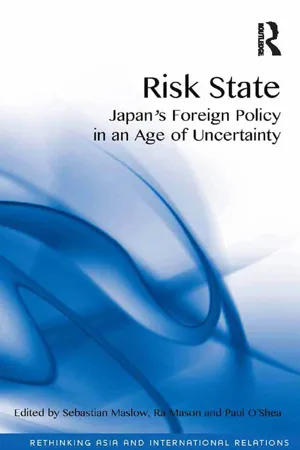
Risk State
Japan's Foreign Policy in an Age of Uncertainty
- 202 pages
- English
- ePUB (mobile friendly)
- Available on iOS & Android
eBook - ePub
About this book
The increase of new complex security challenges and the heightening significance of a diverse array of actors has simultaneously posed a challenge to traditional perspectives on international relations and foreign policy and created an opportunity for new concepts to be applied. Conventional explanations of Japan's foreign policy have provided us with theoretically predetermined understandings and fallacious predictions. Reformulating risk in its application to the study of international relations and foreign policy, this volume promises new insights into the analysis of contemporary foreign policy in East Asia and Japan's post-Cold War international relations in particular.
Information
Introduction
Chapter 1
Risk Recalibration in Japan’s Foreign Policy-Making
Since his return as Prime Minister in December 2012, Abe Shinzō has pushed hard to reform Japan’s security framework. As this is at the centre of his vision for a ‘strong Japan’, Abe’s administration rammed a new ‘state secrecy protection’ bill through the Diet in November 2013 – despite massive public criticism. The new law enables the government to punish whistle-blowers with up to 10 years in prison in cases of disclosing information designated as a ‘special secret’. As part of a broader package designed to enhance Japan’s intelligence and security policy coordination, the move is seen as instrumental to Abe’s strengthening of the US–Japan alliance. The scope of the ‘special secrets’ bill is massive, including everything from enabling Japan’s participation in collective self-defence to dealing with the crippled Fukushima nuclear power plant.
Thus, commenting on the possible ramifications of the new law for the policing of the damaged Fukushima Daiichi reactors, Mori Masako, Liberal Democratic Party (LDP) lawmaker and minister in charge of the legislation explained to the public: ‘If we make public the security plans of police, such information could reach terrorists’ (The Japan Times, 9 November 2013). Yet, Mori’s response failed to recognize the historically positive effect of certain secretive activities conducted by the state having been leaked, such as those relating to government and industry collusion via the appointment of former officials to positions with commercial vested interests – the so-called practice of amakudari, or descent from heaven (The Diplomat, 23 May 2011). Similar rhetoric came from Ishiba Shigeru, Secretary-General of the LDP, in response to a rally against the bill held near the Diet. Staying with the theme of ‘terrorism’, due to the participants’ ‘tactic of simply shouting at the top of their lungs’, Ishiba determined that such protests ‘create tangible pressure and cause fear in the public […] I believe it is the same thing as an act of terrorism’ (Asahi Shimbun, 1 December 2013).
These anecdotes illustrate state-led recalibrations of risk – whereby a given issue such as information is identified and reconceptualized as representing a new kind of hazard that is associated with other constructions of greater harm – in this case terrorism. This process is mostly enacted to legitimate policy objectives and reassign responsibility for contingent risks. In these examples of risk recalibration, those responsible for the joint highest ranking nuclear disaster in history gain immunity while street protesters are equated with terrorists. In light of the above, this volume explains how such initiatives led by the Abe administration are simply the latest case of Japan recalibrating risks in the formation of its foreign policy.
By applying risk, this introduction to the volume and the chapters that follow, provide an alternative approach to understanding the continuities and changes of the politics of Japanese foreign policy-making. This chapter begins with an appraisal of the leading research programmes in the field of International Relations (IR), acknowledging their contribution while highlighting their deficiencies in terms of application to the case studies at hand. The origins and contemporary significance of risk theory are then introduced and unpacked. This includes explanation of how risk has already been utilized and how this volume further develops the risk approach. The chapter concludes with an explanation of how risk is often employed implicitly within contemporary discourse on Japan’s foreign policy and outlines how the book has been synthesized into a series of interlinked case studies.
It is anomalous that despite its prominence in the discipline of Sociology, risk has been under-utilized as a theoretical concept within IR to explain changes in security policy and state behaviour. This book seeks to redress this situation by drawing on and developing a sociological risk framework into a useful concept for understanding international relations. We define risk as both the intransitive potentiality for harmful outcomes to occur and the transitive action of potentially harmful actions, taken to access positive opportunities. Specifically, we apply this concept to the study of Japan’s foreign policy. This is achieved through a series of case studies that reveal how risk shapes the agency of key individual and group actors. It explores how the conception, construction and consideration of risk inform decisions which structure behaviour in diverse areas of foreign policy. We argue that comprehensive analysis of Japan’s foreign policy requires the application of risk. Risk applied across foreign policy domains sheds new light on the complex processes that intersect the state, market and society and underpin Tokyo’s state-level policy trajectories.
These processes are constrained by the fact that Japan is the closest US ally in the region. It also commands one of the world’s most modern military forces. Thus, Japan is directly located at the fault line of East Asia’s contrasting economic and security orders. Japan’s specific position in East Asia therefore makes it an important case study with which to comprehend national responses to the cast of so-called ‘traditional’ and ‘non-traditional’ security challenges. Indeed, the dynamics of conflict and cooperation in East Asia’s international relations can only hope to be fully understood if the case of Japan is well accounted for.
Conventional Approaches to the Study of International Relations
There are obvious limits to the current repertoire of IR theories. Arguing from a system-level perspective, dominant structural realist approaches generate state strategic outlooks based on power redistribution dynamics; in contrast, liberal theories take into account the form of state-society relations and domestic actors in the formation of state preferences. There are numerous works that have criticized these two core paradigms and their derivatives (Legro and Moravcsik 1999; Adler 2012). In contrast to realist and liberal frameworks, this volume locates the concept of risk under the (wide) social constructivist umbrella. Constructivist analysis has gone beyond the rather narrow confines of materialist explanations to include language, culture, identity and norms as factors which influence state behaviour. As outlined below, the risk approach is compatible with this type of approach to the study of international relations, indeed, we argue that one of risk’s most powerful attributes is that it can be applied across the boundaries of traditional and non-traditional security issues alike, as is demonstrated in the case studies. But first let us examine the existing traditional frameworks in order to ground the risk approach in IR theory.
Traditionally, the realist paradigm has dominated in the study of international relations and security. In both its classical form and its structural incarnation, realism’s fundamental principles, from anarchy to a pessimistic conception of human nature, are present in scholarship as ancient as Thucydides’s classical work on the Peloponnesian War. Modern Classical realists, such as Hans Morgenthau (1978), also rooted their theory in human nature; however the development of neo-realism saw a shift from the individual unit (the state) to the anarchic inter-state system as the source of explanation; the units were functionally the same, all states would behave the same way if faced with the same situations – what mattered was the configuration of the inter-state system (Waltz 1979, 2000). This approach therefore disregarded epiphenomenal factors such as regime type and nationalism, as well as ignoring actors below (and indeed above) the level of the state. During the Cold War period, when two superpowers squared off against each other, fighting proxy wars for spheres of influence, neo-realism reigned supreme. However, with the sudden end of the Cold War – and the failure of structural realism to forecast this development – the explanatory power of this research programme was called into question. The inability of realism to cope with the messiness of the post-Cold War world, with its ‘new’ nationalisms, its liberal peace and the explosion of non-state actors led many to question realism’s fundamental assumptions. Nothing was sacred – even Thucydides was rebranded a constructivist (Lebow 2001)! As liberal and constructivist criticism mounted, so did realism reinvent itself in the form of neoclassical realism (Rose 1998; Lobell, Ripsman and Taliaferro 2009). This new form of realism introduced ‘domestic politics as an intervening variable between the distribution of power and foreign policy behaviour’ (Walt 2002: 211). Nevertheless, the new approach still privileged structural over domestic/ideational variables, setting the stage for conflict with the other ‘old man’ of IR theory: liberalism. This offered an opportunity for liberal scholars of various persuasions to assert their counter-realist theories in explaining the workings of the international system (e.g. Ikenberry 2012).
Liberalism, in both its classical and neo-liberal forms, is a broad church. Unlike the realist emphasis on the inter-state structure and the (tragic) inevitability of war, liberal approaches to international relations focus on cooperation, interdependency and institutions. Classically, it traces its roots back to the enlightenment and the ideas of philosophers such as John Locke and especially Immanuel Kant, whose ‘Perpetual Peace’ set out a vision of a world without war: a world of republics trading peacefully with each other. To a certain extent the Wilsonian idealism of the interwar period allowed realism to dominate during the Cold War. Still, even in the 1980s one of the most enduring liberal research programmes, the democratic peace theory, was able to demonstrate that broadly speaking, no democracy had ever gone to war with another democracy (Doyle 1986; Risse-Kappen 1991). Meanwhile neo-liberal scholars have sought to disprove the realist assumption that states are not only interested in relative gains (i.e. gaining more than others states), but they can also cooperate through institutions for absolute gains (Keohane and Nye 2001). This new cooperation has produced a form of ‘complex interdependence’, changing the nature of power – conventionally understood as military capabilities – and recognizing the increasingly complex interdependencies between states.
Whereas more traditional forms of liberalism chafed against the dominance of realism, this version of neo-liberalism shares much in common with neo-realism/neoclassical realism.1 Specifically, both neoclassical realism and neo-liberalism rely on an uncritically rationalist ontology, which largely takes state interests as a priori. In other words, the state still exists as a rationalist and unitary actor. As mentioned, constructivism has enabled scholars to study hitherto theoretically inaccessible phenomena such as language, identity, and culture. It also opens up the black box of the state, no longer taking the rationalist unitary actor for granted.
Concomitantly, new approaches in foreign policy analysis (FPA) have illustrated the extent by which unitary state actor models are insufficient to understand how a state comes to a particular decision (Hudson 2005). Indeed, a ‘dialogue’ has been opened up between constructivism and FPA, promising a ‘reinvigorated’ approach to the understanding of how and why states make foreign policy decisions (Houghton 2007). We propose that the risk approach can contribute to bridging this gap. As the chapters in this volume show, various actors compete and cooperate in the production of narratives that reflect their individual interests, which set the stage for policy debates. They compete in the agenda-setting and decision-making processes, determining the implementation of policies. In addition, they struggle over the manner of the implementation of the pre-selected policy. Rejection of the unitary actor discussion is critical, because there is no unitary state actor, but a host of actors, including: civil society organizations, political parties, newspapers, and sub-national politicians which are engaged in the creation and implementation of policy – all of which are contingent upon these actors taking and incurring risks.
Building on scholarship of ontological security and securitization (Williams 2003; Steele 2008), the concept of risk utilized in this volume is a socially constructed one, hence, the project is a constructivist project. Yet constructivism is not without drawbacks and critiques. One of the most powerful of these critiques has been levelled at constructivism’s ‘empirical ad hocism’, in which theories and concepts are drawn up for a given study and then forgotten or discarded (Checkel 1998), largely because they lack predictive power. One of the goals of this book is to convince the reader that risk does offer an analytical tool that contains a predictive element, which cannot be forgotten or discarded if hoping to accurately analyse the processes behind foreign policy formation. The multidimensional prism offered in the chapters that follow illustrates this.
Risk is nevertheless contained under the umbrella of constructivism, which has focused primarily on those issues which the conventional approaches have had serious difficulty explaining. These include apparent anomalies such as nuclear weapons, ethnic discord and religious conflicts. In Japan’s case, responses to all of the above are informed by ideational norms – such as anti-militarism, developmentalism and or economism (Hook et al. 2011) – which at different times hold more or less causal influence, depending upon how they diverge and converge (Finnemore and Sikkink 1998). However, the form in which these norms shape how risks are taken and incurred as a function of foreign policy formation has not been fully explored. As a result, the promise of constructivism remains only partly fulfilled. This volume proposes a concept of risk which can be applied to a broad range of international issues, from newer, so-called non-traditional concerns (e.g. the environment) to more traditional bilateral relations between major powers, as a contribution towards fulfilling constructivism’s potential.
The Application of Risk
It follows then that risk is deeply embedded in international relations. In applying risk more explicitly, this volume retains a constructivist approach. This is warranted because IR scholars and policy entrepreneurs have often failed to decouple the constructed theoretical definition of risk from that of danger, harm or threat (inflation). This volume asserts that although risk and threat are at times interchangeable, there is a meaningful distinction to be made between them, which has profound implications for understanding and explaining foreign policy processes. This is because, as Ulrich Beck (2005: 90) simply states, ‘perceptions of risk pave the way for new opportunities for power’.2 In order to identify and trace that power accurately, this volume explores how perceptions of risk can be recalibrated through complex processes of mediation between the state, market and society – resulting, ultimately, in the revision of national posture and policy.
This means, for example, that market-based risks – relating to everything from how much of a dwindling budget is spent on weaponry to how commercial media organizations are briefed – are taken by the state and have a direct impact upon how policy designed to ameliorate security risks is formed and implemented. Societal actors, such as pressure groups and issue networks (Campbell et al. 1989), also exert influence upon the process because they help to determine the extent that particular items are agendized. With respect to international relations, then, risks are not necessarily only equivalent to dangers (e.g. as only of military/non-traditional threats posed by external states). Rather, risks are active (taken) as well as passive (incurred), which allows them to be analysed in order to examine process rather than predominantly static understandings of threats (Mason 2014). This applies to the responsibility both for dealing with risks posed by external nation-states and to the formulation and comprehension of transnational risks (Richter et al. 2006: 4–16).
Risk in relation to international relations can be defined in the sense expressed by Copenhagen School scholars as, ‘a scenario followed by a policy proposal for how to prevent this scenario from becoming real’ (Rasmussen 2010: 2). We adopt an approach that further explores the open-ended (future-orientated) construction of risk. This allows explanations of the processes by which Japan recalibrates how risk is understood and mediated at the national level. Risks are operationalized as responsibilities to respond, vis-à-vis a rival state for instance – i.e. to risk taking a particular action in the sphere of foreign policy such as dispatching troops to a peacekeeping operation. The lack of objectivity in making such decisions highlights its malleability. This has already been explored in terms of its reflexive effects, in Beck’s ‘risk society’ (Beck 19...
Table of contents
- Cover Page
- Title Page
- Copyright Page
- Contents
- List of Figures
- List of Tables
- Notes on Contributors
- Foreword
- Preface and Acknowledgements
- Abbreviations and Conventions
- PART I INTRODUCTION
- PART II RISKS AND RESPONSES
- PART III CONCLUSIONS
- Index
Trusted by 375,005 students
Access to over 1.5 million titles for a fair monthly price.
Study more efficiently using our study tools.
Frequently asked questions
Yes, you can cancel anytime from the Subscription tab in your account settings on the Perlego website. Your subscription will stay active until the end of your current billing period. Learn how to cancel your subscription
No, books cannot be downloaded as external files, such as PDFs, for use outside of Perlego. However, you can download books within the Perlego app for offline reading on mobile or tablet. Learn how to download books offline
Perlego offers two plans: Essential and Complete
- Essential is ideal for learners and professionals who enjoy exploring a wide range of subjects. Access the Essential Library with 800,000+ trusted titles and best-sellers across business, personal growth, and the humanities. Includes unlimited reading time and Standard Read Aloud voice.
- Complete: Perfect for advanced learners and researchers needing full, unrestricted access. Unlock 1.5M+ books across hundreds of subjects, including academic and specialized titles. The Complete Plan also includes advanced features like Premium Read Aloud and Research Assistant.
We are an online textbook subscription service, where you can get access to an entire online library for less than the price of a single book per month. With over 1.5 million books across 990+ topics, we’ve got you covered! Learn about our mission
Look out for the read-aloud symbol on your next book to see if you can listen to it. The read-aloud tool reads text aloud for you, highlighting the text as it is being read. You can pause it, speed it up and slow it down. Learn more about Read Aloud
Yes! You can use the Perlego app on both iOS and Android devices to read anytime, anywhere — even offline. Perfect for commutes or when you’re on the go.
Please note we cannot support devices running on iOS 13 and Android 7 or earlier. Learn more about using the app
Please note we cannot support devices running on iOS 13 and Android 7 or earlier. Learn more about using the app
Yes, you can access Risk State by Sebastian Maslow,Ra Mason,Paul O'Shea in PDF and/or ePUB format, as well as other popular books in Politics & International Relations & International Relations. We have over 1.5 million books available in our catalogue for you to explore.