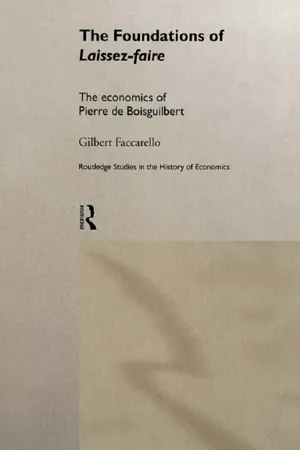
eBook - ePub
The Foundations of 'Laissez-Faire'
The Economics of Pierre de Boisguilbert
- English
- ePUB (mobile friendly)
- Available on iOS & Android
eBook - ePub
About this book
This is the first full length study of Boisguilbert's work to appear in English. It contains an extended discussion of the context in which Boisguilbert worked, as well as a detailed analysis of his life and work.
1 The context (I)
Social and political Augustinianism
I
At first glance Boisguilbert's texts present several difficulties which the reader must overcome in order to grasp the significance and coherence of his work. Some of these difficulties result from his ‘leaden’ style, or his occasional apparently contradictory remarks; but there are also other more serious difficulties. For example, the vocabulary employed may lead to errors, not so much on account of seventeenth-century language, but because of his particular usage of certain words such as bien or revenue, whose meanings we shall examine. Once this difficulty is surmounted, the purely technical and economic aspects of the various texts under consideration may be misleading by creating the impression of a facade of false simplicity. Boisguilbert's texts are undeniably scientific in character, achieving a refinement rarely obtained previously. But to limit our understanding to this aspect, without pursuing the enquiry any further, would be to risk at least a partial misunderstanding of the theoretical construction, if not misinterpretations. The intellectual climate of the era, political and religious opinions and theoretical origins are all extremely important, if only to clarify this author's particular contribution and the meaning of his project; and it must be admitted that as far as this aspect is concerned, Boisguilbert hardly facilitates our task.
We might at least help ourselves by means of the authors who are cited; unfortunately, however, the use of explicit references is far too recent a practice, so that only a few names appear in the texts (e.g. Gerson, Amelot de la Houssaye, Jacques de Sainte-Beuve), and they are of little help. A veritable deciphering project must therefore be embarked upon as the necessary preliminary to a reconstruction of the author's theoretical framework. Without claiming to be exhaustive, the goal of the first two chapters of this study is to draw out a few of the salient aspects of Boisguilbert's intellectual context in France. Of course, there have been many attempts to compare the theoretical principles which emerge from the Détail de la France or the second Factum de la France to those of Anglo-Saxon authors of the same period in order to uncover possible influences: one of the conclusions drawn by the present study, however, offers a very different perspective. Perhaps Boisguilbert did read Petty, Child, Temple or Locke,1 but in this instance the connections with exclusively French concerns and intellectual traditions are too great not to merit exclusive attention.
II
Let us start by examining Boisguilbert's language, for a useful point of departure in this enquiry is an analysis of the metaphors he employs and the significance of their recurrence.
From this perspective, the frequent use of religious vocabulary and images is immediately striking. Gold and money, for example, are described in terms of idols on whose altar the true wealth (commodities) is sacrificed: they are
the tyrant or rather the idol of these same foodstuffs, forcing subjects devoured by avarice to offer them in sacrifice at every moment, and receiving almost no other incense than the smoke which is born of the burning of the most precious fruits and most beautiful gifts of nature.
(1704a, pp. 347–8)
In another recurrent example Boisguilbert claims that in public life no one who has failed to bring about true ‘miracles’ should be ‘canonised’, and that the all too common opposing attitude is only the product of the ‘corruption of the heart’ (1704b, p. 806).
Obviously this use of religious vocabulary is not gratuitous. In fact it is one piece of evidence – other aspects will be studied later – of Boisguilbert's belonging to a predominant intellectual current which traversed the French seventeenth century: Jansenism.2 This is suggested by his thematic choices, and is confirmed by several clear allusions to famous debates of the period: the quarrel of right and fact (la querelle du droit et du fait)3 concerning the five propositions drawn (or supposedly drawn) from the Augustinus by Jansenius and which were condemned by the pope;4 as well as the question of papal infallibility which was occasionally linked to this quarrel. Transposing the theme, Boisguilbert asserted that one must ‘purge an idea of claimed or supposed infallibility from all those in eminent positions, for it prevents one from conceiving that they could be responsible for such a fearful error’ (ibid., p. 790). An ‘unthinking applause … accompanies all those occupying the highest positions, who make use of all kinds of devices to persuade them that they are infallible’ (p. 792). This Jansenist perspective – adopting a style apparently inherited directly from P. Nicole – informs a large part of the theoretical construction and dictated the themes which were a part of Boisguilbert's originality.
Along with religion, another recurrent theme is the theatre. Economic agents are often described as ‘characters playing their roles in the Republic’ (1704d, p. 967), as ‘various characters or performers who contribute to … the perfection of all sorts of projects and trade’ (1704b, p. 874). Thus transactions must be made ‘with a perpetual utility for all those playing a character in this theatre, in other words, all human beings’ (1707a, p. 896). The second Factum is replete with expressions such as ‘here is the first act of the play’ (p. 887). All these ‘actors’ (p. 907) are playing in a tragedy in which self-love and concupiscence mingle with flattery and individual interests so as to mislead state leaders, deadening their goodwill or perceptiveness beneath eternal ‘applause’. There is nothing but ‘surprise’, for there is ‘no ill will in the masters of the theatre in which such a scene may take place today’ (1707b, p. 1011). The term ‘applause’ recurs frequently in Boisguilbert's writing, connoting the flattering deception of the courtesans or those with a direct interest in perpetuating a disastrous state of affairs. They are often the ‘heroes of the play’: ‘These clever financiers … go back to the theatre … wanting to make the most of their talent’ (1707c, p. 823). And since, furthermore, all good tragedies include a death, crimes exist, as is proven by the cadavers presented to the public. ‘The cadaver … is inevitable, through the devastation of farming and trade.’ (1707a, p. 934).
Here, again, it can only be a matter of a baroque rhetorical figure which was very popular in the seventeenth century (Descartes himself uses it)5 and which fits perfectly with the spirit and the letter of court society6 where reality and fiction were irretrievably confused, and where the notions of spectators and actors were interwoven in the daily operations of the representation of power.7 However, some allusions do not deceive any more than does the constant association of the theatrical act with corruption, lying and decadence. This image which is constantly evoked denotes two other more important cultural facts: the Jansenist conception of society again, and the mechanistic view of the world.
III
First of all, the Jansenist conception of society. I shall return to this in detail later in the chapter. Suffice it to remark here that, in accord with its ethic, this current of thought adopted the whole anathema the Church had directed against plays and the acting profession for a great many years; it had even extended them, to some extent, to all artistic disciplines which mask reality, thus rendering sins, faults and the most reprehensible passions ‘amiable’.8 ‘Play acting was honoured amongst the pagans’, Antoine Singlin, Superior in charge at Port-Royal, wrote to the Duchesse de Longueville, ‘although the strictest amongst them ignored it’,
… but it was in vogue at that time, and the false gods often ordered spectacles to be presented, which proves that it is the remains of idolatry. One can even say that it is the conclusion and end of idolatry, since in play acting the devil receives the greatest sacrifice to be offered to him, a sacrifice not of beasts, but of men, not of the bodies of men, but of souls immolated to him through vice and crime exclusively … It is therefore wrong to imagine that today play acting has become innocent, as if it had altered its nature. Actors are always infamous and play acting is always an evil.9
These ideas were also developed by Pierre Nicole in his Traité de la comédie,10 which echoed a famous polemic with another distinguished Jansenist who, for good reason, could not accept this point, namely Racine.11 The opinion is found in Boisguilbert's work, expressed in two different, recurrent forms. There are innumerable passages, particularly amongst his letters, in which Boisguilbert denies being a ‘visionary’ (a term Nicole used to designate the playwright Desmarets de Saint-Sorlin during a famous controversy).12
I have the honour of sending you my first work, corrected and annotated throughout, which I believe will serve as a response to the objections you took the trouble to convey to me … I accept being considered as a visionary by you if, on every reading, you make no new discovery.13
Furthermore, as we shall see, Boisguilbert places the acting profession in the last position on the scale of utility and needs, presenting it as the very symbol of luxury and the corruption of mores. Of the two hundred professions existing in a ‘polished and magnificent’ state of society, the last is that of the actor,
who is the final work of luxury and the highest mark of an excess of the superfluous, since his role consists merely in flattering ears and pleasing the intellect through the simple account of fictions which one knows full well have never been real; such that one is so far from the fear of lacking the bare necessities that one may purchase the presentation of a lie with pleasure.
(1707b, p. 988)
Finally, it should be noted that the image of the theatre agrees with that of a spectator God, the ‘hidden God’ so dear to Port-Royal.
IV
The theatrical image also implies another complementary idea which was the object of passionate discussions throughout the century: that of a mechanistic explanation in the sciences. This is the omnipresent mechanism which Descartes imagined applying even to physiology and which, consciously or not, many authors wished to extend to the description of the functioning of societies. It is common knowledge that Hobbes was amongst these authors; but so too was Nicole, and Boisguilbert followed him into this area. From this perspective, the theatrical metaphor is a good illustration of the project of searching for the wings and machinery which will provide a physical and rational explanation behind the stage of the movements made by the objects and actors on it. This is what Fontenelle explains to the Marquise in a famous passage in Entretiens sur la pluralité des mondes habités (1686).
True philosophers spend their lives not believing what they see, and trying to make out what they do not see … In relation to this I always imagine that nature is a grand spectacle similar to the opera. From where you sit in the opera, you do not see the theatre exactly as it is; the decorations and machines have been arranged so as to create a pleasing effect from a distance, and the wheels and counter-weights causing all the movements are hidden from sight … But what increases the difficulty for the philosophers, is that in the machines brought before us by nature, the ropes are hidden perfectly, so well hidden that it took us a very long time to work out what caused the movements of the universe. Try to imagine all the sages at the opera, for instance Pythagorus, Plato and Aristotle … let us suppose that they saw the flight of Phaëton lifted up by the winds, that they could not detect the ropes, and that they had no idea how the back of the theatre was arranged. One of them would say: ‘A certain secret virtue removes Phaëton’. Another: ‘Phaëton is not made to fly, but he prefers flying to leaving the top of the theatre empty’; and there would be a hundred other reveries … Eventually, Descartes and a few other modern sages would come along and say: ‘Phaëton goes up because he is pulled up by ropes, and because a weight heavier than him goes down’ … In that case, has philosophy become mechanical? asks the Marquise. So mechanical, I answer, that I fear we may soon be ashamed of it. They want the universe to be a larger version of a watch, and for everything to be directed by regulated movements, dependant on the arrangement of the parts.
(1686, pp. 49–51)
Boisguilbert's search for a social physics, an economic mechanism founded on ‘those springs we have just spoken of [the interests of the agents], which cause this machine to work’ (1705b, p. 754), is proof that he shares this opinion. In a letter to the Controller General, the recipient is described as the ‘sovereign conductor of the watch’ (20 July 1704, p. 321), and the subjects are compared to ‘so many parts of the watch concurring in the common movement of the machine, such that the disturbance of a single one of them suffices to stop it entirely’ (p. 320). We also read in Dissertation de la nature des richesses (1707b, p. 997)
There is … a concern which virtually no one has considered, which is that the opulence which consists in the maintenance of all the professions of a polished and magnificent kingdom, which support each other and ensure their reciprocal success, is just like the parts of a watch, and that nearly all of them differ in their reliability, and are liable to various failings.
The problem is also illustrated by the image of a set of scales,14 in which the movement of the pans conveys an amplification of the disruptions linked to the phenomenon of speculation and cumulative processes. ‘So to return to the image, here before us is a pair of scales which has lost its balance’ (1704b, p. 862; cf. also p. 860).
The concept of economic equili...
Table of contents
- Cover
- Half Title
- Routledge Studies in the History of Economics
- Full Title
- Copyright
- Contents
- Foreword
- Introduction: A fin de règne Alceste
- 1 The context (I). Social and political Augustinianism
- 2 The context (II). On some problems in the governing of an ordered state
- 3 Equilibrium (I). The social classes approach: from the ‘state of innocence’ to the ‘polished and magnificent state’
- 4 Equilibrium (II). The market approach: the foundations of equilibrium and of free trade
- 5 Destabilising shocks (I). Court language and merchant truth
- 6 Destabilising shocks (II). Market strategies: the propagation of disequilibrium
- Conclusion
- Appendix
- Notes
- Bibliography
- Index
Trusted by 375,005 students
Access to over 1.5 million titles for a fair monthly price.
Study more efficiently using our study tools.
Frequently asked questions
Yes, you can cancel anytime from the Subscription tab in your account settings on the Perlego website. Your subscription will stay active until the end of your current billing period. Learn how to cancel your subscription
No, books cannot be downloaded as external files, such as PDFs, for use outside of Perlego. However, you can download books within the Perlego app for offline reading on mobile or tablet. Learn how to download books offline
Perlego offers two plans: Essential and Complete
- Essential is ideal for learners and professionals who enjoy exploring a wide range of subjects. Access the Essential Library with 800,000+ trusted titles and best-sellers across business, personal growth, and the humanities. Includes unlimited reading time and Standard Read Aloud voice.
- Complete: Perfect for advanced learners and researchers needing full, unrestricted access. Unlock 1.5M+ books across hundreds of subjects, including academic and specialized titles. The Complete Plan also includes advanced features like Premium Read Aloud and Research Assistant.
We are an online textbook subscription service, where you can get access to an entire online library for less than the price of a single book per month. With over 1.5 million books across 990+ topics, we’ve got you covered! Learn about our mission
Look out for the read-aloud symbol on your next book to see if you can listen to it. The read-aloud tool reads text aloud for you, highlighting the text as it is being read. You can pause it, speed it up and slow it down. Learn more about Read Aloud
Yes! You can use the Perlego app on both iOS and Android devices to read anytime, anywhere — even offline. Perfect for commutes or when you’re on the go.
Please note we cannot support devices running on iOS 13 and Android 7 or earlier. Learn more about using the app
Please note we cannot support devices running on iOS 13 and Android 7 or earlier. Learn more about using the app
Yes, you can access The Foundations of 'Laissez-Faire' by Gilbert Faccarello in PDF and/or ePUB format, as well as other popular books in Business & Business General. We have over 1.5 million books available in our catalogue for you to explore.