eBook - ePub
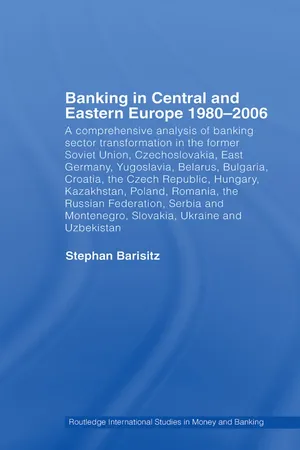
Banking in Central and Eastern Europe 1980-2006
From Communism to Capitalism
- 224 pages
- English
- ePUB (mobile friendly)
- Available on iOS & Android
eBook - ePub
About this book
Comparative in structure and covering an extensive number of transition countries in its survey, this comprehensive book overviews the development of the banking systems in Central and Eastern European since the communist era until the present time.Taking in a range of countries including Hungary, Poland, Czech Republic, Slovakia, Bulgaria, Romania
1 Introduction
This study attempts to give an overview and to analyze the development of the banking systems in Central and Eastern European transition countries since the communist era until the present time. Taking into account historic changes, particularly the emergence of independent states after the collapse of communism, all relatively large countries (in terms of population) are dealt with: the four largest in Central Europe: Hungary, Poland, Czech Republic, Slovakia; the four largest in South Eastern Europe: Bulgaria, Romania, Croatia, FR Yugoslavia (Serbia and Montenegro); the five largest in the Commonwealth of Independent States: Russia, Ukraine, Belarus, Kazakhstan, Uzbekistan. East Germany (the former GDR) is partially also covered. East Asian transition countries, like China, are not dealt with. As far as possible, the study analyzes and compares the evolution of legal foundations, banking supervision, banks’ major sources of assets, liabilities, earnings and related changes, banking crises, restructuring, rehabilitation programs, the role of foreign-owned banks and FDI. In doing this, the study also draws on a number of the author’s previous publications surveying banking sector development in various selected transition economies and partly including comparative perspectives (see also References). However, the scope of the present review surpasses by far that of any banking publications the author has so far written.
Chapter 2 sheds some initial theoretical light on what banks do in modern market economies. The raison d’être and functions of banks in developed capitalist economies are dealt with as a basic point of reference. Chapter 3 explains theoretical and practical aspects of banks’ activities within the regime of socialist central planning. The Soviet model of a monobank system, its strengths and major weaknesses, are depicted, leading to repeated reform attempts, including Hungarian “market socialism” after 1968. Another socialist system is that of “workers’ self-management” erected in former Yugoslavia.
Deteriorating performance triggers new urgent reform efforts, including measures aiming at decentralization of banking systems in the second half of the 1980s. But these cannot prevent the collapse of communism.
Chapters 4 and 5 explore banking developments in the 13 largest Central and Eastern European countries from the beginning of transition up to late 2005. This is done successively, country by country, not simultaneously. It is felt that the relatively large number of countries analyzed and the variety of experiences merit consecutive treatment in the interest of clarity. However, comparative summarizing region-wide tables complement the analysis. The turn of the millennium, i.e. approximately the year 2000, has been chosen to separate Chapter 4 from Chapter 5. This was done for two reasons: First, it was thought necessary and beneficial to subdivide the eventful history of banking development in former socialist countries into easier “digestible” parts. Second, 2000 (or 1999 or 2001) seems to be an interesting turning point or year to make an interim appraisal of banking developments in transition economies. It has either been a time of sector consolidation – sometimes preceded by deep crises – or it has been a culminating point of reforms/restructuring efforts. The first years of the new millennium have generally featured calmer, stronger, and more open banking sectors than the 1990s. More recently, dynamic structural catching-up processes have gathered momentum. Both Chapter 4 and Chapter 5 feature concluding sections that attempt to catch the essence of banking transition developments across all analyzed countries in respective periods. The focus is on distinguishing traits of the overall evolution, without ignoring outliers or laggards.
Chapter 6 finally discusses perspectives of banking in Central and Eastern Europe. These have to be seen in the light of the expanding European Union as well as of prospects of further enlargement of the euro area. No doubt that strong ownership ties have already linked banking sectors across the continent. The majority of CIS countries analyzed in the study – including Russia – have also chosen EU regulatory standards as a primary benchmark for further reforms. While increasing financial integration so far seems to have yielded largely positive results, the future also holds important challenges which may call existing regulatory structures into question.
2 Banks and their role in a modern market-oriented economy
What do banks do in developed capitalist economies? Being the goal and finalité of banking reforms in transition economies, this basic issue will be dealt with first.
Banks’ specialness
Banks are financial intermediaries that focus on taking deposits from savers and providing loans to investors. Apart from this interest-earning core activity, modern banks have engaged in various other intermediary activities, which are mostly fee-earning (investment funds, insurance, etc.). In a “perfect market” with omniscient players and devoid of any transaction costs – admittedly heroic conditions – there would be no need for financial intermediaries. Banks exist due to “market failure”: Given the reality of imperfect information and high search and transaction costs, in an economy without banks the level of fund flows between fund providers and fund users would likely be minor. Banks or credit institutions1 reduce the costs of matching savers and investors, and cut transaction and particularly information and monitoring costs connected to saving/investment deals. Banks thus achieve the transformation of maturities, of risks and of yields (Scialom 2004). Through their institutional capabilities, banks play a compensating job for the limitations of (financial) markets; for instance, they may “bridge” market incompleteness. Thus, one may say that markets are complemented by institutions.
Banks are special in that most of their financial resources come from depositors, therefore constitute debt; banks thus feature among the most highly leveraged enterprises. In the case of sight deposits, funds can be withdrawn at any time, therefore are extremely liquid.2 Moreover, credit institutions are unique in that they are able to create money by granting a loan and thus creating a deposit for the borrower (Aglietta 2001a).3 Banks themselves often borrow for a short term and lend for a longer term. By providing checking accounts or sight deposits, banks contribute to the establishment of payment services. As a public good or a basic element of financial infrastructure, the consumption of which is non-rival, a payment system is very important for economic stability. For all these reasons, banks can contribute to sharing risk, raising investment, improving the allocation of resources and thus to stimulating economic growth (Levine 1997).4
Credit institutions’ specialness in various respects lays the foundations for their regulation and supervision by the authorities. Banks’ usually large debt is dispersed. Most banks have a considerable number of depositors, the majority of whom are equipped with relatively small accounts, but together represent considerable financial clout. Since depositors generally provide the largest amount of banks’ resources, in the event of a crisis they collectively have more to lose than the actual owners of the bank. Depositors are often not well organized, but represent a large number of voters. This is one reason for public efforts to protect depositors (Fink and Haiss 1996b). The fact that a sizable amount of funds can be withdrawn without warning renders banking potentially instable and subject to “runs” by depositors (whatever the motive). Such runs can be initiated by rumors about problems in this or that bank, but may subsequently spread to other credit institutions, whether sound or not.
The possibility that such runs could mushroom and threaten the stability of the financial system (self-destructive escalation) which in turn could trigger serious repercussions for the real economy constitutes an important rationale for the authorities to intervene (Chevallier-Farat 1992). Of course, the extent of possible real sector repercussions will also depend on the depth of financial intermediation in the first place. Generally, banking panics can evolve from three sources: (1) contagious demand of conversion of deposits into cash; (2) nonpayment on the interbank market; (3) deterioration of the quality of bank claims by default of debtors (Aglietta 2001b).
Need for banking regulation and supervision
Apart from the presence of positive externalities through the payment system, credit institutions’ activity may also be linked to the opposite: Bank bankruptcy can bear large negative externalities which may give rise to a systemic crisis which, in the worst case, may trigger a recession or paralyze the entire economy. Therefore, banking sector regulation, the central bank’s lender of last resort function and/or a deposit protection scheme are often regarded as vital. Through intervening, the authorities aim at internalizing externalities. A further rationale for regulation is banks’ money creation capacity and their key involvement in the payment system. This reflects credit institutions’ role in the monetary transmission mechanism and puts them into the prime focus of monetary policy. Finally, banks’ role in promoting economic growth ensures the attention of policy makers.
A particular advantage of credit institutions, compared to financial markets, is that the former are able to reduce asymmetric information, i.e. differences of business-relevant information, between providers and users of financial resources (Leland and Pyle 1977). This is possible through the bank’s holding of a client’s account or through the establishment of credit relations which enable the bank to accumulate detailed knowledge about the client’s financial behavior and projects and may result in long-lasting financial relations and even the buildup of mutual trust (Brender 1980). This is the basis of “relational banking” – as opposed to the “transactional market”. In the name of individual savers a bank is able to carry out delegated monitoring of a borrower of funds, which can avoid duplication of monitoring costs (Diamond 1984). In many cases, banks constitute the principal source of information on small and medium-sized enterprises. However, bank intermediation may not entirely eliminate asymmetric information or forestall incentive problems like the occurrence of moral hazard or adverse selection, which may entail opportunistic behavior.
According to agency theory (Arrow 1985), moral hazard occurs when the agent, who possesses special knowledge on his/her own financial project, actually behaves in a riskier manner than agreed upon with or assured to the principal. The agent thus aims at increasing his/her potential utility/profit, at the cost of jeopardizing or wasting resources provided by the principal. This may refer to a borrower’s hazardous activity with respect to the bank as principal or to the bank’s own possibly fraudulent activity in its capacity as an agent of the depositor (ex-post insufficiency of information). Adverse selection occurs when contractual restrictions do not produce a selection of the most effective projects, as probably intended, but end up targeting the most risky schemes (Stiglitz and Weiss 1981). A frequently mentioned example is what may happen as a result of a strong increase of interest rates. Exorbitant interest rates may knock sound investments out of the credit market and leave only desperate or reckless bidders to contend (ex-ante insufficiency of information) (Diamond 1984).5 In emerging or not yet mature banking systems, like those of transition economies, distorted incentives and agency problems may often show up and even come to plague systems (Gardó 2002).6
While they can stave off bank runs and interbank financial contagion, a lender of last resort as well as deposit insurance, like any safety net, is open to moral hazard. Therefore, such publicly sponsored interventions to rectify market failure generate the necessity of further adjustments or interventions to avert abuse of the newly established conditions/regime. The central bank may thus resort to a behavior of constructive ambiguity to cast some doubt on whether it will actually come to the rescue in every case that may emerge;7 and the authorities may tighten regulations and supervisory control of credit institutions granted access to deposit insurance, in order to thwart overly risky conduct.8 Whereas, in the past, economic theory generally tended to advocate regulatory measures that would substitute themselves for the faulty market (like interest rate caps, credit ceilings), today rather complementary measures are favored, which aim at enhancing prudent behavior of banks while largely letting market mechanisms play (e.g. capital adequacy requirements) (Chevallier-Farat 1992).
Another source of instability in the banking sector can be short-sighted behavior with respect to the business cycle. As Kindleberger (1989) points out, credit institutions tend to display excessive optimism and preparedness to take risks in periods of growth and stock exchange euphoria, which may contribute to exacerbating negative repercussions during the following downturn. Competition for market shares likely constitutes one of the driving forces of this behavior. According to Minsky (1986) and Krugman (1998), such speculative activities of financial institutions and markets may engender an endogenous boom and bust cycle. Systemic and business risk can be reduced by regulation that sets sound eligibility criteria for institutions to be licensed.
Yet regulation also imposes a regulatory burden, i.e. regulation can compromise competitive ability and efficiency with which financial services are delivered. For instance, excessive licensing requirements can result in excess profits for the licensed credit institutions (sheltered from competition) and higher prices for consumers. Thus, the regulatory burden is liable to raise the cost of intermediation and may even slow down the speed of financial innovation (Saunders and Thomas 1988–89). Whatever the optimal design of regulatory intervention, it will not fulfil its purpose unless the rule of law, in particular contract, property and creditor rights, is respected and enforcement standards are upheld. This is of particular relevance in transition economies, as will be shown below.
Deregulation and banking flexibility
Recent technological developments (e.g. the internet) and financial innovations (like derivatives) have cut transaction and information costs in financial markets, thereby reducing market failures, narrowing information asymmetries, and technically facilitating direct access by savers. This may have contributed to triggering deregulation measures, which boosted market competition for credit institutions and made them vulnerable in their traditional spheres of activity. Thus, the “market–institution equation” may have changed. Financial market instabilities and sometimes even banking crises ensued. Deregulation of direct instruments of state intervention (which are today called “financial repression”) was followed by re-regulation with indirect tools of economic and banking sector policy.
Despite growing competition and structural adjustment pressures for the banking business, most economists do not believe that banks may become superfluous in the future, because of their unique capability of procuring liquidity at a low cost, their embodiment of the payment system, and because most banks have reacted flexibly to the technological and institutional challenges and have diversified their activities into various other financial market domains. Increasingly, credit institutions have been earning money from fees as well as from interest. As Bloomestein (2005) argues, this may even lead to a kind of institutional convergence between big banking and other financial groups.
3 Banking under socialism
The Soviet model
Passive banking, accounting and cash money
The following description will not only deal with the banking system of the USSR itself but also with the broad institutional setup in most of the USSR’s former satellites that also embodied Soviet-type economies, including the former GDR, Hungary, Poland and Czechoslovakia.
In a centrally planned economy, banking essentially plays a passive role. Credit institutions are not institutions for voluntary financial intermediation between savers and investors, but passive instruments for central financial control over the productive sphere (Schmieding 1993). In the Soviet Union since the advent of the first five-year plan at the end of the 1920s, in the former satellite countries since the end of the 1940s, banks fulfilled little more than bookkeeping functions for recording the authorities’ decisions about the allocation of resources among various sectors, regions and firms. Banks carried out payment transactions and extended credits that were to accompany – and thus verify – the execution of plans and orders pertaining to the real economy. Monetary flows were to validate corresponding real flows. In the USSR this precept was called “central plan control by the ruble” (Andreff 1993: 218–219). Private property rights with respect to means of production were generally outlawed. Given that purely physical central planning is not achievable in a complex economy due to the lack of a common unit of account, money is needed at least in a restricted way. Socialist countries have, with few exceptions, in practice developed two types of money: “accounting money” and “cash money” (Sutela 2003: 32).
Accounting money dominated the largest part of the economy, i.e. the state and enterprise sector, in the sense of the above-mentioned unit of account. It didn’t exist physically, it showed up as debit and credit entries on the bank accounts of enterprises and public administrations. Cash money (banknotes and coins) was introduced for wage and salary payments to the population and for use in private retail purchases, therefore also incorporated – to a limited degree – medium of exchange and store of value functions. This reflects what Kornai termed the “half-monetized system” of socialism (Kornai 1995: 145). In contrast to the other areas of the economy, central planners allowed consumer goods markets. But prices were arbitrarily fixed and planners oriented themselves either to basic price levels of pre-socialist periods or to a kind of labor input-oriented cost-plus pricing. The circulation of accounting money and the circulation of cash money were generally separated from each other. The separation of the two circuits facilitated central control and prevented any (direct) economic influence of private consumption decisions on production. Turning accounting money into cash money was generally possible only if provided for by the central plan and via wage and salary payments.
The socialist monobank
Apart from issuing cash money, the state bank was responsible for monitoring the “principle of unity of physical (material) and financial (monetary) planning” (Leipold 1980: 216). The monetary authority answered to the Finance Ministry or directly to the Council of Ministers (government). Credit extension and redemption were carried out on the basis of (annual) central credit plans. All credit sources and the entire credit volume were determined in central credit balances. For some types of investments bank loan finance was even required. Given the non-existence of capital and credit markets...
Table of contents
- Cover Page
- Title Page
- Copyright Page
- Illustrations
- Foreword
- Acknowledgments
- Abbreviations
- 1 Introduction
- 2 Banks and their role in a modern market-oriented economy
- 3 Banking under socialism
- 4 Transition, liberalization, banking crises and reform policies (up to around 2000)
- 5 Post-transition crisis developments, strengths and weaknesses of contemporary banking sectors (since around 2000)
- 6 Perspectives of banking in Central and Eastern Europe
- Notes
- References
Trusted by 375,005 students
Access to over 1.5 million titles for a fair monthly price.
Study more efficiently using our study tools.
Frequently asked questions
Yes, you can cancel anytime from the Subscription tab in your account settings on the Perlego website. Your subscription will stay active until the end of your current billing period. Learn how to cancel your subscription
No, books cannot be downloaded as external files, such as PDFs, for use outside of Perlego. However, you can download books within the Perlego app for offline reading on mobile or tablet. Learn how to download books offline
Perlego offers two plans: Essential and Complete
- Essential is ideal for learners and professionals who enjoy exploring a wide range of subjects. Access the Essential Library with 800,000+ trusted titles and best-sellers across business, personal growth, and the humanities. Includes unlimited reading time and Standard Read Aloud voice.
- Complete: Perfect for advanced learners and researchers needing full, unrestricted access. Unlock 1.5M+ books across hundreds of subjects, including academic and specialized titles. The Complete Plan also includes advanced features like Premium Read Aloud and Research Assistant.
We are an online textbook subscription service, where you can get access to an entire online library for less than the price of a single book per month. With over 1.5 million books across 990+ topics, we’ve got you covered! Learn about our mission
Look out for the read-aloud symbol on your next book to see if you can listen to it. The read-aloud tool reads text aloud for you, highlighting the text as it is being read. You can pause it, speed it up and slow it down. Learn more about Read Aloud
Yes! You can use the Perlego app on both iOS and Android devices to read anytime, anywhere — even offline. Perfect for commutes or when you’re on the go.
Please note we cannot support devices running on iOS 13 and Android 7 or earlier. Learn more about using the app
Please note we cannot support devices running on iOS 13 and Android 7 or earlier. Learn more about using the app
Yes, you can access Banking in Central and Eastern Europe 1980-2006 by Stephan Barisitz in PDF and/or ePUB format, as well as other popular books in Business & Business General. We have over 1.5 million books available in our catalogue for you to explore.