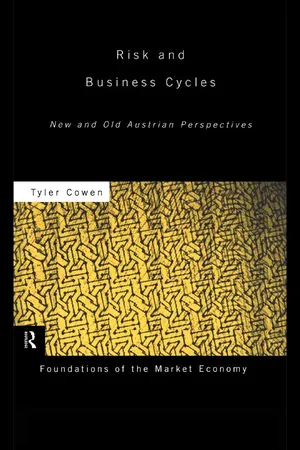
- 184 pages
- English
- ePUB (mobile friendly)
- Available on iOS & Android
eBook - ePub
About this book
Risk and Business Cycles examines the causes of business cycles, a perennial topic of interest within economics. The author argues the case for the revival of an important role for monetary causes in business cycle theory, which challenges the current trend towards favouring purely real theories. The work also presents a critique of the traditional
1
INTRODUCTION
THE PROBLEM
Entrepreneurs seek to match their production to market demands. To the extent that chosen outputs satisfy market demands and earn profits, the plans of consumers and producers are coordinated. How this coordination ever comes about, and why it might sometimes fail to occur, remain central questions for macroeconomics. In this book I shall focus on the coordination of investment and product purchase plans over time.
More specifically, I will examine whether intertemporal coordination provides a useful organizing theme for business cycle research. This investigation pursues the research program of the ‘Austrian’ school of economics (e.g., Menger, Mises, Hayek), using modern treatments of risk, finance, and expectations, and drawing upon contemporary methods of empirical and econometric research. I examine how changes in risk, real interest rates, and finance constraints alter the likelihood of intertemporal plan coordination. I will attempt to synthesize modern real business cycle theory, the work of David Lilien and Fischer Black on sectoral shifts, and the older Austrian analyses of monetary and capital theory, with the purpose of constructing an investment-based approach to business cycles in its most plausible form.
The questions I address include the following:
- What risk-return trade-offs do entrepreneurs face in evaluating alternative investments, and how might these trade-offs account for some features of business cycles? Chapter 2 examines this initial question in purely real terms, focusing on intertemporal coordination.
- Can changes in the nominal money supply create real sectoral shifts? Chapter 3 considers whether real and monetary theories of business cycles can be unified in terms of a general theory of sectoral shifts towards and away from riskier investments.
- What are the policy implications of intertemporal coordination theories of the business cycle? Chapter 3 considers commodity standards, fixed money growth rules, interest rate smoothing, nominal GNP rules, and other policy options, including fixed and floating exchange rates.
- Does the traditional Austrian theory of the trade cycle satisfactorily unify real and monetary business cycle theories? Chapter 4 argues that the traditional Austrian approach fails to establish its central contention— the link between positive rates of nominal money growth and excessive capital-intensity.
- How might an investment-based approach to business cycles avoid some of the problems with the traditional Austrian approach? Chapters 2 and 3 can be read as replacing the traditional Austrian emphasis on capital-intensity with an emphasis on risk. I explicitly contrast the ‘old’ and ‘new’ Austrian approaches in Chapter 4.
- Does the evidence support risk-based, investment-based, and Austrian theories of the business cycle? Does the evidence support the case for real effects of monetary policy, operating through an investment channel? Chapter 5 surveys the empirical work that has been done on these issues.
I will present the business cycle theory outlined in this book as a complement to neo-Keynesian and real business cycle approaches, rather than as a substitute or a direct competitor. The neo-Keynesians focus on why markets may not clear, or why markets may respond to shocks imperfectly. The neo-Keynesians, however, have devoted less attention to specifying how shocks might be propagated through an investment mechanism, or how much initial vulnerability to shocks economic agents will accept. Alternatively, real business cycle theory examines how shocks are propagated through time and through different sectors, but most versions of the theory (with some notable exceptions, discussed later) do not give a central place to investment. Real business cycle theorists typically speak of positive and negative ‘productivity’ shocks. Using a broad interpretation of the concept of shocks, I examine changes in an economy’s capital structure as a particular case of real business cycle theory.
I will focus on sectoral shifts across investments of different kinds. In the simplest scenario, entrepreneurs must choose between risky investments and less risky allocations of resources towards consumption. More generally, entrepreneurs face a trade-off between risk and expected return on investments, as emphasized by modern finance theory and the business cycle theory of Black (1995). Business cycles arise when subsequent expenditure patterns do not validate investors’ initial choices of particular time profiles of inputs and outputs. The disappointment of entrepreneurial plans will give rise to a negative real shock. Economic busts arise when risky, information-sensitive investments are not validated by the subsequent course of events.
The time-consuming nature of production implies that entrepreneurs must make resource commitments based on forecasts of market conditions for the relatively distant future. Black (1995) speaks of the difficulty of matching tastes and technology, given the ‘roundabout’ or time-consuming nature of production; related themes have been stressed by the Austrians. Although information on the time element in production is difficult to find, the data do provide a rough idea of the relevant magnitudes for time to build. Mayer (1958, p. 364) surveyed 276 companies building new industrial plant in the United States. He found that the average time from the decision to invest until the completion of the investment is up to thirty months. Bizer and Sichel (1991, p. 28) calculated the average durability of capital in various industries to be between eighteen and thirty years.1
Table 1.1 Average durability of capital
I characterize risky investments as long-term, costly to reverse, high-yielding, and having returns highly sensitive to the arrival of future information. For purposes of contrast, I characterize safe investments as more liquid, lower yielding, and less sensitive to the arrival of new information. Consumption typically represents a safe means of resource allocation; the returns are received immediately and do not involve reinvestment. Sectoral shifts across less risky and more risky investments provide the crux of the business cycle mechanisms I will examine in Chapters 2 and 3.
The prices of capital investments depend upon both real interest rates and risk, and changes in these variables therefore will influence economic cyclically. For reasons discussed in Chapters 2 and 3, declines in real interest rates will tend to increase aggregate macroeconomic risk and cyclicality. Increases in expected volatility will have the opposite effects—they will penalize risky, information-sensitive investments with special force. The induced move to lower-yielding investments will imply an economic downturn. As we will see in Chapter 2, the asymmetric effects of raising and lowering risk imply that economic busts arrive suddenly and unpredictably as discrete events, rather than as mere fluctuations in the rate of economic growth. Business cycles and changes in the growth rate are theoretically unified phenomena but they are not identical, as some modern real business cycle theories suggest (e.g., Long and Plosser 1983).
Both real and monetary factors may influence real interest rates and risk. Changes in government spending, budget deficits, oil prices, the forecasting abilities of entrepreneurs, and monetary policy all may affect risk and real interest rates, and thus may affect economic cyclicality. Without wishing to pre-judge the empirical issue of whether monetary or real shocks are more important, I will devote special attention to whether changes in monetary policy can create the real sectoral shifts behind a business cycle.
I consider how changes in monetary policy might affect the coordination of saving and investment plans. Monetary economics and monetary approaches to business cycles have fallen into general disfavor, given the current popularity of real business cycle theories. Yet the earlier neoclassical tradition bridged both monetary and real theories of cyclical activity. In these models, monetary factors have real effects by creating sectoral shifts through their influence on capital markets.
In the monetary scenarios I will consider the central bank can stimulate an economy in the short run. Monetary policy, by lowering real interest rates or relaxing finance constraints, can induce entrepreneurs to accept more risk, thereby making the economy more or less cyclical. In other words, monetary expansions can create sectoral shifts in favor of long-term, high-yielding, riskier investments. In the short run, before the relevant uncertainty is resolved, these investments do bring higher expected returns; the economy will appear wealthier. In the long run, however, the additional risk sometimes turns into systematic economic busts; long-term investments are highly sensitive to expectational error. Monetary policy sometimes brings lasting booms, and sometimes brings a boom/bust cycle—the final outcome is never certain in advance. This approach attempts to account for the stylized facts that first, monetary policy often is potent in the short run; second, monetary policy has unpredictable long-run effects; and third, monetary policy cannot improve economic welfare on average.
Instead of producing an inflationary surprise, central banks sometimes increase monetary volatility. In this case entrepreneurs will respond by shifting from riskier to less risky investments. The economy will experience an immediate downturn, and possibly also a high rate of price inflation. If the level and volatility of nominal money growth are positively related we will observe stagflation. These real effects of monetary policy work through capital markets, rather than through non-rational expectations or sticky wages and prices.
The positive theory of monetary cycles presented in Chapter 3 is not a monetary misperceptions theory as commonly defined. Cycles can be induced by real forces as much as by monetary forces, as discussed in Chapter 2. More fundamentally, I do not assume that individuals are tricked by the current money supply. Monetary misperceptions theories have fallen out of favor precisely because it is difficult to generate plausibly large costs from ignorance of the current money supply. In the scenarios I consider, monetary policy has real effects either through lowering real interest rates or, in the ancillary case of imperfect financial markets, through easing finance constraints.
The theories I consider attempt to match not only the empirical data but also some common economic intuitions. Both Wall Street and policymakers demonstrate an almost obsessive concern with capital markets and interest rates. Market participants place great emphasis on the successful prediction of interest rates, and see movements in interest rates as having great import for the economy. Yet capital markets and interest rates play a minor role in most current business cycle theories. Examining sectoral shifts across investments of differing risks attempts to remedy this discrepancy between theory and observation.
Concern with sectoral shifts across different kinds of capital goods is by no means new. The influence of real and monetary factors on the coordination of saving and investment plans dominated macroeconomic research for the first forty years of this century. Wicksell, Hawtrey, Mises, Hayek, Marget, Robertson, Kaldor, Myrdal, Lindahl, Keynes, and Hicks, among many others, all saw the integration of monetary and capital theory as central for business cycle theory and growth theory. Keynes’s General Theory was the final significant contribution to this tradition, although ironically, Keynes’s own influence discouraged the further pursuit of capital theory as a research topic. Yet for all its disparaging remarks about capital theory, the General Theory was obsessed with the topic of capital and its relation to money.
The earlier neo-classical economists failed to satisfactorily integrate monetary theory, capital theory, and the theory of finance. Hayek provided implicit models in his Prices and Production (1935) and other trade cycle writings, but he recognized the incompleteness of his treatment. In response he planned a two-volume set on capital theory. The first volume, Pure Theory of Capital, appeared in 1941, but dealt only with capital theory in a barter setting. The second volume, which was to deal with capital theory in a monetary economy, was abandoned when Hayek turned his attention to political philosophy. Arthur Marget had similar plans to produce a treatise on money and capital theory, to be called Money and Production, but this project also failed to come to fruition. Unfortunately, these earlier economists did not know contemporary microeconomics and possessed no more than a rudimentary understanding of financial theory, and for this reason their planned works proved intractable. I view modern financial theory as the proper substitute for the books which Hayek and Marget never wrote; Austrian capital theory and its offshoots focused too much upon the abstract properties of capital and not enough on its payoff streams in different world-states—a concept we now interpret as risk.2
Today’s macroeconomists are well versed in the theory of risk and finance but, with some prominent exceptions, they have tended to ignore capital theory. For the most part, intertemporal coordination has remained an underground topic, relegated to non-mainstream economists, such as the Austrians and the Post-Keynesians. Intertemporal coordination is a trivial issue in the representative agent models favored by many rational expectations theorists. Overlapping generations models often have no durable capital at all. The neo-Keynesians study coordination failures, but to date have focused on wage, price, and interest rate rigidities, rather than on disappointed expectations and failures of plan coordination. Lilien (1982) gave impetus to the modern literature on sectoral shifts and plan discoordination, but he did not focus on capital and investment.
Capital theory has received some attention in contemporary mainstream macroeconomics, most notably from Kydland and Prescott (1982) in their seminal article ‘Time to Build and Aggregate Economic Fluctuations.’ Greenwald and Stiglitz, in a variety of writings on credit rationing, have reintroduced capital markets into macroeconomics. Fischer Black’s recent Exploring General Equilibrium (1995) has emphasized ‘roundabout production’ as a fundamental source of taste-technology mismatches, thus emphasizing the role of capital in sectoral shocks. Black also stressed the trade-off between risk and return in entrepreneurial investment choice. All of these ideas play prominent roles in this book.
The sectoral shift literature and the earlier Austrian tradition stand apart on a variety of issues, most notably on monetary theory. Sectoral shift theories tend to emphasize real factors; Black (1995) goes so far as to dismiss monetary theories of business cycles altogether. The Austrians, in contrast, emphasized how monetary policy can change the relative demand for capital goods of differing kinds. Chapter 3 examines what assumptions are necessary for monetary policy to create real sectoral shocks.
SOME ASSUMPTIONS
Unless otherwise stated, constant returns and perfect competition hold in both the real sector and the financial intermediation sector. All prices and wages are perfectly flexible, unless otherwise stated. All...
Table of contents
- COVER PAGE
- TITLE PAGE
- COPYRIGHT PAGE
- LIST OF FIGURES AND TABLES
- ACKNOWLEDGEMENTS
- 1. INTRODUCTION
- 2. A RISK-BASED THEORY IN REAL TERMS
- 3. A RISK-BASED THEORY IN MONETARY TERMS
- 4. BUSINESS CYCLES WITHOUT RATIONAL EXPECTATIONS: THE TRADITIONAL APPROACH OF THE AUSTRIAN SCHOOL
- 5. EMPIRICAL EVIDENCE
- BIBLIOGRAPHY
Trusted by 375,005 students
Access to over 1.5 million titles for a fair monthly price.
Study more efficiently using our study tools.
Frequently asked questions
Yes, you can cancel anytime from the Subscription tab in your account settings on the Perlego website. Your subscription will stay active until the end of your current billing period. Learn how to cancel your subscription
No, books cannot be downloaded as external files, such as PDFs, for use outside of Perlego. However, you can download books within the Perlego app for offline reading on mobile or tablet. Learn how to download books offline
Perlego offers two plans: Essential and Complete
- Essential is ideal for learners and professionals who enjoy exploring a wide range of subjects. Access the Essential Library with 800,000+ trusted titles and best-sellers across business, personal growth, and the humanities. Includes unlimited reading time and Standard Read Aloud voice.
- Complete: Perfect for advanced learners and researchers needing full, unrestricted access. Unlock 1.5M+ books across hundreds of subjects, including academic and specialized titles. The Complete Plan also includes advanced features like Premium Read Aloud and Research Assistant.
We are an online textbook subscription service, where you can get access to an entire online library for less than the price of a single book per month. With over 1.5 million books across 990+ topics, we’ve got you covered! Learn about our mission
Look out for the read-aloud symbol on your next book to see if you can listen to it. The read-aloud tool reads text aloud for you, highlighting the text as it is being read. You can pause it, speed it up and slow it down. Learn more about Read Aloud
Yes! You can use the Perlego app on both iOS and Android devices to read anytime, anywhere — even offline. Perfect for commutes or when you’re on the go.
Please note we cannot support devices running on iOS 13 and Android 7 or earlier. Learn more about using the app
Please note we cannot support devices running on iOS 13 and Android 7 or earlier. Learn more about using the app
Yes, you can access Risk and Business Cycles by Tyler Cowen in PDF and/or ePUB format, as well as other popular books in Business & Business General. We have over 1.5 million books available in our catalogue for you to explore.