Over the past 50 years the US economy has experienced economic dynamism and technological change at a dizzying pace, driven substantially by innovation in digital communication technology. This dynamism has had limited effects in the electricity industry, and institutional change within the industry to adapt to these changes has been variable. Many states in the U.S. do not participate in open wholesale markets, and even more states have either no retail markets or have implemented such a restricted and politicized version of retail markets that potential retail market entrants still face substantial entry barriers. This book explores institutional design and regulatory policies in the US electricity industry that can adapt to unknown and changing conditions produced by economic, social, and technological change.
Whereas the dominant regulatory paradigm has traditionally been centralized economic and physical control based on natural monopoly theory and power systems engineering, the ideas presented and synthesized by Kiesling compose a different paradigm – decentralized economic and physical coordination through contracts, transactions, price signals, and integrated intertemporal wholesale and retail markets. Digital communication technology, and its increasing pervasiveness and affordability, make this decentralized coordination possible. Kiesling argues that with decentralized coordination, distributed agents themselves control part of the system, and in aggregate their actions produce order. Technology makes this order feasible, but the institutions, the rules governing the interaction of agents in the system, contribute substantially to whether or not order can emerge from this decentralized coordination process.
eBook - ePub
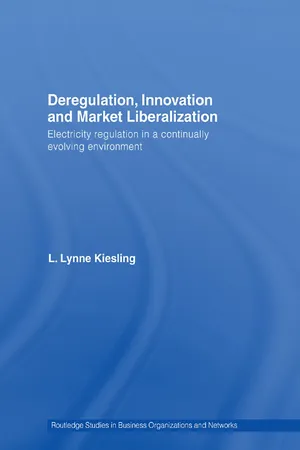
Deregulation, Innovation and Market Liberalization
Electricity Regulation in a Continually Evolving Environment
- 208 pages
- English
- ePUB (mobile friendly)
- Available on iOS & Android
eBook - ePub
Deregulation, Innovation and Market Liberalization
Electricity Regulation in a Continually Evolving Environment
About this book
1
Introduction
Introduction
This book addresses two interrelated topics – the electricity industry in the United States and institutional design. The investor-owned electricity industry is a $245 billion/year industry; it pervades our daily lives and makes our work, our leisure, and our standards of living possible. Few in the U.S. can imagine or desire a life without electricity.
The private firms in this industry have been regulated almost since the indus-try’s inception. Intended to stand in for rivalrous competition in an industry with natural monopoly characteristics and to provide a more stable investment environment for firms, regulatory institutions have focused on cost recovery, ex post rate determination, and regulatory approval of “prudent” investments. These institutions have provided firms with a range of economic incentives, some of them perverse, but they have contributed to the vast electrification achieved in the twentieth century and the remarkable economic growth and increased living standards achieved during that time.
What these institutions do not do, though, is adapt well to unknown and changing conditions. Over the past 50 years we have experienced economic dynamism and technological change at a dizzying pace, driven largely by innovation in digital communication technology. The major institutional adaptations that have occurred in electricity regulation – federal legislative and regulatory changes to remove entry barriers to wholesale power markets – were prompted by innovations in electricity generation technology and transformed the industry, unleashing further economic value creation and institutional change. This institutional change is incomplete and ongoing, though. Many states in the U.S. do not participate in open wholesale markets, and even more states have either no retail markets or have implemented such a restricted and politicized version of retail markets that potential entrants still face substantial entry barriers. The California electricity crisis of 2000–2001 (Sweeney 2002) and the Enron scandal (McLean and Elkind 2003) reinforced the idea that institutional change in this industry is risky and fraught with danger. In many ways we have been in limbo ever since.
This limbo has substantial opportunity costs. By not reducing retail and wholesale market entry barriers, and by not rethinking regulatory institutions to enable them to adapt to technological change and not serve as a barrier to its deployment, we forego the benefits of retail choice, of competition, and of innovation. Even in a network infrastructure industry these foregone benefits can be sizeable, but the problem is that they occur in the future; they are benefits we will fail to create.1 Thus they will take forms that are currently unknown; in the language of Bastiat’s “What Is Seen And What Is Not Seen” (1848), future benefits from a change are unseen, while current benefits of the status quo are seen.
In the economic sphere an act, a habit, an institution, a law produces not only one effect, but a series of effects. Of these effects, the first alone is immediate; it appears simultaneously with its cause; it is seen. The other effects emerge only subsequently; they are not seen; we are fortunate if we foresee them.
These unseen benefits are often less salient than the current benefits of the status quo, especially in an industry that is as heavily politicized as this one. Those who argue for the importance of those unseen benefits usually cannot specify the form or the magnitude of the benefits, so inertia and status quo institutions are more likely to persist, even when they are ill-suited to a new environment brought about by innovation and economic dynamism.
This book is a contribution to helping overcome this inertia by laying out and applying a set of ideas in economics and complexity science that are not typically applied to the analysis of electricity regulatory policy. These ideas – from new institutional economics, Austrian economics, and complexity science – come together to form an argument for thinking differently about the problems associated with electricity policy in the context of rapid and pervasive economic and technological change.
For the past century the dominant paradigm has been centralized economic and physical control based on natural monopoly theory and power systems engineering. The ideas presented and synthesized here compose a different paradigm – decentralized economic and physical coordination through contracts, transactions, price signals, and integrated intertemporal wholesale and retail markets. Digital communication technology, and its increasing pervasiveness and affordability, make this decentralized coordination possible. This decentralized coordination differs from the “distributed control” concept that power systems engineers often invoke; distributed control in that context means using distributed technology to enhance centralized control of a system. Decentralized coordination is a paradigm in which distributed agents themselves control part of the system, and in aggregate their actions produce order: emergent order.2 Technology makes this order feasible, but the institutions, the rules governing the interaction of agents in the system, contribute substantially to whether or not order can emerge from this decentralized coordination process.
That is the sense in which this book is about institutional design. Given that digital technology is increasingly making decentralized coordination possible and possibly value-creating, what institutions are consistent with allowing that process to happen and with increasing the likelihood that decentralized coordination will result in emergent order? In many ways the existing regulatory institutions are not compatible with this decentralized coordination paradigm, and indeed stifle decentralized coordination, either intentionally or inadvertently. Yet technological change continues, reinforcing the mismatch between the possible value creation that innovation reveals and the actual value that will exist if institutions cannot adapt to technological change. This potential value is again Bastiat’s unseen. One goal of this work is to make this unseen value more visible, and to do so in the context of institutional designs that are more likely to enable that value creation to occur.
Context and motivation
Regulatory policy is a function of the underlying cost structure in the industry and the physics of alternating current (AC) power flow. The physical supply chain in electricity has three parts: generation, transmission, and distribution. Generation generally involves using a fuel (or the potential energy stored behind a dam) to drive a turbine that generates electric power.3 Transmission and distribution wires transport that power from the generator to end-use customers. For both engineering and economic purposes, transmission and distribution are the same, except that transmission occurs over longer distances and therefore requires higher voltage capability. The economic supply chain in electricity focuses more on the transactions among the different steps in the supply chain, and thus adds a retail component to the physical description of the supply chain.
The challenge in a complex system like electricity is coordinating the physical and economic requirements of the system (Outhred 2003). Physical and economic requirements must coordinate, but the need for centralized dispatch with regulatory oversight does not necessitate centralized market design with regulatory oversight.
The year 2007 marked the anniversary of a century of formal state-level economic regulation of the electricity industry in the United States. Since the inception of the electricity industry in the 1880s, regulation has been an important determinant of outcomes for both producers and consumers. Initially the concern was twofold: ensuring the safety of electricity delivery to customers and managing or reducing the tangled web of wires strung across urban streets by multiple competitors. By the early 1900s economic regulation was a formal part of the institutional environment, with the establishment of state regulatory commissions starting in 1907.
Despite some adaptive changes over the past decade (such as incentive regulation or performance-based ratemaking, to provide firms with incentives to reduce their costs), the regulatory institutions governing the electric industry remain the institutions that were devised in the early twentieth century to facilitate electrification and to prevent the exercise of market power by a vertically-integrated monopolist. Grounded in neoclassical natural monopoly theory, these institutions embody four principal components: control of entry, price fixing, prescription of quality and conditions of service, and the imposition of an obligation to serve (Kahn 1988, vol. I, p. 3). The hallmarks of such regulation continue to be price determination based on historic cost recovery, an obligation for the regulated firm to serve all customers who request service, and a legal entry barrier that excludes potential competitors from offering some or all of the services in the regulated firm’s value chain.
The U.S. economy and society have grown and changed far beyond the imaginations of the Progressive reformers in 1907, yet the electricity industry and its regulatory institutions have not grown and changed apace. Furthermore, the electric industry is one of the most technologically backward industries in the modern economy. Although digital technology has existed for several decades that could update and streamline the operations of the electricity value chain and reduce transaction costs, the physical assets in use remain, like the regulatory institutions, relics of the first half of the twentieth century. This fact is paradoxical, given the vital role that electricity plays in powering the modern economy that has created these innovations. The regulatory institutions of the twentieth century contributed to the electricity industry’s ability to power extensive, pervasive economic growth.
Economic growth and technological change have brought the electric industry and its regulation to a crossroads. Technological change from outside the industry has prompted changes in both regulatory institutions and business models, leading to the incremental disaggregation of the vertically-integrated firm in some regions of the U.S. and not in others. Simultaneously, increasing use of market transactions within this vertical value chain provides further strains on the existing institutional environment, both in the U.S. and in other countries as we see both incremental market liberalization in the U.S. and the European Union and privatization of industry in many other countries.
This book presents a framework for thinking differently about many of the issues that arise in the regulation of network infrastructure industries (those involving physical interconnection and some economies of scale) in the face of constant and pervasive change, particularly the intersection of regulation and technological change. Because of the economic context of the early twentieth century and the technology of the electricity industry’s infrastructure at the time, the traditional neoclassical approach to regulation forged at that time focuses on static questions of resource allocation: how can we minimize deadweight loss in the provision of a service that is essentially a commodity, in which the underlying economic structure is one of natural monopoly?4 With such a focus, the emphasis of analysis logically falls on cost minimization and cost recovery. Thus our regulatory institutions were built to meet this static objective.
The economic regulatory institutions established in the early twentieth century were premised on neoclassical natural monopoly theory. The argument seemed straightforward: the large capital costs required to enter the industry could constitute an entry barrier, and as generation turbines increased in size after the adoption of the alternating current standard, a firm’s cost curves exhibited economies of scale (downward-sloping, long-run average costs) and sub-additivity (economies of scale over the relevant range of demand for a multiproduct firm). Furthermore, many of these assets were not redeployable, so a large share of those fixed costs became sunk costs.
They were also built on particular technology foundations in place in the early twentieth century. At the time, digital technology to measure, monitor, and meter the real-time flow of the energy commodity over the wires did not exist, so the technology of the time dictated a bundling of the sales of energy with the transportation/rental of the wires to transmit and deliver the energy to the end-use customer with the highest feasible economic efficiency. Combine the effect of bundling and vertical integration with economies of scale in electricity generation and the costly duplication of the wires network, and the natural monopoly characteristics of the industry in the early twentieth century are apparent. These factors led both to the establishment of vertically integrated firms in the industry and to state-level economic regulation of government-granted monopolies.
The policy and cultural climate of the Progressive Era also contributed to the expansion of regulation as an alternative both to large firms with market power and to government ownership. For many (such as Theodore Roosevelt, for example), regulation could forestall the Progressive impetus toward government ownership, given their perception of the inevitability of economies of scale in virtually every industry. The other half of the Progressive movement tended to believe in Jeffersonian small companies. This policy environment transcended the electricity industry, but certainly included it. The culmination of these policy movements was the set of New Deal measures in the 1930s.
Three major problems are associated with natural monopoly theory. The first is that first-best regulation requires that the regulator knows the cost function, which is typically an unrealistic and unfeasible requirement. The regulator knows the expenditure of the firm, which needs not be identical to the cost function, even for the observed levels of output, due to regulation-induced incentives differing from cost minimization. Hence, the regulator does not possess knowledge of the cost structure comparable to the firm’s, and that asymmetric information reduces efficiency, inducing at most a second-best outcome from regulation. Second, price regulation can distort investment incentives, since sufficient gains (in terms of value of the product or of costs) cannot be appropriated by the firm that would be subject to price regulation once investment occurs. A related problem arises in that the benefits of investment are very hard for the regulator to capture on behalf of customers, and investment costs are difficult to detect. Even incentive regulation, which is intended to improve traditional cost-of-service regulation, only addresses costs; it is silent on value creation for consumers through innovation and product differentiation. Hence, except for very special cases, regulation of investment is extremely imperfect, and therefore not easily implementable. Third, natural monopoly regulation forecloses entry by imposing a legal entry barrier. Thus as technology evolves, the appropriateness of the natural monopoly designation cannot be put to a market test. Furthermore, this lack of a market test undermines any potential disruptive innovation, so efficiency gains through technological change will be incremental and small.
These regulatory policies have enshrined the regulatory compact: in return for being granted a monopoly franchise with legal entry barriers, the regulated utility assumed an obligation to serve all customers in their service territory who desired service. The compensation received for this bargain is an estimated normal rate of return based on costs incurred to provide the energy and the service (i.e., the rate base). The costs (rate base) plus the return on those costs form the basis of the retail rate structure, which divides this “revenue require-ment” among three customer classes (residential, commercial, industrial) to determine the retail price, or rate, that each type of customer will pay for the service.
As a consequence of the regulatory compact, utilities focus narrow...
Table of contents
- Routledge studies in business organizations and networks
- Contents
- Acknowledgments
- 1 Introduction
- 2 A brief history and theory of electric utility regulation in the United States
- 3 A decentralized coordination framework for analyzing regulatory institutions
- 4 Rethinking retail regulation
- 5 Organizational form and the wires1
- 6 Network reliability and short-term security
- 7 Reliability, resource adequacy, and capacity markets
- 8 Is network reliability a public good?1
- 9 Facilitating technology-enabled decentralized coordination
- Notes
- References
- Index
Trusted by 375,005 students
Access to over 1.5 million titles for a fair monthly price.
Study more efficiently using our study tools.
Frequently asked questions
Yes, you can cancel anytime from the Subscription tab in your account settings on the Perlego website. Your subscription will stay active until the end of your current billing period. Learn how to cancel your subscription
No, books cannot be downloaded as external files, such as PDFs, for use outside of Perlego. However, you can download books within the Perlego app for offline reading on mobile or tablet. Learn how to download books offline
Perlego offers two plans: Essential and Complete
- Essential is ideal for learners and professionals who enjoy exploring a wide range of subjects. Access the Essential Library with 800,000+ trusted titles and best-sellers across business, personal growth, and the humanities. Includes unlimited reading time and Standard Read Aloud voice.
- Complete: Perfect for advanced learners and researchers needing full, unrestricted access. Unlock 1.5M+ books across hundreds of subjects, including academic and specialized titles. The Complete Plan also includes advanced features like Premium Read Aloud and Research Assistant.
We are an online textbook subscription service, where you can get access to an entire online library for less than the price of a single book per month. With over 1.5 million books across 990+ topics, we’ve got you covered! Learn about our mission
Look out for the read-aloud symbol on your next book to see if you can listen to it. The read-aloud tool reads text aloud for you, highlighting the text as it is being read. You can pause it, speed it up and slow it down. Learn more about Read Aloud
Yes! You can use the Perlego app on both iOS and Android devices to read anytime, anywhere — even offline. Perfect for commutes or when you’re on the go.
Please note we cannot support devices running on iOS 13 and Android 7 or earlier. Learn more about using the app
Please note we cannot support devices running on iOS 13 and Android 7 or earlier. Learn more about using the app
Yes, you can access Deregulation, Innovation and Market Liberalization by L. Lynne Kiesling in PDF and/or ePUB format, as well as other popular books in Business & Business General. We have over 1.5 million books available in our catalogue for you to explore.