eBook - ePub
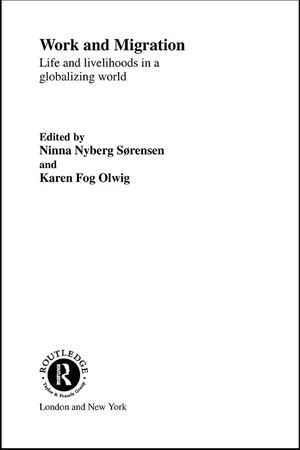
Work and Migration
Life and Livelihoods in a Globalizing World
- 240 pages
- English
- ePUB (mobile friendly)
- Available on iOS & Android
eBook - ePub
About this book
Using case-studies from those who have moved either transnationally or internally within their own country, international contributors offer various definitions of what it means to make a living on the move.
Information
Part I
Mobile livelihoods
Regional and historical perspectives
1 Representing the local
Mobile livelihood practices in the Peruvian Central Sierra
Ninna Nyberg Sørensen
‘I’ll be in Huancayo until Friday’, Guillermo explained, ‘but from Friday I’ll be in the village’. Referring to his rural community of origin, he continued by saying that this was how he lived, acá y allá, in several places: ‘I usually go up once or twice a month, spending more time in the village during the sowing and harvest seasons, and more time in Huancayo the rest of the year’. Like Guillermo, many other ‘rural peasants’ and ‘urban city dwellers’ whom we included in our research on mobile livelihoods prior to, during and after the armed conflict in Andean Peru1 would tell us where they intended to stay for the next few months or so. Sudden or unexpected occurrences would, nevertheless, often change their plans. Like other hyphened populations who challenge the boundaries between the ‘centre’ and the ‘periphery’, appearing one day as professionals or informal street vendors in the city, another day as dedicated comuneros (legitimately recognized members of the community) in the countryside, the women and men we met in Peru during 1999 and 2000 constantly transformed and re-created our notions of mobility and belonging through their everyday livelihood practices. Indeed, as I will argue in this chapter, constant movement between various rural and urban sites has been a central element in their livelihood practices.
Migration is not a new phenomenon in central Peru. Given that Peruvian social science has been influenced by the early work of John Murra and others on livelihood adaptations to the ecological diversity of the Andes from pre-Hispanic times, there has been greater sensitivity to translocal mobility in Peruvian ethnography (cf. Murra 1975; Favre 1977; various contributions in Lehmann 1982)–often studied under the heading of regional identities (Roberts 1974; Long and Roberts 1984)–than one finds elsewhere. Gavin Smith’s discussion of livelihood and resistance in a Peruvian highland community prior to the armed conflict is another good example (Smith 1989). Smith explores confederations of households through which resources dispersed in space are fashioned into family livelihood strategies. Although belonging to a rural community has not always meant being divorced from a specific geographical locality, the institutionalization of migration has meant that the links established between villagers, not just within the rural area but also between the various work centres (both rural and urban), play a major part in how people achieve their identity. Moreover, the social relationships established between dispersed villagers reflect not only the production of a livelihood but also the political protection of its continued reproduction. Finally, and most importantly, as migration became an institutionalized way of life, it acted to select out some villagers for ex-residence while confining others to the village. Given that mobility has been the norm rather than the exception, there is a case for taking Smith’s analysis further and exploring the extent to which rural and urban areas constitute a single space. If so, should movements within a single space be conceptualized as migration? And what happens to such spaces when social inequality and political discontent escalate into armed conflict, as it did in Peru in the early 1980s?
Given that mobility has been a central element in the livelihood strategies of both poor and better-off Andean people, research into the specificities of Andean livelihood practices is central to the analysis of contemporary processes of both rural-urban mobility and the socio-spatial consequences of the civil war that was waged between insurgent groups and the Peruvian military during the 1980s and early 1990s. Although often discussed separately, these two issues are linked. In this chapter I shall therefore explore the historical links between various patterns of displacement and spaces of livelihood practices, and the social institutions and networks that facilitate and sustain these practices.
The discussion is limited geographically to the Central Sierra, and more specifically the urban area of Huancayo (department of Junín) and the rural districts of Vilca and Acobambilla (both in the department of Huancavelica). My theoretical point of departure is that, within the context of everyday life, displacement (defined as coerced or involuntary movement as a result of, or in order to avoid, the effects of armed conflict and situations of generalized violence) may be indistinguishable from migration (defined as ‘voluntary’ migration in search of better living conditions). Not only are both ‘forced’ and ‘voluntary’ mobility characterized by a combination of compulsion and choice: both forms of movement seem to be motivated by a mixture of blocked opportunities, repression, discontent with current livelihood potentials, and aspirations for better futures. In terms of mobility patterns, both groups tend to follow the same ‘routes’, and in the so-called areas of destination, they often live alongside each other.2
At the same time, classification into the categories of ‘internally displaced population’ (IDP) and ‘migrant’ has powerful effects on both formal and informal social organization. Under certain political circumstances, therefore, being defined as respectively a migrant or an IDP may marginalize a group of people, while it, in other circumstances, may provide access to special entitlements or resources (Sørensen and Stepputat 2000; Stepputat and Sørensen 1999). For example, rural-urban migrants have traditionally been marginalized by city dwellers, and throughout the 1980s they were directly subject to state repression (due to their being linked with the Maoist guerrilla movement, Sendero Luminoso). Nonetheless, recognition of the IDP category and the opening up of state-sponsored return or re-population programmes in the mid-1990s (the so-called PAR programmes), including access to emergency aid and development funds, has given rise to new struggles for recognition. But movement is not only imposed from above, it is also induced from below, for example by extending social networks through which the reproduction of social ties, economic organization and politics become transformed.
In the following, I shall focus on a particular mobile livelihood strategy, one that seems to be common to both ‘migrants’ and ‘internally displaced’ persons in the central Peruvian highlands, namely that of forging or sustaining a multiple residence practice. One key objective is to highlight the complicated and often ambivalent relationship between rural points of origin, current urban settlement areas, and different settlement or return strategies. Drawing on the experience of individuals and families who at various times since the early 1950s have left their rural ‘areas of origin’ in the department of Huancavelica and who currently live their lives, or at least part of them, in the city of Huancayo, I shall reflect upon the variety of mobile livelihood practices they employ. The first section provides a broad overview of the Central Sierra region and the historical mobility patterns that Andean peasants practised prior to, during, and after the armed conflict. It also describes the different mobility patterns to be found among migrants and displaced persons in the city of Huancayo, social stratification, and the variety of social relations sustained between rural and urban communities. In the second section, I discuss the outbreak of the civil war and the ways in which the conflict affected mobility in the area. The third section discusses the multi-residence strategy found among migrants and displaced persons alike. To illustrate my point, I describe one particular case of organized return. In the concluding section, I make an attempt to situate these experiences in the broader context of migration.
Establishing mobile livelihoods
Peruvian territory is geographically complex and divided into three major regions: the western coastal plain (la costa), the eastern lowland jungle of the Amazon Basin (la selva), and the high and rugged Andes in the centre (la sierra). For comparative purposes in respect of the history of mobility, it may be useful to provide a few figures. Until the 1940s, approximately 65 per cent of Peru’s population lived in the Andes. At the end of the twentieth century, less than 30 per cent of the total population, which is officially estimated at roughly 24 million, were rural, and the larger cities have grown tremendously (Markwick 1999). This development has generally been portrayed as a threat to stability in which negative images of rural migrants in the city prevail. Following the perspective adopted in this volume, however, mobile livelihoods should rather be understood as being embedded in Andean strategies to sustain a living, as well as in socio-cultural institutions, customs and ideologies.
In the Central Sierra, Huancayo functions as the capital of the Department of Junín. The city is located at an altitude of 3,260 metres in the flat Río Mantaro Valley, one of the most fertile areas of the Central Andes, which supports a large rural population. Being the major commercial centre in the region, Huancayo is of great importance as a market town for the surrounding rural area. For centuries it served as a centro de descanzo entre caminos (a resting place between trips; Manrique 1978), and as an unavoidable crossroads for travelling people, livestock and agricultural products. But it was not until the rapid expansion of commercial agriculture and livestock production in the late nineteenth century that it gained status as a regional centre. Since then, the population has steadily increased, most dramatically during the last ten to fifteen years, in which the city’s population has tripled to close to one million, including the adjoining municipalities of El Tambo and Chilca.3 Today, Huancayo is the third most important city in Peru in terms of transport, trade and production of electricity, and the fifth largest in terms of size. Amongst Huancayo’s newcomers, quite a few originate in the districts of Vilca and Acobambilla. Although these districts belong administratively to the province and department of Huancavelica, distance (in kilometres and accessibility), colonial history (unlike Huancavelica, the location of the infamous mercury mines of the colonial period, Huancayo was never a seat of the colonial administration), cultural belonging (to the Huancayan Wanca Nation as opposed to the Huancavelica Wari Culture),4 and a widespread feeling among the comuneros of having been neglected by the Huancavelica local administration for decades, have all contributed to the creation of an actual feeling of belonging or at least relating to Huancayo.
Forms of mobility
Until around 1980, the only means of transportation in the districts of Vilca and Acobambilla was by foot and/or pack animal. From around 1930, a railroad was built connecting Huancayo and Huancavelica. The nearest station, Tellería, was located some seventeen kilometres north-east of Vilca, and considerably further from Acobambilla. Villagers had to walk or ride the mule path between Acobambilla and Vilca, and from there to Moya, from where they could get a ride to the train station. From the early 1980s, the district of Vilca became connected to Huancayo by road. A road over the high puna was established from Acobambilla to Puente Mellizo in the late 1990s, allowing villagers direct ‘highroad’ access to Huancayo without having to descend to the ‘low-road’ connection from Vilca- a fact of enormous importance, thanks to prevailing racial hierarchies. Communication between the districts or the various villages (anexos and barrios), especially those located higher up, is still by foot or horse. In the rainy season flooding and huaicos (landslides) may block travel by road for weeks.
A poorly developed infrastructure has not prevented villagers from high levels of mobility, especially between the different ecological zones in the district, which are linked to the pasturing of livestock on estancias (pasture land) in the high puna areas, the cultivation of different crops at different altitudes, and attending local and regional markets. Since the turn of the century, villagers have provided labour for the mining industry in Casapalca, Morococha, Huancavelica and La Oroya, and also for various infrastructural developments. From the 1930s, migration to the mining complexes increased, as did temporary migration to more distant places, such as Cañete (the sugarcane plantations and cotton fields on the south coast towards Ica and Pisco), the Ceja de Selva or jungle’s eyebrow (for coffee, plantain and yucca production), and trade in la Selva Central. From the 1950s, migration to Chilca or Huancayo (education, petty trade, domestic service and agricultural labour), and to Lima (primarily to work in the garment industry and poultry farms) became a widespread livelihood strategy, especially among the younger, but still landless villagers.
From this brief sketch a picture emerges of extended spaces of livelihood, maintained through high levels of mobility between subsistence production in different ecological zones, between subsistence and wage work, and between wage work in different localities at different times of the year (in accordance with the agricultural calendar in the different climatic zones in Peru). Temporary migration to the coast, the jungle, the mines and elsewhere has provided the rural population with extra-agricultural incomes, which again have facilitated their maintenance of village life (Favre 1977) as well as their establishing themselves in the city of Huancayo (de la Cadena 1988). The fact that migration to Huancayo has been conditioned not by a demand for industrial labour, but ratherby the possibility ofemploymentin smaller workshops, the informal sector and the surrounding agricultural sector of carrot and potato production further leads de la Cadena to characterize Huancayo as a ciudad de campesinos (a city of peasants; ibid.: 46), that is, a complementary space in which agricultural livelihoods are supplemented with urban lives. Paerregaard has reached a similar conclusion and argues that it is rural–urban interdependence rather than separation that provides the key to understanding the complex, heterogeneous nature of Peruvian society (Paerregaard 1997: 2). Thus, contemporary rural communities in Peru are situated within regional, national, sometimes even transnational or global contexts (see Chapters 5 and 6) that effectively blur the conventional oppositions of rural–urban, traditional–modern, peasant–non-peasant dichotomies on which earlier studies of migration have built.5
Social stratification and mobility
Most Andean rural communities are characterized by social stratification into two social classes: los gamonales or the local landlords, who generally possess more land and livestock than others and act as the intermediaries between the community and the national institutions; and los comuneros, who are generally exploited by los gamonales and often have less or no power or possibility of direct contact with the political centre. This division corresponds to some extent to location in lower or higher zones, the lower zones being the wealthier and more powerful, and has clear origins in the old highland hacienda system (the formal granting of land to Spaniards or highly placed Criollos) and the concentration of ‘Indians’ into village settlements (Smith 1989).
It has clear reference to race too, not least to what de la Cadena has termed ‘silent racism’, a form of social exclusion based on education and intelligence. It is hegemonically inscribed in Peruvian geography, in which a socio-cultural division between gente decente (decent folks from the city) and gente del pueblo (Indian and mestizo Others) is played out. While ‘silent racism’ acknowledges the right of every Peruvian to belong to the nation, it simultaneously positions individuals on a differentiated scale according to their intellectual capacity. It contains a presupposition that educated people are legitimately destined for political leadership, a role Indians are seen as being unable to fulfil, due to their ‘emotional dependence on the old order’ (de la Cadena 1998). Thus races have their proper places. The higher the geographical altitude of origin, the closer one’s ‘natural’ relationship with the soil and with agriculture, and the lower one’s social standing and closeness to Indianness or inferior chuto identity. The lower the geographical altitude of origin, the closer the ‘cultural’ relationship to ‘superior education’, and the higher the social standing and closeness to a new generation of mestizo or cholo identity.6 Rural–urban migration has in principle offered the ‘Indian’ the possibility of social mestizaje or gradual incorporation into the cholo identity through education. The problem is that most professionals who come from Vilca and Acobambilla (and rural communties in general) have had their hopes of social mobility through education disappointed, given the unevenness of academic training in Peru and the racial discrimination that places Serrano students from the interior provinces at an objective disadvantage (Manrique 1998: 199).
For most of the twentieth century, los vilquinos from Vilca proper (the district capital) have played the part of the landowning elite. As well as believing themselves to be whiter and descended more directly from the Spanish than the highlanders, they have exploited people from these higher communities, at times in a servile manner. Being relatively wealthier, they have also been the first to establish themselves in Huancayo.
A larger exodus from the district took place after the earthquake in 1947, which had devastating effects on agricultural outputs for years. But it was ...
Table of contents
- Cover Page
- Title Page
- Copyright Page
- Tables
- Contributors
- Mobile livelihoods: Making a living in the world
- Part I: Mobile livelihoods: Regional and historical perspectives
- Part II: Livelihoods extended
- Part III: Livelihoods and the transnational return
Trusted by 375,005 students
Access to over 1.5 million titles for a fair monthly price.
Study more efficiently using our study tools.
Frequently asked questions
Yes, you can cancel anytime from the Subscription tab in your account settings on the Perlego website. Your subscription will stay active until the end of your current billing period. Learn how to cancel your subscription
No, books cannot be downloaded as external files, such as PDFs, for use outside of Perlego. However, you can download books within the Perlego app for offline reading on mobile or tablet. Learn how to download books offline
Perlego offers two plans: Essential and Complete
- Essential is ideal for learners and professionals who enjoy exploring a wide range of subjects. Access the Essential Library with 800,000+ trusted titles and best-sellers across business, personal growth, and the humanities. Includes unlimited reading time and Standard Read Aloud voice.
- Complete: Perfect for advanced learners and researchers needing full, unrestricted access. Unlock 1.5M+ books across hundreds of subjects, including academic and specialized titles. The Complete Plan also includes advanced features like Premium Read Aloud and Research Assistant.
We are an online textbook subscription service, where you can get access to an entire online library for less than the price of a single book per month. With over 1.5 million books across 990+ topics, we’ve got you covered! Learn about our mission
Look out for the read-aloud symbol on your next book to see if you can listen to it. The read-aloud tool reads text aloud for you, highlighting the text as it is being read. You can pause it, speed it up and slow it down. Learn more about Read Aloud
Yes! You can use the Perlego app on both iOS and Android devices to read anytime, anywhere — even offline. Perfect for commutes or when you’re on the go.
Please note we cannot support devices running on iOS 13 and Android 7 or earlier. Learn more about using the app
Please note we cannot support devices running on iOS 13 and Android 7 or earlier. Learn more about using the app
Yes, you can access Work and Migration by Karen Fog Olwig,Ninna Nyberg Sorensen in PDF and/or ePUB format, as well as other popular books in Politics & International Relations & Politics. We have over 1.5 million books available in our catalogue for you to explore.