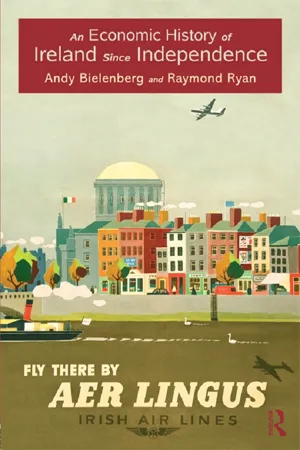
This book provides a cogent summary of the economic history of the Irish Free State/Republic of Ireland. It takes the Irish story from the 1920s right through to the present, providing an excellent case study of one of many European states which obtained independence during and after the First World War. The book covers the transition to protectionism and import substitution between the 1930s and the 1950s and the second major transition to trade liberalisation from the 1960s. In a wider European context, the Irish experience since EEC entry in 1973 was the most extreme European example of the achievement of industrialisation through foreign direct investment. The eager adoption of successive governments in recent decades of a neo-liberal economic model, more particularly de-regulation in banking and construction, has recently led the Republic of Ireland to the most extreme economic crash of any western society since the Great Depression.
- 282 pages
- English
- ePUB (mobile friendly)
- Available on iOS & Android
eBook - ePub
An Economic History of Ireland Since Independence
Part I
1 From dependent free state to
EEC member–state
Economic policies 1922–73
The Irish Free State acquired full fiscal autonomy from the United Kingdom (UK) as a consequence of the Treaty signed in December 1921. This enabled the new state to pursue independent trade and fiscal policies that came into effect from 1 April 1923, with the first tariffs introduced that year. Gradually more were added so that by 1931 there were 59 categories of goods subject to duty, which influenced the development of certain industrial sectors. There was a greater degree of continuity with pre-independence monetary arrangements. The pro-Treaty Cumann na nGaedheal government relied strongly on the economic establishment for political support. Although tariffs and customs duties were introduced on certain goods entering Ireland from the UK, the trading, financial and farming establishment sought continuity and opposed any prospect of wide-scale protectionism, which they feared would raise costs and reduce trade. Irish trade was conducted predominantly with the UK; the labour and capital markets in both countries were strongly integrated. Significantly, interest rates in Ireland continued to be governed by the London bank rate; the major Irish banks established a standing committee in 1920, which set overdraft and deposit rates with reference to British rates. The Irish banks assumed that if domestic interest rates were set lower than British rates funds would be re-deposited in the UK.1
The hallmark of policy relating to monetary, banking and currency issues in the inter war years was caution. There was a general reluctance to change the traditional relationship between the Irish banks and the UK, where they invested a significant share of their balances in the London money market. Continuity was reassuring for business and trade, particularly for Anglo-Irish interests within the new state. The Bank of Ireland retained its predominant position within the Irish banking sector, having already acted as a financial agent for the provisional government on the one hand, while simultaneously retaining many aspects of its special relationship with the Bank of England that lasted until the eve of the Second World War. It was only deemed necessary to establish the Central Bank in 1942.2
The Currency Commission was brought into being by the Currency Act of 1927, which marked the first tentative step towards central banking. The formation of the commission had been recommended by the Parker-Willis Commission in 1926. The Currency Commission, chaired by Joseph Brennan, who had previously served as Secretary of the Department of Finance,3 produced and managed the new currency, the Irish pound. As a consequence the new state acquired seigniorage and the new currency accounted for about two thirds of legal tender by the end of the 1930s. The Irish pound remained firmly linked to sterling, which linked it in turn to the Gold Standard until sterling went off it in the 1930s, even though the government held no gold reserves. Essentially, the Irish pound was backed by sterling assets, which were sufficient to meet any potential demands on the currency until 1955. The economic advantage of this arrangement was that sterling was a relatively stable currency. Moreover, it was highly convenient since most Irish trade and external transactions took place within the sterling area.4
The Irish Department of Finance after 1922 was closely modeled upon the system of administration of the British Treasury; it had premier position within the civil service that subsequently emerged within the new state, retaining control of the financial activities of all other departments. Arguably these traits, inherited from its predecessor, were highly negative, inhibiting developmental innovation in the new state. The fundamental principles of the British financial system were adopted and the new government seldom questioned the decisions made by the Department of Finance, which advocated rigid economy in all areas. However, the department failed to block the Shannon Hydro-electricity Scheme, the largest capital investment by the state during its first 40 years. Finance ultimately had to conform to the government's decision to proceed with the scheme.5 But this was one of the few exceptions to the general pattern.
In the immediate aftermath of independence, some strong protectionist advocates emerged in the Department of Industry and Commerce, including its Secretary, Gordon Campbell. Not only did he argue for a protectionist policy to encourage industrial development; he was of the opinion that an exclusive reliance on agriculture had a detrimental effect on the economic and social progress of the nation.6 Campbell's concept of industrial development was radical and anticipated policies that were to be implemented many years later. Rather than developing heavy industry, Campbell argued that the Irish Free State should develop sectors in advanced technological areas. To this end, he argued that foreign investment should be encouraged and technological skills should be developed within the education system.7 But the Department of Industry and Commerce had little success in changing the general stance of government economic policy. The departure of Joe McGrath as Minister for Industry and Commerce in 1924, followed by the resignation of J. J. Walsh as a minister in 1927 reduced potential support for a more developmental approach to industrial policy.8 However, selective tariff measures in certain industries had resulted in new British investment in the Irish Free State, often by companies who wished to defend or expand their existing interests in the Irish market. As a result, the tobacco sector was largely in British control by the end of the 1920s, with companies such as Wills establishing branch factories in Dublin; Lever Bros had taken over much of the soap industry through takeovers of native firms and about half of all output in the confectionary sector was produced by British companies.9 The early influence of the state in such developments through customs and excise duties and tariffs should not be overlooked as it was already shaping the pattern of development in certain industries, such as tobacco.
Nonetheless, nationalist developmental polices made limited initial advances against the weight of traditional economic thought. Classical economic theory, as evident in the report of the Fiscal Inquiry Committee of 1923, the Agricultural Commission of 1924 and the 1926 Parker-Willis Commission on the banking system, recommended the continuation of free trade. Government institutions, influenced by British practices, emphasized fiscal rectitude and a broadly orthodox approach, which was all firmly underwritten by the Department of Finance.10 Coleman and Considine observe that ‘the desire to impress British doubters of the Irish capacity for self-development and to reassure skeptical British and Anglo-Irish observers of the attitude of the infant government’ reinforced a cautious approach to economic policies.11
Cumann na nGaedheal fiscal policy was based on indirect taxation; namely excise duties on alcoholic beverages and other mass consumption items such as tobacco, which were broadly regressive in nature, since lower income groups spent a relatively higher share of household income on these items. The government had to fund the costs of Civil War damages and compensation claims arising from distress suffered during the War of Independence.12 Yet this was offset by some advantages. The Irish Free State's external liabilities were removed in 1926, as a consequence of the agreement reached with the British government concerning the Boundary Commission (which had been established as part of the Treaty agreement in order to revise the boundaries between the Irish Free State and Northern Ireland). The Irish Free State was at that point relieved of its share of the British National Debt. Moreover, overseas assets held by Irish citizens amounting to some £200 million yielded some income from abroad, which was augmented by emigrants’ remittances, assisting the balance of payments.13
Despite adherence to conservative macro-economic policies and a professed commitment to laissez-faire, Cumann na nGaedheal intervened in the economy in a number of ways; the Dairy Disposal Company (DDC), which contrary to popular opinion was the first semi-state company established in 1927 (a few hours prior to the Electricity Supply Board (ESB), was given the responsibility of rationalizing the dairy sector and reducing the number of creameries. Other examples of intervention included legislation in 1924 that forced the amalgamation and restructuring of all the hard-pressed railway companies into the Great Southern Railway (GSR) and subsequent acts passed in 1927 permitting railways and tramways to operate road services, with the GSR taking over the Irish Omnibus Company in 1929.14 Intervention was also evident in the imposition of experimental tariffs and the continuation of land reform. The formation of the ESB as a semi-state company provided a template for many state enterprises subsequently; by the early 1960s there were no less than 55 semi-state companies. These pioneering interventions were indicative of a rather reluctant commitment towards developmental policies in the early years of the Irish Free State,15 with the Department of Finance using its powers to quash many potential initiatives that might incur short-term costs to the state, but could have been of long-term economic value.
The prevailing ideology of the new state in the 1920s strongly supported the family farm as the basis of social stability, with the objective of having as many people engaged in the agricultural sector as possible. The policy of land transfer to occupying tenants (under the land acts passed since the 1880s) continued with further land legislation passed in 1923. This earlier initiative indicated that land reform was an important priority for the government, with some allowance in the 1920s made for stud farms and larger farms that provided significant employment. The new regime gave priority to the improvement of agriculture for export as it was believed that the well being of the rest of the economy depended on the income of the farming community...
Table of contents
- Cover Page
- Half Title page
- Series page
- Title Page
- Copyright Page
- Contents
- List of Tables
- Acknowledgements
- List of abbreviations
- Introduction
- Part I
- Part II
- Part III
- Statistical appendix
- Notes
- Bibliography
- Index
Trusted by 375,005 students
Access to over 1.5 million titles for a fair monthly price.
Study more efficiently using our study tools.
Frequently asked questions
Yes, you can cancel anytime from the Subscription tab in your account settings on the Perlego website. Your subscription will stay active until the end of your current billing period. Learn how to cancel your subscription
No, books cannot be downloaded as external files, such as PDFs, for use outside of Perlego. However, you can download books within the Perlego app for offline reading on mobile or tablet. Learn how to download books offline
Perlego offers two plans: Essential and Complete
- Essential is ideal for learners and professionals who enjoy exploring a wide range of subjects. Access the Essential Library with 800,000+ trusted titles and best-sellers across business, personal growth, and the humanities. Includes unlimited reading time and Standard Read Aloud voice.
- Complete: Perfect for advanced learners and researchers needing full, unrestricted access. Unlock 1.5M+ books across hundreds of subjects, including academic and specialized titles. The Complete Plan also includes advanced features like Premium Read Aloud and Research Assistant.
We are an online textbook subscription service, where you can get access to an entire online library for less than the price of a single book per month. With over 1.5 million books across 990+ topics, we’ve got you covered! Learn about our mission
Look out for the read-aloud symbol on your next book to see if you can listen to it. The read-aloud tool reads text aloud for you, highlighting the text as it is being read. You can pause it, speed it up and slow it down. Learn more about Read Aloud
Yes! You can use the Perlego app on both iOS and Android devices to read anytime, anywhere — even offline. Perfect for commutes or when you’re on the go.
Please note we cannot support devices running on iOS 13 and Android 7 or earlier. Learn more about using the app
Please note we cannot support devices running on iOS 13 and Android 7 or earlier. Learn more about using the app
Yes, you can access An Economic History of Ireland Since Independence by Andy Bielenberg,Raymond Ryan in PDF and/or ePUB format, as well as other popular books in Business & Business generale. We have over 1.5 million books available in our catalogue for you to explore.