eBook - ePub
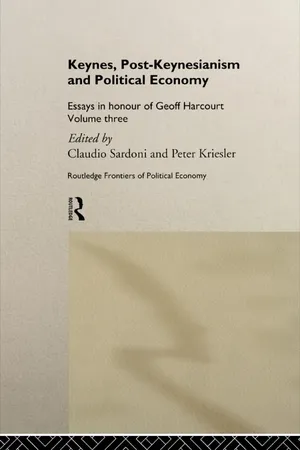
Keynes, Post-Keynesianism and Political Economy
Essays in Honour of Geoff Harcourt, Volume III
- 560 pages
- English
- ePUB (mobile friendly)
- Available on iOS & Android
eBook - ePub
Keynes, Post-Keynesianism and Political Economy
Essays in Honour of Geoff Harcourt, Volume III
About this book
Geoff Harcourt has had a major impact on the field of Post-Keynesian economics, not only in his research but also in his teaching. Many of Harcourts students have gone on to make valuable contributions in this field. This volume brings together contributions from thirty such former students, now established in academic institutions around the world
Part I
HISTORY OF POLITICAL ECONOMY AND METHODOLOGY
1
MANUFACTURING THE SMITHIAN PARADOX OF VALUE
Michael V.White
INTRODUCTION
It has been suggested that paradoxes, which economists regard as puzzling outcomes, can be understood as ‘a normal aspect of ongoing inquiry’ in that they act as a ‘stimulus to further research’. An illustration of this process is provided by the water and diamonds paradox, 1 which Adam Smith presented in the Wealth of Nations as a rhetorical paradox, a device where ‘terminological fuzziness…[is used] to excite puzzlement and interest in the reader’ (De Marchi 1987:796 – 7). This characterisation of the significance of Smith’s paragraph is consistent with the approach taken by those historians of economics who depict the paradox as providing ‘the starting-point for the theorising of economists of the later nineteenth century which finally led to the marginal utility doctrine’ (Roll 1966: 156).
A synthesis of accounts which argue that the paradox was a, if not the, crucial explanatory factor in explaining the advent of the (British) ‘marginalist revolution’, might read as follows. Until 1871, the explanation for the ‘discrepancy’ between value in use and value in exchange remained a mystery because the classical economists were ‘incapable’ of resolving it (Ekelund and Hebert 1990:107). Smith was actually ‘puzzled’ by his own statement 2 and, ‘hampered’ by a failure to use the calculus, he and the Classical school were unable to grasp that the correct solution required a distinction between the marginal and total valuation of a commodity (ibid.: 161, 325; also Galbraith 1989:65). Without that solution, Smith effectively set aside any discussion of value in use and hurried on to ‘explain only’ the determination of exchange value (Roll 1966:156; also Schumpeter 1963: 300; Galbraith 1989:66; Ekelund and Hebert 1990:107). Unable to understand the ‘existence and significance’ of marginal valuations (Ekelund and Hebert 1990:107), other pre-marginalist economists concentrated on ‘costof production as the explanation of price’ (Cooter and Rappoport 1984: 510). Although a basis for the solution was suggested early in the nineteenth century by Jeremy Bentham (Hutchison 1956) and Nassau Senior had the ‘key’ to the solution ‘in his grasp’ (Ekelund and Hebert 1990:161), it was generally ‘puzzled over for nearly a hundred years in the economics literature’ (Schmidt 1992:1). The denouement came in 1871 when William Stanley Jevons finally ‘unlocked’ the paradox with the distinction between marginal and total utility in his Theory of Political Economy (Ekelund and Hebert 1990:358; also Cooter and Rapport 1984:510). 3
This synthesis would not, of course, command universal assent by historians of economics, 4 even by those who accept that a paradox existed before the publication of Jevons’ Theory. Indeed, it has been argued recently that, because Jevons did not discuss the issue until the second edition of his Theory in 1879, the paradox ‘figured only indirectly in the conceptual genesis’ of the marginal utility theory. Nevertheless, the treatment of water and diamonds in premarginalist texts is still depicted as a ‘longstanding anomaly’ or ‘paradox’, a ‘formal solution’ for which was only provided by Jevons (Schabas 1990:23 – 4, 146). In common with the histories it effectively criticises, this account assumes that there was a general uniform or stable reading of the Wealth of Nations paragraph as a paradox which could not be explained.
The principal purpose of this chapter is to show that there was no such stability before 1871. The lack of stability can be demonstrated in two ways. First, as explained in the next section, those economists who accepted Smith’s distinction between value in use (VIU) and value in exchange (VIE) did not regard it as a paradox. Nor did their use of the ‘Classical’ definition of utility, which underpinned the distinction, prevent them from providing an explanation for the relative prices of commodities such as water and diamonds. It was possible, moreover, to present the distinction between VIU and VIE as compatible with two different general explanations of prices—one based on ‘cost of production’ and the other based on ‘scarcity’ (the latter argument is often regarded as a forerunner of marginalist theory). The second reason for the lack of stability, considered in the third section, is that there was significant dissent from the terms of Smith’s discussion, especially regarding the definition of utility. Again, however, there was no mention of a paradox. Instead, the most influential variant of the critique argued that Smith’s discussion was incoherent.
The appearance of the paradox is explained in the final section, which shows that, in the first (not the second) edition of his Theory, Jevons argued that Smith’s distinction between VIU and VIE could be read in terms of the difference between total and marginal utility. While this account was consistent with the redefinition of utility by Smith’s critics, it was also quite different. For it depended upon a theory of human action which was only produced after 1850. Moreover, rather than reading Smith as incoherent,Jevons then presented him, for the first time, as outlining a ‘paradox’. The stabilisation of Smith’s discussion as the classical paradox of value was thus an artefact of British marginalism.
WHAT PARADOX?
In texts of political economy, a distinction between the usefulness or value of commodities (where they were graded in terms of the ‘real’ or ‘intrinsic wants of mankind’) and their value in exchange as price, was made by Barbon and Locke in the late seventeenth century. While their discussion could draw on a much older literature concerning use and price, 5 they were followed by Mandeville and Jocelyn early in the next century, the latter using water and diamonds as examples. The same example to illustrate a distinction between VIU and VIE can be found in Money and Trade Considered (1705) by John Law and An Essay on Money and Coinage (1757) by Joseph Harris. 6Adam Smith had both texts in his library and used that example in his Lectures on Jurisprudence delivered in the 1760s, where he argued that the difference in the prices of water and diamonds could be explained by their relative abundance or scarcity (Smith 1978:333 – 4, 487).
In the Wealth of Nations (WN), having considered how ‘money has become in all civilised nations the universal instrument of commerce’, Smith posed the question of ‘what rules determine what may be called the relative or exchangeable value of goods’ (Smith 1976:44). He then observed, in the passage which was subsequently read as the classic statement of the diamonds and water paradox, that
The word VALUE…has two different meanings, and sometimes expresses the utility of some particular object, and sometimes the power of purchasing other goods which the possession of that object conveys. The one may be called ‘value in use’; the other, ‘value in exchange’. The things which have the greatest value in use have frequently little or no value in exchange; and, on the contrary, those which have the greatest value in exchange have frequently little or no value in use. Nothing is more useful than water; but it will scarce purchase anything; scarce anything may be had in exchange for it. A diamond, on the contrary, has scarce any value in use; but a very great quantity of other goods may frequently be had in exchange for it.
(ibid.: 44 – 5)
Smith then indicated that the analysis which followed was concerned with identifying ‘the principles which regulate the exchangeable value of commodities’ (ibid.: 46). His reference to VIU and VIE was thus ‘solely tobring out’ rather than to ‘establish any distinction between the two’, let alone to state a ‘paradox’ (Kaushil 1973:61n). 7 This point is reinforced by Smith’s subsequent comment that the prices of precious metals, such as gold, were due to their utility, their beauty and their scarcity, while the demand for precious stones depended on their beauty: They are of no use, but as ornaments; and the merit of their beauty is greatly enhanced by their scarcity or by the difficulty and expense of getting them up from the mine.’ Indeed, the prices of precious stones and metals ‘is regulated all over the world by their price at the most fertile mine in it’ (ibid.: 189 – 91; also 563). This reference and other passages in WN indicate that Smith used the word ‘utility’ and hence defined VIU by referring to a hierarchical ranking of commodities in terms of their relative importance in meeting ‘the wants of mankind’. 8 With the hierarchy characterised in terms of necessaries, conveniences and luxuries, it formed the basis for the Classical definition of utility which Malthus summarised as the ‘quality of being serviceable or beneficial to mankind. The utility of an object has generally been considered as proportional to the necessity and real importance of these services and benefits’. Malthus did note that, with VIU considered as ‘synonymous with utility’, confusion was possible over the meaning of value so that the term VIU ‘rarely occurs in political economy, and is never implied by the word value when used alone’ (Malthus 1963:234 – 5; see also McCulloch 1864:3, 4). Nevertheless, the distinction between VIU and VIE was important because it could be used to compare ‘that which is useful and that which is merely high-priced…that which is calculated to satisfy the acknowledged and general wants of mankind, and that which may only be calculated to satisfy the capricious wants of the few’ (Malthus 1963:19).
Ricardo had used the same reading in his Principles, which began by registering agreement with Smith on the distinction between VIU and VIE (Ricardo 195la:11 – 12). The distinction is evident in his subsequent comment that the ‘benefits of commerce’ lay in the acquisition of ‘not more valuable objects, but more useful ones’ (ibid.: 264n) and was particularly important in Chapter 20 where J.B.Say (see below) was criticised for effectively conflating the analysis of ‘riches’ or wealth with VIE by arguing that VIE ‘is the measure’ of a commodity’s utility (ibid.: 282). For Ricardo, if a change in the technique of production meant that two sacks of corn, instead of one, could be produced with the same labour input, their value would be unchanged while there would be ‘double the quantity of riches—double the quantity of utility—double the quantity of what Adam Smith called value in use, but not double the quantity of value’ (ibid.: 281; see also 283). Malthus applauded Ricardo’s critique of Say’s explanation of riches and value despite his strong disagreement with Ricardo’s use of a labour theory of value (evident in the quotation above) to explain the long period or natural prices of commodities. 9
Ricardo’s analysis of natural prices provides one example of the differentexplanations of commodity prices which were considered compatible with the distinction between VIU and VIE. For Ricardo, utility (VIU) was an ‘absolutely essential’ precondition, but could not be a determinant of VIE because the natural prices of commodities were determined either by their ‘scarcity alone’ or by ‘the quantity of labour required to obtain them’. He restricted the commodity domain in the Principles to the latter group, on the ground that ‘[b]y far the greater part of those goods which are the objects of desire, are procured by labour’ (Ricardo 1951a:11 – 12). The domain restriction can explain why there was no discussion of the VIE of water in the Principles. Ricardo followed Smith in assuming that, ‘under ordinary circumstances’, water had no price (ibid.: 11, 287) and, elsewhere, posed the rhetorical question, ‘Why is water without value, but because of its abundance?’ (Ricardo 1951b:221). The absence of discussion of a price for water in the Principles can thus be explained by its categorisation as scarcity-determined. It is possible that Ricardo regarded diamond prices as determined in the same way. This is, of course, a different matter from claiming that he was puzzled by their relative prices. 10
The difficulties which Ricardo acknowledged with a simple labour theory of value were brushed aside by J.R.McCulloch (cf. McCulloch 1864:274) and his explanation of long period prices differed significantly from Ricardo’s.11 Nevertheless, as late as the fifth edition of his Principles, McCulloch kept to the distinction between VIE and VIU, which he illustrated with water and gold prices. Water was ‘indispensable to existence, and has, therefore, a high degree of utility, or of “value in use”’, but a low VIE ‘in most places’ because of the small extent of labour or ‘exertion’ required to obtain it. Gold had a comparatively high VIE because, although ‘of little utility’, it existed ‘in limited quantities’ and required much labour and exertion to obtain it (ibid.: 3, 4). For McCulloch, it was possible to explain a positive price for water by reference to ‘cost of production [which] is the grand regulator of price’ (ibid.: 252 OE).12 William Whewell then produced an account which seems generally consistent with McCulloch’s, in that he argued that market prices were explained by supply and demand, while the long period prices of most commodities were governed by their cost of production (Whewell 1971:8 – 10; 1862:44 – 52). After quoting Smith on water and diamonds in his Lectures on Political Economy delivered at Cambridge in 1861, Whewell argued that, given an article was useful or provided ‘enjoyments’, its VIE depended on whether its ‘procurement’ required ‘the labour of man’ to produce it:
Utility may therefore be considered as the sole cause of value in use, whilst value in exchange may be produced by any circumstance which renders the possession of an object so difficult of attainment, and at the same time so desirable, that men are willing to give something in exchange for it. Thus not only utility but beauty, curiosity,fashion, rarity, and many other qualities may create exchangeable value; and it is to this value that, in political economy, we chiefly confine our attention.
(Whewell 1862:47 – 8 OE)13
Other explanations for price formation were considered compatible with Smith’s distinction between VIU and VIE. In his 1846 and 1847 Oxford lectures, for example, Travers Twiss referred to the distinction and then described the ‘principles…[which] regulate the exchangeable value of commodities’ with what appears to be a simplistic adding-up theory (Twiss 1847:166 – 7). More striking was the way that Richard Whately’s Easy Lessons rejected McCulloch’s argument that cost of production was the grand regulator of price and yet still accepted the distinction between VIU and VIE. Whately noted that it was necessary to distinguish between whether a commodity was ‘useful’ and whether it had ‘value’ in exchange (Whately 1853:27 OE). VIE required that an article be an object of ‘desire’ and that it be exchangeable, so that its owner ‘can part with’ it. The principal determinant of VIE was, however, the ‘scarcity’ of a commodity, that is, whether it was ‘limited in supply, [so] that it is not to be had for nothing’. While a pearl or a diamond was of ‘great value’ because it was ‘scarce…very beautiful’ and constituted ‘a sign of wealth’, it was ‘of no use but to make an ornament for a person’ (ibid.: 27, 28, 29, 30 OE). However, while the scarcity of a commodity could be equated to a large extent with the labour cost of its acquisition, labour did not create value. It was the high price which ‘causes’ people to labour:
It is not…labour that makes things valuable, but their being valuable that makes them worth labouring for. And God, having judged in his wisdom that it is not good for man to be idle, has so appointed things by his Providence, that few of the things that are desirable can be obtained without labour. It is ordained for man to eat bread in the sweat of his face; and almost al...
Table of contents
- Cover Page
- Title Page
- Copyright Page
- Illustrations
- Contributors
- Foreword
- Introduction
- Part I: History of Political Economy and Methodology
- Part II: Economic Theory and Applied Analysis
Trusted by 375,005 students
Access to over 1.5 million titles for a fair monthly price.
Study more efficiently using our study tools.
Frequently asked questions
Yes, you can cancel anytime from the Subscription tab in your account settings on the Perlego website. Your subscription will stay active until the end of your current billing period. Learn how to cancel your subscription
No, books cannot be downloaded as external files, such as PDFs, for use outside of Perlego. However, you can download books within the Perlego app for offline reading on mobile or tablet. Learn how to download books offline
Perlego offers two plans: Essential and Complete
- Essential is ideal for learners and professionals who enjoy exploring a wide range of subjects. Access the Essential Library with 800,000+ trusted titles and best-sellers across business, personal growth, and the humanities. Includes unlimited reading time and Standard Read Aloud voice.
- Complete: Perfect for advanced learners and researchers needing full, unrestricted access. Unlock 1.5M+ books across hundreds of subjects, including academic and specialized titles. The Complete Plan also includes advanced features like Premium Read Aloud and Research Assistant.
We are an online textbook subscription service, where you can get access to an entire online library for less than the price of a single book per month. With over 1.5 million books across 990+ topics, we’ve got you covered! Learn about our mission
Look out for the read-aloud symbol on your next book to see if you can listen to it. The read-aloud tool reads text aloud for you, highlighting the text as it is being read. You can pause it, speed it up and slow it down. Learn more about Read Aloud
Yes! You can use the Perlego app on both iOS and Android devices to read anytime, anywhere — even offline. Perfect for commutes or when you’re on the go.
Please note we cannot support devices running on iOS 13 and Android 7 or earlier. Learn more about using the app
Please note we cannot support devices running on iOS 13 and Android 7 or earlier. Learn more about using the app
Yes, you can access Keynes, Post-Keynesianism and Political Economy by Peter Kriesler,Claudio Sardoni in PDF and/or ePUB format, as well as other popular books in Business & Business General. We have over 1.5 million books available in our catalogue for you to explore.