![]()
1 The Conceptual Framework
Lorena Ruano
INTRODUCTION
This chapter establishes the conceptual framework that constitutes the basis for the case studies that follow in this book. It also addresses some important methodological issues concerning the research design. To do so, it is divided into four sections. The first one builds from the literature on Europeanization a typology that distinguishes three types of relations between policies at the EU and the national levels, “upload,” “download,” and “sideways” or “crossload,” and analyzes each one in turn. The second section discusses the object of analysis, European foreign policy, and points out some special characteristics of that policy area that need to be factored into the analytical framework, in particular its multisectoral nature. Section three presents the variables to be taken into consideration by the case studies as possible causes of Europeanization of each type, and derives working hypotheses to facilitate a structured comparison. This should help to understand why one type of Europeanization predominates over others in each case. The fourth section addresses some methodological issues of the research design, such as case selection and time framing, and explains how this study intends to deal with them. The chapter concludes that relations with Latin America constitute a promising area to do comparative work on the Europeanization of foreign policy.
EUROPEANIZATION: UPLOAD, DOWNLOAD, AND SIDEWAYS POLICY TRANSFERS
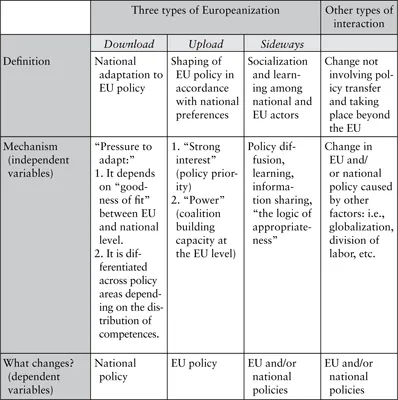
It can be argued that the literature on Europeanization has identified three broad types of policy transfer between the national and the EU levels. Depending on the direction of such transfer, they have been labeled upload, download, and sideways (or crossload) Europeanization. These are summarized in Table 1.1, and will be explained in turn.
The starting idea of the concept of Europeanization was what Börzel called download.1 This is the most widely known definition of Europeanization,
Table 1.1 Types of Interactions between Policies at the EU and National Levels
generally used to guide case studies on national adaptation to EU policy. According to Green Cowles et al., as the EU layer of institutions expands and thickens upon national states, it puts “pressure” on domestic structures and/or policy areas to adapt.2 The extent of this “pressure to adapt” is determined by the “goodness of fit” between the national existing policy and the one existing at the EU level. The precise outcome is modulated by “mediating factors” situated at the domestic level, such as the number of veto points, the existence of “facilitating institutions” and a “cooperative culture.” Outcomes are highly differentiated across member states, because “previously existing policies” and “mediating factors” situated at the national level exhibit a great deal of variation. Therefore, it is important to stress here that Europeanization does not necessarily lead to convergence.3
For the purposes of this book, this concept highlights that member states have had very different tasks in front of them when adapting their national policies towards Latin America to EU policy. For example, after the Mediterranean EEC enlargement of the 1980s, it was more of a challenge for Spain to adapt to an EEC trade policy that discriminated against Latin America than for Greece or Portugal, because Spain's “national pre-existing policy” had a “bad fit” with that of the Community, because it traded considerably with that region before accession. In contrast, the other two new member states had almost no trade relation with it.
A key criticism to this “top-down” approach has been that it assumes something called “EU policy” exists independently of the member states that have to adopt it. However, this is only the case for states before their accession to the EU. Indeed, joining the EU and adopting its acquis communautaire is the process of download par excellence. Thus, this meaning of Europeanization has been suitable to study the EU's most recent enlargement to Central and Eastern Europe, as new member states had to adopt the acquis communautaire through internal reforms which started even before accession.4 However, as is well known, when states are already part of the EU, they constantly try to shape its policies, in order to make them “fit better” with their national preferences and previously existing policies.5 That is a second type of Europeanization called upload that the conceptual framework of this book takes into account (see Table 1.1). Even though EU policies are the result of compromise and often look like a “patchwork,” assembling a variety of national styles,6 the fingerprints of some member states are all over certain EU policies. Such is the case of the French and the Common Agricultural Policy (CAP), or Germany and Monetary Union. In the case of policy towards Latin America, Spain has certainly been the main force behind it since its accession to the EEC, projecting its policy preferences into the EU arena.7
Actually, it is those member states whose national pre-existing policies have a “bad fit” with those of the EU (and therefore, have more difficulty in downloading it), that have more incentives to try to change EU policy, by uploading their preferences. Conversely, for those member states that have managed to upload their preferences at the EU level, subsequent downloading should be easier, in principle. Europeanization is therefore a dynamic process that is composed of both downloads and uploads.8 For this reason, it is important to include in our conceptual framework this second type of interaction between national and EU policies (see Table 1.1).
These two definitions of Europeanization have been criticized, in turn, for their “verticality.” Radaelli has argued that they do not allow space for a more diffuse approach to policy transfer, thus adding a third conceptualization: “sideways Europeanization” or crossload.9 This relates to mechanisms of learning and socialization among member states and European institutions' officials that might lead to policy convergence, or at least, awareness of what other partners are doing (see Table 1.1). Decisions made at the state level are becoming more dependent on collective positions that, in addition to countries' specific interests, are shaping national foreign policy platforms.10 Indeed, some of the case studies developed in this project show that national policy-makers look at what other member states are doing with regard to Latin America when drafting their own policy papers (see the chapters on Germany and Sweden in this volume). This kind of Europeanization introduces a more agency centered approach, than the previous two, which emphasize structural factors.
Although these three types of Europeanization are intimately linked, they entail processes that need to be separated conceptually, as each has specific causal mechanisms (summarized in Table 1.1). Not surprisingly, there is a debate about whether it is appropriate to use the same term to describe such different things. Yet, in reality, EU and national policies are mutually constitutive, so it would be inappropriate to use different terms. Therefore, it is important to establish precise guidelines for accurate analysis in order to keep this commonly accepted nomenclature, while keeping conceptually separate the different types of processes that are involved in Europeanization. In the second section of this chapter, the mechanisms behind each type of Europeanization are discussed and explained in greater detail.
Finally, due to the multiplicity of relations and processes intervening in foreign policy-making at the national and European levels, there is a wide array of interactions that are not Europeanization, but which must, nevertheless be acknowledged. These “other forms of interaction” (see Table 1.1) form a separate category which encompasses various diverse processes. In this study, for example, a certain “division of labor” between the EU and national institutions (or among member states) stands out. Many of the authors in this book mention that a sort of “outsourcing” has occurred, by which member states have delegated certain tasks to the EU completely and disengaged their national authorities. Other examples are provided by certain processes of policy convergence and norm diffusion which have not originated in the EU, but in other fora, such as the UN (United Nations), the OECD (Organization for Economic Cooperation and Development), or the Socialist International. In this book we argue that these “other” types of policy interactions should not be ignored, but must be kept conceptually separate from Europeanization as they do not entail policy transfers to and from the EU.
Having outlined the three types of Europeanization that constitute the building blocks of our conceptual framework, the following section turns to the particular policy that will be the object of analysis: foreign policy.
EUROPEAN FOREIGN POLICY
The use of the term “European foreign policy” is relatively recent, because, for a long time in the history of European integration, foreign policy was strongly guarded within the national remit by member states concerned about its implications for national sovereignty. The first efforts from EEC member states to establish common positions towards certain external issues started in the 1970s. The civil wars in Central America were, in fact, amongst such issues.11 These coordination efforts became known as EPC. However, the use of the term “foreign policy” remained anathema at the EEC level, and developed only with the set up of the CFSP with the Maastricht Treaty in 1992. From then on, the academic literature on European foreign policy concentrated for a long time almost exclusively on CFSP, especially on how its intergovernmental nature made it ineffective.12 Other aspects of the EU's relations with the outside world, known as “External Relations” and under the remit of the European Commission, were kept officially and conceptually separate.
More recently, scholars have agreed that, to gain a better understanding of what Europe does in the international arena, it is necessary to go well beyond CFSP. There is a growing interest in including “External Relations” and other links, especially those related to humanitarian aid, bilateral and regional trade negotiations, the environment, and even Justice and Home Affairs.13 Furthermore, some authors like Hill have insisted that it is impossible to understand what the EU does abroad without at least a cursory look at its member states' foreign policies.14 These arguments have contributed to a long debate on what kind of international actor the EU is, and on whether the tools of f...