- 276 pages
- English
- ePUB (mobile friendly)
- Available on iOS & Android
eBook - ePub
About this book
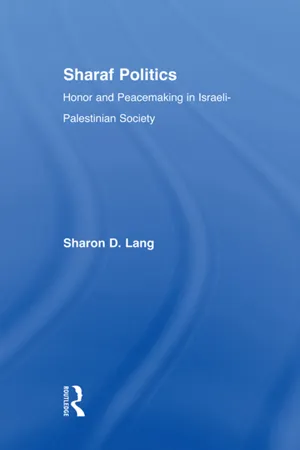
This book examines the Arabic conflict resolution method known as "sulha." In this process, notable male elders mediate conflicts between and within Arab communities. A lengthy process of political jockeying culminates in a ceremony that peaks when "enemies" shake hands and publicly forgive the crimes of the other. The reality of actual sulha deviates considerably from the ideal, but both the official framework and the actual events point to a deep seated valorization of peace and reconciliation in Israeli-Palestinian society.
Chapter One
Entering the Community
While a graduate student in Social Anthropology and Middle Eastern Studies at Harvard in the mid-1990s I received a grant to enroll in an overseas program and study Arabic at Haifa University in Israel. On my arrival I was surprised to find out that in fact there were no Arabic classes being offered. Such courses were listed in the catalog, and prior to my arrival, I had been told they would be available. Apparently, however, there had been some miscommunication and the staff now explained to me that no foreigner had ever registered for this program with the intention of studying the Arabic language. The administrators automatically enrolled me in an ulpan, a course of intensive study of Hebrew, and tried to place me with Israeli students being taught Arabic through Hebrew instruction.
Only after much insisting on my part, did the director agree to hire an Arabic tutor (whose main abilities turned out to be gorging food and ogling blondes). I did not learn much Arabic from him, however, I did learn a considerable amount of Hebrew and spoken Arabic that year,1 mostly from the Israeli friends I made, and I took advantage of my time in Israel to travel around to Palestinian communities in the region. People in this region were so uniformly welcoming, generous, and open with personal discussions that it made fieldwork very feasible. These initial explorations or “field investigations” were the preliminary endeavors that expanded into three years of living in the Middle East and ultimately the writing of this book.
Before embarking on that year-long program in Haifa, I had spent the previous summer in Jerusalem and at the time initiated doctoral research on the Islamic Movement inside of Israel. To that end, I had forged contacts in Kufr Kana, an Islamic stronghold, attended various local events, and informally interviewed residents. I was interested in better understanding the nature and force of the Islamic Movement inside of Israel, given that Israel is about one-fifth Arab, most of whom are Muslim and some of whom fiercely support the Islamic political parties. The Islamic Movement, however, was a highly sensitive subject to be asking questions about at that time. In December of the previous year, the Israeli government had rounded up 415 alleged Hamas activists whom they identified as “terrorists” and deported them to the Lebanese border zone (see e.g., Kristiansen 1993:9-10). No warnings were given to the deportees, no trials held. Palestinians were infuriated and the situation within the country remained tense throughout the following year when I was going around asking questions.
My friends told me that I would get nowhere with my inquiries on the Islamic Movement: “People will think you are a spy for the American or Israeli intelligence; you won’t be able to obtain any genuine information on the subject.” Furthermore, they warned, “You might be placing yourself in serious danger.” Words of caution were repeatedly and frequently uttered. Often too, they ended the discussion by categorically dismissing my intentions altogether: “Anyhow, you’re a girl. Why should you be interested in this?”
It was difficult for me to retreat from such a gendered challenge and I stubbornly resisted my friends’ urging but ultimately I had little choice but to re-direct my studies. Cultural logics created methodological obstacles that proved insurmountable. I could only gain information through a facilitated process whereby well-connected local informants with whom I was friendly personally accompanied and introduced me to key contacts and, at that time, all my potential escorts politely declined to act as go-betweens and assist me; friends who were normally generous with their time made themselves unavailable. The favor of bringing “a girl,” to the home of a notable religious sheikh to ask him questions was too much to ask; it would have put my male friends in an untenable and uncomfortable situation. Many of the Islamic leaders would simply not agree to meet and discuss issues with me and I had no means of winning their trust. I conceded that an ethnographic study of Israeli Islamists and political Islam inside of Israel would have to wait for the future male anthropologist. Although I was frustrated by my limitations at the time, this experience provided me with important lessons on gendered politics and the significance of mediation in this society.
I decided to turn my ethnographic attention to the overall system of Arab local government in Israel and observe more generally, rather than single out any particular movement or party. I consulted with Dr. Majid al-Haj, the only Arab sociologist employed at an Israeli university (as of March 1996), and, after several discussions with him, I chose to relocate my research to the town of Kamila,2 a fairly accessible all-Arab town east of Fiaifa. Kamila promised to be a particularly interesting and appropriate fieldsite because the town had a history of organized local government since 1910 and was a pluralistic community comprised of various Muslims, Christian, Druze, and, until the 1920s, Jews.3
I contacted a man named Jafar Jubran, a Christian Arab notable, whom Dr. al-Haj had put me in touch with, and Jafar invited me to come for a visit. I traveled to Kamila on bus #167 from the central station in Haifa and though only about 18 kilometers away, the trip took over an hour. It was a slow and arduous journey; the noisy and polluting bus drudged along bumpy dirt roads, making countless stops. (Later I did discover the slightly more efficient “express” bus and sherut or shared taxi.) My initial impression of this populous Arab town was not especially favorable and, to be honest, I found the physical surroundings uninviting and unattractive. An old washed-out billboard advertising a bridal shop stood at the western entrance of the town where we entered. At first I did not see any people on the streets, only grey, dusty heaps of rubble and dry dirt, and burnt carcasses of what were once presumably automobiles. Although a sizable town of about 20,000, this appeared to be a place that outsiders rarely entered, clearly not the first stop recommended by the Israeli Tourist Office. Commercial areas were not readily apparent and, in comparison with Jewish locales, the poverty here was apparent and striking. The houses populating the town were simple cement structures at various stages of unfinished construction, many with exposed beams and wires protruding in all directions. The undeveloped areas surrounding the houses were devoid of greenery or natural beauty with a major exception being the knotted old olive trees that lined the eastern entrance of the town.
My sense of unease, which had begun en route when fellow bus travelers cast perplexed glances at me, heightened during the seemingly endless period from when I disembarked and walked the 100 yards to my destination. I was an American, a foreigner, a Jew, with no previous connection to the city or its residents. The few people who appeared on the city streets overtly stared at me with an expression that seemed to ask, “What on earth are you doing here?” I felt intensely self-conscious and wished that I had not selected to do fieldwork in a place where I had no pretense of an insider’s legitimacy. The Arabs of Kamila4 interacted with Israeli Jews and foreigners routinely when they traveled outside of their town for employment, education, and recreation, but the direction of such travel rarely ever reversed.5 I do not think people’s reactions were caused by my physical appearance or apparel but, simply, my enigmatic presence in this space where all others were familiar entities aroused the guarded curiosity of onlookers.
I was marked as an unknown quantity, a being strikingly out of place, and yet I did not sense any hostility directed toward me. After a few moments, the silence on the street broke when dozens of young boys came bounding down the road, returning home from school in droves. The boys approached boldly and immediately and addressed me in Hebrew: M’eefo aatf Uaan aat rotzaf (“Where are you from? Where do you want to go?”). They were shocked and thoroughly amused when I responded to them in Arabic. I fought hard not to be overcome by self-consciousness, to ignore the voice inside of me that repeated, “You don’t belong to this world.” The boys wanted to know who I was, why I was there, and all that they could find out about me. The girls who were also walking home in clusters behind the boys did not speak to me directly but cast shy glances at me. Even though I wished to meet and talk with these children, I moved quickly along sensing that I should get to my destination, lest I do something socially inappropriate, more than I already had by my presence, and jeopardize my goal of being accepted into this community.
Jafar and I sat in “The House of Hope,” a nonprofit peace center that he had founded in 1978. From the outside, the stark stone structure with sealed shutters did not appear particularly hopeful but this Center, he told me, was the only Jewish-Arab peace organization that had sprung from and continued to exist in any Arab village. The Jewish synagogue just outside the window and off the main street was equally exceptional; it appeared to be centuries old and stood in its original form as a testimony to the fact that indigenous Jewish and Arab communities once coexisted in this town.6 The two large Eastern Orthodox churches remain active and dominate the center of the town, while numerous mosques spread throughout the city sound the call to prayer five times daily from loudspeakers at the top of the minarets.
Once I stepped inside the House of Hope, I was in an altogether peaceful and lovely place. I did not know of course at that time that this inviting space in which we sat talking and sipping Arabic coffee, was later to become my home. The rooms were decorated with artistic posters, banners, and statues that displayed symbols of peace and were all in some way connected to the hope of a peaceful Israeli-Palestinian coexistence. Birds flew in and out of the open doors and internal courtyard; large cacti and flowering trees blossomed around the simple furniture. This house was an oasis, a shield from the harsh outside surroundings. Jafar and I talked endlessly about his work that day and many others—he held seminars on the prospects of Israeli-Palestinian peace and ran an interfaith kindergarten for local Arab children. He spoke of his dream of reconciliation between Arabs and Jews and was idealistic in his vision of coexistence. He showed me the blueprints and took me to the location for the planned expansion of the House of Hope where he was going to hold year-round courses and lectures on peace and coexistence and where students from all over the country and region would come to study.
It was during one of those initial meetings with Jafar that we first discussed his time-consuming work as a mediator in an indigenous process of peacemaking referred to as sulba. Jafar spoke of his involvement in this longstanding Arab custom with a clear sense of pride. I was intrigued by this elaborate traditional Arab practice that had rarely been discussed in the anthropological literature, and encouraged Jafar in his musings about recording some information on sulha.7 Sulha and the mediators such as Jafar who engage in processes of peacemaking are elaborated on in much of what follows in this book but it took me quite some time to see and understand sulha as the basis of local politics and a means of maintaining order as well as constructing and competing for power among men.
Jafar invited me to come and live in Kamila and told me that I was welcome to stay with his family indefinitely. I took advantage of his incredible gesture of hospitality and went to live in “The House of Hope,” feeling myself to be extremely fortunate. I had been welcomed into the home of the Jubrans, the most reputable Christian family of the Arab town. The only named road, which runs through the center of town, is Jubran Jubran Street, named after Jafar’s late father who had served as mukbtar (a chosen communal leader) and mayor for over four decades. Though Jafar himself had never obtained quite the level of societal respect accorded to his father, he had become a well-known and reputable regional leader in his own right. Jafar had been involved in local and national politics all of his life and remains one of the village’s most prominent citizens, along with the current Muslim mayor, Ibrahim Nimr Muhammed, and the Druze Sheikh Saleh Zuhayri.8 Jafar approved of my explorations in Kamila, and commended the general anthropological aim of bringing some understanding of Israeli-Palestinian culture to western outsiders whom he believed had little to no knowledge of his world.9 In the privacy of his office and home, Jafar was willing to treat me as a friend and scholar. We passed many hours, days, and months in conversation with other local residents hashing out the meaning, theory, and mechanics of sulha, and I felt fortunate to be privy to this information from the perspectives of true insiders.
A Signpost
Having portrayed my inexpert launching of fieldwork in the town of Kamila and my fortuitous entrée into the subject of sulha peacemaking, my aim for remainder of this opening chapter is tri-fold: First, I will provide information on the history and sociopolitical context of Kamila, the city where much of my research was conducted, and on villages and towns in the wider region of the Galilee in the north of Israel, where the balance of my work was carried out.10 Second, I will offer a reflexive discussion that further details some of the instructive experiences and challenges that I encountered during the formation and carrying out of this research. I bring in certain informative and revealing personal moments of fieldwork experience only as a means and to the extent that they shed light on various cultural forms and understandings that are relevant to the subject matter of the book. Finally, in conjunction with this background information on the sites of research and methodology, I shall present the main foci, premises, and theoretical arguments of this ethnographic study.
Kamila’s Colonized History: A Socioeconomic, Religious, and Political Sketch
Kamila is a town located on the western edge of the Lower Galilee, approximately 18 kilometers from Acre, Fiaifa, and Nazareth, the three cities that form the points of a region commonly known as “the Triangle.” By the 1990s, Kamila had a population of 23,000 inhabitants, according to the Central Bureau of Statistics (1994), and 26,000 according to local estimates, making it the second largest all-Arab locality in Israel after Umm al-Fahm. As is typical of the rest of the Galilee, Kamila has been home to Muslims, Christians, and Druze for centuries. These groups co-exist peacefully in general but the religious division between these communities has always been a salient boundary (cf. Zenner 1972:169). The Muslims of Kamila are Sunni, as is true throughout most of Israel although there is a small Shiite group of Arabs living near the Lebanese border. The Christian Arabs of Kamila are a mix of Greek Catholic and Greek Orthodox predominantly, with smaller numbers of Latin Catholic, Protestant, and a few Armenians, Maronites, and Copts. Religious identity regulates significant aspects of life including marriage, divorce, and inheritance and though interfaith friendships are commonplace, each religious community has remained exceedingly endogamous in terms of marriage and family. These clear religious group identities, as well as other communal identities, become especially significant and sharp during times of crisis and conflict. When a homicide occurs, for example, the family, clan, village, tribe, or entire religious community may feel victimized or be held collectively responsible.
Druze and Christian communities both claim to have been the original settlers in Kamila, and indeed their adjacent and overlapping neighborhoods are situated in the middle of the town today. Judging from the visible layers of ancient stone at the base of the town’s castle, which marks the geographical peak and center of the village (and now functions as a community center), the town has certainly been inhabited for many centuries. Christians tell an anecdote of the time when Jesus came to Kamila, which is said to have been a thriving village during this period. As the story goes, Jesus traveled north to this town when he was a young Jewish boy in order to attend synagogue. After the Sabbath services Jesus stayed around and started gambling with the other young boys but apparently he was not too lucky at his game. After losing all of his money, Jesus wagered and lost his kippah (a Jewish head covering for men) and hence we have the beginning of Christianity.
Although comprehensive historical records of the town do not exist, a resident and notable scholar has compiled some socioeconomic information that mentions the ethnic-religious composition of the Kamila population in past centuries, “[Kamila] had attracted many immigrants: There was considerable movement in and out of the area, with some Christians settling temporarily, then moving to Lebanon but returning during the eighteenth century” (1987:24). It was not until the rule of Dahar al-Omar (r.1698-1775), however, that Muslim families began to settle on the eastern edges of Kamila. Present-day Bedouin state that by the late nineteenth and early twentieth centuries, Bedouin from the Turkman, Sawaid, and Hujairat tribes primarily, began camping in the fields surrounding the town in order to engage in commercial relations with the rest of the Kamila population. According to town records, by 1917, eighty-nine Bedouin families had settled permanently on the outskirts of the town.
Kamila was the first settlement in the northern part of the country to be granted municipal status in 1910 by the Turkish authorities. A local delegate explained to me that the founding of a municipal council in Kamila was the direct result of political events taking place in the weakening Ottoman Empire. In 1908 there was a rebellion against Sultan Abdul Hammid, who was widely considered by the local population to be a corrupt dictator. The two rebels, Anwar and Niyassi, who led this Young Turk movement, were successful in obtaining some concessions from the Sultan, one of which was to establish autonomous local governments in these areas of the Ottoman Empire. Thus, to the delight of Kamila residents, in 1910 a municipality was established and, according to an informant’s recollection, the local people of Kamila considered this to be “the first dawn of freedom, the first ray of light.” Another elderly resident concurred, “People were not happy about the Ottoman regime. Everyone wanted to get rid of this.”
Within a decade Palestinians were fully liberated from Ottoman rule, but this freedom came with a price. “At the beginning of the first World War,” a Christian inhabitant explained, “(Kamila-ites) hoped that the British would win and liberate them from the yoke of Ottoman oppression.” My informant explained what did in fact happen:...
Table of contents
- Cover
- Title
- Copyright
- Dedication
- Contents
- Acknowledgments
- Chapter One Entering the Community
- Chapter Two Murder in the Name of Family Sharaf
- Chapter Three Sulha Politics and Peacemaking
- Chapter Four The Power of the Jaha: Constructing Political Authority in an Egalitarian World
- Chapter Five Indigenous and Official Politics: Dialectics of a Multi-Faceted Relationship
- Chapter Six Israeli Palestinians: Discrimination and the Dilemmas of a Double Minority
- Notes
- Bibliography
- Index
Trusted by 375,005 students
Access to over 1.5 million titles for a fair monthly price.
Study more efficiently using our study tools.
Frequently asked questions
Yes, you can cancel anytime from the Subscription tab in your account settings on the Perlego website. Your subscription will stay active until the end of your current billing period. Learn how to cancel your subscription
No, books cannot be downloaded as external files, such as PDFs, for use outside of Perlego. However, you can download books within the Perlego app for offline reading on mobile or tablet. Learn how to download books offline
Perlego offers two plans: Essential and Complete
- Essential is ideal for learners and professionals who enjoy exploring a wide range of subjects. Access the Essential Library with 800,000+ trusted titles and best-sellers across business, personal growth, and the humanities. Includes unlimited reading time and Standard Read Aloud voice.
- Complete: Perfect for advanced learners and researchers needing full, unrestricted access. Unlock 1.5M+ books across hundreds of subjects, including academic and specialized titles. The Complete Plan also includes advanced features like Premium Read Aloud and Research Assistant.
We are an online textbook subscription service, where you can get access to an entire online library for less than the price of a single book per month. With over 1.5 million books across 990+ topics, we’ve got you covered! Learn about our mission
Look out for the read-aloud symbol on your next book to see if you can listen to it. The read-aloud tool reads text aloud for you, highlighting the text as it is being read. You can pause it, speed it up and slow it down. Learn more about Read Aloud
Yes! You can use the Perlego app on both iOS and Android devices to read anytime, anywhere — even offline. Perfect for commutes or when you’re on the go.
Please note we cannot support devices running on iOS 13 and Android 7 or earlier. Learn more about using the app
Please note we cannot support devices running on iOS 13 and Android 7 or earlier. Learn more about using the app
Yes, you can access Sharaf Politics by Sharon D. Lang in PDF and/or ePUB format, as well as other popular books in History & Middle Eastern History. We have over 1.5 million books available in our catalogue for you to explore.