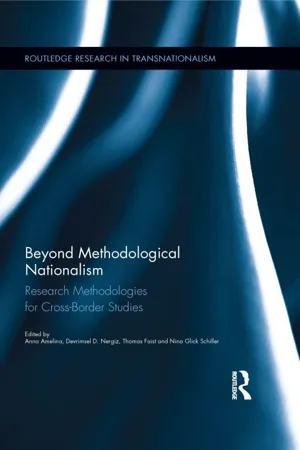
Cross-border studies have become attractive for a number of fields, including international migration, studies of material and cultural globalization, and history. While cross-border studies have expanded, the critique on nation-centered research lens has also grown. This book revisits drawbacks of methodological nationalism in theory and methodological strategies. It summarizes research methodologies of the current studies on transnationalization and globalization, such as multi-scalar and transnational approaches, global and multi-sited ethnography, as well as the entangled history approach and the incorporating comparison approach. This collected volume goes beyond rhetorical criticism on methodological nationalism, which is mainly associated with the ignorance and naturalization of national categories. It proffers insights for the systematic implementation of novel research strategies within empirical studies deployed by young and senior scholars. The novelty lies in an interdisciplinary lens ranging from sociology, social anthropology and history.
eBook - ePub
Beyond Methodological Nationalism
Research Methodologies for Cross-Border Studies
- 16 pages
- English
- ePUB (mobile friendly)
- Available on iOS & Android
eBook - ePub
Beyond Methodological Nationalism
Research Methodologies for Cross-Border Studies
About this book
Information
1 Methodological Predicaments of Cross-Border Studies
Anna Amelina, Thomas Faist, Nina Glick Schiller and Devrimsel D. Nergiz
Which research methodologies are adequate for cross-border studies? How can cross-border relations be studied without falling into the trap of meth-odological nationalism? From which ways of reflection and strategies of contextualization do researchers benefit? Which units of analysis are most useful? To address these and related questions, this volume builds on the existing work in cross-border studies and on its criticism of the nationcentered research lens.
We define cross-border studies as a broad set of concepts addressing issues of cross-border mobility, global institutional restructuring, complex cultural transformations and cross-border histories. This introduction uses the term cross-border studies as an encompassing category to address a variety of cross-border relations. Khagram and Levitt (2008) prefer “transnational studies” to speak of similar concerns. Since this book aims to encourage an interdisciplinary dialogue among sociologists, social anthropologists and historians we view the term cross-border studies as the most appropriate common denominator.
The field of cross-border studies has certainly become multidimensional, expanding from an initial focus on international relations and transnational corporations (Nye and Keohane 1971) to discussions of global cities (Sassen 1991), global ethnoscapes (Appadurai 1996) and world society (Meyer et al. 1997). Cross-border studies have subsequently included the debates on transnational migration (Basch, Glick Schiller and Szanton Blanc 1994; Kearney 2000; Smith and Guarnizo 1998), cosmopolitanism (Beck and Sznaider 2006; Darieva, Glick Schiller and Gruner-Domic 2011) and transnational history writing (Bayly et al. 2006).
However, as the field of cross-border studies has grown and become more prominent, scholars engaged in its development have warned of its pitfalls and reflected on their own work as well as on the work of others (Levitt and Glick Schiller 2004; Brenner 2004; Faist 2000; Beck and Sznaider 2006). The critique from within the field has focused on the continuing use of concepts of nation and the nation-state as the major point of reference, despite an effort to develop a scholarship and topics that were not bounded by these frameworks.
Recently, the criticism of methodological nationalism has been rapidly becoming en vogue within different disciplinary fields including sociology, social anthropology and historiography. Those deploying this term use it to question the nation-centered lens that defines nations as natural units of analysis. They also use it to question the nation-state focus that equates nation-states with the social unit of society. In fact they have been concerned with epistemology as well as with methodology. Moreover, the theorists of a transnational approach in migration studies (Basch, Glick Schiller and Szanton Blanc 1994; Kearney 1991, 2004; Rouse 1992) have reflected on the barriers imposed by the nation-bounded concept of society in some detail. In particular, Wimmer and Glick Schiller (2003) introduced the term methodological nationalism into the discussion of migration studies by identifying the three main gaps in social sciences research generally and in migration studies particularly:
- 1) Omitting nationalism, which overlooks the continuous relevance of nationalism in contemporary social life.
- 2) Naturalizing nation-states, which is an implicit strategy to see nation-state institutions as being the main social context when studying all the issues in question.
- 3) Imposing territorial limitations, which binds empirical research strat-egies to the territory of any selected nation-state (Wimmer and Glick Schiller 2003: 581).
They noted that methodological nationalism becomes particularly appar-ent in studies on geographical mobility and migration, where research questions are constrained because empirical data collection is confined to the territory of an immigration state. The goal of their critique has not been to negate the significance of the nation-state but to insure that nation-states are not the exclusive framework of study and analysis but one of several possible social contexts within which to empirically analyze social rela-tions, institutions, cultures, spaces, ethnicities and histories.
It is worth remembering that challenges to the conceptual equation of societies and nation-states are not new in the social sciences. Influential his-torical and contempary scholars in a lineage that begins with—Karl Marx and Frederick Engels (Marx and Engels 1848) and extends to Immanuel Wallerstein (1989) in sociology; Fernand Braudel (1980) in history; Paul Gilroy (1993) in cultural studies; Henry Lefebvre (1991) in social geography; Eric Wolf (1982), James Clifford and George Marcus (1986), Benedict Anderson (1991) Linda Basch, Nina Glick Schiller and Christina Szanton Blanc (1994) and Akhil Gupta and James Ferguson (1997a, 1997b) in social anthropology, to name only a few—have previously explored the ways social formations extend beyond national arrangements. However, the globalization debate in the 1990s (Appadurai 1996; Giddens 1994; Lash and Urry 1994; Robertson 1998; Swyngedouw 2004) renewed a critique of the theoretical foundations of many social science disciplines, resulting in a more detailed debate on the conceptual relationship between society, the nation-state and space.
In responding to the changing conditions and debates, the critique of methodological nationalism specifically built on already existing concerns voiced by Eric Wolf (1982), who used a billiard ball analogy to scrutinize the ways in which social sciences thought of nation-states as bounded units. In a similar way Martin Albrow (1995) criticized theories of society that assigned social practices in question to a particular national “container.” Other contemporary critiques of boundedness use different vocabularies. For example, Neil Smith (2003) analyzed globalization as a complex spatial restructuring, namely the process of rescaling, which includes the national scale as only one of many spatial dimensions. In a similar vein, Neil Brenner reviewed the state-centrism of globalization studies, which defined space in an essentialist way “as timeless and static” (Brenner 2004: 38). Authors in a range of disciplines have been using varying yet intersecting terms to address the same problem.
However, the methodological implications resulting from the reexamination of methodological nationalism have only been partly applied to the empirical research methodologies of cross-border studies. To be more precise, some research strategies, such as cosmopolitan (Beck and Sznaider 2006; Darieva, Glick Schiller and Gruner-Domic 2011) and scale approaches (Brenner 1999), explicitly tried to overcome methodological nationalism in empirical studies, while others, such as global (Burawoy et al. 2000) and multi-sited ethnography (Marcus 1995), though implicitly rejecting methodological nationalism, did not manifestly address its under-lying premises.
This volume exemplifies various ways through which the criticism of methodological nationalism can be turned into constructive research programs. The contributions shed light on how research methodologies, such as transnational and multi-scalar research programs and global and multisited ethnography, as well as the incorporating comparison approach and the entangled history approach address a research agenda beyond method-ological nationalism.
Criticizing bounded thinking and conceptualizations of society and units of analysis centered on nations and nation-states, this volume builds on scholars who have worked across an array of disciplines including sociology, anthropology, historiography, geography, cultural studies and political science. All these disciplines, situated within particular national academic traditions, have approached issues of globalization with different theoretical emphases and methodological questions. To move past the disciplinary divides and their national myopia the contributions to this volume suggest transcending disciplinary boundaries in order to focus on particular research methodologies or research problems. Thus, this book combines various disciplinary logics to broaden the debate on methodologies of globalization and transnationalization, to identify domains for methodological challenges and innovations and to suggest some ways to overcome container methodology. In doing so, the volume critically reflects on the conceptual relationship between social units, space, nation and nation-state in three thematic areas: migration studies, globalization studies and cross-border historiography. In sum, the volume assesses various research methodologies and discloses how they benefit from overcoming nationally bounded thinking. The next section provides insights into the main methodological challenges of cross-border studies, and the subsequent part highlights par-ticular methodological innovations featured in this volume.
METHODOLOGICAL INNOVATIONS CROSSING DISCIPLINARY BOUNDARIES
Immanuel Wallerstein (1976) argues that occasional review of established methodologies within social sciences is hardly an exceptional event. On the contrary, the revision and redefinition of conventional research strategies usually accompanies scientific transformations.1 From this point of view, one could say that the globalization debate has engendered a reinterpretation and redefinition of terms paving the way for the current critique of methodological nationalism.
In particular, globalization debates arose in relationship to global eco-nomic restructuring of capital production, including the privatization of public resources and the ensuing changes of state-based regulatory regimes. It was in this context that scholars engaged in the critique of methodological nationalism (Beck and Sznaider 2006; Chernilo 2006; Wimmer and Glick Schiller 2003), identifying the epistemological foundations that have guided much of social science research and calling for revisions in both methodologies and paradigms. They took a dialectical approach, noting that it is important to distinguish between the changing objective conditions in the world on the one hand and the subjectivity of researchers and their paradigms on the other hand in order to explore the interrelationship between them. This perspective complements those who critique research that equates territorial and social entities and views their interrelationship as static (Brenner 2004; Pries 2008).
This volume builds from current critical pespectives to demonstrate how the empirical research strategies of cross-border studies profit from the critique of nationally bounded thinking. To achieve this goal researchers of cross-border relations have to deal with two particular questions: First, how can relevant units of analysis be specified while studying processes of transnationalization and globalization? Second, how can the units of analysis in question be contextualized without presuming the nation-state to be the only relevant societal and spatial context? Accord-ingly, cross-border studies do not seek to define the unit of analysis or the relevant context; this would be an expression of static thinking. There cannot be only one unit of analysis or one relevant context since cross-border studies focus on the intersection of various scales. Addressing these two subjects in the following subsections, we highlight the relevant methodological strategies.
Defining Units of Analysis after Methodological Nationalism
In sociological globalization studies the challenge to identify adequate units of analysis became explicit as a consequence of the controversy between the network and world polity approaches. The first, the network approach to globalization (Castells 1996; Lash and Urry 1994), indicates mechanisms by which social realities and practices are no longer confined within or defined by territorial limitations in general and from nation-state territories in particular. Society is, therefore, not reduced to the nation-state institutions but defined as built by social networks. The second position, represented by the world polity approach (Meyer1999), views the globe as encompassed in a single overarching system. Although this theory reflects on nation-building as a historically specific process, theorists working in the frames of this approach predominantly view space and geographic mobility as unchanging physical properties that need not be the concern of social theory.
While the network approach eschews fixed categorizations and stresses the novelty of hybridity and mixity in a world of constant motion, it leaves unchallenged the notions that in the past ethnic and national identities were fixed. Overgeneralizing deterritorialization it overlooks processes of spatialized capital accumulation (Massey 2005; Taylor and Flint 2006) as well as the global, neoliberal restructuring of spatial scales. The world pol-ity approach, despite its focus on global processes, implicitly presupposes state-centric views, taking for granted that the division of populations by national and ethnic categorizations is the main organizing principle. This is because its state-centrism dictates a view that social identities are mutually exclusive, since they are still based on national institutions.
Both lines of argument fail to define units of analysis, which encom-pass identities, networks, organizations or institutions that are multiple, fluid, spatially constituting and constituted yet span geography and time. Transnational spaces (Faist 2000; Pries 2008), transnational social fields (Basch, Glick Schiller and Szanton Blanc 1994; Glick Schiller 2003), but also postcolonial (Chakrabarty 2000) and cosmopolitan (Beck and Grande2010) approaches provide alternative definitions of units of analysis general enough to think of social entities as territorialized and deterritorialized as well as nationalized and cosmopolitan at the same time. Consequently, these approaches suggest defining transnational and cosmopolitan relations, transnational networks, organizations and institutions, and postco-lonial hierarchies of power as possible units of analysis. Nina Glick Schiller (Chapter 2 in this volume) discusses globe spanning strategies of placemaking2 and the transnational linkages of cities as possible units of analysis. In a similar vein, Luin Goldring and Patricia Landolt (Chapter 3 in this volume) identify transnational migrant organizations as relevant units of analysis. The definition of the units of analysis in these cases is contingent and guided by the research questions.
In a similar examination of units of analysis in studies of global cultural transformations (Appadurai 1996; Bhabha 1994; Hannerz 1996), scholars have refused to view culture as nationally, ethnically or territorially bounded. Thes...
Table of contents
- Cover Page
- Half Title Page
- Routledge Research in Transnationalism
- Title Page
- Copyright Page
- Contents
- List of Figures
- List of Tables
- Preface and Acknowledgments
- 1 Methodological Predicaments of Cross-Border Studies
- Part I Researching International Migration after Redefining Space and Mobility
- Part II Materiality, Culture,and Ethnicity Overcoming Pitfalls inResearching Globalization
- Part III Juxtapositions of Historiography after the Hegemony of the National
- Part IV Conclusions
- Contributors
- Index
Trusted by 375,005 students
Access to over 1.5 million titles for a fair monthly price.
Study more efficiently using our study tools.
Frequently asked questions
Yes, you can cancel anytime from the Subscription tab in your account settings on the Perlego website. Your subscription will stay active until the end of your current billing period. Learn how to cancel your subscription
No, books cannot be downloaded as external files, such as PDFs, for use outside of Perlego. However, you can download books within the Perlego app for offline reading on mobile or tablet. Learn how to download books offline
Perlego offers two plans: Essential and Complete
- Essential is ideal for learners and professionals who enjoy exploring a wide range of subjects. Access the Essential Library with 800,000+ trusted titles and best-sellers across business, personal growth, and the humanities. Includes unlimited reading time and Standard Read Aloud voice.
- Complete: Perfect for advanced learners and researchers needing full, unrestricted access. Unlock 1.5M+ books across hundreds of subjects, including academic and specialized titles. The Complete Plan also includes advanced features like Premium Read Aloud and Research Assistant.
We are an online textbook subscription service, where you can get access to an entire online library for less than the price of a single book per month. With over 1.5 million books across 990+ topics, we’ve got you covered! Learn about our mission
Look out for the read-aloud symbol on your next book to see if you can listen to it. The read-aloud tool reads text aloud for you, highlighting the text as it is being read. You can pause it, speed it up and slow it down. Learn more about Read Aloud
Yes! You can use the Perlego app on both iOS and Android devices to read anytime, anywhere — even offline. Perfect for commutes or when you’re on the go.
Please note we cannot support devices running on iOS 13 and Android 7 or earlier. Learn more about using the app
Please note we cannot support devices running on iOS 13 and Android 7 or earlier. Learn more about using the app
Yes, you can access Beyond Methodological Nationalism by Anna Amelina, Devrimsel D. Nergiz, Thomas Faist, Nina Glick Schiller, Anna Amelina,Devrimsel D. Nergiz,Thomas Faist,Nina Glick Schiller in PDF and/or ePUB format, as well as other popular books in Social Sciences & Anthropology. We have over 1.5 million books available in our catalogue for you to explore.