- 46 pages
- English
- ePUB (mobile friendly)
- Available on iOS & Android
eBook - ePub
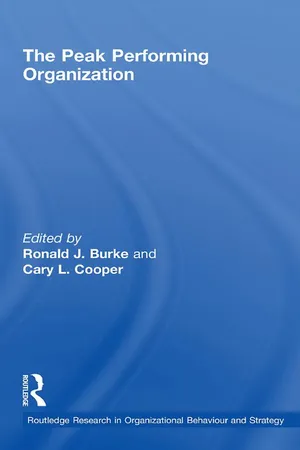
The Peak Performing Organization
About this book
Building a peak performing organization is not easy or else everybody would be achieving this goal. Organizations today are facing heightened challenges in remaining competitive in a more demanding global business environment. New technology, customer expectation, outsourcing, low cost competitors and needs for both higher performance and more inno
Part I
Introduction
1 The peak performing organization: An overview
This chapter sets the stage for those that follow. We seem to be at a “tipping point” (Burke & Cooper, 2006, 2008) in the way organizational leaders are coming to view the importance of people as a key element in their organization’s success and are prepared to act on this realization. It first lays out new challenges facing organizations as their employees, competition and business environment changes. In response to these new, and in some cases continuing, demands, organizations need involved and engaged employees, need to manage and develop their talent, and to continuously adapt and change to survive. Contributions from some central researchers and writers are then reviewed to provide a sense of what is known about continued high levels of organizational performance and the emerging consensus of what needs to be done to achieve this.
The new world of work and organization
O’Toole and Lawler (2006), in collaboration with the Society for Human Resource Management, wrote a follow-up to Work in America, published in 1973. Using focus groups with HR managers and state-of-the-art reviews by leading US academics, they identify ways in which workplaces have changed over this time period, why these changes have occurred, the impact of these changes on workers and organizations, and organizational and government policy initiatives necessary for organizations (and American society) to remain competitive. Effective HRM that emphasizes building human capital lie at the center of these efforts. Too many organizations are wedded to outdated HRM practices that are out of step with the demands of today’s business environment.
O’Toole and Lawler (2006) identify several themes in their review. These include:
• insufficient creation of new “good” jobs
• increased choice and risk now borne by workers
• increased influence of competitive and economic considerations in managerial decisions
• increased tension between work and family life
• increased social stratification based on education
• changes in the nature of careers
• a mismatch of skills and business needs – too few highly skilled, skill shortages in science, engineering and mathematics
• reduction in corporate training
• less sense of community at work associated with reduced motivation and commitment to organizations
• the continuing health care crisis characterized by high escalating costs
• demographic changes leading to a shortage of skilled workers connected with changes in retirement and immigration policies
• failure to use HRM best practices to build human capital
• more women working in professional and managerial jobs; their career patterns and paths becoming increasingly similar
• most people ending up working for several employers during their working life
• lifelong learning being necessary for continuing success
• no longer having to retire at sixty-five
• more people working at home some of the time
• work intensified – having to work faster and harder – making the home–personal life integration problem a major one for more people
• talent now available being richer, and more experienced
• workers having more freedom, responsibility and greater personal accountability
• employees now less loyal to a given employer
• shift from manufacturing to service jobs
• more global operations
• more use of outsourcing and on-shoring – foreign companies buying companies in a given host country.
The global business environment has forced organizations to reinvent themselves, embrace change, and increase the speed of innovation, change and adaptation (Malone, 2004). Bryan and Joyce (2007) maintain that, given the complexity of today’s world, organizations need to be flexible, agile and mobilize their people. Any profits made by an organization stems from people. They believe that to be effective, organizations need to put the same energy and focus they use for new products and processes into their people, cultures and organizational designs.
Unfortunately, organizational inertia is considerable. Most jobs in most organizations use only a fraction of each worker’s thinking capacity. Most organizations today still use a twentieth century model built in the early 1900s to exploit labor and capital assets, not people, when what they really need is to mobilize people’s minds.
Organizations need to use the hierarchy to improve accountabilities and performance (Leavitt, 2004), motivate and reward critical behaviors, increase worker satisfactions (Sirota, Mischkind & Meltzer, 2005), and use organizational designs as an element of corporate strategy.
Most organizations today fall short in creating the conditions that call out the maximum contributions of their people. Knowledge workers say they waste half a day to two days a week on unproductive work (e-mail, voice mail, meetings). A McKinsey survey showed that only 27 percent of respondents believed that their organizations were effective at using talent, matching talent with utilization and development opportunities. Talent is becoming increasingly important for organizational success; organizations need to use their single greatest asset – their people (Davenport, 2007).
The age of human capital
Business is a lot more complex today than it was twenty to thirty years ago. Increase in the provision of services by organizations has raised the importance of human capital (Stewart, 1997, 2001). Intangible assets such as the quality of their brand name, business systems and processes, and the quality of their workforce have become critical defining features of organizations.
Organizations have also developed more complex structures in response to the need for speed, global operations and higher value-added activities. These include changing and flexible job descriptions, global teams, virtual teams and becoming less bureaucratic. There is also a greater pressure for economic performance, often associated with greater use of downsizing and out-sourcing. There is increasing evidence that people and organizational culture represent the only unique competitive advantage (Pfeffer, 1994, 1998; Ulrich & Brockbank, 2005; Ulrich & Smallwood, 2003).
The “war for talent”
Talented people are critical to the success of a company, therefore the importance of strengthening the firm’s talent pool is now heightened.
Why does a war for talent exist today? Michaels, Handfield-Jones and Axelrod (2001) suggest the following:
1. the shift from the industrial age to the information age
2. greater demand for high level managerial talent
3. an increase in the numbers of people changing companies.
Excellent talent management is now a competitive advantage.
Companies that scored in the top quintile on their talent management index earned, on average, 22 percentage points higher return to shareholders than did their industry peers.
Michaels, Handfield-Jones and Axelrod report that most companies are unfortunately poor in talent management. Only 20 percent believe they have enough talented leaders to meet their current business needs and future opportunities. This is also evident in data in response to the following:
Percentage of senior managers who strongly agree that their company:
• is bringing in highly talented people – 14 percent
• develops people quickly and effectively – 3 percent
• retains almost all high performers – 8 percent
• removes low performers – 3 percent
• knows who the high and low performers are – 16 percent.
Organizations are facing a new reality:
• Companies need people.
• Talented people are the competitive advantage.
• Better talent makes a huge difference.
• Talented people are scarce.
• People are mobile and their commitment is short term.
• People now demand much more from their organizations.
Organizations, if they are to successfully manage talent, need to embrace a talent mindset, craft a winning employee value proposition (EVP), rebuild their recruiting strategy, weave development into their organization, and differentiate and affirm their people.
Leaders must passionately believe that performance and competitiveness are achieved with better talent – the talent mindset. That is, to be successful you must have great talent. Managers need to create a statement as to why talented managers should join and stay with their organization (provide challenge, development, a great company with great leaders, good p...
Table of contents
- Routledge research in organizational behaviour and strategy
- Contents
- Illustrations
- Contributors
- Foreword: Peak performing organizations relish change
- Foreword: Designing and nurturing peak performing organizations
- Preface: Achieving peak performance
- Acknowledgments
- Part I Introduction
- Part II Organizational processes
- Part III Organizational strategy and design
- Index
Trusted by 375,005 students
Access to over 1.5 million titles for a fair monthly price.
Study more efficiently using our study tools.
Frequently asked questions
Yes, you can cancel anytime from the Subscription tab in your account settings on the Perlego website. Your subscription will stay active until the end of your current billing period. Learn how to cancel your subscription
No, books cannot be downloaded as external files, such as PDFs, for use outside of Perlego. However, you can download books within the Perlego app for offline reading on mobile or tablet. Learn how to download books offline
Perlego offers two plans: Essential and Complete
- Essential is ideal for learners and professionals who enjoy exploring a wide range of subjects. Access the Essential Library with 800,000+ trusted titles and best-sellers across business, personal growth, and the humanities. Includes unlimited reading time and Standard Read Aloud voice.
- Complete: Perfect for advanced learners and researchers needing full, unrestricted access. Unlock 1.5M+ books across hundreds of subjects, including academic and specialized titles. The Complete Plan also includes advanced features like Premium Read Aloud and Research Assistant.
We are an online textbook subscription service, where you can get access to an entire online library for less than the price of a single book per month. With over 1.5 million books across 990+ topics, we’ve got you covered! Learn about our mission
Look out for the read-aloud symbol on your next book to see if you can listen to it. The read-aloud tool reads text aloud for you, highlighting the text as it is being read. You can pause it, speed it up and slow it down. Learn more about Read Aloud
Yes! You can use the Perlego app on both iOS and Android devices to read anytime, anywhere — even offline. Perfect for commutes or when you’re on the go.
Please note we cannot support devices running on iOS 13 and Android 7 or earlier. Learn more about using the app
Please note we cannot support devices running on iOS 13 and Android 7 or earlier. Learn more about using the app
Yes, you can access The Peak Performing Organization by Ronald J. Burke,Cary L. Cooper in PDF and/or ePUB format, as well as other popular books in Business & Business General. We have over 1.5 million books available in our catalogue for you to explore.