- 208 pages
- English
- ePUB (mobile friendly)
- Available on iOS & Android
eBook - ePub
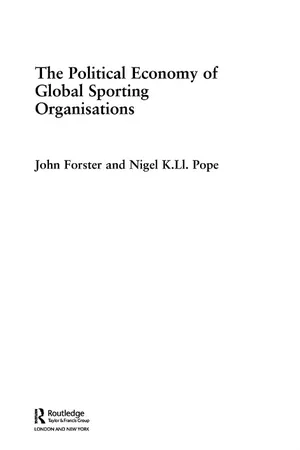
The Political Economy of Global Sports Organisations
About this book
At the global level, sport is ruled by a set of organizations including giants such as the IOC (Olympics), FIFA (soccer), and the IAAF (athletics) as well as sporting minnows such as the World Armsport Federation (armwrestling). Many of these bodies have been surrounded by controversy during their histories, after having to adjust to the reali
1 Global sports organisations
Ringmasters or alphabet boys?
Sport: a commodity without weight
Sport is simultaneously a cultural and an economic activity. It is also a set of highly organised and structured global phenomena. Our interest lies in the role and nature of the global sports organisation (hereafter GSO). The GSOs exist to control sports at the world level and take many shapes and forms. In essence they are the supreme governing body of a sport or some other aspect of sport such as doping. Some are massive in their impacts and influence while others are much less so, even though their claim to global control may be legitimate. Whatever their size within their own circuit they all have some claim to be the ringmasters of sport. To date, there has been little investigation of them as a group but there are some interesting studies of them as individuals. It is our intention to begin to rectify this omission.
Sport as an economic sector is massive. In 1995, sport was the eleventh largest industry in the USA (Harverson, 1997). Also in the USA the sport industry was estimated in 1996 to be worth US$100 bn a year, and projected to reach US$139 bn by 2000 (Pitts and Stotlar, 1996). To suggest a figure for the present of US$200 bn a year is reasonable. In Europe soccer was estimated to be a US$10 bn business in 1997 (Giulianotti, 1999, p. 86). This seems likely to be a gross underestimate when a small number of clubs individually generate close to US$100 mn annually. The British Sports Council (1995) estimated that it accounts for 2.5 per cent of world trade. This figure includes both physical goods such as equipment and intangibles such as earnings and royalties.
There are further figures, all disparate in their nature. Sport-related activities generate 1–1½ per cent of regional ‘value added’ and 1½ per cent of employment in Britain (Lewney and Barker, 2002). More than $798 mn entered Indiana’s economy through fishing and more than $280 mn was expended on hunting in 1996, according to the US Fish and Wildlife Service and the US Census Bureau (Polston, 1997). The 2000 US Tennis Open contributed $699 mn to the New York economy. But the problem is that these figures only give us glimpses of various parts of sport, not of a whole, global phenomenon. As Statistics Canada has observed:
. . . the amount of sport data currently available is insufficient to provide a comprehensive profile of the nature, benefits and value of sport . . . the data that are available are difficult to compare due to conceptual and definitional differences.(Ogrodnik, 1997, pp. 4–5)
Sport and sport-related production are a part of what Alan Greenspan has referred to as the ‘weightless’ economy (1996). For a variety of reasons that are in dispute material production has fallen dramatically as a proportion of GDP around the world – hence the term ‘weightless economy’. Greenspan paid special attention to the IT industry but a general move from manufacturing to service industries is also recognised. Sport, principally a service industry, is part of that movement. This factor, in addition to the magnitude of the revenues generated, the capital invested and circulating, and the indirect economic impacts, allows us to talk of a global sport economy.
More than any other part of the world economy, with the exception of global financial markets, sport is intermediated by its own set of institutions and organisations. These were designed to formalise and further the interests of individual sports, events and culture rather than to be commercial enterprises. They have remained non-profit organisations in a stridently commercial activity. So when examined from the perspective of the mass of non-profit global organisations with cultural or humanitarian objectives, a major difference becomes apparent: the GSOs are organisations with the capacity to control, contest or commercially generate hundreds of billions of dollars. Nevertheless, despite the fact that the revenues, either under the immediate control or indirectly under the influence of the GSOs are enormous, these organisations are largely ignored as a group. Perhaps this is precisely because of a fundamental element in their political economy, their non-profit status. Many of the GSOs have tremendous power to generate revenues, but their ambiguous ‘ownership’ of a sport combined with their non-profit status makes distribution of any surplus difficult. This is part of what makes them singularly interesting.
The GSOs are the outcome of processes that precede the formation of the global sport economy. They are one of that economy’s main actors but their importance stems from the size of that economy. Both the sport economy and the GSOs rely on the prior formalisation of sport. Without that formalisation sport could not be treated as a commodity. While some previous civilisations, China, Greece and Rome had highly organised, commercialised sports, before the eighteenth-century sport can be regarded as limited in extent, and almost entirely localised, non-professional and informal. So while the global sport economy is now a useful category, it is meaningless in an examination of eighteenth-century sport. After all, it was not until the mid-to-late eighteenth century that many sports began to be formalised and standardised in ways that would eventually allow sport commodities to be identified.
To become a commodity, sport not only had to be producible, but also to be re-producible within a standard format, yet maintain uniqueness for each game, match or event. We argue that what is less recognised is that a pool of players, and teams in some cases, had to be created that could play each other on a more than casual basis. This is standardised and trained labour as an input to a commodity production. This requires that games be played under identical rules and is equally true for both amateur and professional sport. Equally important for standards of play, but less recognised, is that the required training for players (often from childhood) be performed under identical and stable rules.
The existence of a readily identifiable, well-defined and discrete commodity is central to the economist’s standard theoretical and applied analyses of markets. Of course, if such commodities are not identified, this does not mean that a market does not exist. Rather it points to the inadequacy of our concepts of commodity. In addition it is likely that market behaviour will vary from the theoretically expected norms. Allowing that sport does not supply commodities that are well defined, readily identifiable or even discrete, there is a prima facie case that sports market behaviour will depart from the theoretical norms. This is entirely consistent with the previous argument concerning formalisation and reproducibility – formalised sport will give rise to reproducible but not always simple, discrete and readily identifiable commodities. This is also consistent with the work of Rosa et al. (1999) who examined the development of the automobile market. Much of what they say can be applied to the sports market and sport commodity. Rosa et al., write:
Starting as unstable, incomplete, and disjointed conceptual systems held by market actors – which is revealed by the cacophony of uses, claims, and product standards that characterise emerging product markets – product markets become coherent as a result of consumers and producers making sense of each others’ behaviors.(Rosa et al., 1999, p. 64)
In the political economy sense, we go somewhat further than this arguing that this is not an equal set of transactions. Instead, a variety of power and control frameworks come into play that can manipulate the decisions of the players in both groups.
Placing sport within this context, it is not necessarily the individual game or match that need be regarded as the commodity. This is recognised within the early classic economic analyses of league sports such as Rottenberg (1956) and Quirk and El Hodiri (1974). For most team sports it is the league that is the production unit. For individual sports such as tennis or squash it may be a series of tournaments as well as the individual matches. This is because consumers do not see a game or match in isolation. Rather, they see it in relation to the season or tournament as a whole. Spectators consume the sport commodity over a period of time, with different degrees of intensity of consumption. Thus the standardisation of the time length of games and events, and the calendarisation of sport goes hand in hand with its commodification. Consequently some games are enormously more important than others, with different meanings to different viewers or fans. The on-field competition is almost entirely symbolic from a league’s point of view. The commodity instead is a season of games that can be consumed in a variety of ways (attendance, broadcast, print, word-of-mouth, etc.). The league or tournament is both the corporate entity and the production unit.
Consequently, codification, the creation of explicit codes of rules, is only one step in the overall formalisation of sport. Yet neither codification nor overall formalisation relies on sport being a commodity. Continuing and finalising the codification process was one of the first functions of early sports organisations, and was important for amateurs. This process was necessarily one that had begun before the organisations were formed. It was the prior creation of codes, and the competitions and events using those codes that became the catalyst for the creation of sports organisations. In global terms the operation of the calendar and the maintenance of the code and rules becomes one of the most important operational functions of a GSO.
The formalisation process first began in Britain, particularly England. It was, of course, no accident that this happened to be the most economically and industrially developed nation in the world. At first the movement towards formalisation was driven by individuals or by special interest groups. In some cases this was for purely sporting reasons while in others, including horse racing, bare-knuckles and cockfighting, there were also economic imperatives driving formalisation. The economic imperative intervened far earlier than is often realised. And while there were sporting clubs, it was only later into the eighteenth century that embryonic sports governance bodies begin to develop. International events began to occur sporadically after the Napoleonic wars and towards the middle of the nineteenth century. It was in this period that the embryonic development of national, international and ultimately global sports governance began.
The GSOs
But the global sport economy is much more than an economic system. So while sport is anything but insignificant in economic terms, it is misunderstood when considered solely in those terms. It embodies sets of cultural values that intermingle with economics, and with which individuals, whole communities and groups of nations identify.
The Olympic Games, soccer’s World Cup and Formula 1 (hereafter F1) motor sport dominate all other sports competitions. Attracting audiences of many billions, they are closer to encompassing the entire human race than any other entertainments. The organisations that own and govern these events, The International Olympic Committee (IOC), Le Federation Internationale de Football Associations (FIFA) and Le Federation Internationale de L’Automobile (FIA) have extraordinarily high global levels of recognition. Even their acronyms are well known.
Their world is not a gentle one. The GSOs, non-profit organisations in a commercial environment, are caught in a web of contradictions that they struggle to resolve. As sport has become immensely financially rewarding so the GSOs have found themselves increasingly involved in off-field competition: drug-related activities, commercial disputes and legal controversies that have led to the formation of specialist global sports bodies to combat these problems. The World Anti-Doping Agency (WADA) is just one of these. Increasingly, nation states have become involved. The International Intergovernmental Consultative Group on Anti-Doping in Sport (IICGADS) in many ways represents several governments’ desire not to leave antidoping entirely in the hands of an International Non-Government Organization (INGO). This reality belies the image of harmony, such as that nurtured by the Olympic movement and its construct of the ‘Olympic family’. Rumours and accusations of corruption, malfeasance and an apparent lack of ethical standards have damaged the IOC, FIFA, FIA and other GSOs. The behaviour of the GSOs in this ungentle world often appears at odds with the behaviour that they impose upon individual athletes.
But what exactly makes a GSO? Virtually without exception, the GSOs claim a legitimate control over their respective sports or some global sporting event. And often it is both. Yet these organisations are self-appointed, as is the case for the IOC. GSOs often point to current and founding member national associations for their legitimacy, for example, FIFA and the International Amateur Athletics Federation (IAAF). This might be considered a circular claim since the national associations, in their own search for legitimacy, point to their membership of the GSO!
Not surprisingly new entrants have challenged these organisations in a variety of forms. CART (Championship Auto Racing Teams) is centred on the USA but has competed for much the same world market as Formula One (hereafter F1), while rejecting the authority of FIA. At present the organisation of motor sport is intensely fluid. Control of major elements of this sport is fought out in the financial markets and the law courts. This is neither a unique nor a new story.
In the 1970s World Series Cricket (WSC) rejected the authority of the International Cricket Council (ICC) and its associated national bodies such as the Australian Cricket Board (ACB). While the WSC no longer operates, it had major impacts on cricket. The intended but minor effect was that it gave its owners an entrée into broadcasting cricket in Australia. The major effect was that it dramatically changed the economics and commercial practices of cricket as a global sport. Many argue that it changed the nature of the game itself. In North America where the GSOs are much less powerful, sports such as football, baseball and ice hockey have seen rebel leagues and competitions come and go. Some have failed but others have ultimately amalgamated with the incumbent leagues. While the ICC was powerless to intervene despite its supposed monopoly of control in cricket it is not clear that this powerlessness would extend to all sports. FIFA’s ability to exclude nations and individual players from international competition is much stronger although potentially contested (e.g. under labour laws in the European Community (EC)).
In other sports there is no single controlling body. Professional boxing is the prime example. Boxing organisations claiming to be world governing bodies are legion. Bernath in assessing the World Athletic Association (WAA), World Boxing Association (WBA), World Boxing Board (WBB), World Boxing Council (WBC), World Boxing Federation (WBF), World Boxing Organization (WBO), World Boxing Union (WBU), International Boxing Board (IBB), International Boxing Council (IBC), International Boxing Federation (IBF), International Boxing Organization (IBO) and so on, most of them meaningless shells, refers to them as ‘the alphabet boys’ (Bernath, 2002). He attributes this splintering to the commercial opportunities offered by the electronic media, especially the TV. Unfortunately for Bernath’s argument, if it were correct the splintering would have appeared throughout the sports world and this has not been the case generally.
However, there are some examples. Chess, a very different form of combat to boxing, has over the last few years been split by rebellion against FIDE (Federation Internationale des Echecs). Viner puts it succinctly:
The task of reunifying the official and unofficial world chess championship titles is akin to putting Humpty Dumpty together again after his great fall.(Viner, 2003)
Some of the factors affecting chess are those that affect boxing. The implication is that GSOs need to be examined as a group.
Difficulties arise in describing and interpreting the GSOs. In most instances GSOs are readily describable as the supreme governing bodies of their respective sports, but not all are of this type. While GSOs have a defining role as sport governance bodies, they also play major roles as management and administration bodies. In addition many are critically involved in global sporting events, running their respective world championships or the equivalent in their sport. Some are also involved in global events through an association, usually a subordinate one, with the IOC and Olympic Games. Another element in describing them is that they are global rather than national or even international. The reason for this is that the sport economy is now a global one; it is global events that are significant both economically and culturally, as well as fitting within the larger framework of globalisation. Thus national sport bodies and even international or supra-national bodies such as Union of European Football Associations (UEFA) do not qualify within our terms as GSOs.
In some cases, such as decisions about rules of the game, part of the governance function, can be carried out relatively easily. In other areas such as drugs, arbitration, corruption and disputes between member nations, the governance function is not only critical but also difficult. There are enormous ethical and moral dimensions to punishing some players for transgressions against a sport code (as opposed to some governmentally instituted law) that can destroy their livelihood. So it is here that the nature of the GSOs as independent, unbiased and non-partisan governance bodies is most tested. And yet more and more of these organisations are not just governance and administrative structures but profit-making organisations, through global events. This is despite their non-profit status. This makes conflicts of interests in their actions and decisions all the more likely.
There are several possible reasons why the GSOs have become involved in the profit making side of sport, thereby changing their nature. These are listed here:
- The organisations have been forced into revenue raising through global events they construct because they have relatively few alternative sources of funds to support their functions. There is a limit to their ability to raise funds from member nations, especially when the basis upon which the level of fees raised is inevitably contentious given different levels and types of participation across nations and huge differences in per capita GDP.
- The growth of commercial opportunities at all levels may require organisations to be independently profitable just to be effective in bargaining and negotiation (this may increasingly be the situation if clubs become more and more powerful vis a vis their national associations).
- Commercial opportunities have increasingly become global, and national and local organisations are not best placed to accomplish in this area.
This is problematic when the GSOs were originally designed to play their role with respect to the symbolic rather than commercial action in a sport. Quite apart from this most GSOs do not fit as private enterprise in that they
- have different formal primary objectives, such as the furtherance of a specific sport;
- operate within different legal frameworks, governance and managerial structures to profit corporations; and perhaps most fundamentally;
- are not ‘owned’ in the same way as private enterprise.
The contradiction between their desire, need and ability to engage in profitable activities and their non-profit status is crucial to understanding them and their political economy. Their lack of ownership occurs in several ways compared to private corporations. GSOs do not generally have direct owners or even shareholders. In some sports there is a legally recognised private ownership and in others there is a variety of forms of beneficial ownership at the international organisational level. Equally importantly, they often do not have a specified means by which owners receive dividends such as exists for multinational corporations (MNCs). Lack of ownership of the profits generated offers enormous areas of discretion to these governance bodies as a whole, and their executives in particular, in the ways they disburse them and the locations to which they are disbursed. These include developmental funds to different points on the globe, the perks of office and inflated remuneration packages, patronage and influence.
Some of the reasons for the problems of the GSOs relate to the embryonic nature of the global sports economy. In most cases, they predate the early 1950s and many were founded before the Second World War. But the sports world is now very different from the 1930s and even the early postwar world. Before then the economic rewards provided little to fight and cheat about for the GSOs. The major North American sports – baseball, basketball, football and ice hockey were intensely commercial but did not have an international following. The major exception was golf. Tennis and athletics were largely amateur at even the highest international levels: all of the Grand Slam events were amateur as were the Olympics. But now, in an irony of ironies what was until recently the IAAF (see Appendix) is now the supporter and promoter of elite professional athletics, while the Grand Slams are ‘open’ tournaments. Many international cricketers were amateurs and the pay for its professionals was low until the advent of the WSC (Forster and Pope, 2002). But the commercial power of sport was becoming recognised, especially TV. This has dramatically changed the world of the GSOs.
Global civil society
We now turn our attention to the nature of the GSOs with respect to a collective role in global society rather than purely within the sport economy. In doing so, we now interpret sport as popular culture rather than as a commodity. The two interpretations, of course, are entirely compatible in that popular culture is often commodified. As a group, the GSOs play a role in the development of a global culture within global...
Table of contents
- Cover Page
- Title Page
- Copyright Page
- Figures
- 1 Global sports organisations
- 2 A product of history
- 3 The economic approach to sport
- 4 Sources of sport revenue
- 5 Going for gold
- 6 Architectures of control
- 7 For the good of the game
- 8 Getting on with the neighbours
- 9 Yielding place to the new
- 10 Postscript
- Appendix
- Bibliography
Trusted by 375,005 students
Access to over 1.5 million titles for a fair monthly price.
Study more efficiently using our study tools.
Frequently asked questions
Yes, you can cancel anytime from the Subscription tab in your account settings on the Perlego website. Your subscription will stay active until the end of your current billing period. Learn how to cancel your subscription
No, books cannot be downloaded as external files, such as PDFs, for use outside of Perlego. However, you can download books within the Perlego app for offline reading on mobile or tablet. Learn how to download books offline
Perlego offers two plans: Essential and Complete
- Essential is ideal for learners and professionals who enjoy exploring a wide range of subjects. Access the Essential Library with 800,000+ trusted titles and best-sellers across business, personal growth, and the humanities. Includes unlimited reading time and Standard Read Aloud voice.
- Complete: Perfect for advanced learners and researchers needing full, unrestricted access. Unlock 1.5M+ books across hundreds of subjects, including academic and specialized titles. The Complete Plan also includes advanced features like Premium Read Aloud and Research Assistant.
We are an online textbook subscription service, where you can get access to an entire online library for less than the price of a single book per month. With over 1.5 million books across 990+ topics, we’ve got you covered! Learn about our mission
Look out for the read-aloud symbol on your next book to see if you can listen to it. The read-aloud tool reads text aloud for you, highlighting the text as it is being read. You can pause it, speed it up and slow it down. Learn more about Read Aloud
Yes! You can use the Perlego app on both iOS and Android devices to read anytime, anywhere — even offline. Perfect for commutes or when you’re on the go.
Please note we cannot support devices running on iOS 13 and Android 7 or earlier. Learn more about using the app
Please note we cannot support devices running on iOS 13 and Android 7 or earlier. Learn more about using the app
Yes, you can access The Political Economy of Global Sports Organisations by John Forster,Nigel Pope in PDF and/or ePUB format, as well as other popular books in Business & Business General. We have over 1.5 million books available in our catalogue for you to explore.