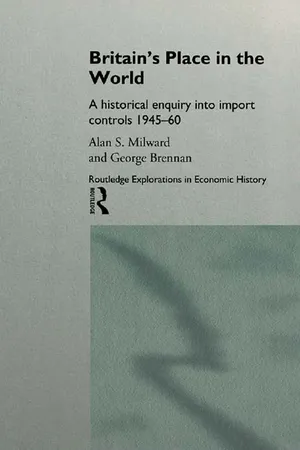
Britain's Place in the World examines the establishment and effectiveness of import controls, particularly quotas. Placing quotas back in the centre of British history, Milward and Brennan make some radical claims for Britain's economic performance in a global context.
Looking into a wide variety of industries from motorcars to typewriters, raw chemicals to food produce, they examine the intended and actual obstruction to imported goods represented by quotas, and the political and financial ramifications beyond the statistics.
This is the fourth book to be published in the Routledge Explorations in Economic History series.
- 340 pages
- English
- ePUB (mobile friendly)
- Available on iOS & Android
eBook - ePub
About this book
1 A PERSPECTIVE ON BRITISH IMPORT CONTROLS
It is a familiar fact that in the aftermath of the Second World War the United Kingdom’s imports, like much of the rest of its economy, remained for some time subject to government regulation and control. Few people, however, have retained an accurate impression of the scale on which this took place nor of the resources of labour and time which it employed. In 1948 the Import Licensing Department of the Board of Trade issued about a quarter of a million separate licences. Over 300,000 applications for licences were processed. Its daily postbag averaged 2,000 letters. It shuffled 500 individual visitors a day through four separate buildings for interview and it answered a daily average of 3,000 telephone calls.1 A licensing staff of 190 in February 1946 had grown to more than 500 three years later, to say nothing of the secretarial staff, postal clerks, filing clerks, switchboard operators and cleaners they required. To carry out the accompanying task of managing exchange controls the Bank of England required a staff of about 1,400.2 And beyond that there was the administration of other forms of domestic economic controls which in effect were also import controls, such as consumption controls on softwood, which was virtually all imported. The removal of licensing of softwood timber, so the Board of Trade estimated in November 1953, would eliminate the completion of more than half a million forms a year.3
The details seem more reminiscent of an eastern European peoples’ republic than of what was then the world’s second greatest capitalist trader and economy. A measure of its importance was that in 1950 no less than 12 per cent of total recorded world imports consisted of arrivals in the United Kingdom. This does not indicate any inefficacy of the control machinery, for in 1938 the equivalent figure had been more than 19 per cent. This machinery has been generally regarded as an accidental episode; survival in the war demanded the centralised control and rationing of all resources and after the war shortages of dollars and goods meant the system could not be immediately dismantled. As far as import controls are concerned this is quite wrong. Such controls were still proliferating at the start of 1949 and were not substantially reduced, apart from a temporary and localised episode between summer 1950 and summer 1951, until 1954. It is also ahistorical to see this development as an accident of war. It should properly be seen as a stage in the evolution of the modern state beginning with the great depression of 1929–32 and, as far as capitalist economies were concerned, ending in the early 1960s. It is by no means a purely British story, indeed it might be more interesting if it could be told about France. It concerns the longrun relationship of the modern developed economy and state to the huge growth in value and volume of international trade on which its inhabitants have come to depend for their wellbeing. How should that trade be regulated in the states own interest?
Consult any large library on the subject of the commercial policy of twentieth-century states. Over 90 per cent of the information deals with tariffs. Yet in most of the highly-industrialised countries in the twentieth century tariffs have become increasingly unimportant both as an instrument of commercial policy and as a source of government revenue. To a significant extent tariffs have declined in importance not as a result of any secular movement towards greater freedom of trade but, on the contrary, because of their relative ineffectiveness as a means of regulating trade. In most developed countries since 1918 they have failed to meet the increasingly complicated and sophisticated objectives of government either in commercial or fiscal policy. As international trade in manufactures becomes increasingly dominated by a small number of large companies whose production operations are international in scope this tendency seems likely to be maintained.
Quantitative restrictions on imports, the subject of this study, have in comparison attracted little political or economic debate and virtually no theoretical discussion. The secrecy and speed which often surrounds the introduction of such restrictions means that the facts, even if recoverable, seem too chaotic to allow analysis or to reward inquiry. Theoretical discussion is scant and empirical investigations are few. Yet in the twentieth century quantitative restrictions, particularly import quotas, have been a main instrument for regulating foreign trade. This was so in the United Kingdom in the decade after 1945 when they were also a cornerstone of post-war reconstruction. It is mainly with that experience that this book deals, but the British experiment was not atypical. In the United Kingdom, as elsewhere, the development of a systematic apparatus of import controls arose out of a sense of the inadequacy of tariffs for supporting domestic policy choices and in the longer run is probably best understood as a stage in the transition from reliance on tariffs to the development of other forms of regulating international markets, business mergers, cartels, common markets and the like, so that their behaviour does not too greatly or too frequently disturb the equilibrium of the domestic economy.
In spite of the importance of quantitative trade controls, little is known about them, not even about their most familiar variant, the import quota. Often disguised, sometimes secret, they have been an unenticing subject for historians because of the difficulty of assembling evidence. They have been even less enticing for economists, because theorising about them has seemed unrewarding while measuring their effect has seemed arbitrary and uncertain. Protectionism, as it has been defined by most historians and economists, has meant tariffs. Their analysis has spawned intricate and unresolved debates not only in economic and political theory but also in constitutional law. Import controls have been discussed only in a more simplified intellectual context.
Everyone acknowledges that forms of protectionism other than tariffs, non-tariff barriers as they are usually called, have been and still are widespread, but their prevalence has yet to be taken into account even in the recent changes of fashion in the theory of international trade.4 Standard works on the international economy usually have little more to say about them other than that they are bad. To some this may seem their only exciting attribute. But that would be to ignore the particular importance they have had in the history of twentieth-century states. Beginning with the collapse of prices of so many products in the great depression of 1929–32, which led states to look for new forms of protecting domestic price levels, quantitative trade controls spread until they probably reached their apogee in 1948. Since then, on trade between developed economies they have diminished in significance, but as a means of protecting such economies against low-wage, labour intensive manufactures in poorer economies they have been spreading since the mid-1950s. While the developed economies have discovered other means of regulating trade between themselves, less inhibiting to its growth, quantitative import controls and their effectiveness must remain a live issue in a world where countries like the United Kingdom or the USA have a congenitally high propensity to import manufactures and where Russia and the former republics of the USSR, and soon perhaps China as well, have a huge, highly-skilled industrial labour force willing to work for a tenth of American or German wages.
The most typical quantitative import control in the post-war British economy was the import quota. A quota on imports has this essential difference from a tariff, that beyond a fixed maximum volume or value over a specified period no further amount of the commodity in question is allowed to enter the country. There is no price at which an additional amount may enter and be sold, whereas even in the case of a tariff intended to be prohibitive the theoretical possibility remains that the external price will fall so far that the good could still be imported and sold more cheaply than the domestic product. Once the quota, however, has been fulfilled prices no longer come into consideration; there is no market.
The Keynesian tradition has been for temporary protectionism, and by this import quotas have often been meant. Keynes himself was an advocate of import controls until the gold standard was abandoned, and several of his followers have at various times advocated forms of import control on particular sectors of the British economy as a way of achieving macroeconomic goals. Such views are now deeply out of political fashion in the United Kingdom, although loudly voiced in recent elections in the USA. But while it may well be that in a perfect and sensible world Britain, Germany and the USA would not, for example, have textile industries, it is also the case that they do have them and the workers they employ are not being retrained to produce semi-conductors.
Intellectual fashions do not last and even when, as in the last fifteen years, there has been a mighty tide of political opinion in Britain behind the belief that only an open economy can be competitive enough to deliver a high standard of living, flatly contradictory voices have been heard on the ‘left’ of the Labour Party demanding the direction of investment into protected industries as a better route to technological competitiveness. Other voices have been heard urging the protection of some manufacturing sectors on the grounds that if the manufacturing sector as a whole becomes too small a part of the economy any period of relatively high growth rates of national income will be sharply curtailed by the rising deficit on commodity trade. It is not fully known how often since 1960, when this book ends, British governments when faced with exactly that circumstance have considered reimposing import controls. They rejected the idea in 1962, partly because of the administrative apparatus it would require, and temporarily doubled many tariffs instead. When tariffs returned to their earlier level in late 1966 and government was again faced with the familiar problem of a surge of imports it bowed to the wisdom of hindsight and devalued. Protectionist arguments are at the time of writing being loudly made in the USA, by the ‘right’ wing of the Republican Party and by Democrats from states where manufacturing is no longer in the forefront of competitiveness and employment has shrunk accordingly, and quantitative controls have been often mentioned.
A ‘bad’ example of the use of import controls dominated and still dominates the contemporary political stage, that of the former communist regimes of the Soviet Union and eastern Europe. But if politicians when considering the possibility of reintroducing import controls looked back on the period covered by this book, when they were heavily used, they would be looking back on a golden age, characterised by a high rate of national and personal income growth and full employment. Import controls are rarely credited with having contributed to these happy conditions. They are treated in histories of the period as an emergency measure to cope with the shortage of foreign exchange caused by world trade and payments imbalances; in a ‘healthy’ economy they would have been removed. Our examination of all the import controls on which we could find good evidence shows, however, that it was very rare for any import control to have only one single policy purpose. It is true that saving foreign exchange was the commonest reason for import controls in Britain between 1945 and 1960, but it was most unusual for it to be the sole reason for any particular import control. There were many others and it is these which are missing from most existing accounts of the post-war British economy.
Export promotion, by guaranteeing the domestic market to manufacturing industries obliged by other forms of government control to export a fixed high percentage of their total output, was also important. The protection by import quotas of modern, science-based, infant industries or single manufacturing processes against American or German competition was widespread. So too was the protection by similar means of industries regarded as strategic, in the sense that their output would be so important in any future war that the country should not rely on foreign supply for what they produced. Regional policy, too, depended heavily on quantitative import controls to persuade foreign direct investment to settle in the scheduled Development Areas. That, in turn, meant that trade controls reinforced employment policy, because the defining characteristic of the Development Areas was their high pre-war unemployment rates. Some older uncompetitive industries, particularly textiles, clothing and jute, were also protected by import controls to safeguard employment in the regions where they were settled. As Chapter 6 and Appendix IV show this does not exhaust the range of motives for import quotas, but it summarises the more prevalent ones in addition to saving foreign exchange by reducing the import bill.
Within this complexity of objectives can be discovered the piecemeal elements of the post-1945 Labour government’s industrial policy, which historians have struggled to find and, not finding very much, have tended to relegate to a rather low order of significance. It did indeed scarcely exist at the level of positive cabinet or party decision-making. There was no coherent, centrally directed attempt to develop manufacturing industries. But the outcome of piecemeal decisions to retain or introduce quantitative import controls, decisions taken within different ministries and at an intermediate level, did amount to the protection and promotion of many important new industries and some older, very large ones, like car manufacturing. If ‘policy’ implies a specified priority and the conscious allocation of resources to achieving it, then it would be correct to say the Labour government had no industrial policy. If, however, it implies the persistent operation of a constant predilection or prejudice at a lower level of decision-making, there was an industrial policy whose primary instrument was quantitative import controls, essentially import quotas and state purchasing.
We estimate (Chapter 6) that in 1954 about 6.7 per cent of British manufacturing output would have been lost to American competition had it not been protected against imports from North America by import controls. In the same year about 16.5 per cent of manufacturing output stood to be lost if all quantitative import controls, including those against western European exports, had been removed. These are static calculations; an unimpeded flow of resources, many would argue, would have maximised efficiency through greater international specialisation, so that the same or a greater volume of output and employment would have been reached without trade controls and the distortions that they introduced. We recommend the reader, however, to read the detail of the book and consider the great variety of circumstance of the industries in question as well as of the purpose of import restrictions. Some industries, jute goods for example, were protected by quota purely for reasons of regional employment policy and had no future other than under permanent protection. Others, like the production of bulk organic chemicals from an oil feedstock, appear a striking justification of the infant industry argument. Their success suggests that in a highly-developed economy a brief period of absolute protection against foreign competition will sometimes suffice to develop a technologically sophisticated manufacturing process which otherwise could not be implanted, and which, once implanted, is in no way inefficient. These are extreme examples. Given the multiple causation of most import quotas within the policy formulation process, most of the examples we consider lie in between these two extremes and it is a matter of judgement whether the gains outweighed the losses. Appendix IV serves to help the reader form such a judgement. But it must be one conclusion of our work that no theory offers a universal basis from which to form such a judgement. Each case of industrial protection by import restrictions was unique in the circumstances of the industry and the purposes of its protection.
Although the percentage figures for the extent of manufacturing protected by import restrictions may seem high, we believe we have erred on the side of underestimation. They are certainly high enough to persuade us that it is justified to write of an industrial policy, in the qualified sense in which we have here defined policy. The different objectives for maintaining or imposing quantitative trade controls suggest the underlying reasons for that industrial policy.
One was high employment, a commitment given to the electorate by the wartime coalition government. We estimate that in 1954 about 5.4 per cent of total employment in manufacturing was in sectors protected by quantitative trade controls. But this is certainly an underestimate, because in the absence of information clear enough to sustain even the vaguest approximation we have had to omit the textile sector from that calculation. Textiles and clothing were protected by import quotas against imports from western Europe (until 1954) and from the dollar area and Japan (until 1960). Export controls imposed by India provided additional protection to textile, although not to clothing, manufacturers before 1954, and after 1956 ‘voluntary’ export restrictions were imposed by Hong Kong and India in the face of clamour for protection in Britain. Until 1954 the key raw material of the industry was purchased through a statutory public body, the Raw Cotton Commission. The reader will sense throughout the book how sensitive both Labour governments and their Conservative successors were to removing trade controls when this was likely to endanger a substantial number of jobs. The idea that protecting these jobs in the circumstances of the 1950s when demand was so high was a distortion, because the same national level of employment at higher productivity might have existed without import controls, has much force. It seems to us doubtful whether quantitative controls on imports did have any important impact on the national unemployment rate.
Where they did have an impact, however, was on regional and sub-regional employment rates and this was another important objective of government policy. Controls were used to ensure a more equal geographical distribution of employment in manufacturing. In this, their use reflected a set of predispositions about policy and the national need which had emerged in the inter-war period, when persistent very high unemployment rates had indeed been a regional problem with severe implications. We are unable to say what percentage of employment in, for example, the Scottish Development Area depended on foreign direct investment in manufacturing which would in most cases not have taken place had imports of the same products been freely allowed or merely taxed on the frontier, but it was clearly a much higher percentage than in the country as a whole. Manufacturing behind a protectionist import quota was one concession the foreign investor might win in return for having to site its factory in Scotland or South Wales. Dunning estimated that in 1957 American firms sited in Development Areas, many, perhaps most, of which had been enticed there by trade controls, employed 35,000 people.5
Another motivation for import controls was the warlike world in which the British economy operated. It would have been extremely foolish in the early 1950s to have forgotten the economic lessons of rearmament and war as they had been learned after 1936. A wide range of industrial processes and technologies in the British economy in 1946 were the result of the rearmament drive, the artificial protection given by the Second World War, and massive government investment in what were considered ‘strategic’ industries. In a war of mass production, as the Second World War had been, an astonishing range of output is classifiable as strategic, in the sense that it is indispensable for victory and that it may be unwise or dangerous to rely on imports for its supply. There was no good reason after 1945 to suppose that the world had become safe enough to eliminate these considerations. Until the mid-1950s defence strategy was still based on the assumption that future wars might well replicate the pattern of 1939–45, so that what had been acquired during that war in the way of skills, technology and output must be kept, even though the market for it was smaller and in many instances the industries were not capable of facing international competition. From aeroplanes to alarm clocks and from shotguns to silk cloth, goods were classified as strategic and protected by import quotas to guarantee a national manufacturing capacity.
The line between this and straightforward industrial protection against the USA and Germany was thin indeed and frequently crossed. There were persuasive arguments for protection against American manufacturing. The extraordinarily rapid expansion of American industry during the war and the ingenuity in technological innovation which accompanied it took place in much more favourable circumstances than those in which British wartime production operated. Constraints on the supply of labour, capital and raw materials meant that investment in new technologies in wartime Britain was governed by one criterion: would they help to win the war within the time frame set by grand strategy? Everything else was postponed. The enormous disparity in size of output by 1945 in some sectors of manufacturing between the USA and the United Kingdom suggested that some form of non-tariff protection was necessary if United Kingdom manufacturing were to expand in those sectors. The argument was easy to win because everyone, including the Americans after 1947, accepted the need for trade controls for balance of payments reasons, to economise on dollar imports.
The argument for industrial protection against Germany was a different one. In the future it was still a potential economic rival and enemy. It was thought that a decade would elapse after 1945 before German manufactured exports would return to world markets in sufficient strength to displace those of Britain. Beginning with the occupation of Germany and the opportunities it presented by fair means or foul for acquiring patents, machinery and even people, and continuing through the official reparations programme, British officials in specialised wartime ministries which continued in existence after 1945, notably the Ministry of Supply, attempted to reconstruct certain sectors of manufacturing industry, or to introduce new ones, so that the United Kingdom would compete in the post-war world on a more equal footing against its greatest European trade rival. Import controls were an important support to this policy.
Protection by import controls against both the USA and Germany was seen as one way of guaranteeing a better place in the world for the United Kingdom than it had had in the 1930s. It was not a purely defensive stance but a deliberately expansionist one, using import controls to boost the post-war industrial reconstruction. Its expansionist nature can be seen in the use of import quotas to promote exports. Drastic restrictions were imposed by agreements and understandings between government and some industries on the proportion of total output that could be sold on domestic markets. There was a brief period when only one-quarter of the cars manufactured could be sold to domestic purchasers and for the first post-war decade the proportion was never supposed to be higher than half the total number produced in any year. Other products too were forced by consumption controls or direct bargains on to export markets; nylon stockings and sewing machines are similar examples. Part of the bargain was that the domestic market was guaranteed to domestic producers.
Lastly, as in all cases of quantitati...
Table of contents
- COVER PAGE
- BRITAIN’S PLACE IN THE WORLD
- ROUTLEDGE EXPLORATIONS IN ECONOMIC HISTORY
- TITLE PAGE
- COPYRIGHT PAGE
- FIGURES
- TABLES
- ACKNOWLEDGEMENTS
- ARCHIVAL REFERENCES
- INTRODUCTION
- 1 A PERSPECTIVE ON BRITISH IMPORT CONTROLS
- 2 QUANTITATIVE IMPORT RESTRICTIONS AND THE MODERN STATE
- 3 BRITISH COMMERCIAL POLICY AND THE OEEC TRADE LIBERALISATION PROGRAMME, 1949–51
- 4 TAKING THE LEAD IN EUROPE: THE INTERNATIONAL POLITICS OF IMPORT CONTROLS, 1952–6
- 5 MEASURING THE EFFECTS OF QUANTITATIVE IMPORT RESTRICTIONS
- 6 THE EFFECT OF IMPORT CONTROLS ON BRITISH MANUFACTURING
- APPENDICES
- NOTES
- BIBLIOGRAPHY
- BIBLIOGRAPHY OF OFFICIAL SOURCES
Trusted by 375,005 students
Access to over 1.5 million titles for a fair monthly price.
Study more efficiently using our study tools.
Frequently asked questions
Yes, you can cancel anytime from the Subscription tab in your account settings on the Perlego website. Your subscription will stay active until the end of your current billing period. Learn how to cancel your subscription
No, books cannot be downloaded as external files, such as PDFs, for use outside of Perlego. However, you can download books within the Perlego app for offline reading on mobile or tablet. Learn how to download books offline
Perlego offers two plans: Essential and Complete
- Essential is ideal for learners and professionals who enjoy exploring a wide range of subjects. Access the Essential Library with 800,000+ trusted titles and best-sellers across business, personal growth, and the humanities. Includes unlimited reading time and Standard Read Aloud voice.
- Complete: Perfect for advanced learners and researchers needing full, unrestricted access. Unlock 1.5M+ books across hundreds of subjects, including academic and specialized titles. The Complete Plan also includes advanced features like Premium Read Aloud and Research Assistant.
We are an online textbook subscription service, where you can get access to an entire online library for less than the price of a single book per month. With over 1.5 million books across 990+ topics, we’ve got you covered! Learn about our mission
Look out for the read-aloud symbol on your next book to see if you can listen to it. The read-aloud tool reads text aloud for you, highlighting the text as it is being read. You can pause it, speed it up and slow it down. Learn more about Read Aloud
Yes! You can use the Perlego app on both iOS and Android devices to read anytime, anywhere — even offline. Perfect for commutes or when you’re on the go.
Please note we cannot support devices running on iOS 13 and Android 7 or earlier. Learn more about using the app
Please note we cannot support devices running on iOS 13 and Android 7 or earlier. Learn more about using the app
Yes, you can access Britain's Place in the World by George Brennan,Alan Milward in PDF and/or ePUB format, as well as other popular books in History & World History. We have over 1.5 million books available in our catalogue for you to explore.