![]() Part I
Part I
Introduction![]()
1
Comparing Japanese and Finnish economies and societies
Longitudinal perspectives
Jari Ojala, Yasushi Tanaka, Toshiaki Tamaki, and Jari Eloranta
Japan and Finland are not obvious countries to compare in terms of their historical experiences and the development of their respective societies during the twentieth century. They are located on almost opposite sides of the globe, the sizes of their populations and economies are vastly different, and culturally they seem to be quite dissimilar. Why then engage in such efforts? There are some precedents to this approach. In earlier comparisons between Japan and Finland, researchers have concentrated on contemporary issues, while longitudinal analyses have gained markedly little attention. (On Japan from a Finnish perspective, see Opas, 2007; Salomaa, 1999; Turkki, 2005; Vesterinen, 1995, 2001; see also Horiuchi, 2008; Momose & Ishino, 2008.) There are some examples of research comparing Japan and Finland, however, including analyses of management cultures (Koivisto, 1998), financial crisis (Miyagawa, Morita, & Sawada, 2008), labour markets (Räisänen & Heinonen, 2005), and welfare policies (Vuori & Merviö, 2007). However, only a few of these comparative analyses have been done in collaborative projects involving both Japanese and Finnish scholars, as was the case with studies on ageing of societies (EVA & Doyukai, 2006) and employment policies (Räisänen & Hori, 2008). The Swedish and Japanese economies, for example, have been compared in the context of welfare and demographic development (Mosk, 1983, 2000).
The analytical focus ties the volume and approach to the recent discussions, especially among global history scholars – that is, connections and comparisons between different areas, countries, and nationalities (McNeill, 1990; O’Brien, 2006; Pomeranz, 2000). From this perspective, this volume enables us also to discuss the theme of possible convergence between countries in different parts of the world – or whether the divergence that emerged several hundreds of years ago has remained between Asia and Europe, as Kenneth Pomeranz has argued (Pomeranz, 2000). The grand narrative both in Japanese and Finnish historical research has been one of modernization, Westernization, and integration to the world economy since the Second World War – and even earlier. The emerging speed of communication and transport plays a crucial role in this process of global convergence, enabling connections between different parts of the world. The direct political, societal, and economic connections between Finland and Japan might have been vague in world scale, but these two countries have been in constant interaction with each other nonetheless, with industrial production chains, international transfer of technology and knowledge, global political arenas, and cultural transmission. Furthermore, more direct contacts have occurred as well – as can be glimpsed, for example, from Chapter 10 of this volume, with a focus on trade relations between Japan and Finland during the twentieth century. Furthermore, direct flight routes between these two countries since the 1980s – the first ones between Europe and Japan – have further enhanced these connections.
Comparisons are the way to analyse these connections between different areas. Comparisons enable us, as implied by Fernand Braudel, to solve the key historical problems – or at least ask the right questions (Braudel, 1982). Comparisons, though, can be challenging, too, especially with historical material obtained from different kinds of sources with two rather distinctive languages – as has been the case with this volume. We are convinced, though, that the major obstacles in these efforts were overcome, following the guidelines stated in Chapter 2 regarding comparative methodology. Furthermore, the particular strength of the chapters in this volume is that they are all written by teams of Japanese and Finnish scholars, thereby enabling the authors to compile relevant data and previous literature from both countries in a representative fashion. The authors have met at two workshops organized in Kyoto, Japan (2010), and Jyväskylä, Finland (2011). In these meetings, the chapters were discussed in a scholarly manner to improve their quality and provide a consistent structure for the volume. These workshops were funded by the Japan Society for the Promotion of Science (JSPS) and the Academy of Finland. There are only a handful of previous research projects on which both the Japanese and the Finnish scholars have worked in such close collaboration. (On Japanese–Finnish comparisons see, for example, EVA & Doyukai, 2006; Koivisto, 1998; Miyagawa et al., 2008; Räisänen & Heinonen, 2005; Räisänen & Hori, 2008; Valaskivi, 2006; Vuori & Merviö, 2007.)
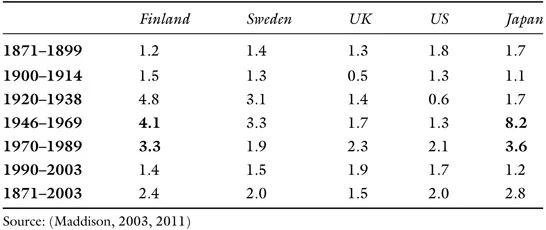
Moreover, Japan and Finland may not necessarily be that different after all. For example, this volume is motivated by the realization that economic growth in Finland and Japan has been among the fastest in the world throughout the past 130 years; the average growth rate in Finland was 2.4 per cent and in Japan 2.8 per cent during the period 1871 to 2003. These numbers are higher than, for example, in Sweden, the UK, or the United States. The growth figures for the post–Second World War period in particular are markedly similar in Finland and in Japan: fast growth and rebuilding of the economy and society from the 1940s to the 1960s; fast economic growth in the 1970s and the 1980s compared to the OECD average growth figures; and declining growth figures from the late 1980s onwards (see Table 1.1).
There are further similarities in terms of the overall economic development of these two countries: the gross domestic product (GDP) per capita figures are comparable (GDP in Finland in 2012 was 46,098 US $ and in Japan it was 46,736 US $); both countries have been successful in export-led industrialization; both are well known for their success in organizing higher education and promoting achievement, as indicated by the recent PISA tests; and both have been among the leading countries in developing high-technology industries. The phrase that Finland is ‘the Japan of the North’ underlines these similarities between the Finnish and Japanese economies, but it can also refer to the cultural similarities between Finnish and Japanese people, for example, in their attitudes to life and work. There are, of course, significant dissimilarities as well. With a total population of 128 million, the Japanese economy is many times larger than that of Finland with its population of 5.3 million. The total GDP in Japan in 2010 was $5,458 billion US, while in Finland it was $239 billion US.
Table 1.1 Annual average economic growth in Finland, Japan, and in certain other countries, 1871–2003 (%)
The aim of this book is, first, to provide readers high-quality scholarly perspectives and up-to-date comparative analyses on the economic and societal development of Japan and Finland by using certain illustrative cases. Moreover, our second aim is a more challenging one, namely, to try to make comparisons between countries that initially do not seem comparable; therefore, the aim of this volume is also to be a methodological test for longitudinal comparative analysis. This aim of the volume is developed further in Chapter 2, which aims to deliver a more structured approach to comparative, historical analysis. Comparisons between Japan and Finland offer a fruitful platform for the study of the similarities and differences in the economic and societal development after the Second World War, namely: “The main argument of this volume is that although Japanese and Finnish economies and societies might look today similar according to certain macro measures, the processes that have led to this are quite divergent – at least with the topics analyzed here. The future challenges, however, are quite similar for both countries.”
Structure of volume
The themes selected for the volume represent areas that are typically linked with the development paths in both countries: welfare state challenges; export-led growth and internationalization of certain industrial sectors; education; labour market development; challenges in energy supply and regulation; and economic crises, together with the economic ideology and practical policies behind the societal development. Besides these country-specific chapters, the volume will also contribute to a more general discussion on comparative methodology in two chapters (Chapter 2 and the concluding chapter), both having authors with an outsider’s view on the development in Japan and Finland.
The volume is structured into four parts and a conclusion. The introductory part includes, besides this chapter, also Chapter 2, which focuses on comparative analysis from a methodological angle. In their analysis of longitudinal comparative historical analysis, Pavel Osinsky and Jari Eloranta offer a comparative framework for this volume – namely, how historical comparative analysis has previously been utilised and what methodological solutions might be valuable in country comparisons such as presented here. Osinsky and Eloranta address the need for using various kinds of comparative methods, depending on the topics and questions stated. In this volume in particular, the rather long-run perspective together with the comparisons enable the authors to go beyond the traditional, national-historical narratives and to recognise, besides changes, continuities over time as well (Osinsky & Eloranta, 2015).
Part II analyses key societal developments in Japan and Finland by focusing on different aspects of the welfare society and state. The chapter on general welfare state development is complemented by analyses of higher education and military spending in Japan and in Finland. In their chapter ‘Two Paths to Building a Welfare Society’, Maare Paloheimo, Kota Sugaraha, Tadashi Fukui, and Merja Uotila argue that both countries have implemented various methods to address welfare policies and emerging social issues during the last decades of the twentieth century and early new millennium. Today, both countries are facing severe challenges with an aging of population and overall cost of the welfare state. By concentrating especially on issues related to family policies and reconciliation of family and working life, the authors stress the religious values that have influenced the way the emerging social issues were managed (Paloheimo, Sugahara, Fukui, & Uotila, 2015).
Higher education in Japan and Finland is compared in the chapter by Anu Ojala, Yasushi Tanaka, and Olli Turunen. Both Japan and Finland are today known for their well-developed and high-performing educational systems. By analysing the higher education systems in these two nations, the authors show that the structures of the two education systems have been rather different, though the outcomes have been equally impressive, as evidenced, for example, by the international studies on mathematics, science, and international student assessment studies (PISA). The most distinctive difference between the two countries is the fact that Japanese higher education is mostly based on private-sector solutions, whereas in Finland the focus has been on public institutions. The authors argue that despite this difference in the ways of financing higher education, both Japan and Finland display a strong adherence and commitment to maintaining high educational standards. By focusing on the educational policies in Japan and Finland, the authors show what kinds of institutional and organizational structures were created and how they performed over time. In both countries, higher education became a possibility for many during the past 100 years, whereas in the early twentieth century it was the privilege of a select few (Ojala, Tanaka, & Turunen, 2015).
The Second World War was a profound historical period for both Japan and Finland. Both countries were defeated in the war, partly devastated (especially Japan), large areas were lost, and Japan was even occupied by its former enemy. Military capacity was disarmed in both countries quite rapidly and new policies were implemented addressing the limited role of the military, and focus shifted to an expansion of the welfare policies. Thus, an interesting question is whether these processes were similar or different in these two countries. In their chapter, Jari Eloranta and Yasushi Tanaka analyse these processes of change from warfare to welfare state. Though both countries lost the war, they won the peace in a fashion with extraordinary economic growth until the turn of the 1990s. The authors argue that both Japan and Finland maintained fairly low levels of military spending after the Second World War while investing heavily in the welfare state. This process occurred, according to them, relatively quickly. Both countries exhibited trade-offs between social and military spending, with the former benefitting from the lower levels in the latter. Moreover, both countries have kept their military spending fairly low despite new security challenges in the twenty-first century. Both have also modernised their military establishments with the introduction of new technologies (Eloranta & Tanaka, 2015).
Part III of the volume, in turn, analyses macroeconomic developments and economic policies. These include an analysis of Keynesian economic policies, regulation in the energy sector, and a study of the 1990s’ financial crises in Finland and Japan. The role played by the Keynesian macroeconomic theory in practical economic policymaking is stressed in the chapter by Toshiaki Tamaki and Timo Särkkä. This was identified in macroeconomic planning, in the rise of Social Democratic ideals, and the emergence of the welfare society. This regulation of capitalism was emphasised especially in order to maintain full employment. The authors show that the complex connections between economic theory and economic policies differed somewhat in these two countries: scale economies and cultural differences, together with social and institutional context, played crucial roles in these connections. Keynesian economic policies were rather unproblematic to implement, as the state has traditionally played a central role in the supply side of the economy in both Japan and Finland. However, the authors argue that the economic policies in these countries were never ‘purely’ Keynesian but rather conditioned by their economic and social surroundings (Tamaki & Särkkä, 2015).
Both Japan and Finland had energy-intensive industries and economies that were extremely dependent on the energy supply. Park Seung-Joon and Esa Ruuskanen emphasise in their chapter the role of the governmental policy making on securing a sustainable supply of energy. Both countries were reliant on energy imports, and especially after the oil crises of the 1970s invested heavily in nuclear power. The authors argue that this enthusiasm for nuclear power and suspicions regarding alternative energy sources determined the broad lines of energy policy in both countries up to the 2010s. Thus, there is a striking similarity in the type of power emphasised, though the organization of the energy system was rather different in Japan and Finland, as the chapter shows (Park & Ruuskanen, 2015).
The economic crises of the 1990s hit Japan and Finland particularly hard; both have been shown to be among the severest financial crises in recent economic history. The causes and consequences of these crises are analysed in depth by Kari Heimonen, Shigeyoshi Miyagawa, and Yoji Morita. The authors find similarities in these crises not only with each other but also when compared to other financial boom-bust cycles during the last decades. The authors emphasize financial deregulation and liberalization and banking crises as the background features for the crises. Both countries also experienced some exogenous shocks that deepened the downturns, as addressed by the authors in the chapter. Finland managed to survive and rebound from the crisis quite rapidly, while in Japan the economic downturn became prolonged. The rapid recovery of Finland from the crisis was caused, according to the authors, by the firm and active public intervention in the capital markets, especially to recapitalize the banking sector. In comparison, in Japan, there was a long delay in the commitment of public funds (Heimonen, Miyagawa, & Morita, 2015).
Part IV focuses on industries and trade and features two analytical chapters on the trade relations and industrial development in these two countries. The industrial development and export-led growth formed a basis for both the economic and societal development of both Japan and Finland during the period examined. The direct trade relations between Japan and Finland, examined by Juha Sahi and Kazuhiro Igawa, offer us, therefore, an example of how to better understand the importance of foreign trade for these countries. During the time period, the trade between Japan and Finland witnessed a massive growth in terms of both value and volume. Sahi and Igawa frame this development in conjunction with international changes from protectionism to free trade during the twentieth century. Though the trade with Finland was rather insignificant for Japan – but much more important to Finland – these trade relations have existed for almost a hundred years. Sahi and Igawa show that during certain time periods and with certain commodities, these contacts have been especially intensive. For example, Finland was the first European country to start regular imports of Datsun cars in the early 1960s. The trade has mainly been composed of industrial products, typically produced in both of the countries in question, like textiles and cars in Japan and forest industry products in Finland. Thus, this analysis can also provide more general insights on world trade and the position of Japan and Finland within it. This is further tested in the chapter on the face of new international trade theories. Sahi and Igawa suggest that trade between Japan and Finland is in a process of change from traditional interindustry towards intra-industry trade, with exchanges of products within the same industry. Thus, the chapter is also closely linked to a global history perspective: how international production chains have become more important in the global economy and trade, witnessed also in the case of trade relations between Japan and Finland (Sahi & Igawa, 2015).
As for industrial development, the paper industry is used as an example in the chapter by Pasi Sajasalo and Kazuhiro Igawa. The paper industry is a good example of industrial evolution in these countries, as they both were among the largest paper producers in the world throughout the period – though this product is usually more associated with the Finnish rather than the Japanese economy. The large-scale paper making has been similar in both countries, even though the markets and raw material base are strikingly different. Whilst the Finnish success in paper making has been based on domestic raw materials and international markets, the Japanese development has been the opposite: the markets are domestic, and the raw materials are mainly imported. The companies in both countries have also been among the dominant firms in their respective geographical areas, the Finnish ones in Northern Europe and the Japanese in the Southeast Asia. Sajasalo and Igawa concentrate especially on certain key institutional and organizational arrangements among the Finnish and Japanese paper industry firms during the post-war period, namely the Japanese Keiretsu and the Finnish sales associations (Sajasalo & Igawa, 2015).
The concluding chapter by professor Christopher Lloyd sums up the comparisons presented in the individual chapters and provides the topic a more general perspective on how to compare different countries over a long period of time.
![]()
2
Longitudinal comparative historical analysis
Challenges and possibilities
Pave...