- 266 pages
- English
- ePUB (mobile friendly)
- Available on iOS & Android
eBook - ePub
About this book
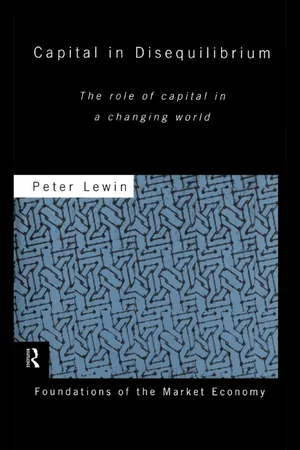
Drawing on the work of the Austrian School and its heirs, Capital in Disequilibrium develops a modern, systematic version of capital theory in order to suggest a new approach to the subject of economics. Original and provocative in his reflection, Lewin offers both a new approach and an accessible discussion of one of the most important, but also o
1: INTRODUCTION AND OUTLINE
“Case study”
This book is the result of a capital project, a production plan. More accurately it is the final product of a series of related intertemporal plans, and is the intermediate product of some higher level plans. This structure of plans encompasses both my own particular plans and the plans of others, like the publisher and the editors. As I write this, it is still too early to say whether the project is to be judged a success, by me or the other planners. But, whatever the final judgment, the planning process is illustrative of the ingredients of capital planning in general.
I am writing this introduction having already completed (at least a first draft of) the rest of the book, save for the conclusion. This means that you, the reader, are going to read the introduction and the rest of the book to which it refers in reverse order from the way in which they were written. The reason for this is obvious. I could not have written the introduction first, or at least not most of it with all the details and the outline to follow, because I did not know what I was going to write in the book. To be sure, I did have a general idea of the chapter layout and the points that I wanted to establish in each chapter, but I was unable to imagine in any kind of detail the words and sentences that would eventually fill the pages. This is in part due to the fact that the writing was a kind of learning experience, a kind of spontaneous unfolding of ideas that depend sequentially on one another, a kind of “learning by doing.” And in part this was also because of the occurrence of events that could not be anticipated in any detail. I shall argue that all planning is like this to some degree. Because of the way that we experience time, plans are necessarily incompletely specified.
Nevertheless, my inability to completely visualize the unfolding of my production plan, which depended in part on the fulfillment of the plans of others, and influenced the plans of still others, will not, in itself, prevent its fulfillment. It is not necessary that every aspect of the plan turn out as expected, especially as there are many aspects that could not be expected. But some things must turn out as expected. Among these are the crucial actions of mine and others which conform to certain preconceived or tacitly held notions of how people do and will behave in certain types of circumstances. This plan, like any other that is to have a chance of success, proceeded within an institutional framework of shared “ways of doing things.”
This book, the product of a capital project, is the result of “team production.” I did the writing, my editor did the guiding and the nudging, and the publisher did a number of things including overseeing the whole project, providing the necessary financial capital and equipment and the support staff. This “team” transcends the boundaries of the “firm.” In a sense there are a number of “firms” involved; myself, the editor, the publisher, the publisher’s suppliers and customers, and so on. We are all part of a grand matrix of organizations, some of whose employees are part of the “team.” So the book is in reality a team product. Each member’s contribution helped to facilitate its production. The value of the final product is thus causally attributable to these efforts and, therefore, the value of these joint efforts can be imputed from a knowledge of the value of the product.
Team production has to be coordinated, and in order to facilitate this coordination efficiently it may be argued that the members of the team should receive the full value of their marginal contribution to the product. This turns out to be quite problematic, especially when the extent or the value of the contribution of any team member is wholly or partially indeterminate (difficult or impossible to measure). But, as a practical matter, the existence of certain types of organizations and institutions—like a firm that specializes in publishing, and a market economy, where contracts and promises are made and honored and are expected to be honored, and in which money is used and understood, so that decision-makers can attribute a value to the efforts of the team members even though there may be a large element of indeterminacy surrounding each one’s contribution—helps to facilitate the necessary coordination.
So capitalistic production is about more than the existence of capital goods. It involves in addition the social and institutional framework that I have mentioned and the human capital of the individual team members. These are also indispensable parts of the capital structure, and thus of the value of any project. It is true, for example, that my prior conscious investments in human capital (generally in learning to read and write and more specifically in the studying of economics) helped to equip me for the task of writing this book. “Knowledge capital” is a crucial part of capital in general.
In this “case study” I anticipate some of the themes that I shall examine in this book:
- The complexity of plans and the inevitable existence of disequilibrium does not imply the failure of all plans, or of all aspects of plans. Production occurs in a changing world, but this can only happen if some aspects of that world are relatively stable and ordered.
- Capital is more than an array of capital equipment and involves an understanding of how value gets created by a combination of human and physical resources over time in an organizational structure that facilitates that creation.
- Organizational form, routines, habits, rules, norms, and mores are thus part of the social capital of any society. And the knowledge of its members are part of its human capital. And both are part of its capital structure.
- Any social policy that involves regulating or substituting for these largely spontaneous value-creating structures should, at the very least, be aware of the complexity of this all-encompassing capital structure.
Some more detail is provided in the rest of this chapter.
A disequilibrium approach to capital
Most students of economics encounter the theory of capital as part of a theory of finance and/or project evaluation. When considering the question of how to measure (known or estimated) values that occur at different points in time, they get introduced to the arithmetic of present values. And while the notion of present value can be elaborated and dissected in many subtle ways, its basics derive from some very straightforward, intuitive ideas. It is surprising, then, to find that capital theory is regarded as a particularly esoteric and largely irrelevant part of economics.
Obviously, although present-value arithmetic is an important part of an understanding of capital, it is only a part of that understanding. It is the other parts that have been regarded as obscure and irrelevant. Although capital theory may be difficult, it is hard to see that it could justifiably be judged as irrelevant. After all, the market economies of the world are often referred to as “capitalist” economies. Surely a good understanding of the meaning and significance of the “capital” in “capitalist” is of some importance, for history and for policy. If capital is that phenomenon that makes market economies different, ought we not to accord it a prominent place in the education of an economist?
As will become clear from the discussion below (Chapter 4), much of the reluctance of economists to deal with the theory of capital is a result of the historical context in which it was developed. The history of thought in capital theory contains volumes of discussion on intricate technical and sometimes philosophical issues that modern economists have come to think they can do quite well without. This impression was strongly reinforced by the Keynesian revolution and Keynes’s summary dismissal of capital theory as irrelevant. Even with the emergence of a more critical approach to Keynesian macroeconomics, this habit of ignoring the deeper issues, that a consideration of the nature of capital invites, was not broken. Capital theory is widely (if tacitly) regarded as a topic in the history of economic thought.
This book is an attempt to reawaken to some extent an interest in the kind of issues that emerged in the historical capital theory discussions. While it cannot be denied that much of those discussions meandered into areas of dubious relevance to the functioning of modern capitalist economies, it also remains true that many of the issues emerged and continue to emerge from any careful consideration of the nature and significance of capital. A good understanding of these issues would hopefully enhance our ability to talk intelligently about our economies and to make wise policy.
The history of capital theory contains relevant lessons and I examine this history in an attempt to understand it and to free capital theory from it, in the sense that its significance will be seen to extend far beyond the concerns to be found in those historical discussions. Those concerns, it seems to me, are largely the result of a particular approach to capital theory, a particular mindset, which we may call an equilibrium approach. Dating at least from Ricardo, economists have become accustomed to thinking about economic concepts in the context of a world in which individual plans largely dovetailed. This enabled them to build grand systems in which economic aggregates, including capital (the value of capital for the economy as a whole), made perfect sense. Even with the advent of the marginalist revolution, and the related discovery of subjective utility, the assumption of equilibrium enabled the construction of logically consistent and contextually meaningful aggregates like national income, wealth and capital.
The debates in capital theory thus took it for granted that it was relevant to discuss such things as the correct way to measure the capital stock theoretically. So while some (like Böhm-Bawerk) tried to argue for a simple logical formula involving production time (although, as we shall see, this was only a small part of his theory), others (like Clark and Knight) tried to finesse or banish the problem (of how capital should be valued) by assuming that the market “takes care of it,” by assuring that the multitude of heterogeneous capital items in existence are all somehow consistently and spontaneously integrated into the large, permanent organic network of production which had no beginning or end. These latter theorists thus wondered about the meaning and relevance of “production time” and quite predictably the discussion progressed into the realm of metaphysics.
In a world in which individual plans may embody disparate views of that world, which the unfolding of time would put to the test, as is the case in the real world, the value of capital has no objective meaning. Yet capital evaluation is performed all the time and is a crucial and indispensable part of the market process. One might do well, therefore, to abandon any search for the appropriate method to measure economic aggregates like the capital stock and focus instead on understanding how the process of capital valuation actually functions as part of the market process as a whole. This is the approach taken in this book.
Capital as value
Physical analogies featured heavily in the capital theory debates. This probably reflects not only the difficulty of the subject in which analogies based on familiar physical processes helped to simplify, but also the natural tendency to think about production as a physical process. Production, after all, (often) involves the physical transformation of matter from one form into a more useful one. And since these physical processes were seen to be involved, it was but a small step to seeing them as the essence of the process. Yet, I shall argue, these engineering aspects of production are among the least important for an understanding of the social significance of capital. Production technologies exist within a social framework. It is the value that is placed on these technologies, under different circumstances, that needs to be explained. Indeed, the evaluation of technologies is also a large part of the story of their discovery and adoption.
We see capital as an aspect of wealth, the result of the creation of value. Value is created in the context of trade (except in the unlikely instance of completely autarkic production, “trading with nature”). And trade occurs in an institutional context. Instead of focusing on the meaning and measurement of capital as an aggregate category, we shall focus on the individual capital evaluation decision. From the perspective of the individual, capital value is the perceived value of a particular production plan or set of plans. We examine therefore the logic of this individual evaluation, where we find the arithmetic of present value to be indispensable, and we examine the institutional context in which these evaluations, and the decisions to which they lead, occur.
Out of these individual decisions emerge the results of the market process. And these results are most often at some variance with the imagined and expected results of the planners whose combined and interacting actions gave rise to them. These planners thus experience capital gains and losses, that is, revisions to the capital evaluations embodied in original plans. These capital gains and losses are a crucial part of the market process. They are indispensable guides to ongoing decision-making in a changing world. It is thus startling to recall that capital gains and losses were taken out of capital theory in the traditional approaches to capital. This is related to the banishment of profit in the same context. It is a context of the banishment of change. The absence of change means no more (and no less) than the coinciding of the expected with the actual, and this must mean that everyone plans on the basis of accurate and consistent expectations. So if we are to understand why profits are earned, we must understand why people make capital gains—why some people are able to evaluate combinations of productive resources, capital combinations, more accurately than others, according to their judgment of the market. That is, we must recognize the existence and importance of different individual evaluations, even of the same things. Capitalist economies are changing economies. How do they cope with change?
Outline
The main body of this book is divided into three parts. Part I, consisting of two chapters, examines the concept of equilibrium and its relationship to change. Chapter 2 investigates the concept of equilibrium in the context of the enduring debate in modern Austrian economics about the presence or absence of equilibrating tendencies. This exercise in the “history of thought” has relevance beyond Austrian circles, however, as the issues involved are intrinsic to the subject. For example, it is at the heart of much of the debate in macroeconomics between the English Keynesians (see, for example, Kaldor 1985:60ff.) and the American Neoclassicals. What is at stake are the implications of the fact that different individuals have different and often inconsistent expectations. Is there a tendency for these expectations to become more consistent over time as a result of the market process? If yes, what does this mean? If no, does this matter? How do individuals make decisions on the basis of inconsistent plans? The inescapable and troubling “loose ends” of mainstream economics are nicely brought out in this debate, particularly in the insightful analysis of Israel Kirzner. If we want to assume that markets are either in, or are in the process of approaching, equilibrium, ought we not to be able to explain how they get into equilibrium or are able to approach it?
In Chapter 3 I suggest that it is the adoption of an insufficiently examined concept of equilibrium that is behind the apparent impasse that this, and related, debates have reached. Specifically, if equilibrium is defined, along with Hayek, as a situation in which individual plans are mutually consistent (and realistic), then a closer examination of the way in which individuals plan will reveal that economies are at any time both in and out of equilibrium and are tending toward and away from equilibrium at the same time. This paradoxical conclusion is the result of a semantical sleight of hand. The Hayekian definition of equilibrium does not examine the limits and dimensions of the individual plans that feature in it. Once we realize that individual plans are, of necessity, based on different types of knowledge, are incomplete in crucial respects and are multidimensional in nature, we realize that some aspects or plans are, and must be, highly, or even completely, consistent; while, at the same time, other aspects of plans are (and must be if we are to have the kind of change necessary for dynamic market processes) inconsistent. And we shall see that equilibrium in relation to some aspects, or levels, of plans is a necessary condition for the toleration of disequilibrium in others, the levels at which innovation occurs. The insights derived in this chapter provide a necessary general backdrop for the consideration of capital evaluation and the decisions to which they give rise in a changing economy, that occupy the rest of the book.
Part II, Chapters 4 through 7, consists of investigations into the nature of capital and the related concepts of interest and profits. These concepts cannot be adequately considered apart from their development in the history of economic thought. Chapter 4 is an impressionistic historical outline of the development of the concept of capital. It is suggestive rather than accurate or complete. I examine the “model” offered by Adam Smith in the Wealth of Nations as a prototype “corn economy,” an agrarian economy devoid of disruptive innovation in productive methods. In this corn economy, capital is a homogeneous circulating fund. (Adam Smith’s contributions to the notion of the division of labor will occupy us later in a different context.) When we move from Smith’s world to the world of Ricardo’s Principles we find that things are not so simple. Ricardo strove valiantly to apply Smith’s insights and method to a world in which much of the productive equipment was in the form of heterogeneous “machinery.” He salvaged homogeneity by banishing considerations of change, by focusing on the conditions of the “long-run” stationary state. Those who followed Ricardo thus came to see this long-run equilibrium not only as the condition toward which the economy was always moving, but also as a sort of essential reality that characterized the market system below the surface reality of which our senses may at any time be aware.
In this sense, all modern-day theorists who work in terms of stationary or steady-state economics are “Ricardians.” Their approach is to be contrasted with that of Carl Menger who, while also following Adam Smith in some respects, offered a different vision of the economy and of the process of production. For Menger production was characterized by a time structure of production that was the result of individual intertemporal planning. There is no suggestion that the economy is in a stationary-state equilibrium.
These two approaches exist in uneasy combination in the work of perhaps the most famous capital theorist in economics, Eugene von Böhm-Bawerk. Though a disciple of Menger’s, Böhm-Bawerk’s work has been adopted by Neoclassicals, Neo-Ricardians, and Austrians alike as embodying their particular approaches. We thus examine how it is that these apparently conflicting visions could coexist in the work of the same theorist. From Böhm-Bawerk s work we will learn a great deal about the ways in which time is seen to be involved in the process of production. In particular, his assertion that the essence of capitalist production is the adoption of increasingly “roundabout” methods will be seen to be of enduring relevance.
One way of reading Böhm-Bawerk can be seen to be consistent with the modern “production function” approach to capital. This is examined in Chapter 5. The production function story rests on some particular assumptions; production is an unvarying input-output scheme in which both inputs and outputs are unambiguous aggregate values. The logic of the production function approach is informative and yields some important insights into the meaning of constant returns to scale, diminishing returns, and technological change. It has also recently focused attention on the important phenomenon of endogenous change. But these insights come only by straining to the limit the bounds within which the production function makes any sense.
The debate between the Cambridges in the 1950s, 1960s, and 1970s featured the English Neo-Ricardians against the American Neoclassicals. Taking the production function approach to be definitive of production economics, the Neo-Ricardians relentlessly picked at its logical limits in an effort to discredit it and seem to have been largely successful in this. But what they gained in logical consistency, they arguably lost in relevance. Both the Cambridges implicitly assumed a Ricardian equilibrium world in which the “rate of profit” was uniformly equal to the rate of interest. From the perspective of a technologically dynamic market economy, both approaches would appear to be largely irrelevant.
John Hicks was a penetrating thinker, an economist who helped to guide his colleagues through the difficult issues of the day. He did considerable work on the theory of capital over his long and productive career and, althou...
Table of contents
- Cover page
- Capital in disequilibrium
- Foundations of the market economy
- Title page
- Copyright page
- Acknowledgments
- 1: Introduction and outline
- Part I: Background
- Part II: Capital, interest, and profits
- Part III: Capital in a dynamic world
- Notes
- Bibliography
Trusted by 375,005 students
Access to over 1.5 million titles for a fair monthly price.
Study more efficiently using our study tools.
Frequently asked questions
Yes, you can cancel anytime from the Subscription tab in your account settings on the Perlego website. Your subscription will stay active until the end of your current billing period. Learn how to cancel your subscription
No, books cannot be downloaded as external files, such as PDFs, for use outside of Perlego. However, you can download books within the Perlego app for offline reading on mobile or tablet. Learn how to download books offline
Perlego offers two plans: Essential and Complete
- Essential is ideal for learners and professionals who enjoy exploring a wide range of subjects. Access the Essential Library with 800,000+ trusted titles and best-sellers across business, personal growth, and the humanities. Includes unlimited reading time and Standard Read Aloud voice.
- Complete: Perfect for advanced learners and researchers needing full, unrestricted access. Unlock 1.5M+ books across hundreds of subjects, including academic and specialized titles. The Complete Plan also includes advanced features like Premium Read Aloud and Research Assistant.
We are an online textbook subscription service, where you can get access to an entire online library for less than the price of a single book per month. With over 1.5 million books across 990+ topics, we’ve got you covered! Learn about our mission
Look out for the read-aloud symbol on your next book to see if you can listen to it. The read-aloud tool reads text aloud for you, highlighting the text as it is being read. You can pause it, speed it up and slow it down. Learn more about Read Aloud
Yes! You can use the Perlego app on both iOS and Android devices to read anytime, anywhere — even offline. Perfect for commutes or when you’re on the go.
Please note we cannot support devices running on iOS 13 and Android 7 or earlier. Learn more about using the app
Please note we cannot support devices running on iOS 13 and Android 7 or earlier. Learn more about using the app
Yes, you can access Capital in Disequilibrium by Peter Lewin in PDF and/or ePUB format, as well as other popular books in Business & Business generale. We have over 1.5 million books available in our catalogue for you to explore.